Showing posts with label clethra. Show all posts

July 9, 2025

Thank you, Facebook

One of the pleasures of being part of a Facebook 'interest group' is that it can frequently cause you to, well, get off your arse and do the right thing. Today was one of those days.
I am part of a group with ungainly name, 'Bringing Nature Home - a Native Plant Community'. It is populated by an enthusiastic group of gardeners that have read the books, and espouse the wisdom, of a gentleman named Doug Tallamy. His thesis is that the quarter-acre, perfectly manicured grass lawn is an ecological desert. Instead, as much as practical of that quarter acre ought to be native plants that are friendly to pollinators.
It was truly a blank slate...
Ten years ago, Betty, took that philosophy to heart when she designed the garden for 26 Pine Street. In her vision, it wouldn't just minimize the amount of grass: it would eliminate it. Instead, there would be pollinator-friendly trees, shrubs, perennials and ground covers; about 90 to 95% of which would be native.
The photo I posted
I periodically post photos of our garden to this group. Several days ago, I posted several photos of things in bloom on the property, including one of a striking butterfly weed called Asclepias 'Hello Yellow', The background of the photo showed the spent flower spikes of a stand of Carolina lupine (Thermopsis villosa) and, peeking over the top, several flower spikes of an oakleaf hydrangea (Querecifolia). Many people 'liked' the photo and one viewer asked about those background plants, which caused me to wonder why I was, in essence, hiding the oakleaf hydrangea from view.
My next photo - minus the spent seed heads.
So, I cut the lupine flower spikes and, suddenly, there was a great view of not only the oakleaf hydrangea but also a wonderful, dark-leaved ninebark . I posted that photo, which engendered discussion of whether cutting down seedheads was a good idea (mine stay on the property where they become food for birds and critters). But another viewer inquired as to how much space the hydrangea took up, and what requirements it had for such successful blooms.
The Spirea is the yellowish plant in the
center of the photo. It had quadrupled
in size in a decade.
Which caused me to go out and get a 'real' answer rather than make a guess. In the process, I realized the hydrangea was being squeezed by the ninebark, but even more so by a volunteer summersweet - and all were being encroached on by a spirea which was relentlessly enlarging its footprint. The spirea is the lone non-native in the above discussion.
The spirea has been there since the garden was planned in 2015. Yes, it is non-native, but it is attractive and has a long bloom. But it had also quadrupled in size. Common sense said it had to go. I had even allowed as much in my response to one commentor.
By noon, the spirea was history, and there
was lots of room for plants to expand.
This morning, I went out and removed it. And realized in the process it ought to have come out years ago. with the spirea gone, the four remaining shrubs (there are actually two oakleaf hydrangea) can spread out toward the morning sun. Two ground covers, a Bar Harbor juniper and bearberry (which in fact has a berry beloved by ursines) will vie for the 'floor' space.
The garden at noon today. The 'hole' where the spirea
was located is just above where the driveway meets
the parking pad along the street.
Were it not for those questions and comments, entropy would have decreed that the spirea would stay because... of some semi-plausible reason I would invent. Now, though, the deed is done and the garden will be better for it over the long run.
Thank you, Facebook, and especially 'Bringing Nature Home - a Native Plant Community', for getting me to go outside and do some honest work when where the humidity would have otherwise had me indoors all day.
(click on the photos to see how each one fits into the story)

May 7, 2025

Spring Renewal - the 2025 Edition

The 'before' picture
For anyone who thinks maintaining a Homegrown National Park (or any other native plant environment) is a piece of cake once the ‘hard work’ is done, here is a reality check.

By design, there is no late-autumn clean-up at our property in Medfield, Massachusetts. We let our garden sleep for the winter. The leaves that fall from trees end up under shrubs where they provide winter shelter for insects and vulnerable wildlife. The moss pathways that link parts of the garden collect branches and anything else that blows into the property.

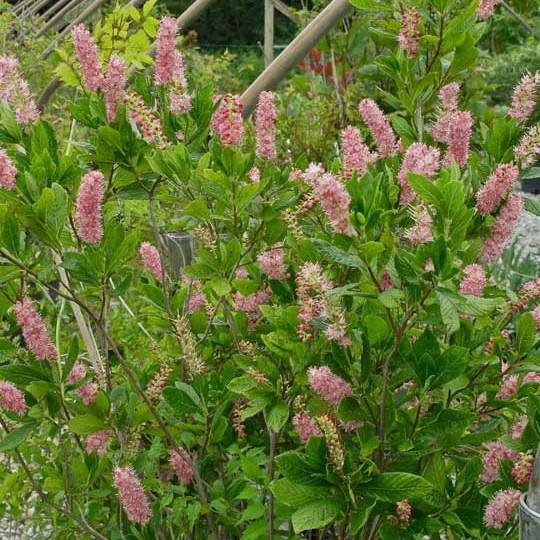
Shown here is one small corner of our half-acre garden. We call it the ‘birch bed’ because it is anchored by Betula nigra, a dwarf black birch. At one end of the bed is a clump of three Clethra alnifolia – better known as pepperbush – ‘Hummingbird’. Under the birch is planted Packera aurea, an aggressive ground cover. Beyond the shade zone of the birch is a clump of Chelone glabra, better known as white Turtlehead, and a favored nectaring site for certain butterflies.

The Clethra, also 'before'
In April and May, we slowly bring the garden back to life. Today was cool and breezy following two days of rain. As Principal Undergardener, my job is to, well, get whatever needs to be done, done. Rather than be overwhelmed, I take one section of the garden at a time; figure out what I can do in two or three hours, gather the tools, and go to work.

What a difference a 
few hours can make...

The birch bed seemed like a good place to work this morning. The two ‘before’ photos tell the story of what needed to be done. The moss path than runs between the birch bed and the foundation planting along the east wall of our home had filled in with weeds and Packera. Tiarella and Heuchera that bordered the path had disappeared from view. The Clethra was packed with several inches of leaves. And the Packera was everywhere… despite a late-fall removal of several hundred plugs for a planting project elsewhere in town.

There is no automation for this kind of garden maintenance. You get on your hands and knees and start pulling and lifting. A rake is useless under Clethra: the shrub grows via runners that need to be encouraged. A rake is also useless in the moss pathways. Moss doesn’t have roots. Rake moss and it comes up in pieces or sheets. This is skilled work only in that you use common sense to know what you should and shouldn’t do.

The Clethra, free of leaves
and Packera aurea
And, one of the things you shouldn’t do is hurry.  Speed results in pulling up a ‘good plant’ or severing a Clethra’s runner. Gardening breeds patience.

It took just under three hours to accomplish what you see in the ‘after’ photos. There are three bags of leaves, weeds, and excess Packera in the deep woods behind our home. Over the course of several years, that plant debris will compost into rick soil. What a great natural cycle.

And what good exercise…

October 7, 2017

Gardening Rocks

20,000 years ago, New England
was under a mile-thick sheet of ice
Twenty thousand years ago, New England lay under a mile-thick layer of ice.  Glaciers pushed down from the north, sculpting the land as they pushed southward as far as what is now southern Illinois.  Then, some ten thousand years ago, those glaciers gradually retreated, leaving behind terminal moraines that became Long Island and Cape Cod, and creating the Connecticut and Hudson River valleys.  Playing sand castles on some cosmic scale, glaciers gouged out the Great Lakes and New York’s Finger Lakes.

Louis Agassiz
The glaciers also occasionally ‘burped’, leaving piles of rocks in odd places.  Areas of bedrock proved to be the immovable objects against which the otherwise irresistible force of the glacier was forced to go over rather than through.  As the glacier moved, it pushed along sometimes enormous chunks of rock it had gathered from more pliable formations. 

Until the nineteenth century, the above paragraphs would have been considered something between nonsense and heresy, especially in the United States. Everyone ‘knew’ that Noah’s Flood had been responsible for the shape of lakes, rivers, and mountains.  Then, in 1837, Swiss Professor Louis Agassiz proposed the theory of glaciation.  His work caught the attention of Boston philanthropist John Amory Lowell, who induced him to emigrate to America, where the ‘Noah’s Flood’ theory was still firmly entrenched.

In the background is 'Little' Agassiz.  Double-click to see
the family at its base.
Agassiz settled at Harvard and found the New England coastal plain to be a proving ground for his theory.  Over several decades, glaciation came to be the only rational explanation for ‘errata’ like giant rocks atop hills that were hundreds of miles from their point of origin.  One of the prime examples of such ‘errata’ was a pair of rocks in Manchester-by-the-Sea, Massachusetts.  In 1874, at the end of his career, Agassiz visited the site and confirmed what his students had found: a glacier had pushed up and left behind these rocks.  The site was named for him.

On Saturday, Betty and I hiked half a mile from the nearest road to observe these rocks, which more than lived up to advance billing.  We were at the top of a prominent hill overlooking the countryside and there, in two locations, were these barn-sized rocks, the smaller of which was resting at an improbable angle.

A Google Maps view.  The white area marks the site
surrounding 'Little' Agassiz.
We were able to do this because, decades ago, someone gave a large chunk of land (which was later augmented by additional gifts) to an organization called Trustees of Reservations.  In Massachusetts, the Trustees own vast swaths of ecologically sensitive or historic land.  Their goal, stated elegantly, is to protect the region's heritage for future generations. 

The Agassiz Rocks Reservation is a rounding error in the Trustees holdings, a few hundred acres in a part of Massachusetts that has dozens of similar sites (including the Trustees’ ‘crown jewel’, Crane Beach).  While there are marked trails and an evident effort to ensure that ordinary walkers can get from the road to the rocks (and beyond), there’s no admissions gate or other barrier to entry.  On an early October day at noon, there was just one other car in the parking area.
Clethra grows wild, too
I write all this because, when the gardening season draws to a close, it is time for gardeners to go exploring new places and see what nature can teach them.  Saturday offered a few eye-opening lessons.  The first was seeing a grove of clethra surrounding ‘Big Agassiz’.  To me, clethra is a ‘suburban’ shrub; we have half a dozen compact specimens in our garden.  But there it was: an expanse of clethra growing as nature intended in a boggy area at the base of the rock.  It was, in its own way, an epiphany.

The ferns at the top of a rock
Then, there were the ferns.  Betty saw them first: they were improbably ensconced fifteen feet up at the top of an enormous rock.  The ferns were thriving where they ought to be washed away with every rainfall and erased out of existence with each winter.  Were they growing in a quarter inch of leaf litter, or had their roots found purchase in unseen crevices?


With luck, yesterday started a new season of discovery and of learning.