June 11, 2012

Giverny in the Bronx

There’s a truism in the art museum world that, when attendance starts to flag or publicity has been sparse, curators have a ready, foolproof solution:  mount an Impressionist exhibition.  Borrow some Renoirs and Monets, throw in a Cezanne or a Pizarro, and the public will be standing in line every morning.  Impressionism sells.

I’ve been lured to a couple of those exhibitions.  A few were outstanding but most simply recycled the same highly overexposed paintings.  So, I was understandably dubious when Betty and I went to the New York Botanical Garden Saturday morning to see “Monet’s Garden”.  Why did NYBG, an institution with no dearth of resources or lack of visitors, feel a need to put on a six-month-long tribute to Claude Monet? 

What you see when you enter
the exhibit.  Double-click on any
photo to see it at full size.
I had a right to be suspicious.  Two years ago, there was another attempt to recreate a much-beloved nineteenth-century figure’s garden.   That time, it was Emily Dickinson and, in my opinion, it fell flat (I wrote about it here).  This time, however, my doubts were misplaced.  I love being proved wrong and, even more, I appreciate leaving an exhibition with more knowledge than I had going in. 

Straight ahead, the Japanese
footbridge
“Monet’s Garden” has a simple premise:  In the latter half of his life, Claude Monet (1840-1926) worked in plants the same way he worked in paints.  Giverny, to which he moved in 1883 and remained until his death, became a canvas imbued with as much care, imagination and skill as the paintings that lined collectors’ walls; and bellflowers, hollyhocks, wisteria, water lilies and snapdragons were a palette as endlessly versatile as the one he carried when he painted.

The surprising part of the above paragraph is that it is written by someone who has made the trip to Giverny.  I have seen the Grande Allée, the pergolas, the Japanese bridge.  I thought it was very beautiful.  Somehow, though, it never connected in my tiny little brain that Monet’s garden was his passion and that he devoted as much time to it as he did to his painting.  Now, after a trip to the Bronx, I do.

Turn around, and there's a glimpse
of the main house at Giverny
“Monet’s Garden” unfolds in multiple parts.  As you enter NYBG and walk toward the Enid A. Haupt Conservatory, you see placards bearing poetry that was written during Monet’s painting years.  Once in the Conservatory, you hear music; uniquely French and from the late nineteenth and early twentieth century (Ravel’s Bolero is a terrific accompaniment).  You go through a pair of glass doors and you are assaulted by colors.

Monet was meticulous in his record-keeping.  He documented his purchases of plants and his instructions to his gardeners.  His garden was extensively photographed in his lifetime.  NYBG brought in Scott Pask, a Broadway scenic designer, to create, in a few thousand square feet, a set piece that is both accurate and representational.  The Grande Allée has been condensed to approximately 250 feet but is packed with thousands of annuals and perennials, each true to Monet’s time and vision.  Overhead, on metal arches painted the ‘Monet Green’ used in Giverny, roses are beginning to climb.

Is it Giverny or the Bronx?
What is stunning is that a) everything in the Grande Allée is in perfect bloom and that b) growing in NYBG’s greenhouses are replacement plants to parallel the march of the seasons between now and October.  This day, the snapdragons were eight feet high, the bellflowers were in full purple flower and the hollyhocks had not a single spent petal.  According to the NYBG literature, more than 150 varieties of annuals and perennials are on display.  By October, the count will exceed 600.

It is an exhibit that encourages you to keep looking around.  If you turn around to admire the garden behind you, you see a two-story fragment of the main house at Giverny, perfect in its pink and green accents, the carriage lamps beside the shuttered doors just as they are in Monet’s paintings.  Ahead of you, through a double gate (again, in Monet Green, is the iconic footbridge, swathed in wisteria, bamboo and willows.

An abundance of water lilies.  Alas,
it was a different Ray Davies.
The second part of “Monet’s Garden” is outdoors.  The two pools in the Conservatory’s courtyard have been given over to water lilies.  I learned that  Nymphaea odorata underwent an seismic change in the 1880s as colorful North American specimens were cross-bred with their hardy European cousins to produced new cultivars with colors never before seen on the Continent.  Monet collected these lilies and overwintered them.

I thought for a brief instant that I had discovered a previously unknown footnote to the genius of Kinks founder Ray Davies.  One of the water lilies in the pool has the cultivar name, ‘Ray Davies’.  Alas, some research showed that the cultivar in question is named for the founder of Stapeley Water Gardens of Great Britain and not for the lead singer on Sunny Afternoon.

Amazingly, there is more to see.  We walked over to the Mertz Library where photographs and a pair of Monet paintings were on display.  In another room, Monet’s gardening notes, lists and letters were laid out and translated, with small photos providing visual reference points. 

It was while perusing his extensive notes that everything fell into place: this man was a passionate gardener who created a private Eden far from Paris.  Here, he could garden and paint (his series on the Rouen cathedral, poplars, and haystacks were all products of Giverny, as well as the masterpiece ‘Les Nymphéas’ now in the Musée de l’Orangerie).  Here he entertained friends and dignitaries.  Here, he was at peace.

Maybe it’s one of those ‘duh’ moments – everyone on the face of the earth already knew these things.  But I didn’t, or at least I didn’t know I knew it.  Now, I do.  Thank you, NYBG, for a lovely education.

*  *  *  *  *

We also spent time at the Rockefeller Rose Garden at NYBG.  It is at its peak in June and, on this day (June 9), it is as though every single one of the 1700 varieties were in simultaneous sensual bloom.  It was the perfect ending to a perfect trip.

May 27, 2012

Finding the Quality Niche

Let us begin with a statement of fact and a question.  The statement of fact is this:  the suburbs of Boston positively groan with garden centers.  Moreover, a handful of these establishments – Weston Nurseries, Briggs, and Russell’s Garden Center come immediately to mind – are one-stop sources for high-quality annuals and perennials as well as for superb trees and shrubs.  The area is also chockablock with specialty sellers of unusual plants and especially of hard-to-find perennials.  Tranquil Lake Nursery in Rehoboth, Blanchette Garden and Seawright Garden, both in Carlisle, fit this description.  Betty and I are on a first-name basis with the staff at several of those businesses because of the frequency and volume of our purchases.

So, here’s the question:  with all that quality plant material available locally, why on earth would we drive 167 miles round trip just to buy annuals?

To answer that question, you have to visit Andrew’s Greenhouse in South Amherst, Massachusetts, and see for yourself.  We usually make two trips a year; one around May 1 and another at the end of the month.  The purpose: to find a selection of ‘wow’ plants to go into container gardens and our perennial beds.

During the month of May, Betty did four container gardening demonstrations for garden clubs in eastern Massachusetts (she has one more scheduled in June).  Each program calls for Betty to put together five very different containers.  So, that’s 25 containers right there.  Beginning in early May and continuing through mid-June, she puts together the containers that grace our own property.  Last year, those numbered around 60 with at least half being made up of annuals. (The balance are shrubs, succulents or trees.)


An acre of annuals under one roof
How many plants per container?  Let’s say an average of five different cultivars (in the oversimplified world of P. Allan Smith, “a thriller, a spiller and a filler”) and, often, multiples of the same cultivar to provide instant appeal.  Call it ten plants.  (Betty was required to submit receipts for one group; the five containers required a total of 47 plants, including a window box that took 13.)

So, we’re talking about a lot of annuals.  At ten per container, Betty will purchase 250 plants, mostly annuals, for her programs.  For the roughly 30 annual/perennial pots on our property, that’s another 250 to 275 plants (many of the perennials get wintered over in our garage and go on to grace containers for multiple years).  That’s a minimum of 500 annuals each year.

Betty fills a double cart with plants
This year, Betty’s schedule was especially hectic in late April and May, and a half-day to devote to a trip to Andrew’s was not in the cards.  So, the four May garden club programs used plants sourced locally.  But on Thursday of last week, we finally had a full-day hole in our schedule and so off we went.

Rather than potting up from plugs, Andrew’s grows from seed in half a dozen hoop greenhouses.  But Amherst is solidly in Zone 5B and Andrew’s takes the idea of ‘late season frosts’ very seriously.  When plants are of saleable size – and only when they’re at that size - they’re moved to an acre-sized retail greenhouse.  Cold-tolerant perennials are housed on dozens of outdoor stands.  There are no frost-tipped plants to be wary of.

Shade-loving perennials have their
own light-filtered area
But the true appeal of Andrew’s lies in two critical areas. First, Andrew’s offers uncommon annuals.  Do you want a nemesia ‘Sunsatia Cranberry’?  It’s a new introduction and Betty found it at Russell’s Garden Center in Wayland.  But how about a fragrant nemesia with a glorious scent that catches your attention long before you see the flower?  You find that at Andrew’s, where it’s available in three colors.  Or, how about calibrachoa ‘Superbells Yellow’?  Weston Nurseries had that one and it wowed the Community Garden Club of Duxbury.  Last Thursday, Betty spotted a calibrachoa – a plant with small, petunia-like flowers that just keeps flowering from May until frost – with a double ruffle.  She bought four of them.

The second distinction lies in the plant descriptions.  Andrew’s sends out a very good catalog every January and it lists what the nursery expects to be able to offer for annuals and perennials.  And those descriptions go beyond what 95% of garden centers provide.  For example, here’s their entry for Ipomoea: IPOMOEA (Sweet Potato Vine) A varied genus which includes the Morning Glory (See Annual Vines), Cypress Vine (See Annual Vines), as well as the popular “Sweet Potato Vines”, which are not known for their flowers, but loved for their foliage.

That’s a good basic description, but drill down to some of the nine varieties being offered: 'Illusion garnet lace' [NEW] If you love sweet potato vines, but find them a bit imposing in your containers, then you are in luck with the Illusion series. They are specially bred to be very compact, dense and lacy. Garnet lace has an unexpected coloration of purple red with a mixture of light green as the new growth appears. Pairs nicely with petunias or calibrachoas for a knockout combination. 6-10".

'Cardinal Climber' wasn't in the
catalog, but we found a full
description of it.  (Double-click
to see at full size)
When you get to Andrew’s, you find things that aren’t in the catalog, like the Ipomoea ‘Cardinal Climber’ described in detail at left.  You get everything you need to make a decision and, if you still have questions, the staff knows their plants very well.  We brought ‘Cardinal Climber’ home on a whim.

If you’re looking for ageratum and marigolds, go to Home Depot. If you’re looking for Thai basil or Brandy Boy tomatoes, Andrew’s has them.  In short, Andrew’s has found a niche and I hope is both a successful and a lucrative one.  We’ve been going there long enough that we’ve forgotten how we first heard of the place.  But I can recommend it without reservation.

May 21, 2012

Overnight Sensation

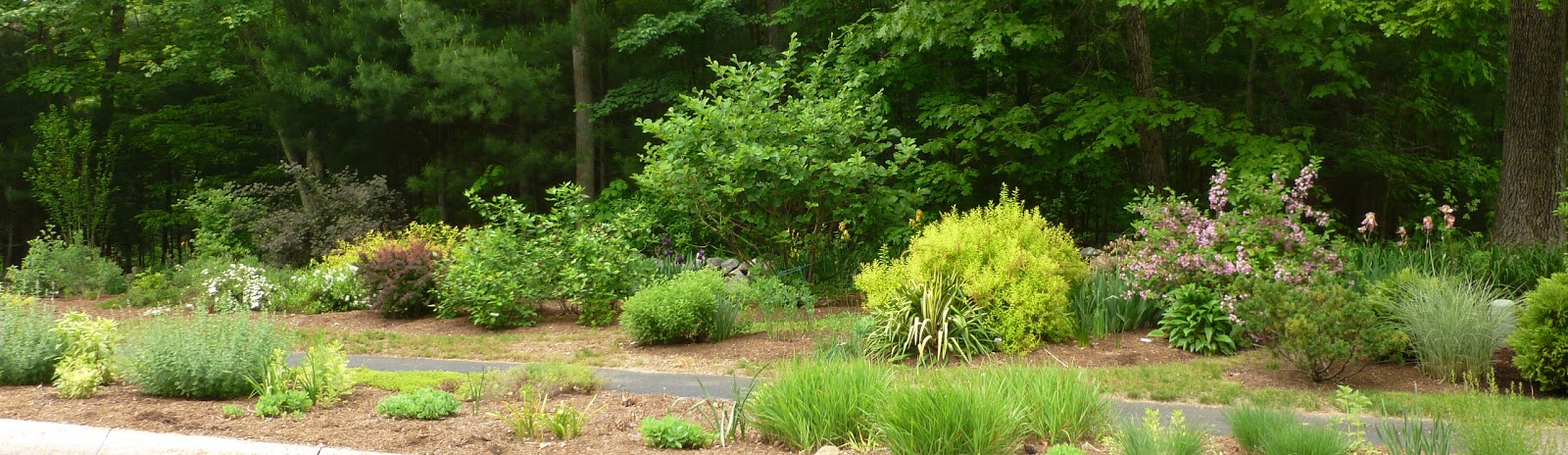
The shrub bed, otherwise known as 'Long Island' on May 21, 2012

The shrub bed at the front of our property was our first ‘big’ project.  It was a broad expanse of grass in 1999 – twenty feet deep and more than a hundred feet in length, with a small copse of trees for a backdrop.  We decided that shrubs – with different color and textures – would make a more attractive impression from the street.

Using a rototiller, we began turning over the soil and quickly found that the builder had placed an inch or two of loam over what can only be described as ‘crud’ – dirt with no organics to speak of and rocks of every size.  Over the course of a year of often back-breaking work, we created soil and built a very impressive stone fence from the rocks we excavated.

The shrub bed – formally known as Long Island because its shape – is now mature and low-maintenance.  We removed a Norway maple (see ‘Adjo, Acer Plantanoides’) three years ago which brought increased light into the site.  Each spring, we add a fresh inch of mulch, we keep shrubs in shape through aggressive trimming, and then we sit back and enjoy the results.

Wigela 'Wine and Roses'
We see the first blooms in February when a witch hazel (Hamamelis virginiana) produces its pale yellow flowers, and a spirea ‘Ogon Mellow Yellow’ puts of a burst of white flowers at the end of March, but the real explosion comes at the end of May.  This weekend, the bed was in its full glory.

Cotinus coggyria
There are three wigelas, one of them a ‘Pink Princess’ that dates to 1999, and two more recently planted ‘Wine and Roses’.  All three are blooming brightly.  Another original tenant, a smokebush (Cotinus coggyria ‘Royal Purple’) is in full regalia.  A third old-timer, Calycanthus (Carolina sweetshrub or spicebush), produces a long-lasting but subdued cinnamon-colored flower that is also lightly scented. 

Physocarpus opulifolius 'Dart's Gold'
in full bloom
There are two devil’s ninebark (Physocarpus opulifolius) in the bed, a ‘Dart’s Gold’ as well as its more familiar, dark-leafed ‘Diabolo’.  Dart’s Gold is currently dazzling with flowers that look white from a distance but are specked with yellow and red on closer inspection.  Nearby, a new Enkianthus campanulatus has finally established itself after a rough start (a summer drought and hungry deer) and has produced a terrific clutch of yellow and pink bell-like flowers.

Potentilla 'Abbotswood' and Duetzia
gracilis 'Nana' in bloom
Two adjacent shrubs are flowering white.  A Potentilla ‘Abbotswood’ has sent out sprays of showy, rose-like blooms with yellow centers.  Next to it, Duetzia gracilis ‘Nana’ has double white blooms against dark green foliage.  Both are low-growing but stunning.

Scotch broom with the rock wall
as backdrop
Finally, a Cytisis scoparius, better known as Scotch broom, is making its presence known.  The shrub was there when we bought the house, lurking at the edge of the woods.  It was ungainly and bloomed an unpleasant shade of yellow and so we cut it to the ground, expecting it to die.  To add insult to (fatal) injury, we built the stone wall on top of the stump.  Two years later, an amazing transformation happened:  the broom came back, but bearing entirely new flowers.  Because we didn’t plant it, we can’t say what it is exactly, but it looks like Cytisis ‘Lena’.  The bloom is prolific but brief.

May 10, 2012

Lookin' Out My Front Door

(Update:  On May 28, the three robin nestlings turned into fledglings.  As robins do not return to a nest, we have the use of both our library and the inner sidewalk bed again.)

For the past two weeks, I've been unable to use my library.  The problem is that a robin has built a best in the thuja occidentalis just outside, and everytime I open the door to the library, it spooks the robin sitting on three eggs.  I do not know how robins choose their nesting sites but a western red cedar right up against a house seems like a reasonable choice.  The nest is on the 'house' side of the tree and the foliage is quite thick.  But the nest is just four feet off the ground and the thuja rises more than 15 feet at this point.

Our piers andromeda with its new
pinot noir-colored foliage.  Behind it
is the pink rhododendron that just
bloomed this week.
Just outside another of the library's windows is a beautiful sight:  a pieris (andromeda) in its spring glory.  We planted the pieris a decade ago because it's an ideal foundation shrub for New England.  It's an evergreen and keeps its white canticles well into winter.  Our specific cultivar has lightly speckled leaves that give it added visual interest.  But the real payoff is in April when it produces new foliage: a red the color of a pinot noir.  That red will linger into mid-May when the leaves begin to turn green.

Looking left, four
dependable foundation
shrubs: ilex, pieris and
rhododendron.
Just in front of the pieris is a rhododendron that burst into bloom just this week.  The rhodie is the only thing in that part of the garden (the inner sidewalk bed) that survives from before our ownership of the house.  For the first seven years of its existence, the rhodie sat in the perpetual shadow of a five-clump river birch.  The birch was dug out by hand (as opposed to by machine) in order to save the many perennials in the bed.  I made a point of preserving the rhododendron's root system during the excavation.

The rhodie has repaid our kindness by thriving.  It has tripled in size and bloomed prolifically ever since.  Behind the pieris and the rhodie in the photo above is the newly-leafing-out oxydendrum.  This is the first year it is starting the season with the same branches from past year.  In each of the past four years, snow had taken out as much as a third of the existing branch system.

Looking left from the front door you see an ilex (holly) in the foregound; a peony growing quickly; another, much less auspicious andromeda, and a leucothoe.  At the corner is a pair of rhododendron blooming white.  All four shrubs are great foundation plants for cold climates; all are evergreens and all have thrived with their southeastern exposure.  The shrubs have been repeatedly moved as they have grown; the area once sported another ilex and a smaller rhodie.  The leucothoe and pieris have expanded into their places.

The inner and outer sidewalk beds,
as viewed from the front door. 
Double-click on the image to see
details.
Looking straight out the door is a winderful sight that will grow and change as the season progresses: the inner and outer sidewalk beds.  On the right, starting closes to the camera, is the first growth of coreopsis 'Moonbeam'.   Just beyond it are a growing family of Stokesia laevis, or Stokes' Aster, which will bloom a prolific white and blue in June.  To their right is white astilbe.  There are at least a dozen peonies growing in this bed together with Siberian iris and heuchera.  I'll show them as the season progresses.  The blue flowers you see are muscari, more commonly known as grape hyacinth.

On the left, in the outer sidewalk bed, are geranium, heuchera of every color, alchimella or lady's mantle, phlox, and literally dozens of specimen perennials that will make themselves know as the season progresses.  There's a daphne Atlantica that is starting to overhang the sidewalk.  To its left is a now-golden, but soon to be red Japanese maple.

These beds have undergone a gradual transformation over the past few years.  Once almost all perennials, lower-maintenance shrubs have been introduced and less aggressive perennials introduced.  I promise to continue to update the images as the season progresses.

May 3, 2012

Spring Migrations


Berkeley the Snail, at bottom, with
a more conventional bird bath,
visible at top
Just as the swallows come back to Capistrano and the Swan Boats re-appear in the Public Garden, so there comes a spring day when our garden ornaments emerge from their basement winter quarters.

Like beauty, garden ornaments are in the eye of the beholder.  They can be almost anything you want them to be.  Our neighbors tend toward gazing balls.  Some people have cherubim.  There is a house on a main road a few miles from me with literally hundreds of garden gnomes and fairies out for all to see.  I’ve never quite comprehended gnomes, except as things to steal and send on trips around the world, taking photos along the way; but I accept that, for a certain subset of gardeners, gnomes are gotta-have items. 

Our own stash of ornaments ranges from the expected to the highly eclectic.  There are four bird baths, surely a staple of any respectable garden.  But there are also at least three frogs in our collection, one of them so plug-ugly that it stops visitors in their tracks.  There is a large terra-cotta fish that is supposed to grace a Japanese home, but instead ‘swims’ in our garden.

The Winterthur turtle, prized for its
chipped nose and bargain price
We have a large and heavy (20 pounds or so) metal snail named Berkeley, acquired in London and brought back in the overhead bin of an airplane back before such things would have been considered weapons.  There is also a stone turtle which lacks a name but has a provenance just as memorable as that of our snail.  The turtle was acquired at Winterthur for the sum of just five dollars after we pointed out the chip on its nose.  My wife considers it one of the great bargains of her garden travels.  Of course, we also have a stone cat that we found abandoned after a flower show.  It, too, has a chip, but is less noteworthy because no offer or counter-offer was required for its acquisition.

There is a frog with a permanent site because, one summer, he was topped with a live red frog who seemed to like the vantage point.  We hope for a recurrence.

This black frog, visible now,
will disappear as the
astilbe foliage grows
Most of our garden ornaments are intended to be seen and admired.  But a few, especially the smaller ones, are deliberately placed in locations where they can only be seen from certain angles.  Their serendipitous discovery delights visitors, but the practice also has its downside: we forget where we put them and find them only in November and December when the foliage that obscured them dies back.  This annual recovery process is made more difficult because, except for a few ornaments such as the bird baths, there are no permanent positions reserved for members of our growing collection.

Several ceramic and terra cotta containers have passed from bearing annuals and perennials to the status of garden ornaments.  These tend to be very large ones that, were they filled with plants, would each take a jumbo-size bag of potting mix.  Instead, they grace perennial beds and rock gardens, providing focal points for visual interest.

Our newest ornament, the 'silver
sphere', is looking for a home
Our newest ornament came into our possession following the World Association of Flower Arrangers’ triennial meeting in Boston last June.  It’s an open sphere comprised of aluminum bands; one of 20 fabricated for that show.  I found it last October in a warehouse in Northborough where it was packaged up with staging destined for a landfill.  I brought it home on a whim, and Betty literally jumped up and down with excitement upon seeing it.

Our ‘silver sphere’, as we call it, has yet to find a permanent spot.  It will likely spend several weeks migrating from bed to bed where it will ‘try out’ for a season-long gig.  At our little house, there’s always room for one more – garden ornament, that is.

April 23, 2012

The Rhythm of the Rain

Between three and four inches of rain have fallen on our garden in the past 24 hours, putting the first meaningful dent in a drought that stretches back through the Winter-That-Wasn’t.  Yesterday morning, we were ten inches below ‘normal’ precipitation since January 1; today we are six or seven inches down.  I might add that there is still light mist falling as this is written.

This is the best spring bloom ever
for our cersis canadensis
But the unnatural weather of the past month – 80-degree days in mid-March followed by a long stretch of cool, dry weather – produced a rare spring treat: a prolonged period in which daffodils co-existed with the blooming of our cersis canadensis (forest pansy redbud), and Virginia bluebells are in full show mode at the same time as epimediums.  The bergenia is glorious, and so is a bright pink azalea off on a corner of the garden.  A dogwood that customarily blooms in mid-May is already bursting, as are our lilacs.

Our Virginia bluebelles typically
appear in mid-April for a few weeks
As the rain tapers off, though, the suddenly waterlogged daffodils and hyacinths will keel over.  The petals from the ornamental plum will fall and form a blanket of pink around the base of the tree.  Those bulbs that lingered beyond their normal bloom time will be gone in a matter of days.

Jeffersonia diphylla (twinleaf) makes
a brief appearance, but has lingered
this year
It has been a beautiful spring thus far, though I know the stress placed on our shrubs and perennials will cause problems this summer (unless this weekend’s storm is a harbinger of a lot more of the same).  But we hooked up the rain barrels on Friday and so captured 150 gallons of rainwater plus filled two dozen two-and-three gallon jugs. 

This is epimedium suphureum.  The
flowers seldom last longer than a week
Our nearly snow-free winter is already having other repercussions.  Ticks made it through the winter unscathed and the tiny deer tick nymphs – which have the highest prevalence of Lyme and other disease infection – are several weeks early in making their appearance.  Deer, squirrels, moles, voles and rabbits also had an easy winter, which means extra applications of repellents.

This is not intended as a rant or complaint.  If you garden, you have to expect the unexpected.  The same quirk of weather that gave New England a spectacularly beautiful March and April is going to be responsible for a set of problems down the road.  If you’re an astute gardener, you alter your plans and make allowances.  It’s as simple (or complex) as that.

March 23, 2012

The Brief Life But Enduring Legacy of a Flower Show Garden


It is not part of my formal curriculum vitae but, for the past three years, I have been chairman of Blooms! at the Boston Flower & Garden Show.  The word ‘chairman’ implies some honorific: it sounds as if I wrote a large check and an organization – in this case, the Massachusetts Horticultural Society – gave me a title with no responsibilities other than to write another, presumably larger, check at some point in the future.

That is not the case.  I became chairman because someone needed to organize Mass Hort’s multiple efforts at the show which came into being after the demise of the much beloved but startlingly unprofitable New England Spring Flower Show.  A for-profit trade show group created the Boston Flower & Garden Show; Mass Hort was retained to produce the ‘amateur horticulture’ elements of the show.  I took on the task of running ‘Blooms!’ (the collective name for those elements) when it became apparent no one else wanted, much less would accept, the job (not the least because the sum total of the remuneration for a thousand hours of work is reimbursement for parking while at the show).

Saturday morning at 8 a.m.  There's
nothing but a cavernous hall and
a show-polish line (double-click on
any photo to see it full-screen size)
At the 2012 Boston Flower & Garden Show, Blooms! comprised two divisions of floral design competition (114 designs over two entry days), a large Ikebana display (28 displays over two entry days), a photography competition (36 exquisite entries from around the country), miniature gardens (a fascinating and highly specialized corner of horticulture), a book store, 400+ individual entries of amateur horticulture and nine group collections arrayed in structures. It also encompassed a display garden, and it is that garden about which I write today.

When you or I create a garden for our home, we may sketch it out on paper, walk our property and consider the views, and then visit nurseries and garden centers to find the trees, shrubs, perennials and annuals that will form the garden.  We will add benches, planters and other hardscape elements; changing things as we go until we are satisfied with the result.  And, if we are not pleased, we dig out the trees and re-arrange them until we get it right.
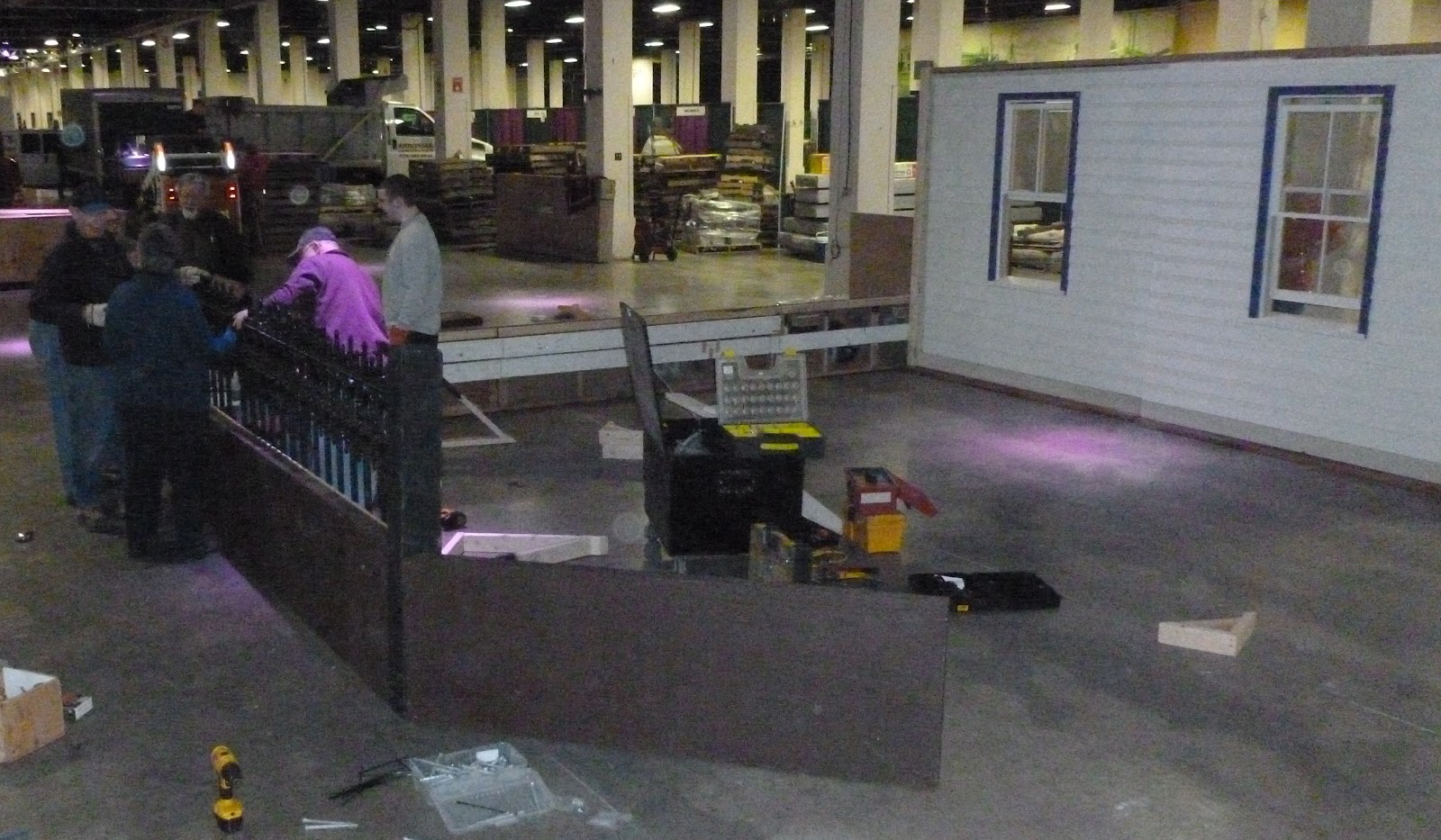
The wrought iron fence starts
to take shape
A garden at a flower show incorporates almost none of these conventional elements.  Instead, it is gardening as theater; except that, because the garden would bear Mass Hort’s name, it was also gardening as education.  Not even the size of the garden was fixed: as exhibitors were added and dropped out, Mass Hort’s allotted garden space grew from less than 400 square feet to eventually encompass nearly 1200 square feet of floor space.

The key differences between that garden in your side yard and one on the floor of a flower show are these:  first, the flower show garden must be built from scratch in three days, exist for five, and then be torn down in one.  And, second, the garden must be in full, glorious bloom for those five days.

The first segments of the townhouse
are raised onto the concrete wall
These were the parameters and obstacles that I faced when planning began for Mass Hort’s garden.  In turn, I had four secret weapons in my arsenal.  One was Paul Miskovsky, a Cape Cod landscaper who is a veteran of dozens of flower shows.  The second was my wife, Betty, who knows floral design had created gardens for five previous flower shows.  The third was Clark Bryan, Mass Hort’s Director of Operations, whose unique combination of organizational skills and mechanical competence is unparalleled.  The fourth is the Massachusetts Master Gardener Association, a group of people for whom horticulture is a passion and who collectively possess the skills to build anything from a garden shed to, probably, an aircraft carrier.

Behind the townhouse, a mass of
stabilizers kept it in place
I should also mention at this point that a flower show garden is a horrendously expensive undertaking.  A thousand-square-foot exhibit can cost between $50,000 and $75,000 in labor and materials.  My budget for the garden was $6,000 (unless I wanted to give up my parking stipend, in which case the budget could be expanded to about $6,084).  In other words, creating this garden would involve a lot of begging.

Every flower show has a theme and the one for the 2012 Boston Flower & Garden Show was ‘First Impressions’.  I knew that I wanted a house as the backdrop for the exhibit, and I described the quest to build that backdrop back in January (see, ‘Would You Like a Townhouse to Go with that Garden?’).  Assembling the plant material was touch and go:  Paul Miskovsky agreed to supply most of the ‘big’ items – the trees and shrubs, especially.  Betty and some of her more larcenous Master Gardener buddies prowled New England Grows and came away with hundreds of smaller shrubs, perennials and annuals.  Various growers with a soft spot for Mass Hort offered flats of plants.

A small portion of the plants planned
for use in the exhibit
Why so much?  Because the rule of thumb is to start with three times the plant material you think you’ll need.  Come show time, one-third won’t be blooming (or be past bloom) and another third won’t look right in the exhibit.

At 8 a.m. on Saturday, March 10, Betty, Clark and I assembled at the Seaport World Trade Center.  We found a cavernous, empty hall.  On the floor, Paragon’s Show Director, Carolyn Weston, has put down the ‘shoe polish line’ (double-click on the top photo to see the shoe-polish line); white marks indicating the corners of our exhibit.  The rest was up to us, and luck.

Clark Bryan, at left
This would be a good time to say a little more about Clark Bryan.  His role as ‘Director of Operations’ at Mass Hort is something of a misnomer.  ‘Chief Magician’ would be a more appropriate title.  His job for the past four years has been to make things happen without the use of actual money.  If I said I needed that aircraft carrier mentioned a few paragraphs above, three things would happen: first, he would roar that what I wanted was impossible, and he would stomp off in a huff.  Second, he would re-appear, three days later, with a thick binder containing plans for an aircraft carrier and little slips of paper indicating favors owed to him for things done decades ago.  And, two weeks later, I would come to Mass Hort and find a working, Nimitz-class aircraft carrier outside his office, which he would say he whipped up at home over the weekend.  He is the ultimate can-do guy.

At 8:20 a.m., trucks began rolling into the hall.  Out came the segments of the townhouse, ready to be assembled like a Tinkertoy set; a pre-built, ready-to-screw-together kickboard; a hundred concrete blocks and 200 bricks; 40 feet of antique, wrought-iron fence; and enough braces, clamps, screws, and ancillary tools to stock the grand opening of a Home Depot.  By 8:30, a cadre of volunteers working under Clark’s direction was building the two-foot-high concrete block wall on which the townhouse would rest.

The kickboard was a giant jigsaw
puzzle, ready to be bolted together
We worked steadily though the day.  Ten hours later, the kickboard was in place and the town house rose a majestic 16 feet from the floor of the convention hall.


Sunday morning brought the plants.  A truck from Olsen’s Greenhouse, to which we had paid $1,000 of our precious budget for nearly 200 pots of perfectly color-coordinated tulips and daffodils, was already parked outside.  An hour later, the first of three trucks bearing plants, trees and shrubs appeared.  Two days earlier, Betty and two fellow Master Gardeners had gone through two Mass Hort greenhouses, marking plants that looked like they would be at the right state of bloom for the show.  Now, she unloaded them, segregating plants into ‘front and center’ perfection and ‘background’. 

Monday afternoon, 20 Master
Gardeners worked to complete
the display's vegetable garden
Paul Miskovsky’s trucks arrived, bearing both good and bad news.  Twenty ‘Light-O-Day’ hydrangeas had been tinged with frost while loading them.  They would be unusable for the show.  Fortunately, Paul packed along lots of extra plants - that "three times what you need" rule at work.

Now began the actual design of the garden.  We knew we wanted a few set pieces – an enormous Heptadcodium miconiodes (Seven Son tree), a Picea orientalis ‘Horstmann’s Gen’, and a Picea omorika ‘Pendula’ (weeping Siberian spruce) – and knew approximately where they would go.  But everything else was done on the fly, with 45 cubic yards of mulch arriving a scoop at a time.  Betty and Paul would review the available plant material and then argue over what ought to go where.  It was a case of two people with very different design aesthetics working in the same small space.  Paul is more of a showman with a flamboyant style that wins awards and the praise of big-budget clients.  Betty is more attuned to the interweaving of color and texture and creating spaces for real-world budgets.  At various times, each one retreated to fume at the other’s intransigence. It was Betty’s garden but Paul deserved a say.  In the end, they collaborated with delightful results.

The Townhouse Garden.  Double-click for a full-screen view
At the end of another ten-hour day, the town house garden was largely in place.

The townhouse garden, though, was only one-third of the exhibit. Next to it was a backyard vegetable garden.  Work began on it in earnest on Monday morning as twenty volunteers planted, pulled out, and re-planted displays of exotic vegetables that can be grown in New England.  And, on the right, the ‘secret space’ began to take shape.  The Mass Hort garden is about education but it is also, ultimately, a tool for attracting members.  One way to get those members is to invite them to have their picture taken.

Paul Cook, Master
Gardener, an incredibly
competent carpenter, was
indispensible to creating
the exhibit
For two years, I brought in an enormous chair that normally resides in a children’s garden at Mass Hort’s Elm Bank headquarters.  Wanting not to get stale, I asked for something different for 2012.  Clark knew a guy who was closing his flower shop in Allston and, in December, Mass Hort became the proud owner of a beautiful arched trellis.  Betty saw the arch and decreed that she knew just the bench to sit under it – the one in our side yard.  Add all those tulips and daffodils plus a bank of Rhododendron ‘Dora Amateis’ in full white bloom, and you have a magnet for people with cameras and cell phones.  While a volunteer snapped photos, a membership specialist gave the ‘elevator pitch’ to become a Mass Hort member.  It worked.
People lined up all day to have their
photo taken in the 'secret garden';
many became Mass Hort members

That last piece of the display garden – the Secret Corner – was completed around 11 a.m. on Tuesday. 

The result was, by all accounts, a fantastic garden and one that was useful to someone looking for ideas. (By contrast, the vignette next to Mass Hort’s garden was a relaxing space atop a ten-foot-high  ‘hill’ with a waterfall.  It was both a crowd- and a judge-pleaser, but it unlikely that anyone took it for anything other than entertainment.)  We attracted tens of thousands of show-goers who lingered and asked questions.  It was, in short, a class act.

A final look at Betty's miraculous
garden
The Boston Flower & Garden Show closed Sunday at 6 p.m.  We put tape around the exhibit (to keep out ‘light fingers’ and disassembled it on Monday, starting at 8 a.m. and concluding by mid-afternoon.  When it was all over, there was nothing but a pile of mulch.  Tuesday morning, another shoe-polish line went down for the next show.


A garden for education
But the exhibit left behind memories and ideas.  It inspired, it taught.  More than 50 volunteers worked on it at one point and twice that number were involved all together.  Like good theater, it was hard work.  Like great education, it was worthwhile.

I have hung up my ‘Chairman’ badge for the year and, indeed, for the last time.  Three years is enough.  But this particular garden, which lasted just five days, will endure in my mind for a lifetime.