We’ve had a great autumn here in New England. Rainfall was close enough to normal that
trees and shrubs were not stressed, and there were no heavy storms in September
or October to strip plants of their foliage.
While it’s now slightly past peak, the colors this year have been
delightful.
 |
| Our oxydendrum |
Our property offers a tutorial in the use of uncommon trees
and shrubs that extend the season’s color.
For example, the sourwood (oxydendrum) we planted four years ago in the
inner sidewalk bed has started to hit its stride, growing by about a third in
size this year. The unexpected delight,
though, is the brilliant, multiple-shades-of-red to which its previously green
leaves have turned in the past two weeks.
We’re not counting on the show to last past the end of the month but,
for now, it’s an eye-catching display.
 |
| The left-hand side of the shrub bed. That's the smokebush in purple at farthest left with 'Miss Rubyspice' in front of it. |
The shrub bed that lies at the front of our property has the
best autumn display. The bed is comprised mainly of drought-tolerant natives, and
it gets a great deal of sun and wind. Stretching
more than a hundred feet from end to end, it provides space for roughly 30
specimen shrubs. Here’s how it looked
this morning (October 23) There’s a purple smokebush (Cotinus coggygria) with purple-brown leaves that soar above the
bed. In front of it is a clethra ‘Miss Rubyspice’ with brilliant yellow
leaves. The brown theme is continued
with a small Enkianthus, a
slow-growing Asian native that has settled happily into the bed. There are two Devil Ninebarks (Physocarpus opulifolius), a ‘Diablo’
with burgundy-colored foliage that will linger well into November, and a Dart’s
Gold that will keep its golden leaves for another one-to-two weeks.
 |
| Fothergilla Mt. Airy; each leaf is like a painting |
Scattered among the shrubs in the bed are several that
retain their leaves – and striking color - for an extended period. One of my favorites is Fothergilla. We have two in the shrub bed: Blue Shadow and Mt. Airy. Both produce a dazzling palette of autumn
colors on each leaf and both are long-lasting.
Our Carolina sweetshrub (calycanthus)
now shows with large, lemon-yellow leaves that will reward us with color well
into November. Our two wigelia ‘Wine and Roses’ have turned a
speckled dark red and will stay that way until the weather turns bitter.
 |
| Spirea Ogon Mellow Yellow is just starting its long-lasting autumn turn |
The two champs, though, are an itea ‘Henry Garnet’ (sometimes called a Virginia sweetspire) and a spirea ‘Ogon Mellow Yellow’. We have two iteas on the property. They’re a pretty green from spring through
September, then begin a metamorphosis to a coppery color with specks of red,
yellow and brown. Last year, the one at
the front of the property eventually went bare sometime in late December. The second itea is in a sheltered area behind
our house, and it lost its foliage only when the new leaves pushed out in late
April.
‘Mellow Yellow’ puts on two shows each year. The first is in very early April when it
flowers a pale white-yellow when little else is in bloom. Now, its profusion of small leaves have
turned a specked yellow red and orange.
Those leaves will still be in place for Christmas.
Two other deciduous shrubs are still green: a viburnum ‘Catskill’
will not turn yellow until the beginning of November. Its color will last about three weeks. Finally, an oakleaf hydrangea (hydrangea quercifolia) will stay stubbornly
green until well in November, after which its leaves will gradually become a
mottled brown.
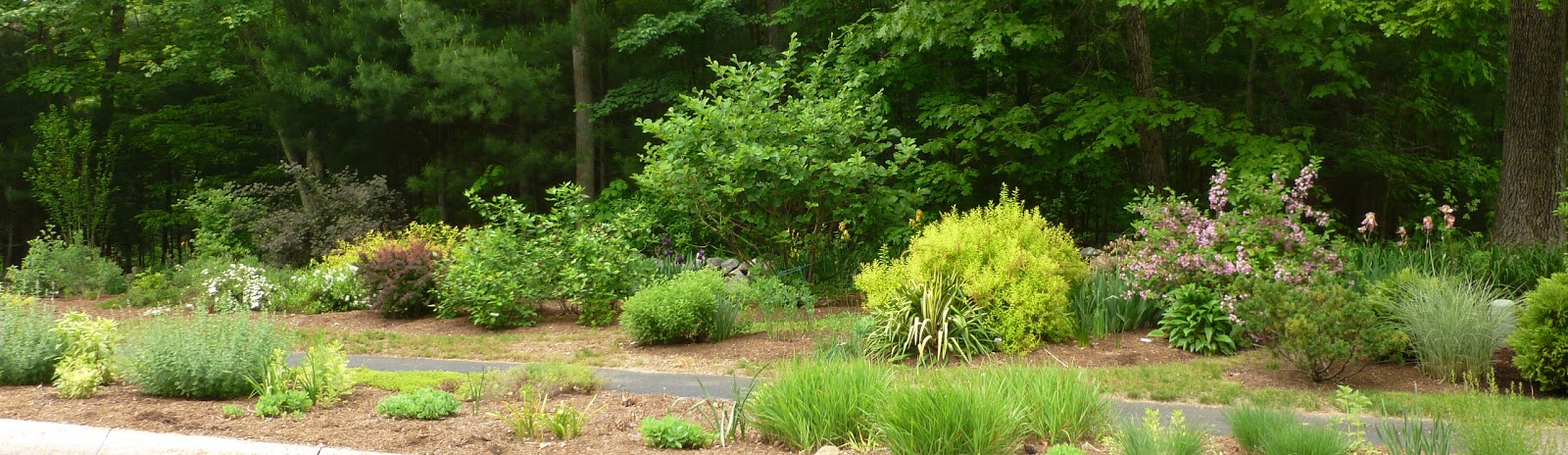
Ours was not an ‘instant’ landscape. The shrub bed, like everything else, has evolved
organically over a dozen years with lots of trial and error. But now, in late October, it appears as a
coherent whole. Someone looking at that
bed today might conclude that we put it together with the purpose of showing
visitors how to have late-autumn color with a variety of leaf textures and
sizes. They’d be wrong, but I wouldn’t correct
their perception.
 |
| The right-hand side of the shrub bed. The large yellow shrub is calycanthus. |