Showing posts with label volunteers. Show all posts

July 7, 2026

The unwanted interloper

If anyone ever offers you the opportunity - and calls it ‘the honor’ – of running a community garden, you should run at high speed from the person trying to recruit you. Delete the individual from your phone and email. Change your address. Answer the phone in a foreign language.

600 square feet of Japanese hop

I know this because I spent Monday afternoon removing a nasty, invasive vine from 600 square feet of the conservation land in which the Medfield Community Garden is located; and from which garden I have been removing yet another pernicious vine now for the better part of a month.

Two millennia ago, the poet Virgil wrote the famous Latin line “Timeo Danaos et dona ferentes”, which translates to: "I fear the Greeks (Danaans), even those bearing gifts." My update is “Beware of anything your town’s Department of Public Works brings you.” It especially applies when you’ve been told that only the DPW can supply something.

As the Community Garden co-manager (or Garden Ogre, and I have titled myself), one of my tasks each spring is to request that tenants of the 70 plots in the acre-sized garden replenish the wood chips that for the ‘streets and avenues’ around their gardens. I start saving newspapers beginning in September so that gardeners can easily a) rake back last year’s chips that did not break down into organic material over the winter; b) put down either cardboard or (preferably) newspapers across the three-foot-wide paths around all sides of their plot; and c) rake the old chips over the newspaper and supplement with fresh chips for a depth not to exceed two inches.

The town's mulch pile, in theory, weed free
Where do the chips come from? Historically, they have come from the Medfield DPW, which take wood debris dumped by homeowners at the town’s transfer station, grinds it up into a mulch, puts it in a large pile where, in theory, the internal temperature of the wood pile will get to just below the combustion point. In the process, those high temperatures will kill off pathogens and sterilize any weed seeds or vines that might have been ground up along with the wood.

The key phrase, is ‘in theory’,

The chips were perfect!
Each year, I request 60 cubic yards of mulch, starting with four piles, each of ten cubic yards. If that isn’t enough, I request more. Last year, for reasons I cannot understand, the DPW pointedly declined to provide additional chips.  Weeds were starting to appear in the unchipped aisles and so, after pleading for six weeks, my co-manager and I used a wonderful, free service called ‘Chip Drop’ which allows tree service firms to avoid paying tipping fees at landfills and, instead, drop off freshly-chipped wood at homes or other locations. You can even specify ‘no logs’ or ‘no branches’. Did I mention it is free?

Two days later, we got ten cubic yards of the best wood chips we had ever seen.  I was in thrall.

But the Community Garden is not a power unto itself. Like many such gardens, we are under the auspices of our town’s Conservation Commission, and the Medfield Conservation Commission takes its stewardship role quite seriously. We are on the site of Medfield’s last working farm, acquired by the town a quarter century ago. I did not ask permission to bring in ‘outside’ chips. And, when it was learned we had not asked permission, my co-manager and I were – and I will use this word because it is the dictionary-perfect description – castigated for violating the trust of the Conservation Commission.

This spring, we requested our usual supply of chips… and were told by the DPW they didn’t have any available because of the cold winter. So, I investigated ‘outside’ wood chips and narrowed the choice to two: Chip Drop (free) and Certified Playground Chips, which are milled from the everwood and pith of hardwood trees.., and are $55 per cubic yard. The community garden collects enough in user fees to pay for the chips, and I agreed to pay any overage from my own pocket.

We were about to order the certified chips when the DPW said it had taken the temperature of its wood mulch pile and found it had gotten high enough to kill off all the bad stuff. The Conservation Commission decreed we should use DPW chips and they were delivered and spread by gardeners in their aisles.

Three weeks ago, I noticed something I had not seen in the garden in almost a decade: bindweed.

For the uninitiated, bindweed is evil incarnate. It exists to make the lives of gardeners miserable. It can regenerate from root pieces as small as two inches.  And, it was all over the garden, vining up fences. I pulled back the mulch around my own plot. Pieces of the bindweed had survived in the wood mulch and taken root. Since then, I have been cajoling my fellow gardeners to cut off the vines at ground level so as to ‘starve’ the roots of energy.

Underneath the hop, the remnants of
the compost pile which harbored seeds
Two weeks ago, I noticed something else. In 2025, the DPW also delivered two truckloads of compost. It looked beautiful.  We augmented the soil in the garden with it. What was left over just stayed in two piles on opposite ends of the garden…. where, this spring, dormant seeds for an invasive vine called Japanese hop germinated and were running wild.

The Japanese hop, removed.
The smaller tangle was removed, unbidden, by one of our long-time gardeners. Which gave me the idea that I could do the larger one. Took me three hours. To clear the vines that came from the seeds brought in by the compost from the DPW.

But it’s done. And, because the vines were removed before they had an opportunity to flower and set seed, it should be the last I see of it. And the satisfaction of a task completed maybe makes it OK to accept an offer to run a community garden after all.

Unless, of course, the DPW has more ‘surprises’ in store for me….


February 27, 2013

"Do You Miss It?"


I remember February 27, 2012.  A year ago this morning, I left my home in Medfield, Massachusetts and drove 45 miles to Raynham to check on the progress of several hundred pots of tulips being forced in a greenhouse.  From Raynham, I drove another 40 miles to Cape Cod, there to see with my own eyes how badly a whitefly infestation had ravaged some flats and gallon-pot containers of annuals and perennials.  From Falmouth, I drove 90 miles to Wellesley to inspect the painting of staging and to meet with the indefatigable Clark Bryan to discuss budgets.  I then drove 10 miles home to deal with several dozen emails relating to a dinner for out-of-town judges.

I relate the above because, for the past week, there hasn’t been a day – and sometimes several times a day – when someone has asked, “Do you miss it?”

My answer is always, “Yes, and no.”

Joanne Caccavale
creates an Ikebana
display.
For three years, I was the Chairman of Blooms! at the Boston Flower and Garden Show, an ungainly moniker for the person running the Massachusetts Horticultural Society’s many activities at the giant mid-March flower show at the Seaport World Trade Center.  I fell into the job because I possessed the four critical bullet-point skills enumerated in the job description.  Not necessarily in order of importance, I possessed a passing knowledge of horticulture, I understood project management, I had a lot of free time on my hands, and I was willing to do the job for free.  I might add that nobody else wanted the honor.

Mass Hort had imploded in 2008.  The organization announced it had no cash and a mountain of debts.  In one day, the organization laid off 70% of its staff.  Then came the electrifying announcement that the 2009 New England Spring Flower Show was cancelled.  This was an organization on the verge of extinction.

I had been in Mass Hort’s peripheral orbit because of Betty’s work as a Master Gardener (in Massachusetts at the time, Master Gardeners were essentially indentured servants to Mass Hort) and I had helped build exhibits at three flower shows.  When Mass Hort put out a call for volunteers to mount a not-quite-a-flower-show event called ‘Blooms!’ in Boston’s financial district in 2009, I offered to help.  The next year, after The Paragon Group, an events company, announced plans for the 2010 Boston Flower & Garden Show, I was asked to run Mass Hort’s activities.

Displays of amateur horticulture
are at the heart of the flower show.
Paragon had agreed to pay Mass Hort a fixed amount of money to stage ‘amateur horticulture’, a term broad enough to encompass the judging of plants, two judged flower design competitions, Ikebana, plant rooms, a day of speakers and a Mass Hort exhibit.  My charge was, using volunteers and donated materials, to create a credible presence for Mass Hort while spending as little money as possible.  The mission was accomplished thanks to hundreds of volunteers and heroic efforts by Mass Hort’s staff.

I had a simple goal:  get people to
come into the exhibit, relax, have
their picture taken... and become
Mass Hort members.
I was asked to reprise my role in 2011.  Mass Hort’s presence expanded to include a photography competition, a book store, and miniature gardens.  The Mass Hort exhibit expanded in size.  So did my time involvement.  What had been a thousand-hour project in 2010 became more than a thousand hours in 2011.  But thanks to that ever-growing cadre of volunteers and that wonderful staff, it was another great show.  And, in addition to the funds retained by Mass Hort, membership swelled.

I had been given a free hand during those two shows to organize and run Mass Hort’s activities as I saw fit.  As planning for the 2012 show progressed, change was in the air.  Many suggestions were offered to ‘improve’ Mass Hort’s exhibits, many of them well not well thought out.  I accommodated those that made sense and rebuffed those that I knew from experience would not work.  There came points when those differences boiled over into public display.  By the time the 2012 show opened, I knew it would be my last one.  Two days after a very successful show ended, I informed Mass Hort that I could not and would not return for 2013.  At that meeting, I was shown a plan for a new, large Flower Show Committee structure that would make all decisions about Mass Hort’s involvement.  There would be no more one-man bands.  My era had passed.

Shirley Minott, in front,
whose two-sided floral
design blew away the
judges.
What do I miss?  I miss the people and their dedication.  Three days before the 2012 show opened, one of my floral design demonstrators had a death in her family.  I called a gifted designer by the name of Shirley Minott.  She promptly agreed to fill in and then put on a display that drew standing applause.  Two days later, Shirley was entered in the most difficult class of the floral design competition; a two-sided display.  I had the pleasure to watch her create her design, and then the experience of seeing the judges’ reaction to it.  Shirley’s design swept every major award.  And, just two days earlier, she had agreed to drop everything to help a friend in a time of need.

The photography competition. From
the start, it was a class act.
I miss the passion of the small cabal that midwifed the birth of the photography competition.  Beth Hume, Arabella Dane, and Vicki Saltonstall started with a blank sheet of paper and created a show that drew stunning entries from around the country.  The result was photography on a par with that of the Philadelphia Flower Show, the gold standard. 

I miss the ‘we can make this work’ attitude of committee chairs.  People like Julie Pipe and Yvonne Capella (and their predecessors, Maureen Christmas and Joyce Bakshi) worked miracles with small budgets for the two floral design divisions and produced outsized results.  Their determination to deliver quality should be studied by business schools.

I miss the zeal of the plant societies and their desire to educate the public. People like Wanda Macnair, Art Scarpa, Pat Beirne, Ellen Todd and Martha Clouse are treasures.  Listening to them is a treat; working with them is memorable. I miss the near-mystical quiet as Ikebana designers go about creating their spare designs.

The 2012 Mass Hort garden.  It was
simply stunning.
I miss the thrill of watching an exhibit rise from a bare concrete floor to fully-imagined garden in three days.  My wife, Betty, designed and shepherded three such displays, aided by a crew of skilled volunteers like Paul Cook, and professionals like Paul Miskovsky.

And I miss working with Garry Edgar and Carolyn Weston of the Paragon Group, who have a palpable understanding of the place that ‘the flower show’ has in the hearts of New Englanders; who understand the need for profits but who are not driven solely by a requirement to maximize revenue per square foot.

And, while I pleased to have back the 1200+ hours of my life that went into last year’s show, neither would I have traded it for the world.  All that I’ll not miss is the politics.

March 23, 2012

The Brief Life But Enduring Legacy of a Flower Show Garden


It is not part of my formal curriculum vitae but, for the past three years, I have been chairman of Blooms! at the Boston Flower & Garden Show.  The word ‘chairman’ implies some honorific: it sounds as if I wrote a large check and an organization – in this case, the Massachusetts Horticultural Society – gave me a title with no responsibilities other than to write another, presumably larger, check at some point in the future.

That is not the case.  I became chairman because someone needed to organize Mass Hort’s multiple efforts at the show which came into being after the demise of the much beloved but startlingly unprofitable New England Spring Flower Show.  A for-profit trade show group created the Boston Flower & Garden Show; Mass Hort was retained to produce the ‘amateur horticulture’ elements of the show.  I took on the task of running ‘Blooms!’ (the collective name for those elements) when it became apparent no one else wanted, much less would accept, the job (not the least because the sum total of the remuneration for a thousand hours of work is reimbursement for parking while at the show).

Saturday morning at 8 a.m.  There's
nothing but a cavernous hall and
a show-polish line (double-click on
any photo to see it full-screen size)
At the 2012 Boston Flower & Garden Show, Blooms! comprised two divisions of floral design competition (114 designs over two entry days), a large Ikebana display (28 displays over two entry days), a photography competition (36 exquisite entries from around the country), miniature gardens (a fascinating and highly specialized corner of horticulture), a book store, 400+ individual entries of amateur horticulture and nine group collections arrayed in structures. It also encompassed a display garden, and it is that garden about which I write today.

When you or I create a garden for our home, we may sketch it out on paper, walk our property and consider the views, and then visit nurseries and garden centers to find the trees, shrubs, perennials and annuals that will form the garden.  We will add benches, planters and other hardscape elements; changing things as we go until we are satisfied with the result.  And, if we are not pleased, we dig out the trees and re-arrange them until we get it right.
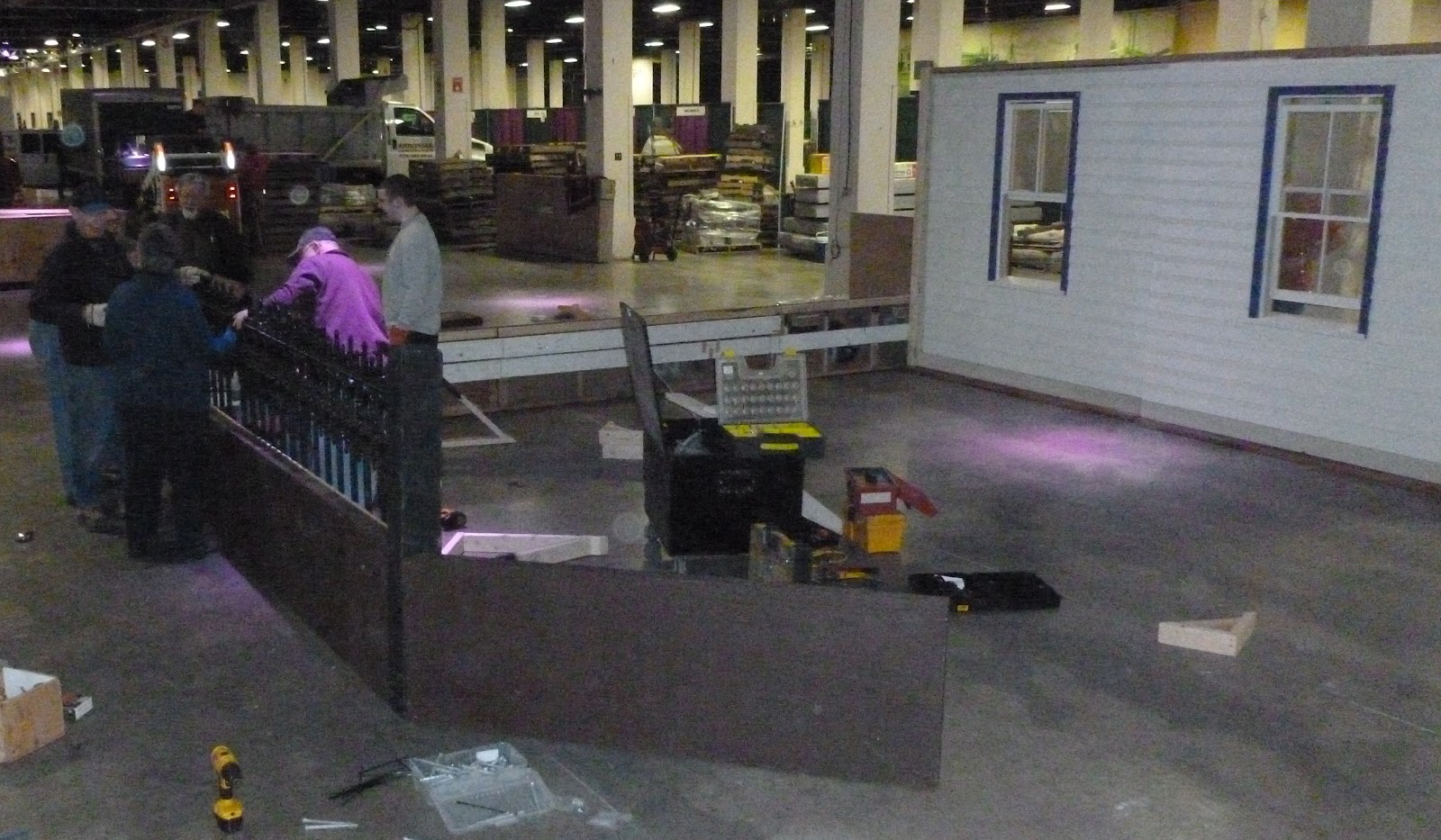
The wrought iron fence starts
to take shape
A garden at a flower show incorporates almost none of these conventional elements.  Instead, it is gardening as theater; except that, because the garden would bear Mass Hort’s name, it was also gardening as education.  Not even the size of the garden was fixed: as exhibitors were added and dropped out, Mass Hort’s allotted garden space grew from less than 400 square feet to eventually encompass nearly 1200 square feet of floor space.

The key differences between that garden in your side yard and one on the floor of a flower show are these:  first, the flower show garden must be built from scratch in three days, exist for five, and then be torn down in one.  And, second, the garden must be in full, glorious bloom for those five days.

The first segments of the townhouse
are raised onto the concrete wall
These were the parameters and obstacles that I faced when planning began for Mass Hort’s garden.  In turn, I had four secret weapons in my arsenal.  One was Paul Miskovsky, a Cape Cod landscaper who is a veteran of dozens of flower shows.  The second was my wife, Betty, who knows floral design had created gardens for five previous flower shows.  The third was Clark Bryan, Mass Hort’s Director of Operations, whose unique combination of organizational skills and mechanical competence is unparalleled.  The fourth is the Massachusetts Master Gardener Association, a group of people for whom horticulture is a passion and who collectively possess the skills to build anything from a garden shed to, probably, an aircraft carrier.

Behind the townhouse, a mass of
stabilizers kept it in place
I should also mention at this point that a flower show garden is a horrendously expensive undertaking.  A thousand-square-foot exhibit can cost between $50,000 and $75,000 in labor and materials.  My budget for the garden was $6,000 (unless I wanted to give up my parking stipend, in which case the budget could be expanded to about $6,084).  In other words, creating this garden would involve a lot of begging.

Every flower show has a theme and the one for the 2012 Boston Flower & Garden Show was ‘First Impressions’.  I knew that I wanted a house as the backdrop for the exhibit, and I described the quest to build that backdrop back in January (see, ‘Would You Like a Townhouse to Go with that Garden?’).  Assembling the plant material was touch and go:  Paul Miskovsky agreed to supply most of the ‘big’ items – the trees and shrubs, especially.  Betty and some of her more larcenous Master Gardener buddies prowled New England Grows and came away with hundreds of smaller shrubs, perennials and annuals.  Various growers with a soft spot for Mass Hort offered flats of plants.

A small portion of the plants planned
for use in the exhibit
Why so much?  Because the rule of thumb is to start with three times the plant material you think you’ll need.  Come show time, one-third won’t be blooming (or be past bloom) and another third won’t look right in the exhibit.

At 8 a.m. on Saturday, March 10, Betty, Clark and I assembled at the Seaport World Trade Center.  We found a cavernous, empty hall.  On the floor, Paragon’s Show Director, Carolyn Weston, has put down the ‘shoe polish line’ (double-click on the top photo to see the shoe-polish line); white marks indicating the corners of our exhibit.  The rest was up to us, and luck.

Clark Bryan, at left
This would be a good time to say a little more about Clark Bryan.  His role as ‘Director of Operations’ at Mass Hort is something of a misnomer.  ‘Chief Magician’ would be a more appropriate title.  His job for the past four years has been to make things happen without the use of actual money.  If I said I needed that aircraft carrier mentioned a few paragraphs above, three things would happen: first, he would roar that what I wanted was impossible, and he would stomp off in a huff.  Second, he would re-appear, three days later, with a thick binder containing plans for an aircraft carrier and little slips of paper indicating favors owed to him for things done decades ago.  And, two weeks later, I would come to Mass Hort and find a working, Nimitz-class aircraft carrier outside his office, which he would say he whipped up at home over the weekend.  He is the ultimate can-do guy.

At 8:20 a.m., trucks began rolling into the hall.  Out came the segments of the townhouse, ready to be assembled like a Tinkertoy set; a pre-built, ready-to-screw-together kickboard; a hundred concrete blocks and 200 bricks; 40 feet of antique, wrought-iron fence; and enough braces, clamps, screws, and ancillary tools to stock the grand opening of a Home Depot.  By 8:30, a cadre of volunteers working under Clark’s direction was building the two-foot-high concrete block wall on which the townhouse would rest.

The kickboard was a giant jigsaw
puzzle, ready to be bolted together
We worked steadily though the day.  Ten hours later, the kickboard was in place and the town house rose a majestic 16 feet from the floor of the convention hall.


Sunday morning brought the plants.  A truck from Olsen’s Greenhouse, to which we had paid $1,000 of our precious budget for nearly 200 pots of perfectly color-coordinated tulips and daffodils, was already parked outside.  An hour later, the first of three trucks bearing plants, trees and shrubs appeared.  Two days earlier, Betty and two fellow Master Gardeners had gone through two Mass Hort greenhouses, marking plants that looked like they would be at the right state of bloom for the show.  Now, she unloaded them, segregating plants into ‘front and center’ perfection and ‘background’. 

Monday afternoon, 20 Master
Gardeners worked to complete
the display's vegetable garden
Paul Miskovsky’s trucks arrived, bearing both good and bad news.  Twenty ‘Light-O-Day’ hydrangeas had been tinged with frost while loading them.  They would be unusable for the show.  Fortunately, Paul packed along lots of extra plants - that "three times what you need" rule at work.

Now began the actual design of the garden.  We knew we wanted a few set pieces – an enormous Heptadcodium miconiodes (Seven Son tree), a Picea orientalis ‘Horstmann’s Gen’, and a Picea omorika ‘Pendula’ (weeping Siberian spruce) – and knew approximately where they would go.  But everything else was done on the fly, with 45 cubic yards of mulch arriving a scoop at a time.  Betty and Paul would review the available plant material and then argue over what ought to go where.  It was a case of two people with very different design aesthetics working in the same small space.  Paul is more of a showman with a flamboyant style that wins awards and the praise of big-budget clients.  Betty is more attuned to the interweaving of color and texture and creating spaces for real-world budgets.  At various times, each one retreated to fume at the other’s intransigence. It was Betty’s garden but Paul deserved a say.  In the end, they collaborated with delightful results.

The Townhouse Garden.  Double-click for a full-screen view
At the end of another ten-hour day, the town house garden was largely in place.

The townhouse garden, though, was only one-third of the exhibit. Next to it was a backyard vegetable garden.  Work began on it in earnest on Monday morning as twenty volunteers planted, pulled out, and re-planted displays of exotic vegetables that can be grown in New England.  And, on the right, the ‘secret space’ began to take shape.  The Mass Hort garden is about education but it is also, ultimately, a tool for attracting members.  One way to get those members is to invite them to have their picture taken.

Paul Cook, Master
Gardener, an incredibly
competent carpenter, was
indispensible to creating
the exhibit
For two years, I brought in an enormous chair that normally resides in a children’s garden at Mass Hort’s Elm Bank headquarters.  Wanting not to get stale, I asked for something different for 2012.  Clark knew a guy who was closing his flower shop in Allston and, in December, Mass Hort became the proud owner of a beautiful arched trellis.  Betty saw the arch and decreed that she knew just the bench to sit under it – the one in our side yard.  Add all those tulips and daffodils plus a bank of Rhododendron ‘Dora Amateis’ in full white bloom, and you have a magnet for people with cameras and cell phones.  While a volunteer snapped photos, a membership specialist gave the ‘elevator pitch’ to become a Mass Hort member.  It worked.
People lined up all day to have their
photo taken in the 'secret garden';
many became Mass Hort members

That last piece of the display garden – the Secret Corner – was completed around 11 a.m. on Tuesday. 

The result was, by all accounts, a fantastic garden and one that was useful to someone looking for ideas. (By contrast, the vignette next to Mass Hort’s garden was a relaxing space atop a ten-foot-high  ‘hill’ with a waterfall.  It was both a crowd- and a judge-pleaser, but it unlikely that anyone took it for anything other than entertainment.)  We attracted tens of thousands of show-goers who lingered and asked questions.  It was, in short, a class act.

A final look at Betty's miraculous
garden
The Boston Flower & Garden Show closed Sunday at 6 p.m.  We put tape around the exhibit (to keep out ‘light fingers’ and disassembled it on Monday, starting at 8 a.m. and concluding by mid-afternoon.  When it was all over, there was nothing but a pile of mulch.  Tuesday morning, another shoe-polish line went down for the next show.


A garden for education
But the exhibit left behind memories and ideas.  It inspired, it taught.  More than 50 volunteers worked on it at one point and twice that number were involved all together.  Like good theater, it was hard work.  Like great education, it was worthwhile.

I have hung up my ‘Chairman’ badge for the year and, indeed, for the last time.  Three years is enough.  But this particular garden, which lasted just five days, will endure in my mind for a lifetime.