August 25, 2023

The Peril of Perennial Ageratum

One of the most memorable of the original ‘Star Trek’ episodes involves an itinerant space peddler who barters for an alcoholic beverage with a small, fluffy creature called a Tribble, the likes of which no one had ever seen before. The Tribble likes to be stroked; it coos and makes people feel good; perhaps too good. The Tribble’s chief downside is that is fecund to a fault. In the words, of Dr. McCoy, “Jim, as near as I can tell, these things are born pregnant.” Tribbles soon overrun the space station and threaten a shipment of a valuable grain seed stock. I won’t spoil the plot, but at the end of the episode the Tribbles are dispatched to a Klingon war ship.

Perennial ageratum
I was thinking about that episode yesterday as I spent the better part of an hour getting rid of my own Tribbles; specifically, pulling out patches of Conoclinium coelestinum, better known as perennial ageratum, from my garden. Thus far I have filled two, 50-gallon cloth barrels with the nasty stuff. I suspect my work is not yet done.

'Good' Ageratum houstonianum
A quick tutorial: Ageratum houstonianum, as anyone who grows summer annuals knows, is a wonderful filler plant for containers and a great ‘boots and socks’ border for beds. It has a lovely, bluish-purple flower than draws the eye. Alas, it dies with the first frost. It is a wonderfully well-behaved annual, prized for that unusual color. I can recommend it unconditionally.

Note the area circled in blue:
the perennial ageratum was
half the height of the Fothergilla
'Blue Shadow'
Now, let’s talk about perennial ageratum. While both it and its annual namesake are members of the aster family, their only common attribute is their similar-colored flower. Conoclinium is anything but well-behaved. It spreads by rhizomes; it spreads by flower seeds. It may even spread by word of mouth. But, once it is in your garden, controlling it is a full-time job come the end of summer.

To the best of my knowledge, neither Betty nor I have ever purchased a pot of perennial ageratum, yet this August it is everywhere in the garden. It is crowding out our beautiful Astilbe, upstaging our Fothergilla, and colonizing a bed of spring bulbs that, without human intervention, would be suffocated by a mat of roots. How did it get here? Maybe an itinerant peddler traded a sprig if it to one of our neighbors for an alcoholic beverage.

This false strawberry ground cover was
engulfed by perennial ageratum. Time 
will tell if I got it all.
What I do know is it has to go. But the Conoclinium has its own plan. Pulling it out is a piece of cake: it appears to come out with its roots intact. But, if you pull out a stand and then sift the soil, you’ll find pieces of roots and rhizomes cleverly left behind. I found that out because I thought I had completely eradicated perennial ageratum from the top of our driveway bed. Three weeks later, there were hundreds of replacement stalk coming into flower. (The plant apparently thrives in rain, of which we have more than our share.)  Now, whenever I remove a patch of Conoclinium, I immediately also dig around in the surrounding soil to see what may have been left behind. I am seldom disappointed.

Note the perennial ageratum
(circled in blue) hiding in
the Rudbeckia goldstrum
What is worse, the more I look, the more of it I find. The plant loves the sun. It also thrives in deep shade. It had insinuated itself in a bed of Potentilla indica (false strawberry) where it was keeping a low profile, as well as in a clump of just-past-bloom Clethra alnifolia (summersweet), where it had stretched to a height of four feet. Perennial ageratum is an ambitious interloper.

As of yesterday, I believe I have, at least for the moment, gotten it under control.  Which is, of course, a foolish statement. We’ve had two inches of rain in the past 24 hours. I know darned well the perennial ageratum is using the time to take stock of where its remaining troops are recovering. Reinforcements will be called in, perhaps from neighboring properties. I don’t know exactly when this war was declared. What’s more unsettling is that I don’t know if I’m winning or losing.

June 25, 2023

A Late June Walk in the Garden

 Sleep. Creep. Leap.

The garden at 26 Pine Street, June 2023.
Double-click for the slideshow.
Those are the words all gardeners learn to live by. You put something in the ground. You pamper it, water it, weed it, and keep it free of disease and interlopers. And, in return, you get… nothing (at least for that first year and, sometimes, for two or three years).  Everything is going on below ground: your plant/tree/shrub is establishing roots. It is exploring its surroundings. It doesn’t care that you want instant gratification. Ultimately, you accept that, at least above the soil line, that thing you planted is sleeping.

Itea 'Little Henry' in full
flower. Three shrubs have
merged into a single mass
Then, after a few years, you see the tangible growth. Your frustration eases – except that you wish you could get more flowers/branches/fruit. Your precious plant is ‘creeping’.

Finally, one spring morning you come out and find you can’t believe your eyes. That scrawny plant is now gorgeous. The awkward teenager has come of age. It flowers in profusion, its branches are sturdy, and its fruits hang heavy. You know all those years of pampering have paid off.  You are proud as punch.

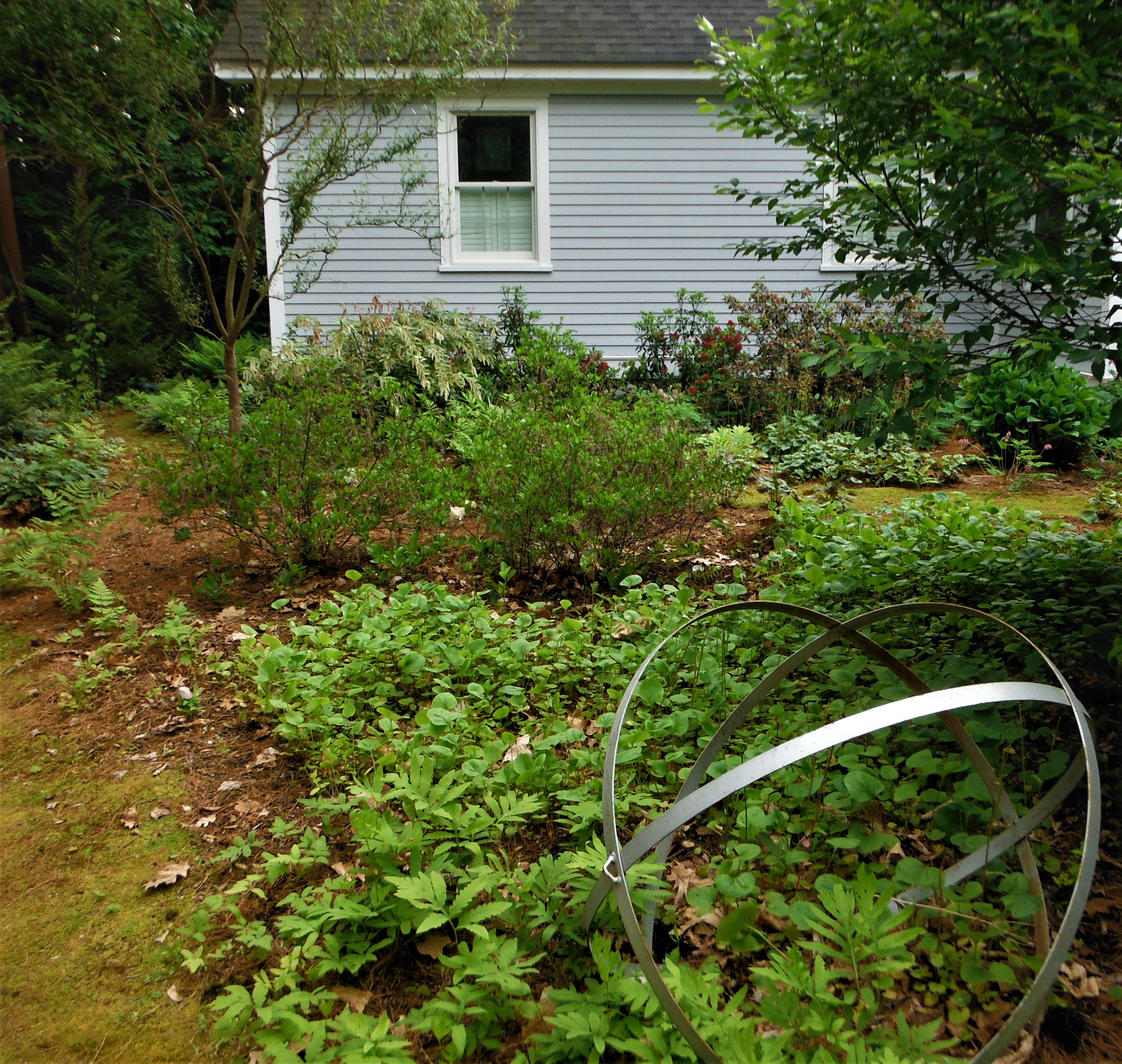
The garden at 26 Pine Street has reached, if not full maturity, a grown-up status. Eight years after the first trees and shrubs were placed, they look as though they’ve always been there. Shrubs planted on three-foot centers with what seemed like yawning chasms between them are now a glorious, full-leafed mass. Trees that were slender saplings are twenty feet high and limbs are touching their neighbors.

The sidewalk's hard edges are
softened by border plants
Best of all are the surprises: the bluestone sidewalk’s edges are softened by geraniums and lavender. A dozen, bare-root asclepias ‘Hello Yellow’ milkweed plants that seemed doomed not to make it through their first year have multiplied to become a glorious colony, dense with flowers – and butterflies. An original plan to use metal borders and gravel for paths within the garden fell by the wayside when moss thrived where we walked. Today, those moss paths traverse the property; gloriously unplanned but far superior to the original concept.

Carolina lupine and asclepias
'Hello Yellow' milkweed
We have taken chances on ‘un-pedigreed’ plants and have been rewarded for being adventurous. Betty spotted Thermopsis villosa – Carolina lupine – at a Grow Native Massachusetts plant sale three years ago. We put it in the front of the garden where it would get full sun. It grew to an impressive seven feet with spikes of brilliant yellow flowers. We let some of the seed pods remain in the soil. This year, a dozen specimens form a brilliant cluster.

Moss walkways weren't part of the
original plan - they were a better idea
Betty was recently asked to give a talk about the garden at a convention in Michigan. Her sponsors made a request that her talk include ‘mistakes’. Betty and I put our heads together and made a list. We started with a reliable one: accepting gifts from friends. While Betty intended the garden to be nearly-all native, she graciously accepted an Asian interloper: a variegated Petasites japonica. It forms a lovely, visually arresting mound of green-and-white leaves. We placed it in a shady site adjacent to a clump of Podophyllum peltatum – Mayapples. All went well that first year. The next spring, we noted with pleasure the Mayapple’s range had almost doubled in size. The Petasites, however, had tripled in area, including a foray into the Mayapples.

Petasites. Now long gone,
and good riddance.
It took three years to completely dislodge the last vestige of the Petasites.

Another error – and it is one we have made with every garden we have had – is to not be sufficiently stern with what I call ‘the Cute Little Interlopers’; plants that hitch-hiked onto the property. At 26 Pine Street, the CILs are the violets. They emerge in early March and are quickly in flower… and almost as quickly in seed. My task each April and May is to grub out every trace of those violets; which by now have insinuated themselves with and intertwined their root into hundreds of ‘good’ plants.

Be wary of Packera aurea
The third mistake is to believe that all native plants are well-behaved. They are not. Exhibit ‘A’ is a thug called Packera aurea, or golden ragwort. Because we have no grass in the garden, we need something else – actually many something elses – to provide a pleasing, low-growing ground cover. Most of these have been quite successful. For the bed comprising our black birch and clump of Clethra (aka summerweet) ‘Hummigbird’, we purchased four pots of Packera.

The dominant ground cover plants in the
rear garden are strawberries, tiarella,
and astilbe.
It is indeed a pretty groundcover with dense, dark green leaves and an attractive golden flower on a tall spike. What is not pretty about it is its intention to take over the entire garden. Three times a year, I venture out with a large cloth barrel and remove Packera from underneath the summersweet, the walkways and half a dozen other places far removed from the mother plants. If you are ever tempted to grow this hoodlum, run – do not walk – to the nearest nursery exit. And, if you already have it growing in your garden, never ever let that golden flower turn into a dandelion-type seed head.

Eight year ago, this is all 
there was...
But the garden is a joy as the accompanying photos will attest. Except for the Petasites photo and this Google Earth view of the garden from September 2015, all images were taken on June 24, 2023 – almost exactly eight years after the first specimen trees were placed in this, their new home.

June 2, 2023

Tales from the Garden

The 4-H shed and, nearby, the
Medfield Community Garden
Running a 75-plot community garden is a delicate balancing act, and Betty and I take our responsibilities seriously. Despite my self-appointed title of Garden Ogre, I attempt to enforce guidelines with as soft a touch as possible. Betty’s role is one of rendering assistance on all matters horticultural, and she will take all the time necessary to debunk bad internet myths and offer advice based on actual science and real-world experience rather than something dreamed up by a clueless would-be Tik-Tok star.

Yesterday brought events from both ends of the management spectrum.

First, the good news. Four years ago, a new gardener, recently retired from the academic world, joined the Community Garden family. An engineer by training, he also became part of the garden’s corps of volunteers; mending hoses and refurbishing our fleet of wheelbarrows. He further agreed to help stake the garden in the spring and clear ‘problem’ plots in the fall. All of these activities fall under the heading of thankless tasks.

The injured gardener maintains our fleet
of a dozen wheelbarrows
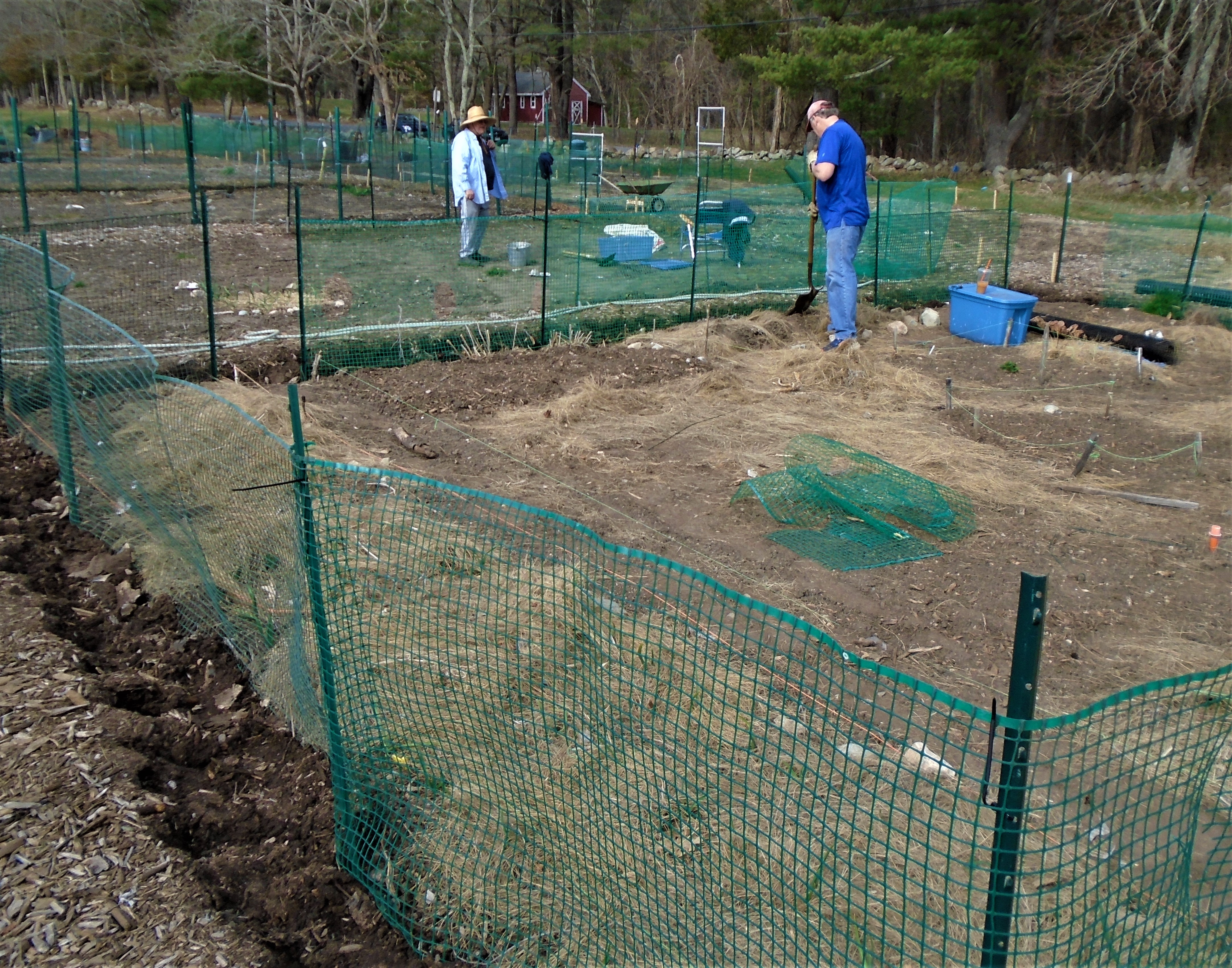
In late March, that gardener had a fall that left him with serious injuries to a leg and foot. He notified me he was unlikely to be able to have a garden this season as he would need one or more surgeries and rehabilitation that would last into summer. My response to him was that it was too soon to make such an irreversible decision. Two garden friends put up his fence; including digging a 100-foot-long trench around the plot’s perimeter to ensure critters could not sneak in uninvited.

That first good deed was the start of many more. His plot neighbors began planting the garden he had envisioned for the season. They weeded and they watered. I have counted no fewer than four helpers whom I have spotted in his plot; working diligently to ensure all is well in his absence.

Volunteers put up the fence around the
injured gardener's plot, including
digging a trench for it
Three days ago, I made a walking tour of the garden and made notes on plots where either no gardening has yet taken place (an ominous sign) or weeds have started appearing among vegetables planted at the season’s beginning in April. I also noted the sterling appearance of our wounded gardener’s plot and wrote off a note to him.

A few hours later I received a reply. I will not quote it out of a respect for a private communication, but his reaction was one of sheer awe that so many people cared. I can honestly say I was choked up as I read it. In a world where altruism is supposed to be passé, a group of people whose sole connection to one another is a shared love of gardening have come together to give one of their own a continuing helping hand.

While watering this morning, I ran into one of the benefactors. She had in her hands several tomatillo plants ready to go into the housebound gardener’s plot. They were, in turn, a gift from yet another benefactor. Truly, there is hope for mankind.

On the other side of the garden, though, something quite different was going on.

Gardeners can over-winter fencing and stakes
in the 4-H shed
Not all of our gardening families have houses with spacious garages, sheds, or basements. And, so, the community garden offers off-season storage of garden fencing, stakes, and tomato cages in a small building across from the garden. The shed will hold material for roughly 25 families and preference is given to people living in multi-family dwellings. All material has to be tightly tied together and labeled with the owner’s name. The shed is locked on November 1 and re-opened only when the garden formally opens April 1. From then on, it is open for the season as gardeners retrieve their supplies.

Before I lock the shed for the season, I make certain all those stakes and fences are tagged, and the names are legible. There is a list of the people who have requested space and I make certain no interlopers have decided one more roll of fencing among 25 won’t be noticed.

The system worked exceptionally well… until this year. On April 1, I unlocked the shed and checked to see everything was still where it was supposed to be. All was right with the world.

Loaner 'Ogre' fencing was available
in an adjacent lean-to
Ten days later, one gardener notified me he had gone to the shed and his fencing bundle was missing. I went to the shed, did my own search, and came to the same conclusion. Yet I knew the bundle was there at the beginning of the month.

There were two possibilities. The first was that someone, likely a new gardener, had erroneously concluded the fencing in the shed was part of the ‘Ogre Fencing’ available for loan to first-year gardeners and stored in an adjacent lean-to. The second possibility was someone filched it.

I queried the garden community but no one had any information. In the meantime, the gardener with the missing fencing purchased new material – spending just over $200 (that’s what it costs!). He put up his new fencing. I said I would try to seek reimbursement for him from the Community Garden Revolving Fund into which all our plot fees are deposited.

Then, the gardener – let’s call him Gardener #1 – took a walk through the now-mostly-fenced community garden and spotted what he was certain were his materials. He contacted me and told me the plot number. It took some time, but I made contact with the individual – a new gardener who would have invited to use Ogre Fencing. I asked the new gardener if there might have been a mistake. The gardener – let’s call him Gardener #2 – stated unequivocally, that the fencing was his.

To me, that closed the issue. I didn’t demand receipts. Somehow, for the first time in more than a decade, someone from outside the garden community had gone into the shed and pilfered someone’s fencing. I reported this to Gardener #1 and repeated that I was going to seek restitution on his behalf.

Restitution, unfortunately, was not as easy as reaching for a checkbook. First, a decision had to be made by someone in authority that such an unprecedented reimbursement was a good idea. The second was actually getting the check written. (I know this because it took six weeks to get reimbursed for the stakes and string used to mark out the garden.) I communicated all this to the gardener.

Unfortunately, as the wheels of progress ground slowly and inconclusively, Gardener #1’s belief hardened that Gardener #2 was using purloined material. It so happened that, yesterday morning, the two gardeners (who had never met) were in the garden at the same time. Gardener #1 went to Gardener #2’s plot and… heated words were exchanged.

Each party emailed me; Gardener #2’s note included a copy of the receipt for the fencing he had purchased. I wrote an apology to Gardener #2, which settled at least that side of the issue. I also wrote Gardener #1 reiterating my earlier statement that, in my mind, the ‘stolen fencing’ question had been resolved as soon as Gardener #2 said the fencing was his own. I further wrote that, if Gardener #1 had an argument with anyone, it should be with me.

Before I became a Garden Ogre in 2009, I had a 35-year career in the corporate world, complete with fancy management titles. I sometimes witnessed (or had a hand in) cooperation across groups that already had a full plate of responsibilities and no spare manpower to lend a hand to struggling peers. Somehow, in hindsight, those examples of selflessness were less inspiring than what I saw this week in the actions of half a dozen gardeners. I also resolved many problems where I had to determine who was right, who was wrong, and enforce my decision. For reasons I will make no effort to explore, those long-ago clashes of ego and power seem less consequential to me than the problems between two gardeners.

March 20, 2023

Acts of Kindness on a Southern Sojourn

My best guess is that it fell off the back of one of the campers racing toward a weekend on the Gulf of Mexico. I had seen several such caravans in the preceding hours: chairs, bicycles, umbrellas and other bric-a-brac that had no assigned storage space, and so were tied or bungee-corded to the vehicle. If you hit enough bumps and don’t inspect your lashings every time you take a break from the road, something will inevitably come loose.

The ’something’ was an aluminum beach chair; the kind you can buy at Ocean State Job Lot for ten bucks. The chair had already been struck at least once; likely by a high-riding SUV or truck which crushed and bent it. In the instant I saw the object before our car, too, ran over it, I remember the gaudy colored plastic mesh that formed the seat and back of the chair.

A Prius rides very low to the ground
Our vehicle, though, is a Prius; and part of the design of the Prius that adds to its well-deserved fuel-sipping reputation is that it rides lower to the ground than those ubiquitous SUVs and pickups. When one of our tires passed over the debris, one or more pieces of aluminum obeyed the laws of physics and angled upward, snagging the undercarriage of our car. Betty and I heard the crunch but assumed we had merely further flattened the carcass.

Fifteen seconds later, our assumption was proven wrong. HYBRID DRIVE COMPROMISED – PULL OVER IMMEDIATELY AND SEEK ASSISTANCE appeared on the Prius’ display. We quickly did so, guiding our vehicle to the breakdown lane. Getting out of the car, we discovered a clear liquid was puddling underneath it.

Thus began eight days of discovering that there is a stunning amount of kindness in this world.

We were on that road – Interstate 59 in Hattiesburg, Mississippi – because, a year earlier, I had accepted an invitation from the Deep South Region of National Garden Clubs to be the speaker at the Friday luncheon of their annual convention, to be held in New Orleans. I would present ‘Gardening Is Murder’ to an audience where few (if any) of the attendees knew of me or my books. I was being presented with an opportunity to reach 150 prospective readers by delivering a humorous talk about gardening from a spouse’s point of view.

Our 1526-mile drive. We almost made it.
It is 1526 miles from Medfield, Massachusetts to New Orleans (22 hours and 48 minutes of driving, according to Google Maps) and Jet Blue will get you there in 3 hours and 40 minutes. But, in addition to providing laughter coupled with a modicum of horticulture to a receptive audience, my mission was also to sell books. The cost of separately shipping books, displays, and banners would make the trip economically impractical. With a vehicle that averaged 64 miles per gallon though, I could make the trip within the travel stipend agreed to by the convention organizers.

Betty made it clear there was no way I going to make the journey alone. We would share driving duties; leaving our home early on Wednesday, stopping overnight in Tennessee, and arriving in New Orleans in time for a 4 p.m. reception on Thursday.  It was a good plan and, but for that beach chair, we would have made it with an hour to spare.

A call to AAA got us a tow to Toyota of Hattiesburg. I had already been on the phone with one of the dealership’s service advisors, Michael Metzger. He quickly understood our predicament and offered to intercede to help with a car rental. Ordinarily, such a task would be easy; but this was the beginning of spring break for area colleges and all cars in the region were spoken for. Through a series of direct calls to local agencies rather than through impersonal call centers, he found a vehicle we could have for two days; but must be returned to Hattiesburg by noon Saturday. Once our Prius was at the dealership, Mike also got us to the car rental agency ten minutes before its 5 p.m. closing time.

The second kindness came from the organizers of the convention, and especially from Convention Co-chair Elizabeth McDougald, who had hired me a year earlier. We arrived after 7 p.m. – long after that reception and also as dessert was being served at the evening awards dinner.  We were quietly seated and fed, our room key already in our hand. The following morning as I set up my books display, I found everyone at the conference knew of our on-the-road travails; a general announcement had been made. It would not be an overstatement to say more than a hundred people said they were glad me made it to the convention and wished us a safe return home.

We were left with a dilemma, however. Our Prius had been thoroughly examined early Friday morning. The lawn chair had damaged our radiator, A/C coolant line, fans, and fan housings. None of these were in-stock parts; all had been ordered but would not arrive until at least Monday. Repairs and road testing would push our departure to Tuesday at the earliest - possibly until Wednesday - and Thursday if additional problems were found. Our rental car had a hard return time of Saturday at noon. We could be stuck in a hotel room in Hattiesburg with no means of transportation for at least four days; possibly six.

Better this than five days in a
Hattiesburg motel room
Thus came the third kindness. While I delivered my lunch presentation, Elizabeth McDougald’s husband, Glenn, researched travel options. By 3 p.m., Betty and I had seats on a Jet Blue flight back to Boston leaving that evening. Elizabeth offered to gather and store all the books and other paraphernalia we would be unable to take with us on the flight. The McDougalds also said they would arrange for the return of our rental car.

Once at the airport, we emailed our neighbor, Jane Cobb, who was performing cat-sitting duties, to let her know we were arriving home a day early and so she need not give Abigail her morning feeding. Ten minutes later, our cell phone rang asking what time out plane landed at Logan Airport and how did we plan to get home? We said we would take a taxi because of the post-midnight arrival. Jane replied she would meet us outside baggage claim and would not take ‘no’ for an answer.

On Monday morning, Mike Metzger let us know the parts were in hand and a body shop was already straightening out housing brackets. Mike suggested our Prius could be ready as early as Tuesday afternoon. I have never known a repair to go so quickly. We had assumed we would fly into New Orleans, use an Uber to collect our stranded belongings from the McDougalds, and then continue in the Uber to Hattiesburg at some astronomical price.

An act of kindness
Instead, we had yet additional acts of kindness. If we could fly into Mobile, Alabama, instead of New Orleans, Elizabeth and Glenn would meet us at that airport with our peripatetic possessions and drop us off in Hattiesburg on their way back to New Orleans. A quick look at a map showed Hattiesburg is ‘on the way’ to New Orleans from Mobile in the same way Albany is on the way from Boston to New York City. We gratefully agreed to the offer.

Our final hurdle: 20 minutes to go 
3600 feet (2/3 of a mile)
More kindnesses: Jane Cobb’s spouse, Dennis Amtower, drove us to Logan for an 8:00 a.m. flight (for which you leave Medfield at 5:45 a.m. to cope with morning rush hour traffic and TSA inspection). We made our connection in Charlotte – a 3600-foot sprint – with just minutes to spare and arrived in Mobile just after noon. Mike Metzger had our car prepped and ready when the McDougalds dropped us off in Hattiesburg. We were on our way back to New England at 2:30 p.m.

So many things could have gone wrong along the way. But they didn’t. And, thanks to a group of people – most of whom we had never met before last week – what could have been an unmitigated disaster was instead only a time-consuming (albeit expensive) mishap. I have three more speaking ‘road trips’ on my schedule this Spring, with destinations in South Carolina, Illinois and Michigan.

There are three more 'road trips' 
scheduled this Spring.
In hindsight, at 1500+ miles each way, New Orleans was probably too far to drive. Illinois will almost be certainly done by air, and I will figure out a way to ship books ahead of schedule. But Myrtle Beach is an (almost) leisurely 850 miles and Michigan (819 miles) features a dual speaking engagement with me at noon and Betty at 2 p.m.

Though I have lived 'up north'  for almost all of my adult life, I am a son of the South, and this trip reinforced the notion there is something both real and very special about 'Southern Hospitality'. No matter how the rest of this speaking season goes, I will forever remember the kindness we discovered on our sojourn to New Orleans.

March 6, 2023

Gardeners Wanted

For the past 14 years, Betty and I have performed an end-of-winter task that is equal parts sheer joy and pulling teeth: We’ve filled a community vegetable garden with gardeners. This year, we’re finding that job isn’t an easy one.

In an age of sticker shock in the vegetable aisle,
a garden ought to be a no-brainer
In an age of sticker shock in the vegetable aisles and an emphasis on eating wholesome foods, you would think that finding 75 gung-ho gardeners ought to be as easy as announcing the availability of plots and then jumping back to avoid being trampled… especially when 90% of your gardeners from last year tell you in November they’re ‘definitely coming back’.

The reality, for reasons I’ll attempt to explain, is quite different. Let’s start with the 90% ‘count-us-in-for-next-year’ rate. If that statistic held true, we would be looking for seven or eight new gardeners each year. Why did that handful of last year’s gardeners drop out? Mostly, they tried the garden for a season and discovered it was harder than they thought, or not as much fun. That is to be expected. In addition, at least one or two gardeners ‘age out’ each year because of their own decreased mobility. There’s also another kind of ‘aging out’ in which six-year-olds who once thrilled at the idea of going to play in the dirt with Mommy were now tweens who would rather lose their screen privileges for a week than be seen in a vegetable garden – and Mommy’s biggest reason for having the garden was to educate her children. That scenario plays out several times a year.


The other problem is that people’s lives get in the way. Over the winter, three full-plot holders – all excellent gardeners – moved out of town and so are no longer eligible for a space. Two other long-timers are having Big Events this summer and need to take the year off. A mother and daughter who had separate plots decided to share one. Add to all those stories the three abandoned plots that became food pantry gardens last year and we found ourselves with twenty vacant spaces for the 2023 season.

Fortunately, three long-time gardeners who until this year had made do with half-plots (300 square feet) asked to upgrade to full ones. I quickly emailed them and granted their wish. In theory, all I was doing was swapping one vacancy for another; I still need to find a new gardener for their old plot. Well, yes, but I’ve filled a vacant full plot that might otherwise be carved into two smaller ones (as a policy, we ask first-year gardeners to begin with a half-plot).

To fill these twenty spaces, we started a media blitz. Medfield has a weekly ‘shopper’-style newspaper delivered to every home. I wrote an article and submitted some great photos. We made the front page! There is an online news outlet called Patch dedicated to all things Medfield which published a second article. There are also two or three Facebook groups dedicated to things going on in Medfield. Those sites are being peppered with photos of happy gardeners, lush gardens, and cornucopia of perfect vegetables.

The result of that publicity barrage, as of this morning, is eight gardeners who have sent checks and a few more who promise to do so. Which leaves nine gardens still to fill.

'Weeding' went to the top of the
'Gardening Guidelines'
There have been other queries. Everyone who calls or emails is sent a peppy, encouraging response that encourages would-be gardener to take the next step. But my response also includes an attachment – the Garden Guidelines.

We don’t have ‘rules’. ‘Rules’ smack of dictatorships. ‘Rules’ are totalitarian. ‘Guidelines’ are things everyone can agree to do, especially when they fit on one page. Each year Betty and I review and re-write the Guidelines with a view to addressing things that caused problems the previous season.  For example, a woodchuck wrought destruction in one garden, so burying fences six inches was elevated from a ‘nice thing to do’ to something expected of every plot holder.  Weeding aisles was also a problem last year. The gardener’s obligation to keep aisles weeded went from the middle of the page to the top.

We make certain everyone
knows the gardens do
require work.
Do the Guidelines scare off would-be gardeners? I think a more accurate description is that they are a reality check. A few years ago – and I promise I am not making this up – a husband and wife seeking a plot for the first time informed me they intended to plant their garden in mid-May but were thereafter going to their vacation home in Maine for six weeks with no plans to return to Medfield until late June at the earliest. Betty (who is the family diplomat) gently told them their expectation they would return to a weed-free garden lush with ready-to-pick vegetables was probably unrealistic. The couple passed on the garden.

In an average year, though, all the plots are filled by the second week in March and we have started a wait list for the inevitable handful of people who change their minds about gardening after the season begins.

The world has re-opened
This year, I have a queasy feeling those last plots are going to hard sells. During the pandemic, we had a virtual monopoly on ‘acceptable’ outdoor mask-free activities. Even if you were tepid about the idea of vegetable gardening, the idea of getting out of your house and into the sunshine three or four days a week for a few hours was irresistible.  Three years later, the world has re-opened and Spain or Yellowstone National Park or New Zealand beckon. Being tied to a garden is an obligation fewer people are willing to undertake.

We will make it work. As noted above, last year’s abandoned plots became gardens dedicated to growing produce for food pantries. That turned out well because of the dedication of half a dozen participants with hearts of gold. Let’s see how this year unfolds.

February 4, 2023

The Fifteenth Season Begins

An abandoned plot. 'Mom' apparently
had other ideas for the summer
Please double-click on any image, including
the video, for a full-screen view.
In August 2008, Betty and I were spitting mad. It was our fifth year with a plot in the Medfield Community Garden. Two spigots were non-functional and two others leaked a continuing stream of water because of degraded gaskets. Half a dozen abandoned spaces among the 40 plots were growing up in weeds. Yet, in the center of this dystopian landscape, three gardens rose like plantation houses above the sharecropped fields. The smallest occupied two plots; the largest, four. Sprinklers, forbidden to us serfs, soaked those gardens. Contraband bags of weed killer lay in plain sight.

One member of our town’s Select Board (think Town Council) also happened to be our attorney. We went to him with our grievances. He said he would look into the matter. Two weeks later, the Town Clerk asked us to come to the Town House (think Town Hall) to be sworn in as members of the Town Garden Committee. When we were duly installed, we asked whom we should contact about attending the next meeting. The Town Clerk, with a perfectly straight face, informed us all the members of the committee had resigned. We were on our own.

The inmates were left in charge of the asylum.

We informed the Select Board what we wanted to do and they said, ‘fine, whatever’. We ripped up the eight-page ‘Garden Rules’ and wrote a set of ‘Guidelines’ that fit on a single page (so no one could say they didn’t have time to read them). The spigots were repaired, all plots were weeded under penalty of expulsion, and no one could have more than one plot. The garden expanded three times to become 75 plots in two sizes.


The last expansion came in 2021 – amid Covid – after we could not accommodate all the town residents who wanted in. Last year, with Covid restrictions largely gone and people again free to travel, we nearly concluded that last growth spurt was a mistake. Seven plots were surrendered early in the season, only four gardeners were on our wait list, and repeated entreaties via social media yielded no takers. In a ‘Hail-Mary-pass’ moment, we turned the three tenant-less plots over to volunteers to grow produce for the Medfield Food Cupboard.

Part of one delivery to a food pantry
The idea not only worked; it was a touchdown. When our town’s food pantry turned away a donation, we discovered a nearby town would happily take everything we could grow. The volunteers labored just as diligently on the ‘food insecure’ sites as they did on their own. We were onto something.

At the end of last season, the lingering question in Betty’s and my mind was, like a ‘dot-com’ company that hires too many people and takes on too much real estate only to find its customers have moved on to something newer and shinier, whether community vegetable gardening was a bubble doomed to burst?

We got our first inkling of an answer when we sent out our ‘straw poll’ in November and found just ten of our 75 plot holders didn’t plan to return – and two of those who declined were doing so because them were moving. Moreover, three half-plot (300 square feet) gardeners said they would like to move up to a full (600 square feet) space. Maybe it’s the astronomical prices of vegetables, but interest in community gardening appears to be as strong as ever.

Those ‘Gardening Guidelines’ have always been an evolving document. This year, we inserted language into it specifically encouraging our members to plant more than they need for their own families, and plan to share the rest with food pantries. We are also recruiting for someone to take on the time-consuming task of setting up for food pantry collections, picking up the donated produce, and transporting it to the correct site. (As with other garden volunteer jobs, the ‘salary’ is a free plot for the season – a $25 value!)

We also start this fifteenth season with a third member of the Community Garden Committee. No less a sage than Leonard Cohen wrote, ‘Seventy is not old age; it is the foothills of old age’. Both Betty and I check that box and, while we certainly don’t feel ‘old’, we know the baton will need to be passed at some point. Whether our new ‘Ogre Understudy’ is the person to take the reins or that task falls to someone (or several someones) who have yet to raise their hands, we want the Community Garden to not just be around, but to thrive for the next generation of folks who want to get their hands dirty.

November 6, 2022

November Surprise

 The drought of 2022 and total water bans that left most New England lawns brown barely affected 26 Pine Street. 'Tough natives' is one answer why our garden remained green. Rain barrels refilled during the infrequent rains is another. After our 250-gallon rainwater reserve was gone, we resorted to 'grey water' from showers and kitchen use.

We also practiced triage. Already-bloomed perennials were left to their own devices. Our scant water was lavished on the late summer and autumn bloomers. We watched with dread as immature tiarellas and heucheras withered - and hope they will return from their roots next spring.

The biggest surprise, though, came with the shortened days of October. We have had a vivid, long-lasting autumn. The photo at the top of the page is of Fothergilla gardenii 'Blue Shadow'. We have nine specimens in groups of three around the property. We purchased and planted them in 2015 because of their blue-green leaves and long-enduring white bottlebrush flowers in June. Autumn color was not part of the buying decision. But the brilliant yellow-gold leaves fairly require sunglasses. More than a few walkers have stopped, pointed, and asked, "are those real?" The answer: yes, they are.

Itea 'Little Henry' with Magnolia 
'Elizabeth' in the background.
Our Itea 'Little Henry' is also putting on a dramatic show. Virginia sweetspire is well-known for its long-lasting autumn transformation from glossy green leaves to speckled red, orange, and gold ones. It is also the last deciduous shrub to drop its leaves; and inclusion of multiple specimens of the cultivar was on our shopping list from the first draft. 

Itea's dirty little secret is that it is not well-behaved. It sends out runners to colonize any nearly open area. and patches of the shrub have become thickets. We have allowed it semi-free rein in just a few areas. One is by our garage and adjacent to our Magnolia 'Elizabeth'. Both the Itea and magnolia are in full autumn regalia in the photo just above.

Rhus aromatica (fragrant sumac)
Rhus aromatica, better known as fragrant sumac, is usually planted because of its pleasant scent, white (but short-lived) flowers, and spreading habit. The 'Gro-Low' cultivar also made our plant list because it grows in marginal soil and we wanted it to cap and grow down the small hillock between our house and the street. The idea was it would be the neutral background for the more interesting specimens (Ilex and Azalea, primarily) rising above the stone wall. As the photo at left shows, our Rhus has ideas of its own. The photo is taken from the street to show what walkers and bikers see when they pass by. And, as you can see, it is also obediently beginning to trail down the hillside.

Some trees have already dropped their leaves: the Magnolia shown in the second photo is an exception. In time, our Oxydendron (sourwood) will have a colorful autumn display; but it is still too immature to look like anything other than the gangling teenager it resembles. At the base of our Betula nigra (dwarf black birch), though, is a stunning perennial Aconitum, variously called wolf's-bane or monkshood.  It is one of the plants we lavished water on back in July and August, and it has rewarded us with a flowering of vivid blue purple flowers. It has grows from a single plant to a small colony. 

Viburnum Winterthur
In our back garden, our two specimens of Viburnum 'Winterthur' have had their purple berry clusters picked clean by our colony of overwintering  birds, but their show continues with leaves now red-purple at the top of the shrub and green/yellow/pink at the base. Adjacent to those specimens are our six Vaccinium corymbosum - highbush blueberry by any other name. They've been red and gold for more than a month and are now in their final glory days; their color complements and frames the maples and oaks in the woods beyond.

highbush blueberry
It's a remarkable display and, yes, in a few weeks it will be just a memory.  But, for a month or so, New England has something no other places can boast: a riot of color, all produced by Mother Nature as part of her preparation for winter.  We're delighted our small garden shows so well and pleases so many of those passing by. 

Author's note: all photos were taken on November 5, 2022

September 22, 2022

The Summer of Giving Back

A carload of produce
For more than a decade, the community garden my wife, Betty, and I manage has had a good working relationship with our local ‘food pantry’, which provides a grocery-store-type experience for Medfield’s food-insecure families. Until this year, though, apart from contributions from our own plot, my involvement was primarily posting (via email to our member gardeners) a pickup schedule provided by one of our gardeners who is also on the food pantry’s board. I knew we were ‘doing good’ but had little insight into the process.

In March, that gardener notified me she needed to take the 2022 season off and asked if could Betty and I could fill in for her. Without hesitation, we said, “sure.” That’s when we found out what ‘being involved’ really means. It is a lesson that will stay with us for a very long time.

Our 75-plot community garden formally opens in April; but until early May the ground is too cold to grow much of anything except leaf greens. Our first collection of 2022 was little more than a few bags of lettuce and arugula.

This abandoned plot was planted
specifically for food pantry use
Something else, though, had also happened in the first month of the gardening season: several gardeners dropped out, and we had already exhausted our wait list. Our inspirational solution was to turn those vacant plots over to volunteers willing to plant crops specifically for the food pantry. Three plots were quickly covered in seeds, plugs, and plants.

I also confess my dormant business background was aroused from its 17-year-long slumber. For years, donations for the food cupboard went into two wheelbarrows at the garden’s main entrance. There are, however, no fewer than five entrances from the street. Thanks to a mechanically inclined member of the garden, we have at least ten working carts and wheelbarrows. I deployed all of them in such a way it was impossible to enter or leave the garden without passing at least two barrows.

To enter or exit the garden, you have
to walk by wheelbarrows
Further, specific ‘sweep’ times were established. The Medfield Food Cupboard requests a single delivery at 3 p.m. on Tuesday. Because gardeners have varying work and life schedules, Betty and I made certain everyone knew we would pick up produce from the wheelbarrows on Monday at sunset, Tuesday morning after the ‘early shift’ gardeners had left, and Tuesday afternoon at 2:30. And, if you couldn’t get to the garden, a volunteer would carefully pick you plot in your absence.

Suddenly, we had a carload of produce for each distribution.

We were aware there was a smaller distribution organized on Saturdays for home-bound clients of the food cupboard. One Friday morning, we offered produce for it and were told it wasn’t needed. “But,” our food cupboard contact told us, “you might see if the food pantry in Medway can use it.”

The Medway Village Food Pantry
with our produce on display
The Medway Village Church Food Pantry was indeed interested. On some weeks we were now organizing twice-weekly drives. How could we keep gardeners interested in contributing more frequently? Betty’s innate marketing skills came into play. We began soliciting photos of our produce arrayed for the two towns distributions. We emailed these beautifully composed photos, together with testimonials, to our gardeners. Contributions rose apace.

We are now in the final third of September. The Great Zucchini Glut is behind us and tomatoes no longer fill an entire crate; but I see winter squash ripening in plots, kale continuing to grow, and an emerging bounty of spinach and greens. We’ll keep contributing until there is a hard freeze.

We send our gardeners photos of
their contributions on display
This has been a learning experience; an eye-opener of major proportions. I get urgent emails from gardeners who couldn’t get to their plots but who don’t want their green beans to go to waste. Can we pick them? Yesterday, a gardener fretted her eggplant, though ripe, are still too hard and so might be rejected by food cupboard clients. I told her what the head of the Medway pantry told me: not only does every vegetable go; they’re the first thing to disappear off the tables.

By Betty’s count, we’re making as many as twelve trips a week to the community garden to collect produce, devoting additional hours to harvesting gardens that are not our own, turning over a corner of our basement to be a vegetable sorting and packing center, and making at least one delivery every week to a food pantry. It has been a busy summer and a satisfying season of sharing.