June 7, 2020

What the World Needs Now Is... A Flower Show

Flower shows are big deals for
garden clubs

Spring is the season for flower shows. Here in New England, seemingly every other town’s garden club has one in May or June.  There are multiple classes of floral designs to admire, plus table after table of amateur horticulture: irises, peonies, flowering branches, early roses, and every annual imaginable.  Notices of the event go out in the local paper and signs appear on Main Street inviting the public to partake of a delight for the senses.

The flower shows we're used to won't
work in a time of social distancing
But not this year.  In a season of shelter-in-place orders and social distancing mandates, town garden clubs put a giant ‘X’ though the balance of their 2019-2020 schedule back in early March, including not just monthly meetings and road trips but special events such as flower shows.  They’ll re-group and (fingers crossed) start fresh in September. 

At a flower show, everything is up
close and personal - a no-no in 2020
The plight of local clubs extends to state and regional garden club organizations.  I had been invited to speak at several conventions this spring and I noted in their schedules that each had a major flower show attached to the listing of events.  Not a single one of those shows took place as scheduled.  And, the disappointment went all the way to National Garden Clubs, Inc., which cancelled its May convention for the first time ever.  It, too, had an enormous flower show as one of its attractions (Betty was part of the show’s committee).

Sometimes, though, you can’t keep a good idea down.  When the word went out that the NGC convention was to be a victim of Covid-19, the organization’s president, Gay Austin, made a phone call to a guy named David Robson and asked the question: “what would it take to make the flower show an on-line event?”

David Robson, directing the
building of a peacock
David is a retired Extension Horticultural Specialist at the University of Illinois, and so has a certain amount of spare time on his hands.  He is also one of the behind-the-scenes forces in the flower show world.  He could have told Ms. Austin, ‘search me’ or ‘it’s impossible’, but he did neither.  Instead, he started thinking about the logistics of holding a standard flower show (the term of art for one that adheres to a very specific set of rules) on the internet.  There was, naturally, no precedent.  It has never been attempted before.

He then went a step further and wondered what would happen if, instead of having just the 30 or so floral designers who were to have participated in the original event, plus the hundred or so people who might have brought horticultural entries to Milwaukee (where the convention was to have been held), NGC invited the entire garden club world to participate?

Clip the best flowers in
your garden, take photos...
That is exactly what is going to happen:  Download the schedule.  Choose one of the seven horticultural categories (including flowers, foliage, and arboreals among others).  Photograph your entry in the approved manner, and email it with your entry form (there is no entry fee). Your entry will be examined by accredited flower show judges.

It’s such an audacious idea it just might work. 

I am pleased to count David Robson as a friend (he’s the guy who hooked me into building peacocks in the rain at the Newport Flower Show last year).  When he called to ask Betty to be part of the committee (and, yes, Betty is in the schedule as chair of one of the horticultural sections), I broke into the conversation to ask him how many horticultural entries he thought Betty might end up reviewing.

“It depends on how successful the show is,” he replied, verbally bobbing and weaving.

“Well,” I asked, “what constitutes the low end of ‘successful’?”

“A couple of hundred entries,” he allowed.

“Then, what’s the high end?” I pressed.

After a few moments for contemplation, he replied, “The server crashes.”

This could be yours!
I’m rooting for the server to crash.  I’ll bet that between now and June 15th (the period entries will be accepted), your garden is ablaze with color.  Assuming your garden club is NGC-affiliated, clip the best half dozen of those flowers or branches, rig up a white board to put behind them and a clear bottle to put them in.  Take the required six photos of each specimen as described in the guide.  Fill in the entry form. Email it off.

Judging will take place between June 16 and June 30, with winners notified shortly thereafter.  And I hope this time next month I'll be writing about what happened when David’s server crashed.

June 4, 2020

The Bucket List - 1


For two months, Betty and I adhered to both the letter and the spirit of Massachusetts’ ‘shelter-in-place’ order.  We went once a week to the supermarket during ‘senior hours’ shopping time, we socially distanced ourselves from friends, and our car’s gas gauge barely budged.  Our lone extravagances were trips to the Community Garden and long walks around Medfield to avoid packing on the ‘Quarantine 15’.

We adjusted as we went along; learning how to navigate the pandemic in a way that didn’t cause us to go crazy in the process.  Principal among these was skipping those ‘senior hours’, when 50 of us would be in line at 6 a.m.  We now go at 9 a.m., walk directly into the store, and find the shelves are fully stocked.  We also made two, 88-mile runs out to Andrews Greenhouse for vegetables, perennials, and annuals.  You have to support local agriculture, after all; and if you get an exhilarating, traffic-free drive out the Mass Pike in the bargain, so much the better.
The last tine my hair was this long, it
was brown and Nixon was president

Two weeks ago, Massachusetts began a cautious return toward a ‘new normal’.  On May 27, I was my barber’s fourth customer.  It was my first trim since the middle of February.  My hair hadn’t been that long since 1969.  Two days later, our favorite bakery re-opened and a pair of chocolate croissants graced our breakfast table.  These are the important things in life.
But there is more to life than chocolate and shorter hair.  There are gardens and open spaces. 

You can walk neighborhoods only so long before they all start to feel alike and, by mid-May, our walks were getting frankly repetitive.  Then, Trustees of Reservations gradually opened its most-lightly-trafficked properties.  We walked one less than three miles from our home that we had ignored for decades because it was ‘just a trail through the woods’.  Oh, were we wrong.  We even enjoyed getting lost by missing the turn in our trail.

Phlox stolonifera at Garden in the Woods
Then, came the electrifying emails: the opening of several gardens to members on a timed-ticket basis.  We jumped at the opportunity.  Our first excursion was to Garden in the Woods, the Framingham home of Native Plant Trust (formerly the New England Wildflower Society). May 29th was a beautiful day and the woodland garden was in its peak spring glory.  A field of blue phlox greeted us. Trilliums were everywhere. 

Yellow lady slippers
Frogs and turtles basked on tree trunks semi-submerged in a pond.  Native Plant Trust may have taken social distancing too far: there were just three cars when we arrived at 10 a.m., and seven when we departed at 11:30.

Tower Hill was in its spring glory
Next was Tower Hill Botanical Garden, the home of the Worcester County Horticultural Society.  The site is an old farm high above the Wauchusett Reservoir. When we go to Tower Hill, it is usually for an indoor event and, while we always knew the gardens were there, we had never walked all of them at once.  We corrected that error on June 2nd. 

Everywhere, plants were awaiting
their new homes
We were the first car through the gate at 9:50 a.m.  When we departed a few minutes before noon, there were perhaps 30 cars in the parking lot, though I suspect more than a few of those belonged to volunteers and staff, because everywhere we went, beds were in the process of being planted.

It is a beautiful garden with a lovely mix of annuals, perennials, shrubs and mature trees.  Its lone drawback, at least in my view, is the dominance of Asian cultivars. American gardening is bending toward native specimens, and to see so many Japanese and Chinese trees and shrubs – despite their beautiful, variegated leaves and sinuous branches – is disappointing when conservationists and naturalists are demonstrating the critical role of native plants for pollinators.

At the top of Tower Hill....
We walked each of Tower Hill’s gardens and savored them.  We sat in Adirondack chairs overlooking the reservoir.  We hiked to the peak of the eponymous hill to see scenery little changed by time.  It was a picture-perfect morning.

Yesterday (June 3), we made the 55-mile drive to Crane Beach in Ipswich.  In my opinion, this is the crown jewel of the Trustees of Reservation; it had opened only a week earlier, and only on an ‘experimental basis’.  On-line tickets were snapped up in a few hours.

So much beach, so few people...
We know Crane Beach intimately.  Its four miles of fully-protected and undeveloped, white-sand beach backed by dunes is a treasure.  Also, as retirees with a highly flexible schedule, we can go when the crowds aren’t there.  But nothing prepared us for the sight of the beach on a perfect, 75-degree day with only sparse family groups on the ‘lifeguard’ section of the beach, and only the occasional walker along the other 95 percent of the coastline.  The endangered piping plovers that call the dune home were the lone competition to the sound of the ocean.

Warnings amid the dunes
We stayed two hours (our ticket was good for all day, so there are definitely kinks to be worked out in the reservation process) and left tired but rejuvenated.  Of course, being so close, we also ticked off two more ‘to do’ items on our post-pandemic bucket list: fried clams and onion rings at J.T. Farnham’s, and homemade ice cream at White Farms.

Our next outing will be to the Coastal Maine Botanical Garden.  But that’s a story for another time.

May 10, 2020

There's One In Every Crowd

Medfield's Community Garden

If you are a regular reader of this blog, you will remember that I wrote just a few weeks ago about community gardening being wonderful therapy for a country caught in the jaws of a pandemic, and how I predicted, “people will wave greetings to one another from their respective plots until it is once again safe to offer a hug.  In short, I think it’s going to be a great season for the Community Garden.”

Well, scratch that idea.

A ‘community garden’ is just that… a community built around a common interest in gardening.  Those gardeners, in turn, bring a diverse level of skills and depth of experience.  Some are true, hard-core dirt gardeners; others are dipping their toe into the soil for the first time.
The garden, circa 2007.  Some plots
were never claimed...
Running a community garden is akin to being the mayor of that community.  Ten years ago, Betty and I somehow found ourselves in charge of the Medfield Community Garden; which was then as dysfunctional as an activity could be.  There was a four-page-long, single-spaced rule book, but no one cared about it, much less heeded its Draconian list of commandments. There were nominally 40 plots but just 25 gardeners (some had assembled three- and four-plot dynasties).  Moreover, if a gardener dropped out or the space was never assigned, the plot or plots grew up in weeds.

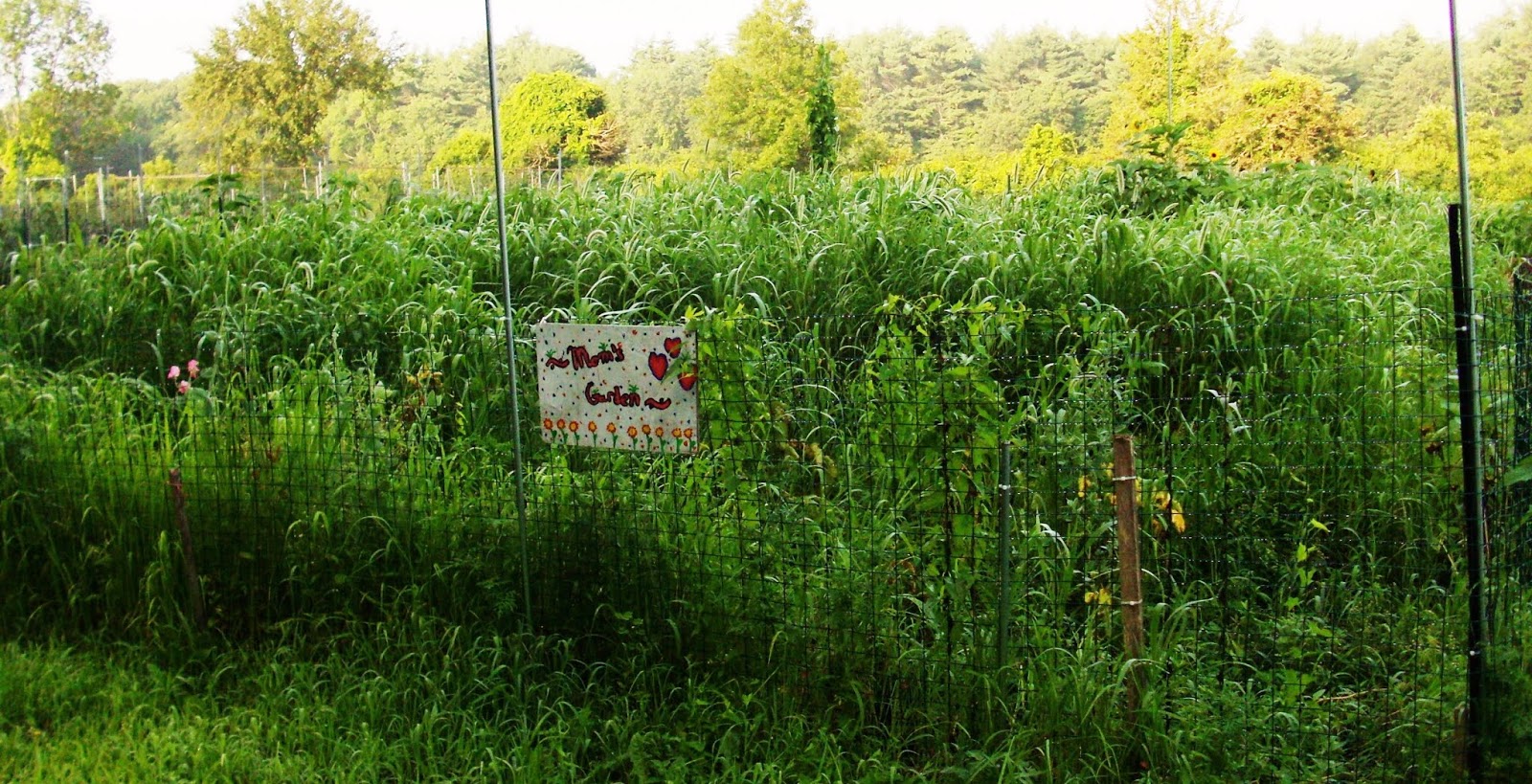
... others were abandoned, like 
'Mom's Garden' from 2009
When we took over, our number one goal was to keep all the plots filled.  Six hundred square feet of fertile topsoil will grow a lot of weeds in just a few weeks; and an abandoned plot will quickly spread its weed seeds to its neighbors.  Our solution to keeping the garden populated was to a) drum up a lot of interest in the garden to ensure each plot was filled at the beginning of every season; b) encourage gardeners to hang in, even if things didn’t go perfectly (and, the corollary to that solution of not doing things that would cause gardeners to leave); and c) have a wait list in the wings for the inevitable mid-season dropouts.

Each year, Betty does
a gardening presentation
Having nominally mastered the art of running a garden, we (and, by ‘we’, I mean Betty) turned our attention to educating gardeners and upgrading the garden’s practices.  Every March, Betty gives a well-attended vegetable gardening talk at our town library.  A steady stream of emailed educational materials (including soil test results and an explanation of how to read them) goes out to plot holders, and even simple queries receive serious responses. 

With the support of Medfield’s Conservation Commission (which oversees the town land upon which the garden is located), we banished pesticides, herbicides, and smoking.  We began sub-dividing plots to give gardeners a choice of size.  We required fencing and well-maintained paths.  The garden grew by nearly half, to 70 plots on a full acre of rich land; 30 of those plots 300 square feet in size and 40 of them the full 600 square feet. We went no-till when it became apparent our annual plowing of the garden disrupted the soil food web underneath.

Despite its claims to the contrary,
scientists were increasingly
questioning plastic mulch's effect
on the food soil web
As a Lifetime Master Gardener and avid horticulturalist, Betty regularly attends talks by people who are at the cutting of gardening science.  By last year, what was once a murmur that perhaps ‘plastic mulch’ (rows of plastic matting laid down over fields to warm the soil and prevent weeds) had significant downsides, had become a rising, though hardly universal, chorus of concern.  Betty read the studies, and reached a logical conclusion: there is nothing a plastic mulch can do that an organic mulch cannot do, and there are truly important things (like break down into humus and ultimately new soil) organic mulches can do that plastic ones cannot.

We decided to implement a ‘no plastic mulch’ policy effective with the 2020 gardening season.  It would affect perhaps four gardeners who had laid down plastic over their entire plot in 2019, and another twenty or so who lay down plastic sheets between raised rows.  On March 29, the date we opened the garden after staking it, we sent an email to everyone in the garden giving our reasons for the new policy. To those gardeners who questioned why we were making the change, we explained and they said, ‘OK, we understand’.

Seven days later, I was walking the garden when I was stopped in my tracks by a garden partially cloaked in plastic sheets, with additionally rolls of matting waiting to go down.  I went home and wrote the gardener – I’ll use the gender-neutral name ‘Reilly’.  I politely pointed out the earlier memo.  The following afternoon, Reilly responded at length, starting with the observation that this was “an awfully silly thing to quibble about during a global pandemic.”  The gardener went onto say, “there is ample science supporting the beneficial use of landscape fabric.”

There are two things I know with certainty.  The first is that, on any controversial topic, the first page of Google results – including the ones that don’t say ‘ad’ – have been bought and paid for by organizations with deep pockets, a vested financial interest, and an ability to ‘game’ Google’s ranking algorithm.  The second thing I know is that there is no upside in picking fights with my fellow gardeners.  As self-appointed 'Garden Ogre', my management policy is to ‘nudge’ gardeners into doing the right thing; not make enemies of them.  I agreed with Reilly on a few points and offered praised for having had the foresight to purchase a better grade of plastic mulch.  But, I stressed, the policy is the policy. No plastic sheets. Please remove them.

Reilly responded with an even longer missive, ending with the statement, “I intend to leave my ground covering down.”  That’s when I went to Medfield’s Conservation Commissioner, Leslee Willetts, and said, “This is above Betty’s and my pay grade.”

On April 12, the scientific journal Global Change Biology published the blockbuster results of a peer-reviewed study on plastic mulch, concluding its use boosted yields for a single season, then became injurious to the soil and crops grown in it; all the while doing long-term damage to that soil food web.  Concurrent with the publication of the study, China – hardly an enlightened paragon of environmental practices – set in motion laws to outlaw the use of plastic mulch.

Ultimately, Reilly asked for and, last Thursday got, a hearing (held via Zoom) before the Conservation Commission. Reilly came prepared with a PowerPoint presentation.  I responded with abstracts of several peer-reviewed studies and said Reilly was ‘flat wrong on the science’.  The Commission voted unanimously to uphold the ban on plastic mulch.

Reilly then shifted gears and asked for a hardship exemption for this season, stating it had taken Reilly’s family all day to put in the fence and plastic sheets, the garden was now growing and well established, taking out the plastic was impossible at this late date, and Reilly’s family was uneasy about going out in a Covid-19 world for such a task.  Reilly’s plea swayed three commissioners.  The plastic would stay down for this season.

The photo I wish I had at the
Commission meeting
The next day, I went to the Community Garden and took photos of Reilly’s plot – something I did not think to do before the Commission meeting.  There are no thriving plants.  I could have taken out the plastic sheeting in a morning without disturbing the site.  If there were sprouted seeds, they were likely killed by Saturday night’s hard freeze.

But Reilly’s plastic will stay for this season.  Betty and I won the larger battle – a ban on plastic mulch.  It will not make me alter my management style; I’ll continue to change behavior by nudging, not by wielding a sledgehammer.  But it was a learning experience that will stay with me for a very long time: the world is full of people like Reilly who choose to follow only those rules that do not inconvenience them.

April 28, 2020

Wanted: A Dozen Warm Spring Days in May

It's the end of April and the soil
temperature is still just 50 degrees

Never have so many wanted or needed something so much.  And never has the weather been so uncooperative.

The Medfield Community Garden formally opened on April 1 and, by April 3 more than half of the 70 gardens had fences.  By April 10, many gardens showed stakes and strings inside; strong evidence seeds for ‘cool weather’ vegetables had been planted.

Then, the heavens opened up and the temperature plunged.  On April 23, it snowed.  Yesterday, it rained.  All day.  The radar map showed a blob of dark green over eastern New England that slowly rotated counter-clockwise, sucking in an unending supply of moisture from the Atlantic.  The high yesterday was 46 degrees, which was also the low, and which was also the ocean temperature.

Wood chips make paths
passable and keep down
weeds.
Two weeks ago, we ran out of wood chips to create paths around the garden.  Medfield’s Department of Public Works has more chips than it knows what to do with because of all the trees that have come down in the parade of nor’easters that buffeted the region with winds north of 60 miles per hour.  For days, my contact at the DPW apologized that the town couldn’t deliver those chips because they feared making ruts in the sod around the garden.  Then over the weekend (and amid a driving rain) a load of chips appeared. And, yes, with the load came heavy-equipment tire impressions that will be with us for weeks to come.

Unending rain and cool
temps well into May
It isn’t just the rain that is unseasonable.  After a winter with well-above-average temperatures, southern New England now finds itself on the wrong side of the jet stream.  Nighttime temperatures have routinely dropped close to – or even below – freezing.  The soil temperature was a chilly 50 degrees on Sunday, and the 15-day forecast shows just five days when the daytime highs get to 60 degrees or better, and 11 days when overnight temperatures will be in the upper 30s or lower 40s.  This does not bode well for home-grown lettuce or spinach.

I do not complain for myself.  Betty has been growing vegetables in New England since 1974 (when I first helped turn over the soil behind her apartment in Lenox).  We planted our first garden in Medfield in 1980.  We know some seasons are doomed to mediocrity (or outright failure) by flukes of nature, while other years yield bonanza supplies from any seed you drop on the ground.

This year, though, is different.  We have 77 families in our little acre.  Of those families, 16 are new and the number one reason they signed up was COVID-19.  The garden ensures food.  The garden provides the perfect reason to be outdoors when state and local health organizations are repeating a mantra of ‘shelter in place’.  The garden provides an opportunity to socialize at a safe distance.

New England will stay cool, but I
want gardens to grow lush with
vegetables
I want those new gardeners to have a great season.  I want them to have terrific yields of adventurous crops.  To that end, I’ve supplied fencing and stakes to gardeners who found there was none to be had at stores.  Betty is making certain everyone knows what is safe to plant and what is not (there is a special section of hell reserved for the decision-making folks at Home Depot who put out annuals and vegetables sets that are a full month or more ahead of the season).

In other words, while I care about the success of the garden in any year (to volunteer to manage one for a decade with any other motivation would be weird in the extreme), this quarantine spring of 2020 carries a special onus.  I feel I’m helping people get through this, and I’m certain Betty’s sentiments echo my own.

April 12, 2020

Garden Therapy


Though I was not present at the meeting, apparently sometime toward the end of March, Medfield’s Covid-19 Response Committee discussed which additional community activities (in addition to schools, libraries, restaurants, etc.) could or should be discontinued in order to discourage unnecessary public gatherings.

A returning gardener
carries in her plot's
'mascot' - a terra cotta
pig
The Community Garden was one of the ‘group activities’ up for consideration.

I would not have known this except a town employee forwarded a copy of an internal email noting the Community Garden had been spared, and permitted to go forward on schedule.   A few days later, in one of my periodic ‘updates’ to the 75 families who have plots in the garden, I mentioned the decision in passing.

The response from gardeners was swift and vocal.  The most memorable one came from a wonderful lady whom I think of as giving the garden a certain ‘classiness’.  She is always in a good mood; she maintains a glorious garden; and she dresses better than any gardener I have ever met.  Her response was as follows:

Betty dispenses gardening advice from
a socially responsible distance
So help me God, if they were to close the garden I would have a HUGE problem with that. The garden is my ONLY solace from home- schooling these animals, and my escape from the “office”.

The message concluded with a number of emojis, the exact translation of them I could not ascertain, but which appeared to threaten to visit some ancient Egyptian curse upon anyone who dared to mess with the status quo.

Betty and I have spent multiple hours the past few days at the Community Garden.  Betty answers questions (from a CDC-acceptable distance) about what it is safe to plant.  I introduce myself to the new gardeners (signup is via email) and explain why we recommend burying the bottom six inches of fences. 

It's too soon to plan anything but the
hardiest of crops, but everyone is
getting prepped
What we have received from gardeners is universal thanks.  Back in January and February, I was having trouble getting people to sign up for plots.  After the ‘shelter in place’ orders went out, demand exploded.  Not only were all plots filled; I had a wait list with eight names on it.  Everyone, it seems, is in need of some garden therapy.

A group of volunteers always stakes the garden at the end of March and we ask gardeners to have a fence up by the first weekend in May; a very reasonable four or five weeks to accomplish a task that provides ‘proof of gardening.’ Yet, in a ‘normal’ year, I have to don my Ogre costume to get people to meet the deadline.  This year, the first half dozen fences were in place the day after I put out a memo announcing that the garden was open.  Today (April 12) I counted just nine plots out of 70 that are not fenced, with the deadline still three weeks away. 

Everyone is working on fences
Granted, people have far more time on their hands in the spring of 2020 than in previous years, but there is also a palpable sense of pleasure on the faces of everyone I see.  Moreover, there is more courtesy.  For example, every year, I grit my teeth as I find many of the three-foot walkways between plots have been prepared just half the width; gardeners figured they were responsible for only ‘their’ half of the pathway.  This year, whoever does the path puts down cardboard or paper plus bark mulch for the full 36 inches.  Another example: we discourage gardeners who share a full plot (dividing each 20-foot-by-30-foot space into two 15-foot-by-20-foot ones) from dividing the plots with an internal fence (it wastes space and promotes weeds). Last year, perhaps four of the 15 gardens bore just a length of string or row of flowers to ‘suggest’ a demarcation.  This year, I’ve seen just three plots with interior fences.

Four plots are prepared
Most of all, I’ve seen gardeners luxuriating in having a legitimate and ‘responsible’ reason to be outdoors.  There were 15 cars at the garden this afternoon.  A few had back ends bulging with fencing or stakes, but most people were there just to find something to do in their plots.  They were building raised beds, marking out rows, and creating obelisks on which peas will grow this summer.  Betty warned everyone soil temperatures are still in the 40’s, meaning it is too early to plant anything except the hardiest of ‘cool weather’ vegetables (spinach, onions).    Yet, people were hoeing or on their hands and knees as if a heat wave was expected, rather than the two days of cold rain forecast for early this coming week.

This is the earliest we've been busy.
Usually, early April is very quiet.
Had the garden been ‘disallowed’ because of coronavirus concerns, I could have made all the valid arguments in favor of reversing the decision (chief among them that opportunistic weeds would have swallowed the garden by the end of May), but the likelihood I would have prevailed was slim.  As a nation, we are trying to flatten the curve of a pandemic.

But, for 75 Medfield families, we are providing the best kind of therapy.  We’re offering hope.  I suspect the bins we put out to aid the town’s Food Cupboard will overflow this season.  I have a feeling disagreements will be settled amicably and (fingers crossed) vines may even stay inside fences come August.
 
I predict people will wave greetings to one another from their respective plots until it is once again safe to offer a hug.  In short, I think it’s going to be a great season for the Community Garden.

April 8, 2020

Thank Goodness for Gardening


March 2020 may go down as the month that gardening saved my sanity.

A month that began with such promise went sideways with a speed and whip-lash-inducing severity that, in my memory, is unprecedented.  No, I didn’t test positive for Covid-19; but more than a dozen speaking engagements as close as my town library and as far away as South Carolina, Florida, Illinois and Missouri fell like dominoes and evaporated out of ‘an abundance of caution’.  It wasn't fair; I had a new book to talk about and people to entertain.  I confess to having fallen into a funk that no amount of binge-watching Cheers reruns could cure.

Ten days into the month, Betty appeared in the bedroom that serves as my office (where I was, of course, immersing myself in contagion statistics).  She had a rake in her hand.  “Stand up, Mister Gloom and Doom,” she said.  “I would like you to help me clean up the garden.”

Betty had the kind of look of her face that said the use of the words, ‘would like’, was not intended to be taken at face value.  This was a command, and was to be obeyed now.

I found crocus along the sidewalk
I rose from my chair and, for the next three days, we pulled a winter’s worth of leaves out from under shrubs.  I mended a stone wall.  We cut back the four-inch stubble on perennials, and carefully trimmed out broken branches.  And, along the way, I found dicentra already leafing out; awaiting only the removal of six inches of oak leaves to start on their early spring flowering.  Daffodil greens were three inches high and, where there was bright sunlight, heads were forming.

The aconite planted last fall bloomed
I removed a mulch of pine needles and discovered a small forest of greens that meant the winter aconite bulbs we planted in October were going to bloom.  Off our patio, a clutch of hellebores had probably been in bloom since February, but were under so many leaves, I had forgotten they were there.  When I carefully pulled off leaves and pine needles by hand, I found myself with a pink and white reward.  Those small signs lifted my spirits more than I can express in words. 

It was not all ‘rake and discover’.  Cleaning the garden also meant hours on my knees pulling out thousands of inch-tall pine seedlings and a nasty green weed with world domination hard-wired into its DNA. 

The garden was staked and fences
bloomed immeiately
Then, the sun warmed the soil and, a week later, miracle of miracles, we had crocus by the hundreds.  My spirits had done a 180.  I was looking forward to working in the garden. 

On a Friday toward the end of the month – when the temperature rose into the mid-40s and no rain was in the forecast - we gathered a group of intrepid volunteers and put down 220 stakes to mark our town’s Community Garden.  The next day, we put up our fence – or at least tried to.  A cold, nasty wind whipped up and drove us indoors.  But we will be back out.  We have to: the garlic is already three or four inches high and will be fodder for deer if we don’t protect it.

The hellebores were there all along
Perhaps the rejuvenation of my spirits has some kind of cosmic, Karma-like reverberation.  One morning in late March, an email appeared in my in-box.  The garden club convention in Missouri I was to speak to in early May was one of the first to cancel the event at the beginning of March.  But they were now planning their 2021 event.  Everyone had been looking forward to my talk.  Might I be available the first week of May a year from now? 
Of course I could; and I wrote them back immediately.  No sooner that that email was posted, my phone rang.  The group in Illinois was cancelling my talk, also scheduled for May, but was anxious to know if I could be re-booked for the same date in 2021.

I write this looking out my office window.  A few weeks ago, I saw only missed opportunities I thought would never come again, and contagion as far as the eye could see.  Now, I focus on the mass of yellow, white and blue crocuses and aconite.  And I know we will all get through this.