June 3, 2024

May Turns to June, and Purple Reigns

The garden at 26 Pine Street, June 1, 2024
double-click on any image for a slide show.
When Betty began planning our new garden in 2015, she focused principally on trees and shrubs. It was a logical decision because those elements provide the 'structure' that anchors the property. It isn't that perennials, groundcovers, and bulbs weren't important; it's more the reality that, until Cladrastis kentuckyea (yellowwood), the right Chionanthus virginicus (fringetree) and the rest of the their horticultural brethren were on site and had been planted, everything else was going to be consigned to the sidelines. There was also the matter that Betty wanted to be able to imagine the garden as it would be viewed from inside our new home.

The same garden nine years ago.
Amazingly, by July (three months after we moved in), and as the photo at right attests, ten specimen trees and roughly 40 shrubs were in the ground (and a 500-count bottle of Ibuprofen had been consumed).  Betty then turned her thoughts to groundcovers and perennials. With the benefit of nine years of hindsight, what she accomplished is nothing short of miraculous. The garden is now approaching maturity, with weekly revelations of what a combination of long-term thinking, meticulous planning and luck can provide.

The view from the library
I start with the sight that greeted us for two weeks in mid- and late May as we gazed out of our library windows and front door. My memory is that we looked at more than half a dozen dogwoods. Betty checked for crossing branches, general vigor, and any indication of disease or abuse. She was also looking for a pink-flowering Cornus florida. Why pink? All I know is, she was adamant. But, here it is. It was a stunning sight, made all the more alluring because its color was echoed by multiple specimens of Dicentra (bleeding heart).

The view from the back porch
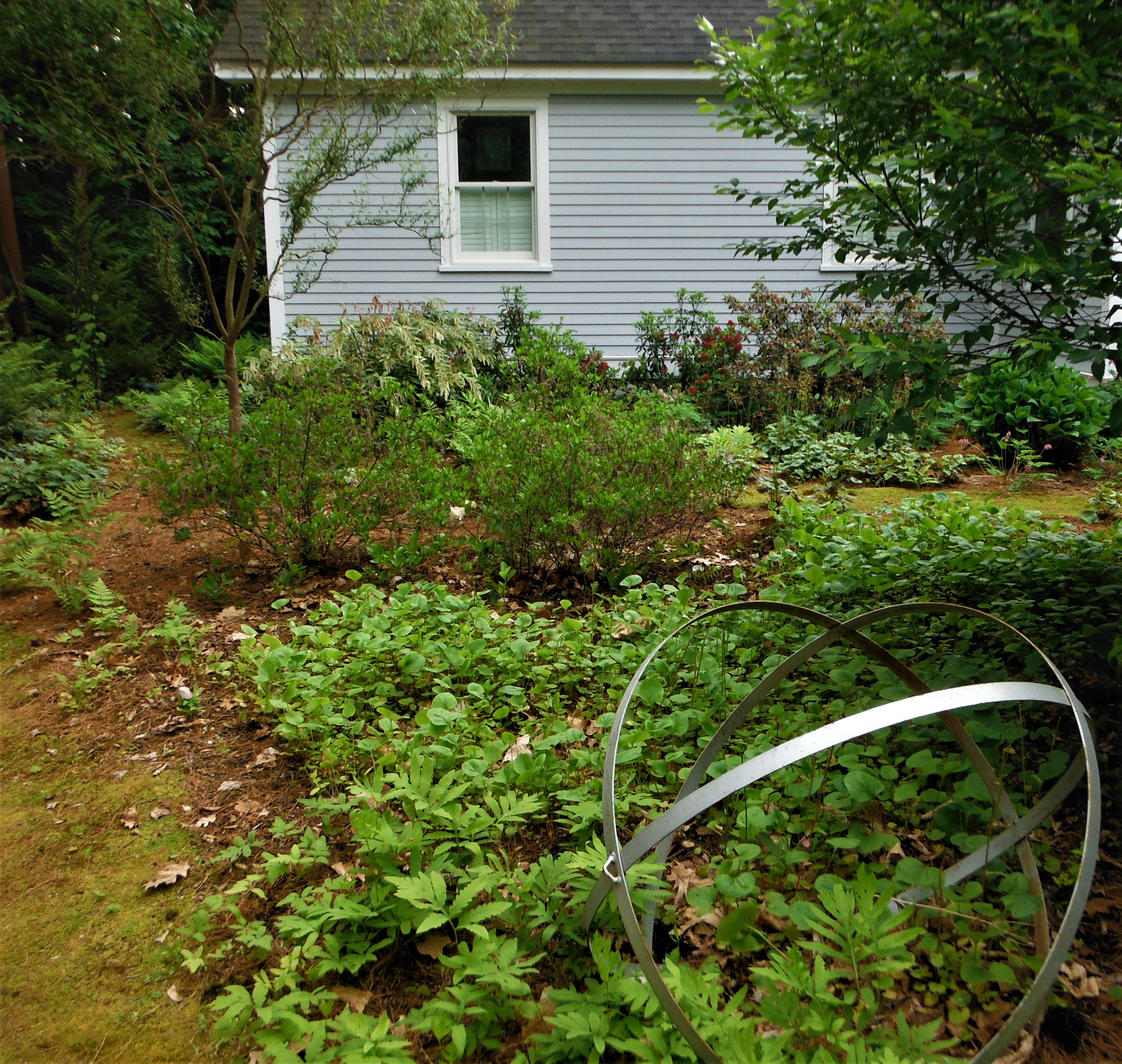
The view out of the back of the house is no less important. Because we chose to place our new home some 30 feet farther back that its predecessor (both for added privacy and to have a larger front garden), we have just 50 feet or so of 'cultivatable' land before we run afoul of our town's Conservation Commission restrictions. Betty wanted to preserve the view into the mixed pine and oak forest behind our home, while creating visually interesting vignettes nearby that change with the season.  Chamaecyparis 'Snow' is a remarkable shrub that shifts its color accents across the year while providing a predator-proof habitat for birds. Viburnum 'Winterthur' is a month away from flowering, but already is showing great texture and color. The purple-blooming perennial is Thalictrum aquilegifolium, better known as meadow rue.

In the front garden, Allium (not a native) offers purple umbels on tall stalks. The blue/purple blooming perennial in front is a native salvia, procured like many of our perennials from the Grow Native Massachusetts plant sale. Alas, the tag identifying the cultivar is nowhere to be found. At the back of the photo is our magnificent Cercis canadensis 'Burgundy Hearts'. Its deep purple leaves will remain that color until nighttime temperatures fail to fall below 70 degrees - likely some time in August.

That's a quick look at the garden. Check back in a few weeks to see summer begin unfolding on Pine Street.


May 7, 2024

The Spring of 2024 at 26 Pine Street

The winter of 2023-2024 was fairly well non-existent in eastern Massachusetts. There was rain - lots of rain - but not a single plowable snowfall in Medfield, the town Betty and I have called home for the past quarter century. There were  nor'easters that brought near-hurricane-force winds to the region, but the ponds never froze. As a result, we lost no trees or shrubs; the perennials did not get heaved out of the ground. In this, the first full week of May, the garden is a sea of new green with bursts of color from all the usual suspects. Please double-click on any photo to get a full-screen slideshow of the garden.

Sometimes, though, words get in the way of things. Rather than wax poetic, I'd like to let the garden speak for itself.  Let me start with the first tree to bloom. This is Amelanchier 'Autumn Brilliance'. It was, if memory serves correctly, the first tree to be planted on the property in June 2015. It wasn't so much an honor bestowed as a practical reality: Betty and I were still driving from nursery to nursery looking for 'the right' specimens. Weston Nurseries had exactly the Amelanchier in stock we wanted and so we brought it home and dug a hole in what we hoped would be the right place.

Our Amelanchier's bloom is brief. This photo shows it at its peak on April 23.  Two weeks later, the leaves have eclipsed the blooms.

Magnolia 'Elizabeth' bloomed right behind the Amelanchier. It us a glorious shade of yellow and it fairly glows.  This photo is from April 30 and shows the tree at or near its peak. 'Elizabeth' is supposed to get to roughly 25 feet in height and then stop.  By my estimate, it has reached its mature status.  The tree is still in bloom, but much of its earliest flowers have dropped to the ground. In another week it will be all green - though still a lovely tree.

New England wouldn't be New England without azaleas and rhododendron (the latter is technically a subset of the former). We have multiple specimens, but it is Azalea 'Weston's Aglo' that beats all the others to display the first color. This pair are readily visible from our library. In the photo at left, Magnolia 'Elizabeth' stands at peak glory in the background. There are other azaleas and rhododendron dotted around the property. They'll bloom as late as mid-June.

Fothergilla is largely overlooked in garden design. Part of their lack of broad appeal is that their leaves are a dull green. The exception is 'Blue Shadow', which offers a much more attractive leaf color. But, for a few weeks in May, all Fothergilla have a stunning white brush-like flower. Some are round balls; F Blue Shadow's bloom looks like a bottle brush straight out of a Williams Sonoma catalog. We have three groups of three on the property; one of which is shown in the left third of the adjacent photo.
Which brings us to Cornus florida, the American dogwood. It was only today, May 7, that ours burst out in its full glory.  Cornus florida has a bad rap: that it is disease prone, specifically anthracnose which can kill the tree. Cornus kousa, the Korean  variant, is considered immune to the disease.  The solution, though, isn't to abandon the native version. Rather, it is to give Cornus florida an open space to ensure adequate air flow. 
Why does it matter? Because our native birds can eat the small, thin-skilled fruit of the native tree. The large, rubbery-skinned Korean fruit falls to the ground and rots.
There are other, less grand  blooms around the property. For example, the Tiarellas are in bloom.  Betty acquired 120 Tiarellas and Heucheras in a sharp deal at the 2015 Boston Flower & Garden Show; taking them off the hands of an exhibitor for the price of the plugs - one dollar each.  Three months later, having pampered the plants with daily excursions into the sun, we placed them all over the property.  What you see at the right, blooming white, are maybe ten of those Tiarella, interspersed with ginger as a foundation planting for our garage.
Finally, we are endeavoring to use as many native groundcovers as possible to eliminate the need for grass. At the front of our property there's a growing expanse of Arctostaphylos uva-ursi, otherwise known as bearberry. It's a terrific groundcover, but its bloom is what is called 'insignificant'... a flower you need a magnifying glass to see. Not so Phlox stolonifera, shown at left. For about three weeks, it puts up a glorious blue flower spike. Then, the flower fades and the spike browns. We're left with a green mat of phlox that takes light foot traffic. What you see here started as three plugs back in 2015.  It's now about nine square feet and expanding at a rate of about two square feet a year.
That's how the garden looks this spring. Hope you enjoyed the visit!

April 11, 2024

Gloria Freitas-Steidinger

Some giants come in diminutive packages. I know because I was acquainted with one.

My enduring memory of Gloria Freitas-Steidinger is from late November of 2009. I was one of a handful of volunteers who were putting together an event called ‘The Festival of Trees’ for the Massachusetts Horticultural Society.  We had shamelessly copied the idea from a town fifty miles north of Mass Hort’s headquarters at the Elm Bank estate in Wellesley. The idea was ingenious: charge people a few dollars to come in and see beautifully decorated holiday trees, then sell them what amounted to lottery tickets for the opportunity to take home their favorite one.

Gloria and Paul unload her tree in 2009
To get entries, we entreated garden clubs across the region to bring in a tree and decorate it on site. We also went to businesses and asked for money for trees we would decorate. (Because Mass Hort’s coffers were bare, the organization could not contribute its own candidates.)

Gloria had promised us a tree but, as the ‘decorating day’ was drawing to a close, she was nowhere to be seen. A few clubs had sent last-minute regrets and we were scrambling to meet our goal of 30 trees for this first-time event. Then, a horse van appeared in the driveway of the building in which the Festival would be held.  Moments later, Gloria and her husband, Paul Steidinger, unloaded a stunning, fully decorated tree.

Gloria (right) with Ann Lange at
the 2013 Festival of Trees
We gave it a place of honor. It drew a mountain of tickets, stuffed in a box at the base of the tree.

My wife, Betty, already knew Gloria from what is politely called ‘the flower show world’, but which could be more accurately described as ‘the Judges Council Mafia’. Gloria was a force within that world, as well as an extraordinarily gifted and creative designer.

I would get to know Gloria better at later editions of the Festival of Trees, but our relationship

Gloria, on a ladder, creates
a miniature landscape
blossomed when I became Chairman of Blooms at the Boston Flower and Garden Show.  Gloria entered not only the amateur floral design competitions (and routinely won not just ‘Blues’, but also ‘Tri-Colors’ indicating hers was one of the best of the hundred-plus entries for the show). She also contributed entries for the ‘Miniature Gardens’ exhibits; one of the most challenging of all flower show activities because it entails creating a horticultural landscape within a box measuring approximately three feet on a side.

Unloading Gloria's car at the Boston
Flower & Garden Show in 2012
It was a pleasure to work with Gloria – even to unload her car at the Flower Show at 5:30 a.m. One of the reasons was that Gloria was a ranconteur extraordinaire.  The story on which she could, if she chose to, dine out on forever revolved around her presence in the White House during the government shutdown of 1995. Gloria was one of about a dozen designers chosen each year to decorate the many Christmas trees that grace the White House.

When the shutdown commenced on November 14, all federal employees were sent home. Because they were volunteers, Gloria and her cadre of decorators were allowed to remain.  President Bill Clinton remained because he lived there. And, because she was a lowly unpaid intern, so did a woman by the name of Monica Lewinsky. Gloria said she saw it all, and I believe her.

When I began writing ‘Murder in Negative Space’, I knew I needed to incorporate a Gloria-type character. I did so, but I also had the opportunity to give her a shout-out. As my amateur sleuth, Liz Phillips, attempts to help out a floral designer struggling with a ‘stretch design’ (one of the more difficult ones). Liz asks if the designer remembers a famous stretch design that won a Tri-Color at a show a few years earlier – a floral design that evoked a man pulling a dog on a leash. “The one by Gloria Freitas!” the woman exclaims.

Gloria gave me a kiss when she read that book. Many people have told me she carried a copy of it in her purse to show it off.

Gloria passed away in late March, just over a month before her 92nd birthday.  Her husband, Paul, pre-deceased her by six months. She was a lovely lady. gracious and kind to all. More than that, she was a firecracker; funny, witty, and possessed of an energy few people of her age possess. Her death leaves a hole in the garden club and floral design world.

February 6, 2024

Another February Morning, 46 Years Ago

Forty-six years ago this morning, my wife and I started on a fantastic journey, which turned out to be a little more ‘unscheduled’ than we expected.  After living in Chicago for two years, I had accepted a job in New York City.  On the morning on February 5, Betty and I boarded a 7:30 flight at Chicago’s O’Hare Airport bound for New York LaGuardia.  Our flight time was supposed to be 90 minutes.  We were told there was ‘some snow’ in the New York area but that we should arrive on time at 10 a.m.  We carried four large suitcases plus two carry-ons with us (this was before airlines discovered they could mint money by charging for such things).

The Blizzard of '78 shut down the
Northeast for more than a week
At a few minutes before ten, we were circling LaGuardia and the ‘some snow’ was getting much more serious.  At one point we were told we were next in line to land.  Then, after half an hour of circling, the announcement came that LaGuardia had just closed due to weather conditions and that we would be diverted to Bradley Field north of Hartford.

We landed at Hartford in blinding snow, the last plane to do so before that airport, too, was closed.  Our airline (I believe it was American) gave passengers the option of being taken by bus the fifty miles to New Haven where we could get the train for New York, or being put up ‘overnight’ at a hotel near the airport.

Betty grew up in the Finger Lakes of New York state, the land of ‘lake effect’ snow that can drop two feet of the stuff overnight.  She took a look at the snow and said, “We can do this.”  At noon, thirty intrepid passengers stowed their luggage on the bus and we headed south.

Double-click to see snowfall
totals - we landed right in the
thick of the thing.
Fifteen miles south of Hartford in swiftly deteriorating conditions, our bus skidded off the road and – very fortunately – into a guard rail.  It was fortunate because the guard rail was all that stood between us a steep ravine.  The bus could go no further.  Miraculously, another bus was dispatched, picked us up, and we slowly made out way down to New Haven.

It took three hours to reach New Haven and we feared we had missed the last New-York-bound train.  But there were people on the platform and so we lugged our many suitcases and waited.  A few minutes later, an Amtrak train pulled in.  It was now 4 p.m.  The train had left Boston at 6 a.m.  and would, as it turned out, the only train to make the trek that day.  Had we been a few minutes later, we would have been stranded in New Haven for the duration.

Note the fifth bullet...
There were no seats on the train; we sat on our luggage in one of the passenger compartments.  But at least we were inside the train.  Most of those who boarded at New Haven spent the next several hours in the unheated vestibule between cars.  Pushing snow in front of it, the train made it to Penn Station at about 8 p.m.

I had done one intelligent thing that day.  At Bradley Field, I had called my employer’s Manhattan office and pleaded for someone to walk over to the Statler Hilton and pay for our room, get a key, and leave it with the concierge.

It turned out to be a prescient move.  We arrived to a city that had shut down, stranding tens of thousands of travelers and commuters in the city.  Seventh Avenue was covered with two feet of snow and almost nothing moving.  A porter helped get our suitcases across the street to the hotel where we found a mob of people occupying every square foot of sleep-able surface.  I went the concierge desk and held my breath.

A minute later, I held up the key for Betty to see.  Twelve hours after we left Chicago, we were finally in New York.
* * * * *
This is what we saw when we
got off the subway in Brooklyn
The blizzard turned out to be a fortunate event for us.  While the city was paralyzed, the subways were running on the subterranean part of their routes.  Two days after our arrival, a Realtor met us in Boerum Hill in Brooklyn. “If you can get here, I’ll show you houses,” she told us.  We emerged from the subway to a landscape of unplowed streets, with a police car – immobilized up to its windows in snow – blocking an intersection.  A bus sat abandoned in snow drifts in front of the brownstone we were there to see.

It was the house we had looked for in vain in Chicago.  Betty and I squeezed one another’s hand so tightly I nearly broke her fingers.  We made an offer that day, counter-offered over dinner that evening at the then-newly-opened River CafĂ©, and had our offer accepted over dessert.

211 Bergen Street in Boerum Hill.
We planted that tree in front, at left.
That was 40 years ago.  It was a time before cell phones, the internet or reliable forecasts.  Today, of course, everyone knows to stay home .  Passengers on the 7:30 flight from Chicago to New York are called the night before and told their flight has been cancelled and they have been re-booked for Thursday.  In short, apart from ones based on stupidity, there are a lot fewer ‘blizzard stories’ today.

But I wouldn’t have had it any other way.  It was an adventure – albeit a harrowing one at the time.  We got through it and we found the house of our dreams, made possible in large part by our perseverance.

February 1, 2024

Fifty Years Ago, Today

 The passage of time throws a haze over most of our adult lives.  Months blend into years that are smoothed into decades.  Can you say with any certainty what you did on your birthday in, say, 1997?  Unless it was the date of the birth of a child or some other such milestone, can you recall what you did on a specific date two or three decades ago?

What was going on in the world on that
fateful day. Double-click to see details.
With enough research I can approximate where I was and what I was doing during a given month of a year; I went somewhere on vacation or completed a project for work.  A newspaper headline might jog a memory.  For me, though, as for most people, our adult lives are a continuum; a blur.

I can, however, remember one day with perfect clarity.  That date is Friday, February 1, 1974.

GE's Schenectady Works on its heyday
For me, the year 1974 did not start off auspiciously.  I had been out of college nearly three years and I was spending my second winter in Schenectady, New York.  I had gone to work for General Electric in a management training program with the promise that, after a year in North Carolina, I would be transferred to an office in San Jose, California.  That promise was turning out to be hollow.  Moreover, I discovered that the branch of GE that was my employer was a stagnant backwater and that my skill set was ones that the company valued only as an afterthought.

My goal upon graduation from college had been to get as far away from Florida – the state of my birth and the place I had ever known – as possible.  At least on that score, I had succeeded.  However, in the middle of yet another upstate New York winter, my plan was looking increasingly ill-thought-out.  Mostly, though, the year was starting off poorly because I was alone.  Apart from a few friends at work, I had no one in my life.

80 Wolf Road, Colonie, NY
On the morning of February 1, my attendance was required at what was called a ‘section meeting’ in Colonie, where my office had recently moved from the massive Schenectady Works.  There, the sixty or so of us who could not find an excuse to be somewhere else got to hear about the importance of filling out time sheets and filing weekly activity reports.  A subsection manager delivered a half-hour talk outlining an exciting (to him) new business opportunity.

Then, at about 10 a.m., a small group of people joined the meeting.  They were from an office in Pittsfield, Massachusetts, some 40 miles distant.  I would not have noticed their arrival except that they were forced to sit in the front of the room (I was ensconced in my preferred spot in the back row) and that one of the group’s number was a striking looking blonde. 

For the next two hours I did little but look at her (well, at the back of her head and shoulders) and wonder who she was.  The meeting broke up shortly after noon and she was one of the first people out of the room.  My heart sank.  Then, I found her sitting in the lobby.  She was waiting for her ride back to Pittsfield. 

She said that her name was Betty Burgess and that she had been late because she had been at a Bob Dylan concert at Madison Square Garden the previous evening and had returned to Pittsfield with an empty gas tank (courtesy of a now-four-month-old Arab oil embargo, this was an era of odd/even gas rationing).  Her smile was radiant.  She was intelligent and funny; knowledgeable and quick.  I asked if she could excuse me for a minute, but that I would be right back.

I went back to my cubicle and pulled out my copy of the employee phone directory.  There she was.  And, in the grand, sexist tradition of GE and of the era, employee names bore one of three prefixes: ‘Mr.’, ‘Mrs.’ and ‘Miss’.  Betty Burgess was a ‘Miss’.

I was back in the lobby in seconds.  She was still there, though she was gathering her coat and briefcase for the trip back.  I gathered every ounce of courage I could muster and asked the dumbest question I had ever put to a member of the opposite sex in my life: “Are you dateable?”

Eleuthera, Bahamas, later that year
She paused for a moment and said ‘yes’.

Two years and two weeks later, we were married.  Two weeks after our wedding, we escaped from General Electric and began a new life together.

That’s what happened 50 years ago today. 

It was the luckiest day of my life.

November 1, 2023

The 2023 Gardening Season Ends


The following letter went out to the members of the Medfield Community Garden today. I thought it was worth sharing...

Good morning, everyone,

The Medfield Community Garden officially closes today. This year, 81 families gardened on 75 plots, putting up with one of the rainiest seasons on record, yet harvesting gorgeous fruits, vegetables and flowers.

Our acre of land has always been called the ‘Community Garden’ but this year it truly proved to be a genuine ‘community’. Let us explain.

There was a time when the town pretty much did everything for us. We applied for a plot and paid our fees to a town employee. We came to the garden on the first of April to find it newly harrowed, staked, and ready to plant - all done by town employees. Piles of wood chips appeared and a town tractor sporadically mowed the perimeter. There were just 40 plots.

Beginning in 2010, we began fending for ourselves. This year, twelve volunteers braved 40-degree weather and stiff winds to stake the garden. Christian Donner and Eric Pender mowed the perimeter. Chris Hogan kept four lawnmowers (some operational, some kept for cannibalizing) in great condition. Allyn Hubbard maintained a fleet of wheelbarrows; perennially stalking the Transfer Station for wheels, axles, and other parts.

And, speaking of Allyn, he suffered a compound foot injury before the season began. In March he contacted us to say he was unlikely to be able to garden. We asked him not to be so hasty. By the end of April, volunteers had put up a fence, tilled, and planted a garden. Then, the garden was weeded and regularly harvested. When Allyn made his first appearance at the garden in June, he was rightly astonished.

We (Betty and Neal) had to step back from food cupboard duties this season due to out-of-town commitments. Cathy Summa stepped in, giving up what we suspect was a substantial part of her sabbatical year, to make the operation work flawlessly. ‘Flawlessly’ means putting out wheelbarrows, sweeping for produce as many as four days a week, and making either one or two deliveries to food pantries. Assisting (and sometimes substituting for) Cathy were a cadre of volunteers, chief among them Hy Greenbaum and Jeanne Hill. If there is a ‘Rookie of the Year’ award for food cupboard service, it is first-year gardener Ellen Vigoda, who threw herself into the project. Dina Russell not only gave generously from her own plot, she also planted and harvested from a half-plot given up early in the season. Edmund Prescottano, Mary McCarthy and Heather Cochran gave weekly. Other regular contributors were Lena Stonkevitch and Rob Doe (who also asked their plot be picked when they could not be at the garden on collection days). Susan Perry, Jennifer Hern, Chris Hillenmeyer, Yulin Liu, Lauren Bietelspacher, Mary Ann Vann, Kim Catlin, and Lisa Wood all deserve thanks for their generous, regular contributions.

As the season closed, Barbara and John Collins, and Yulin Liu volunteered their trucks and, more importantly, their Saturday mornings, to make it possible for all of us to more easily get our garden detritus to the Transfer Station.

There were many other acts of kindness – large and small – throughout the season; and many touching, personal stories told to us by members who told us why gardened. Suffice it to say we are proud be able to say we ‘oversee’ this garden. In reality, though, what we do is to empower so many others in the Community Garden to grow – in every sense of the word.

See you in 2024,

Betty and Neal Sanders

Co-managers, Medfield Community Garden

August 25, 2023

The Peril of Perennial Ageratum

One of the most memorable of the original ‘Star Trek’ episodes involves an itinerant space peddler who barters for an alcoholic beverage with a small, fluffy creature called a Tribble, the likes of which no one had ever seen before. The Tribble likes to be stroked; it coos and makes people feel good; perhaps too good. The Tribble’s chief downside is that is fecund to a fault. In the words, of Dr. McCoy, “Jim, as near as I can tell, these things are born pregnant.” Tribbles soon overrun the space station and threaten a shipment of a valuable grain seed stock. I won’t spoil the plot, but at the end of the episode the Tribbles are dispatched to a Klingon war ship.

Perennial ageratum
I was thinking about that episode yesterday as I spent the better part of an hour getting rid of my own Tribbles; specifically, pulling out patches of Conoclinium coelestinum, better known as perennial ageratum, from my garden. Thus far I have filled two, 50-gallon cloth barrels with the nasty stuff. I suspect my work is not yet done.

'Good' Ageratum houstonianum
A quick tutorial: Ageratum houstonianum, as anyone who grows summer annuals knows, is a wonderful filler plant for containers and a great ‘boots and socks’ border for beds. It has a lovely, bluish-purple flower than draws the eye. Alas, it dies with the first frost. It is a wonderfully well-behaved annual, prized for that unusual color. I can recommend it unconditionally.

Note the area circled in blue:
the perennial ageratum was
half the height of the Fothergilla
'Blue Shadow'
Now, let’s talk about perennial ageratum. While both it and its annual namesake are members of the aster family, their only common attribute is their similar-colored flower. Conoclinium is anything but well-behaved. It spreads by rhizomes; it spreads by flower seeds. It may even spread by word of mouth. But, once it is in your garden, controlling it is a full-time job come the end of summer.

To the best of my knowledge, neither Betty nor I have ever purchased a pot of perennial ageratum, yet this August it is everywhere in the garden. It is crowding out our beautiful Astilbe, upstaging our Fothergilla, and colonizing a bed of spring bulbs that, without human intervention, would be suffocated by a mat of roots. How did it get here? Maybe an itinerant peddler traded a sprig if it to one of our neighbors for an alcoholic beverage.

This false strawberry ground cover was
engulfed by perennial ageratum. Time 
will tell if I got it all.
What I do know is it has to go. But the Conoclinium has its own plan. Pulling it out is a piece of cake: it appears to come out with its roots intact. But, if you pull out a stand and then sift the soil, you’ll find pieces of roots and rhizomes cleverly left behind. I found that out because I thought I had completely eradicated perennial ageratum from the top of our driveway bed. Three weeks later, there were hundreds of replacement stalk coming into flower. (The plant apparently thrives in rain, of which we have more than our share.)  Now, whenever I remove a patch of Conoclinium, I immediately also dig around in the surrounding soil to see what may have been left behind. I am seldom disappointed.

Note the perennial ageratum
(circled in blue) hiding in
the Rudbeckia goldstrum
What is worse, the more I look, the more of it I find. The plant loves the sun. It also thrives in deep shade. It had insinuated itself in a bed of Potentilla indica (false strawberry) where it was keeping a low profile, as well as in a clump of just-past-bloom Clethra alnifolia (summersweet), where it had stretched to a height of four feet. Perennial ageratum is an ambitious interloper.

As of yesterday, I believe I have, at least for the moment, gotten it under control.  Which is, of course, a foolish statement. We’ve had two inches of rain in the past 24 hours. I know darned well the perennial ageratum is using the time to take stock of where its remaining troops are recovering. Reinforcements will be called in, perhaps from neighboring properties. I don’t know exactly when this war was declared. What’s more unsettling is that I don’t know if I’m winning or losing.

June 25, 2023

A Late June Walk in the Garden

 Sleep. Creep. Leap.

The garden at 26 Pine Street, June 2023.
Double-click for the slideshow.
Those are the words all gardeners learn to live by. You put something in the ground. You pamper it, water it, weed it, and keep it free of disease and interlopers. And, in return, you get… nothing (at least for that first year and, sometimes, for two or three years).  Everything is going on below ground: your plant/tree/shrub is establishing roots. It is exploring its surroundings. It doesn’t care that you want instant gratification. Ultimately, you accept that, at least above the soil line, that thing you planted is sleeping.

Itea 'Little Henry' in full
flower. Three shrubs have
merged into a single mass
Then, after a few years, you see the tangible growth. Your frustration eases – except that you wish you could get more flowers/branches/fruit. Your precious plant is ‘creeping’.

Finally, one spring morning you come out and find you can’t believe your eyes. That scrawny plant is now gorgeous. The awkward teenager has come of age. It flowers in profusion, its branches are sturdy, and its fruits hang heavy. You know all those years of pampering have paid off.  You are proud as punch.

The garden at 26 Pine Street has reached, if not full maturity, a grown-up status. Eight years after the first trees and shrubs were placed, they look as though they’ve always been there. Shrubs planted on three-foot centers with what seemed like yawning chasms between them are now a glorious, full-leafed mass. Trees that were slender saplings are twenty feet high and limbs are touching their neighbors.

The sidewalk's hard edges are
softened by border plants
Best of all are the surprises: the bluestone sidewalk’s edges are softened by geraniums and lavender. A dozen, bare-root asclepias ‘Hello Yellow’ milkweed plants that seemed doomed not to make it through their first year have multiplied to become a glorious colony, dense with flowers – and butterflies. An original plan to use metal borders and gravel for paths within the garden fell by the wayside when moss thrived where we walked. Today, those moss paths traverse the property; gloriously unplanned but far superior to the original concept.

Carolina lupine and asclepias
'Hello Yellow' milkweed
We have taken chances on ‘un-pedigreed’ plants and have been rewarded for being adventurous. Betty spotted Thermopsis villosa – Carolina lupine – at a Grow Native Massachusetts plant sale three years ago. We put it in the front of the garden where it would get full sun. It grew to an impressive seven feet with spikes of brilliant yellow flowers. We let some of the seed pods remain in the soil. This year, a dozen specimens form a brilliant cluster.

Moss walkways weren't part of the
original plan - they were a better idea
Betty was recently asked to give a talk about the garden at a convention in Michigan. Her sponsors made a request that her talk include ‘mistakes’. Betty and I put our heads together and made a list. We started with a reliable one: accepting gifts from friends. While Betty intended the garden to be nearly-all native, she graciously accepted an Asian interloper: a variegated Petasites japonica. It forms a lovely, visually arresting mound of green-and-white leaves. We placed it in a shady site adjacent to a clump of Podophyllum peltatum – Mayapples. All went well that first year. The next spring, we noted with pleasure the Mayapple’s range had almost doubled in size. The Petasites, however, had tripled in area, including a foray into the Mayapples.

Petasites. Now long gone,
and good riddance.
It took three years to completely dislodge the last vestige of the Petasites.

Another error – and it is one we have made with every garden we have had – is to not be sufficiently stern with what I call ‘the Cute Little Interlopers’; plants that hitch-hiked onto the property. At 26 Pine Street, the CILs are the violets. They emerge in early March and are quickly in flower… and almost as quickly in seed. My task each April and May is to grub out every trace of those violets; which by now have insinuated themselves with and intertwined their root into hundreds of ‘good’ plants.

Be wary of Packera aurea
The third mistake is to believe that all native plants are well-behaved. They are not. Exhibit ‘A’ is a thug called Packera aurea, or golden ragwort. Because we have no grass in the garden, we need something else – actually many something elses – to provide a pleasing, low-growing ground cover. Most of these have been quite successful. For the bed comprising our black birch and clump of Clethra (aka summerweet) ‘Hummigbird’, we purchased four pots of Packera.

The dominant ground cover plants in the
rear garden are strawberries, tiarella,
and astilbe.
It is indeed a pretty groundcover with dense, dark green leaves and an attractive golden flower on a tall spike. What is not pretty about it is its intention to take over the entire garden. Three times a year, I venture out with a large cloth barrel and remove Packera from underneath the summersweet, the walkways and half a dozen other places far removed from the mother plants. If you are ever tempted to grow this hoodlum, run – do not walk – to the nearest nursery exit. And, if you already have it growing in your garden, never ever let that golden flower turn into a dandelion-type seed head.

Eight year ago, this is all 
there was...
But the garden is a joy as the accompanying photos will attest. Except for the Petasites photo and this Google Earth view of the garden from September 2015, all images were taken on June 24, 2023 – almost exactly eight years after the first specimen trees were placed in this, their new home.

June 2, 2023

Tales from the Garden

The 4-H shed and, nearby, the
Medfield Community Garden
Running a 75-plot community garden is a delicate balancing act, and Betty and I take our responsibilities seriously. Despite my self-appointed title of Garden Ogre, I attempt to enforce guidelines with as soft a touch as possible. Betty’s role is one of rendering assistance on all matters horticultural, and she will take all the time necessary to debunk bad internet myths and offer advice based on actual science and real-world experience rather than something dreamed up by a clueless would-be Tik-Tok star.

Yesterday brought events from both ends of the management spectrum.

First, the good news. Four years ago, a new gardener, recently retired from the academic world, joined the Community Garden family. An engineer by training, he also became part of the garden’s corps of volunteers; mending hoses and refurbishing our fleet of wheelbarrows. He further agreed to help stake the garden in the spring and clear ‘problem’ plots in the fall. All of these activities fall under the heading of thankless tasks.

The injured gardener maintains our fleet
of a dozen wheelbarrows
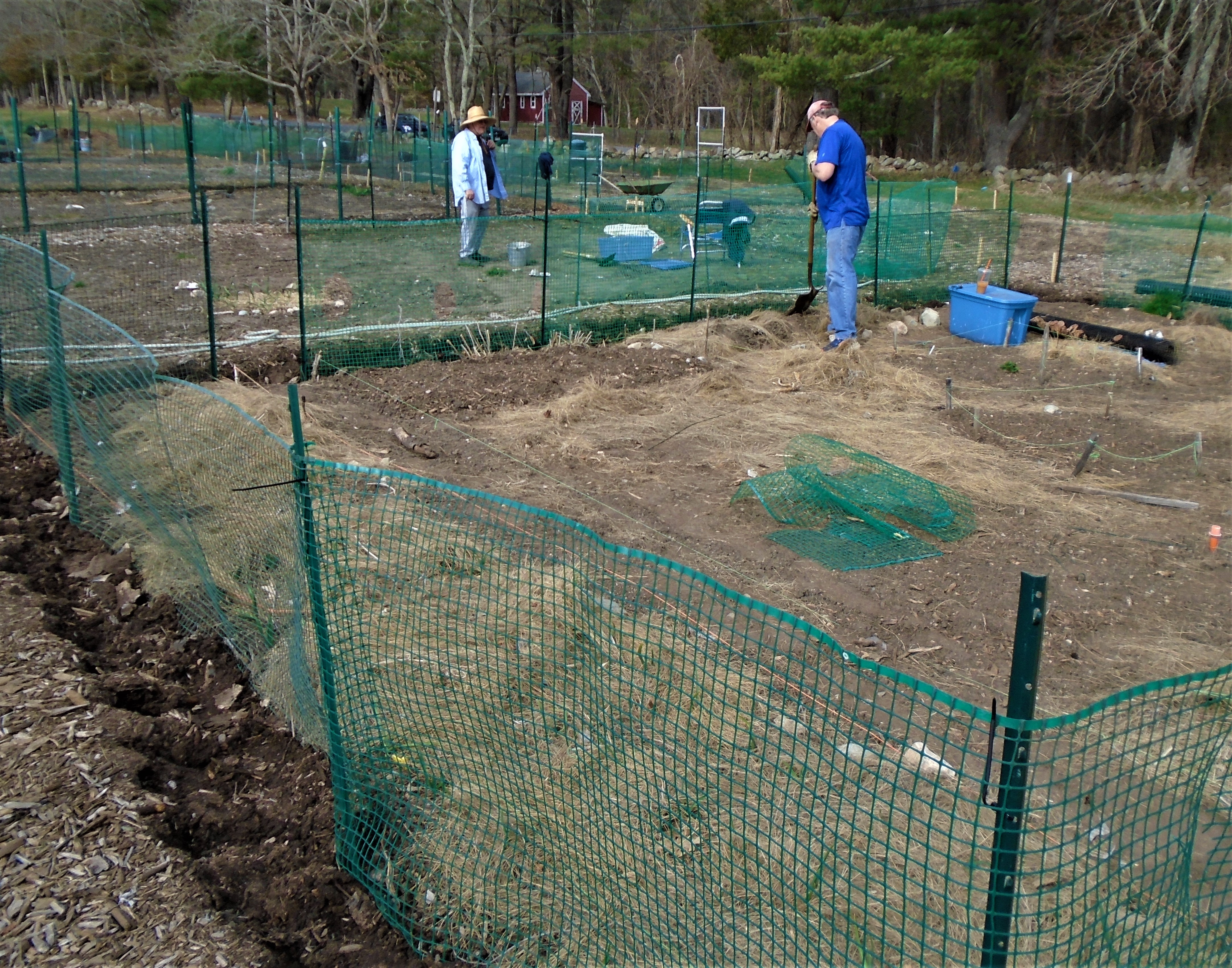
In late March, that gardener had a fall that left him with serious injuries to a leg and foot. He notified me he was unlikely to be able to have a garden this season as he would need one or more surgeries and rehabilitation that would last into summer. My response to him was that it was too soon to make such an irreversible decision. Two garden friends put up his fence; including digging a 100-foot-long trench around the plot’s perimeter to ensure critters could not sneak in uninvited.

That first good deed was the start of many more. His plot neighbors began planting the garden he had envisioned for the season. They weeded and they watered. I have counted no fewer than four helpers whom I have spotted in his plot; working diligently to ensure all is well in his absence.

Volunteers put up the fence around the
injured gardener's plot, including
digging a trench for it
Three days ago, I made a walking tour of the garden and made notes on plots where either no gardening has yet taken place (an ominous sign) or weeds have started appearing among vegetables planted at the season’s beginning in April. I also noted the sterling appearance of our wounded gardener’s plot and wrote off a note to him.

A few hours later I received a reply. I will not quote it out of a respect for a private communication, but his reaction was one of sheer awe that so many people cared. I can honestly say I was choked up as I read it. In a world where altruism is supposed to be passé, a group of people whose sole connection to one another is a shared love of gardening have come together to give one of their own a continuing helping hand.

While watering this morning, I ran into one of the benefactors. She had in her hands several tomatillo plants ready to go into the housebound gardener’s plot. They were, in turn, a gift from yet another benefactor. Truly, there is hope for mankind.

On the other side of the garden, though, something quite different was going on.

Gardeners can over-winter fencing and stakes
in the 4-H shed
Not all of our gardening families have houses with spacious garages, sheds, or basements. And, so, the community garden offers off-season storage of garden fencing, stakes, and tomato cages in a small building across from the garden. The shed will hold material for roughly 25 families and preference is given to people living in multi-family dwellings. All material has to be tightly tied together and labeled with the owner’s name. The shed is locked on November 1 and re-opened only when the garden formally opens April 1. From then on, it is open for the season as gardeners retrieve their supplies.

Before I lock the shed for the season, I make certain all those stakes and fences are tagged, and the names are legible. There is a list of the people who have requested space and I make certain no interlopers have decided one more roll of fencing among 25 won’t be noticed.

The system worked exceptionally well… until this year. On April 1, I unlocked the shed and checked to see everything was still where it was supposed to be. All was right with the world.

Loaner 'Ogre' fencing was available
in an adjacent lean-to
Ten days later, one gardener notified me he had gone to the shed and his fencing bundle was missing. I went to the shed, did my own search, and came to the same conclusion. Yet I knew the bundle was there at the beginning of the month.

There were two possibilities. The first was that someone, likely a new gardener, had erroneously concluded the fencing in the shed was part of the ‘Ogre Fencing’ available for loan to first-year gardeners and stored in an adjacent lean-to. The second possibility was someone filched it.

I queried the garden community but no one had any information. In the meantime, the gardener with the missing fencing purchased new material – spending just over $200 (that’s what it costs!). He put up his new fencing. I said I would try to seek reimbursement for him from the Community Garden Revolving Fund into which all our plot fees are deposited.

Then, the gardener – let’s call him Gardener #1 – took a walk through the now-mostly-fenced community garden and spotted what he was certain were his materials. He contacted me and told me the plot number. It took some time, but I made contact with the individual – a new gardener who would have invited to use Ogre Fencing. I asked the new gardener if there might have been a mistake. The gardener – let’s call him Gardener #2 – stated unequivocally, that the fencing was his.

To me, that closed the issue. I didn’t demand receipts. Somehow, for the first time in more than a decade, someone from outside the garden community had gone into the shed and pilfered someone’s fencing. I reported this to Gardener #1 and repeated that I was going to seek restitution on his behalf.

Restitution, unfortunately, was not as easy as reaching for a checkbook. First, a decision had to be made by someone in authority that such an unprecedented reimbursement was a good idea. The second was actually getting the check written. (I know this because it took six weeks to get reimbursed for the stakes and string used to mark out the garden.) I communicated all this to the gardener.

Unfortunately, as the wheels of progress ground slowly and inconclusively, Gardener #1’s belief hardened that Gardener #2 was using purloined material. It so happened that, yesterday morning, the two gardeners (who had never met) were in the garden at the same time. Gardener #1 went to Gardener #2’s plot and… heated words were exchanged.

Each party emailed me; Gardener #2’s note included a copy of the receipt for the fencing he had purchased. I wrote an apology to Gardener #2, which settled at least that side of the issue. I also wrote Gardener #1 reiterating my earlier statement that, in my mind, the ‘stolen fencing’ question had been resolved as soon as Gardener #2 said the fencing was his own. I further wrote that, if Gardener #1 had an argument with anyone, it should be with me.

Before I became a Garden Ogre in 2009, I had a 35-year career in the corporate world, complete with fancy management titles. I sometimes witnessed (or had a hand in) cooperation across groups that already had a full plate of responsibilities and no spare manpower to lend a hand to struggling peers. Somehow, in hindsight, those examples of selflessness were less inspiring than what I saw this week in the actions of half a dozen gardeners. I also resolved many problems where I had to determine who was right, who was wrong, and enforce my decision. For reasons I will make no effort to explore, those long-ago clashes of ego and power seem less consequential to me than the problems between two gardeners.