August 5, 2012

Hot August Morning

The forecast for Boston yesterday morning was for 95 degrees and oppressive humidity.  In other words, a perfect day for a day trip to someplace cooler and with a lower dew point.   Lesser sorts would have gone to the beach, the Cape or the White Mountains.  Betty and I packed a picnic lunch and headed for Stonecrop Gardens in New York’s Hudson Highlands, elevation 1100 feet and ‘only’ 184 miles away.
A planter idea you could
try at home
Stonecrop Gardens and the Garden Conservancy are inextricably linked.  Located in Cold Spring, NY, the garden was the home of Anne and Frank Cabot, who founded the Garden Conservancy in 1989 with the goal of “preserving America’s finest gardens for posterity and to enhance public appreciation of gardens.”  Today, it is a public garden, open every day except Sunday between April and October.

The Cabots built their summer home at Stonecrop in the late 1950s and began creating twelve acres of gardens.  Frank Cabot (who died in 2011) was an avid plant collector and the unusual structures he built to display his collections are still in use (a pair of half-sunken greenhouses are especially attractive).  The idea of turning Stonecrop into a public garden began in 1985 and, over the next seven years, the property was gradually transformed to create an ‘educational’ garden where people could learn about horticulture, experience his enthusiasm for fine gardening, and take inspiration back home to their own gardens.


Getting to know one of the
Stonecrop staff?
Stonecrop opened to the public in 1992 and, twenty years later, it is glorious.  Maintenance is top-notch, the horticulture is in prime condition, and every visitor gets a sheet with a listing of more than a hundred ‘points of interest’ showing what’s in bloom or otherwise shouldn’t be missed.  In turn, discreet numbered tags next to plants tie to the sheet, leaving garden vistas uncluttered.


The Cabots were not your usual exurban gardeners.  For example, there is a glorious pond with cascading pools, each filled with carefully selected aquatic plants.  The pond is bisected by a stone bridge, the centerpiece of which is an irregular slab of granite roughly thirty feet long, six feet wide and three feet thick.  Standing on the stone, looking across the pond, you realize that the entire facing wall of the pond – including all those cascading pools – is made up of other enormous chunks of granite, carefully placed to create a ‘look’. 


The stone bridge in the pond
The stonework was done by masons over several years, but the raw stone came to the Cabots as the result of blasting on the Cold Spring Turnpike (SR 301) which connects the property to the nearby Taconic Parkway and the Hudson River. When New York State allows you to take away the blast debris from a public road project, this speaks of a very good relationship, but then you have to keep in mind that Anne Cabot’s family donated much the land that became Fahnestock State Park and her grandfather helped create the Palisades Interstate Park Commission. 


Succulents massed in a
sunny courtyard
As a garden that gives homeowners good ideas, Stonecrop is top notch.  There are attractive containers that look like something that anyone with a little Portland cement and some spare pieces of stone could throw together.  There is a massing of succulents in a sunny courtyard than has probably been photographed by everyone who has a terrace or a patio and six cacti in pots.  The intricate woodland trail is something that can be emulated by anyone with a preponderance of shade and a love of perennials. 
Water cascades down a man-made
hillside into the pond
All that was missing from our trip were fellow visitors.  We arrived a few minutes after the opening time of 10 a.m. and were the garden’s second guests.  We stayed two hours and stopped to chat with the friendly docent who had taken our five dollar admission.  Glancing down at the sign-in sheet, there were still just two more names.  On a beautiful weekend morning at the height of get-out-of-New-York season, the garden should have overflowed with people.  Instead, we had the place to ourselves.  A garden this beautiful deserves visitors – lots of them.
This coming Saturday (August 11), the garden will be open as part of the Garden Conservancy Open Days Program, with tea and refreshments.  Please go. 


Note:  We opened our property for the Garden Conservancy Open Days program in 2008.  Four years later, it still ranks as one of our proudest days as gardeners.

August 1, 2012

The Bressingham Garden Turns Five

For the 150 people who were there, August 3, 2007 is one of those days they’ll remember for a very long time.  The temperature was in the upper nineties, the humidity was unbearable, and the sun beat down relentlessly.

The 'souvenir' yellow shirt
given to everyone who
worked that day
That was the day the Bressingham Garden at the Massachusetts Horticultural Society was born.  And those 150 people weren’t there to dedicate the garden.  They were there to build it.  I know all this because I was one of them.

Most gardens are built over months or even years.  The acre-plus Bressingham Garden was planned to be built in a single day. (It wasn’t, and more about that in a moment.)  The idea of the garden came together over several months.  To better acquaint Americans with the spectacular cultivars being developed by U.K.’s Blooms of Bressingham, renowned plantsman Adrian Bloom had hit on the successful idea of creating small demonstrations gardens around the United States.  ‘Small’ meant approximately 4,000 square feet, such as one at Ohio State University, also completed in 2007.  All were built in a day by volunteers.

In the spring of that year, Mass Hort approached Adrian about creating one of his signature gardens at Elm Bank, and Adrian agreed.  Sketches were exchanged and the project grew.  A 4,000-square-foot garden became a 10,000 one, and then 20,000.  By the time Adrian arrived in Boston to oversee its construction, the ‘canvas’ had become 45,000 square feet; slightly over an acre.

The site was a pancake-flat field of grass, part of which had once been a clay tennis court.  In the days before those 150 people assembled, that field was sculpted into sinuous mounds of earth and hundreds of truckloads of soil were brought in.  Boulders were added as visual anchor points and a handful of specimen trees were planted.

At the end of day one, less than half
of the garden had been planted
(double-click to see the photo
at full-screen size)
The scale of the project can best be summed up with numbers: 100+ trees, 300+ shrubs, and 8,000 perennials.  For each item, a hole had to be dug, the item conditioned and planted, then the area raked and watered.

There were a few unforeseen problems with the project. First, 150 people cannot be properly employed at one time in a one-acre site.  They bump into one another and step on plants.  Second – and this was both good news and bad – Adrian Bloom came with one plan on paper, but devised a better one as he saw the site.  Implementing this better plan meant that Adrian would walk around, look at an area, and say, ‘get me fifty of those (fill in the name) perennials’.  A runner would fetch the plants, a spotter would carry a plant to the starting point specified by Adrian, and then the fifty plants would be arranged according to his specification.  Areas would be left blank so that he could come back an hour later, evaluate the look of the bed, and then call for thirty of a different plant to complement the adjacent area. 

A third problem was that the searing heat baked the top inch of the loam into which we were to plant those perennials and shrubs to the consistency of terra cotta pottery.  My enduring memory of that day was jumping up and down on a shovel, trying to break though that outer shell.

The Bressingham Garden
in 2012.  Mature, yet
subtly changing
The net result was that at the end of the day, less than half of the garden had been planted.  The accompanying photo (above) shows the site at the end of day one.

Thirty of us came back for a second day, and this time we started at 7:30 a.m.  We were now ‘seasoned’ volunteers who knew what we were doing, or at least we followed Adrian’s directions to his satisfaction.  And, there was a new secret weapon added: several power augurs capable of making a hole a foot wide and a foot deep in about twenty seconds.  By the end of day two, we had more than 6,000 perennials in the ground.  Not bad for heat-stricken, sunburned volunteers.

It would take several more weekends of work to complete the garden according to Adrian’s plan.  In the intervening years, much more work has been done on the garden (including accounting for the pesky remnants of that clay tennis court). 

In early July, Adrian was back at the Bressingham Garden as part of a tour of Elm Bank by the Perennial Plant Association’s national convention.  Today, the garden is thought of as mature yet, even in its maturity, it subtly changes.  Seeing and appreciating those changes are what make it worth coming back to, year after year.

July 23, 2012

To Be Opened January 23, 2013

Call this a time capsule with a quick ‘open on’ date. 

In New England, there is a very short window during the summer – measured in weeks - when almost everything in the vegetable garden is simultaneously ripe for picking.  Today was one of those days.  As a result, tonight’s dinner was one of those meals that deserves to be memoralized.

As an ‘appetizer’, there were five perfect ears of corn, so sweet they needed no spice to enhance their flavor.  Picked at 6 p.m., they were eaten before 7:30.  A little butter and they were heavenly.  That appetizer course was followed by a second amuse bouche: a pair of artichokes.  Most artichokes are flown in from cool marine valleys in California.  This one was ‘vernalized’ beginning in February and planted in mid-May.  The two artichokes from the harvest were small but incredibly delicious.

There was a salad made of lettuce, tomatoes, arugula, beets and beet greens – all picked today. There could have been carrots to go into the salad, but they would have been too much.

For the main course there was a small piece of steak, and accompanying that steak was a mountain of chard and green beans picked that afternoon. There was also fresh yellow and green squash, but we were too full.  It was cooked to be eaten at a later date - like tomorrow.

Apart from the steak and the butter (oh, all right, and the gin, tonic and lime), everything we ate came from our garden.  We ate until we were full; no need for dessert.  I know that in Boston, there are restaurants that charge a significant premium for such ‘guaranteed localvore’ fare; our meal was paid for with our sweat and gardening smarts.

Absent this post, tonight’s meal would likely have been forgotten by January.  This is a meal I want to remember.  To the glory of July 23!

July 22, 2012

Pickin' Time

July 19 was a memorable date in our vegetable garden.  We picked our first ears of corn (‘Quickie’) and our first cherry tomatoes.  We also picked our umpteenth pound of green beans, yellow and green summer squash, beets, chard and lettuce.  We are, in short, self-sufficient in the vegetable department for the next six weeks.

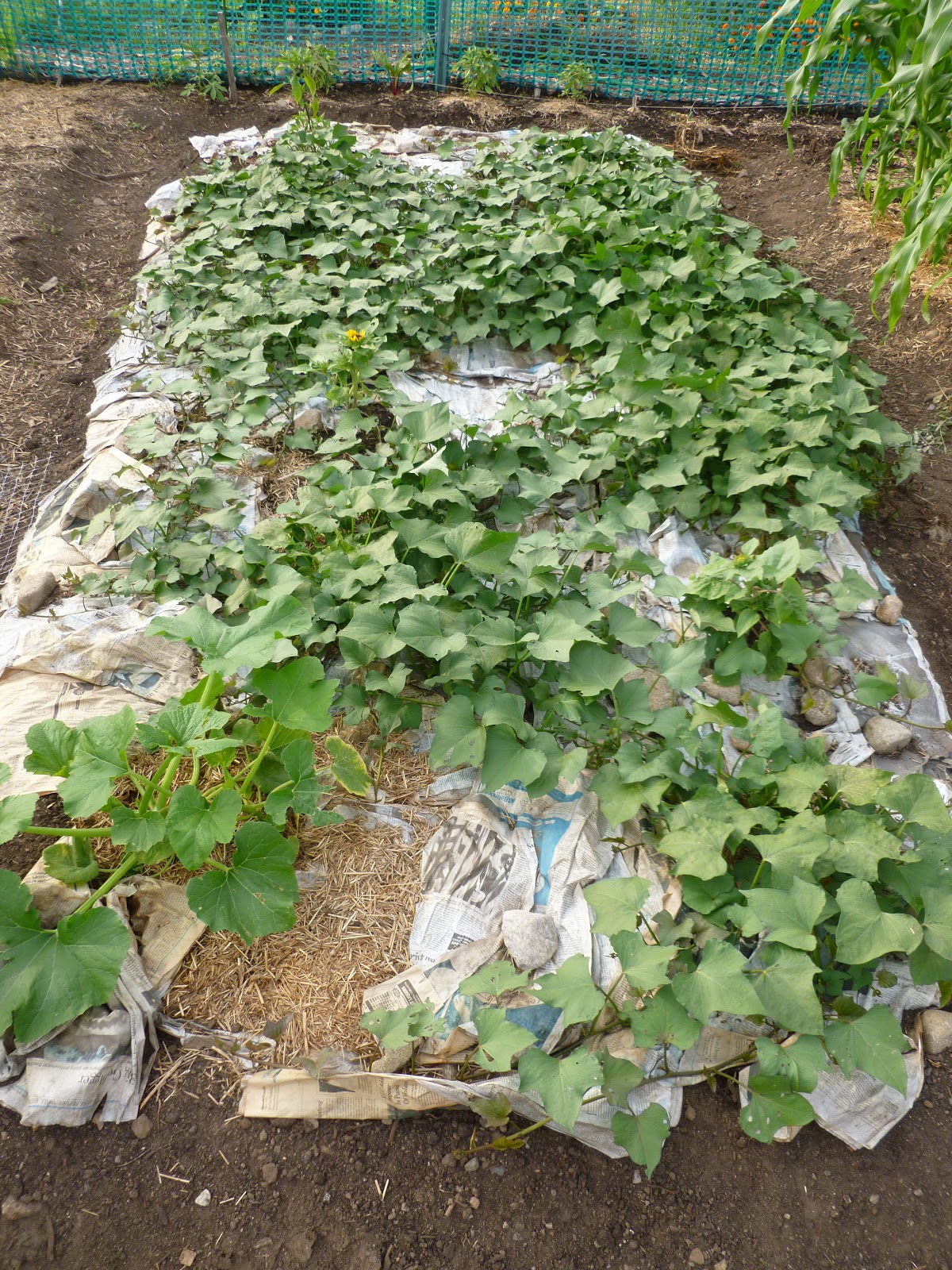
There are four squares of corn, each planted a week apart, which should collectively provide more than a hundred ears of sweet corn; plus six ‘producing’ summer squash plants and a like number of seedlings that will yield somewhere between a hundred pounds and a ton of zucchini.  There are plenty of leeks, fennel and carrots to be harvested in September and half a dozen winter squash vines that are threatening to overrun anything in their path.  There is an eight-foot-by-twenty-foot plot of sweet potatoes growing vigorously (at least the greens are growing; we have no idea what is happening underneath the soil). 

These tomatoes, hard and
green now, will be ripe in
just two weeks
The okra plants – ten of them – are now a foot high and, by early August, will start throwing off pods.  The sweet peppers are small and hard now but will grow rapidly and ripen through August.  There is a Chinese cabbage that Betty planted on a whim that is thriving.  The tomatoes, especially are starting to get serious.  It was a pair of cherry tomatoes that ripened under last week’s blistering heat, but now the large heirlooms and hybrids are catching up quickly.  Absent the appearance of late blight or other disease, we will have a bumper tomato crop and be in lycopene overdrive until well into September.

So why, exactly, do two people need a 1200 square foot vegetable garden?  Our freezer already groans with the bags of processed peas from plants that have now been pulled out.  We have green beans to last us well into the winter yet, just two days ago, Betty replaced the peas with another row of beans.

Part of the reason we grow so much is the joy of eating fresh vegetables every evening – including a few all-vegetarian meals.  Another aspect is the sharing.  Part of last week’s harvest of summer squash went to a community food pantry.  Other vegetables go to friends and neighbors.  A plate of fresh-picked green beans with a dill mayonnaise was a hit at a party.

This is our first-ever effort
to grow sweet potatoes. 
Right now, we have a lot
of greenery.  Only time will
tell if there are sweet
potatoes underneath.
We also have the pleasure of the company of a community of fellow vegetable gardeners.  One of our gardening neighbors is brand new to the process; another has graduated this year from a half-plot to a full one; and a third jumped at the opportunity to claim an adjoining second plot.  It’s a joy to talk to them, hear their ideas, and share their excitement.

And there’s the opportunity to share knowledge.  Any trip to the garden inevitably produces a round of questions from novice gardeners.  Some evenings, a planned ten-minute foray to pick enough lettuce and arugula for dinner salads turns into a 45-minute-long, hands-on seminar on the value of row covers, the right way to water deeply, or pest identification.  It seems as though there’s always a crowd at our garden.

Vegetable gardening is, in reality, a short season in New England.  We put up a fence in late April and plant cold-weather crops in early May, but for that first month there’s nothing to look at but black earth marked with stakes and string (plus an early crop of weeds).  It is only in early June, with the planting of the ‘warm weather’ crops that that there is sufficient greenery to give hope that there will indeed be a crop.  July and August are the garden’s glory.  By the beginning of September, the garden will look tired.  We’re enjoying it while we can.

July 16, 2012

The Class of 2012

That's me at Great Dixter, providing
scale to one of Christopher Lloyd's
container garden groupings
You can blame it in Christopher Lloyd.  No, not the mad scientist of Back to the Future; the other Christopher Lloyd, who made Great Dixter a ‘worth-a-journey’ garden in East Sussex.  Betty and I were there in May 2004 and it was on that day that Betty fell in love with container gardening.  And, not just pots with multiple kinds of flowering annals in them, but the idea of massing containers to create portable landscapes.  That’s me, at Great Dixter, providing scale for one of Lloyd’s compositions. (Double-click on any image to see it at full-screen size.)

This container is on our back
deck, and consists of coleus,
supertunias, a red grass and a
flowering maple.
And so each year we observe a ritual around our garden.  In early May, we go into our basement and retrieve maybe a dozen beautiful large pots from our collection.  We place them in the turnaround of our driveway.  Betty then goes off in search of annuals and perennials to fill them.  She creates a dozen exquisite containers; they are sited according to their color and texture.  We also pull another dozen plant-bearing containers that we have overwintered in our garage (a subject explored in depth in ‘The January Thaw’).  These containers, too, are placed around the property.  Once those two dozen containers are completed, Betty pronounces herself satisfied.  She is done for the year.

There are more than a dozen
containers in this grouping,
providing a seamless transition
between our driveway and a
perennial garden.
But there is more to the ritual.  When she is done I point to the leftover annuals and perennials that were not used in the creation of those containers and say it is a shame that we can’t have a few more.  After giving me her ‘why do you do this to me’ look, we go down into the basement and pull up a few more pots. 

At the same time, Betty does roughly six container gardening presentations for garden clubs and civic organizations (not including two at the Boston Flower & Garden Show this year).  Each demonstration requires that she put together five such containers.  She purchases more plants plus the lightweight pots that she uses for “road work”.  Inevitably, she brings home a few pots that she later judges to be “too heavy” or “not right” for her demonstrations.  She inevitably buys more plants than she will need for a demonstration in order to have exactly the right 'look' for the containers in her demonstration.  Oh, and she will go to sales when quality garden centers such as Andrew’s, Weston and Russell’s start marking down their plant.

Containers, many using
succulents, soften the sidewalk
and vary its width.
I will bring the preamble of this piece to a merciful conclusion:  right now, there are 61 containers scattered around our property.  Christopher Lloyd would be proud.

There’s a loropetalum that appears to have settled into its container for a long, happy life.  The acuba we purchased in Maryland last year quickly outgrew its container and, in the process of re-potting it, Betty found a daughter shrub which now has its own pot.  Our crape myrtle and Cape plumbago also are thriving in seasonal glory; Zone 8 shrubs summering in a Zone 5B world.

On the front porch, five containers
provide a mix of formal and
informal elements.
But it is the mixed containers that are the ‘wow’ part of the collection.  Now that July is here, they are in prolific flower and visitors can see what Betty had in mind when she first started putting plants together two months ago.  We are still mixing containers to provide height and texture contrast.  A water garden – actually, a four-container water garden – was completed just  this morning.

At a driveway turnaround, five
containers mix annuals
with shrubs (the acuba and
hydrangea).
These portable gardens provide bridges to our ‘permanent’ gardens, softening buffers for sidewalks and driveways, and focal points to pull the eye to corners of the garden that might otherwise escape attention.

They require maintenance: flowers need to be deadheaded just as in any garden; ‘thugs’ need to be trimmed back less they take over.  And, on hot summer days, each container can take a gallon or more of water to keep roots cool and damp. 

This container, likely in its last
year of use, mixes caladiums
with a prolifically flowering
vine.
And, finally, some containers are
there just to draw the eye to
corners of the property.

July 3, 2012

Why Vegetable Gardeners Are Optimists

Vegetable gardeners are optimists.  They have to be because, otherwise, they’d never lift a hoe again after they saw their first tomato hornworm.  
We have a plot at a community vegetable garden in our town.  It’s a sunny, 1200-square-foot space that has some of the richest soil in New England.  Because we also ‘run’ the garden (we thought we were joining a committee but it turned out no one else was on it), we field all the questions and problems from our fifty-plus fellow gardeners.  As you read on, please keep in mind that this is a good year for vegetable gardening.
This is a cucumber beetle.  It can make
a plant disappear overnight.
·         Everyone is coping with an infestation of cucumber beetles.  The comments started in mid-May that cucumber vine leaves had little holes in them.  By mid-June, plants were disappearing overnight.  By now, any squash, cucumber, or soybean plant that isn’t being grown under a row cover is an endangered species.
·         Also, the first of the Mexican bean beetles have been spotted.  This charming pest chomps on green beans and anything that looks like a green bean (the bugs are apparently far-sighted), including mung beans, soybeans and alfalfa.  You know you have a Mexican bean beetle infestation because, one day, you come out to your garden and all you have are skeletons of leaves.  Again, row covers are the lone salvation unless you’re not averse to dowsing your vegetables with exceedingly non-organic bug killers.
And this is a squash borer.  One of
the nastiest pests in the garden.
·         Yesterday, someone asked Betty about the cute little orange and gray moths on her squash plants.  Betty patiently explained that they are the adult manifestations of Melitta curcurbitae, otherwise known as the squash vine borer.  When two adults get together and make whoopee, they’ll lay a mass of eggs under a summer or winter squash vine.  Two few weeks later, there go the zucchini, butternut squash, and melons.
·         Two weeks ago, it was reported that a nemesis called late blight had been found as close as Pennsylvania.  Late blight, which is endemic in the South, can kill a tomato plant in a few days.  This morning, I learned that it has been spotted in two towns less than ten miles away.  There is no 'cure' for late blight.  If the fungus spores reach our garden, our tomatoes are goners.
Because of the threat of these pests, our garden this year looks like a Red Cross aid station.  White row covers shield our green beans, zucchini, yellow squash and a couple of other things that have been cloaked so long that I’ve forgotten what’s underneath them.
Our floating row covers keep susceptible vegetables safe
from pests.  It also makes our garden look like a Red
Cross first aid station.
Yet, despite the alarming reports noted above, this is turning out to be a great year for vegetables.  Not just ‘knee-high by the Fourth of July’, our early corn already shows tassels and we’ll likely pick our first ears before the end of July.  The cooler-than-normal May and June means that our lettuce and arugula haven’t bolted and are producing prolifically.  Our peas produce pods by the gazillion and we’ve pulled beets that have reached the size of softballs without turning woody.  Our basil is dark green and already redolent of the citral that gives it that wonderful scent.  Rainfall has been well-spaced and the heat blasts have been of short duration.
Of course, all of this can change overnight.  Our ten tomato plants look perfect right now, but Late Blight – a scourge that wiped out virtually the entire Northeast tomato crop in 2010 – has been found as close as Pennsylvania.  Fungus could discover the basil and corn borers could lay waste to our crop.
The only way to keep your sanity when you grow vegetables is to assume the best.  We plant, we weed, we pick off the bad bugs, we water and we fertilize.  We cross our fingers and imagine the taste of that first tomato and fresh-picked sweet corn.  Gardeners count their wins, not their losses.

June 30, 2012

The Principal Undergardener's Time to Shine

There are two competing explanations for where the idea of ‘the gates’ came from.  Mine is that we saw one at a Yellow Book garden in Kent seven or eight years ago.  Betty believes, just as firmly, that we saw one on a garden tour in a neighboring town.  Either way, I came home determined to build some gates of my own.

Each gate begins with two to three
times the material needed
‘The gates’ – they have no other, more formal name – are at once exceedingly simple and complex structures.  They are ornamental and decorative; functional only in the loosest sense of the word.  I build them from limbs of trees that have been cut down.  More than anything, I suppose, they are artistic.

I have built roughly ten in the intervening years.  Because the wood (typically oak and maple) is not seasoned and the trees or branches are cut when relatively small, a gate’s life span is two to three years.

I have just completed a new one for the pathway between the Manhattan and Long Island beds at the front of the property and the ‘wildflower walk’ garden room.  Readers of this blog know that there is a long stone wall behind the Manhattan and Long Island beds, a byproduct of the rototilling that produced those two planting areas a dozen years ago.  A break was left between the two segments of the wall to allow cart traffic from the east side of the property.  The newest gate is the third generation to grace that site.

The gate is laid out before assembly
Building a gate starts with scouting for material.  There are always tree branches that have encroached into places they are not welcome and saplings growing where they have become annoying.  These are the raw materials.  I’ve learned from experience that softwoods (and especially pine) disintegrate within a year and are to be avoided.

Two straight pieces are required for the fence posts.  They’re usually at least three inches in diameter and are secured in concrete.  Properly chosen, posts can last a long time; the ones to which the new gate is attached have been in place for six years.

The finished gate; the Manhattan bed
is on the left, Long Island on the right
For the gate, four straight and sturdy pieces are needed.  These form the perimeter or frame of the gate and are secured with three-inch wood screws. The interior pieces are selected for their interesting forms: a nifty ‘Y’ or even a ‘W’; a graceful arch or a good knot.  As the photo above shows, these are laid out once the perimeter is built.  I cut the pieces to size and secure them to the frame using narrower-gauge three-inch wood screws.  For the smallest interior pieces, I still use at least two-inch screws.

If you compare the preliminary layout to the finished gate below, you’ll see that compromises need to be made along the way.  A piece of wood may bend the wrong way or just look wrong as the gate nears completion. The goal is to have a finished piece that looks like it was meant to be there; not to meet a deadline.

Detail of the completed gate
I do not use hinges or latches.  Apart from the fact that they’d likely pull out in a matter of months, the goal is to look rustic.  Accordingly, I use hemp rope to secure the gate to its posts.

My tools are simple: a sharp saw and an antiquated power drill.  I suppose that, with a multi-speed reversible drill I could build a gate in a day.  As it is, the one shown here took about 15 hours of work to get right. 

The gates are the one creative element of our garden to which I can lay unquestioned ownership.  Betty is the superb designer with an excellent eye for color and texture.  In those matters – which comprise 99% of the garden, my role is to lift, carry and dig.  But on the subject of gates, I am the guy.  It’s the Principal Undergardener’s time to shine.

June 28, 2012

The Good, the Bad, and the Virtuous

There are three rain barrels connected to the downspouts around our house.  Those rain barrels are in use during the seven-month gardening season, after which they are drained and reside in our basement for the late autumn and winter months.  Because of those rain barrels (and coupled with recycling ‘gray water’), I can state with a clear conscience that not a single gallon of fresh water, pumped from our town’s underground watershed, was used last year in the maintenance of our large garden.  The same is true thus far this year.

The question is, is using a rain barrel an economical decision?  Or, is it one that we make because it’s the ‘green’ thing to do?

Our three rain barrels, all manufactured by the New England Rain Barrel Company, cost us a total of $145.  The least expensive one was purchased through a friend from the town of Dedham for $32.  The other two were purchased from the town of Medfield for $55 each.  All three purchases were subsidized by the state under a since-discontinued conservation program.  In the case of Dedham, the town further subsidized the cost.  At present, the company offers a 55 gallon rain barrel for $75 in ‘bulk deliveries’ to towns in Massachusetts; otherwise, a single rain barrel is $120.

This is the rain barrel that
waters our hostas
The beauty of a rain barrel is that it collects the rain that falls on a roof, flows into gutters, and goes into a downspout.  As little as a quarter-inch of rain falling on 350 square feet of roof will fill a 55 gallon barrel.  If there’s more than a quarter inch of rain, the downspout can be diverted so that the rainwater flows to wherever it would have flowed has the rain barrel not been collecting it.

Another rain barrel benefit is the water that you draw out of it.  It’s air temperature and chlorine free.  Your plants love it.

One of our rain barrels is tied to a drip hose and waters part of our hosta garden. I turn it on when the top two inches of the soil around the hostas is dry.  It takes about two days for the barrel to empty. Two of our rain barrels store water that will be used primarily to keep our 50-plus container gardens properly hydrated.  Since we can’t haul a rain barrel to the containers (55 gallons of water weighs 440 pounds), we fill a collection of two- and three-gallon plastic cat litter carriers; an innovative piece of recycling on our part.  Depending on the temperature and humidity, it can take between 20 and 40 gallons of water to ‘do’ all of our containers.

Let’s say, just to establish a baseline calculation, that each of our rain barrels are filled and emptied ten times over the course of the gardening season.  That’s 1650 gallons of water.  What did we save?

The answer is depressing.  In Medfield, ten thousand gallons of water costs $28.20.  Those 1650 gallons cost a little over $4.00.  The time to pay pack the initial purchase price of our rain barrels is 30 years.  If we lived in Boston, where ten thousand gallons of water is $57.30, the payback is a shorter, but still depressing, 15 years.  However, those barrels were purchased at a steep discount.  Had we paid $75 per barrel, the time to recover their cost would be 56 years; in Boston, 23 years.

Rain barrels also have one drawback that is not usually mentioned in the sales literature: unless they’re drained frequently, the water in a rain barrel can get rather dank.  Put less delicately, old rainwater smells and coats the inside of those cat litter containers with scum.  At the end of each season, any containers that are going to be over-wintered get bleached; the interiors of the rain barrels get washed thoroughly.

So, rain barrels are uneconomic and they can be a nuisance.  But they’re virtuous and, if your town has a water ban in place, they can also be a necessity.  Knowing what I know today (our rain barrels are six years old), would I buy them again? 

The answer: in a heartbeat.  They’re an easy way to practice conservation and to put water on your plants that is, well, pure rainwater.  Call it a small virtue.

June 11, 2012

Giverny in the Bronx

There’s a truism in the art museum world that, when attendance starts to flag or publicity has been sparse, curators have a ready, foolproof solution:  mount an Impressionist exhibition.  Borrow some Renoirs and Monets, throw in a Cezanne or a Pizarro, and the public will be standing in line every morning.  Impressionism sells.

I’ve been lured to a couple of those exhibitions.  A few were outstanding but most simply recycled the same highly overexposed paintings.  So, I was understandably dubious when Betty and I went to the New York Botanical Garden Saturday morning to see “Monet’s Garden”.  Why did NYBG, an institution with no dearth of resources or lack of visitors, feel a need to put on a six-month-long tribute to Claude Monet? 

What you see when you enter
the exhibit.  Double-click on any
photo to see it at full size.
I had a right to be suspicious.  Two years ago, there was another attempt to recreate a much-beloved nineteenth-century figure’s garden.   That time, it was Emily Dickinson and, in my opinion, it fell flat (I wrote about it here).  This time, however, my doubts were misplaced.  I love being proved wrong and, even more, I appreciate leaving an exhibition with more knowledge than I had going in. 

Straight ahead, the Japanese
footbridge
“Monet’s Garden” has a simple premise:  In the latter half of his life, Claude Monet (1840-1926) worked in plants the same way he worked in paints.  Giverny, to which he moved in 1883 and remained until his death, became a canvas imbued with as much care, imagination and skill as the paintings that lined collectors’ walls; and bellflowers, hollyhocks, wisteria, water lilies and snapdragons were a palette as endlessly versatile as the one he carried when he painted.

The surprising part of the above paragraph is that it is written by someone who has made the trip to Giverny.  I have seen the Grande Allée, the pergolas, the Japanese bridge.  I thought it was very beautiful.  Somehow, though, it never connected in my tiny little brain that Monet’s garden was his passion and that he devoted as much time to it as he did to his painting.  Now, after a trip to the Bronx, I do.

Turn around, and there's a glimpse
of the main house at Giverny
“Monet’s Garden” unfolds in multiple parts.  As you enter NYBG and walk toward the Enid A. Haupt Conservatory, you see placards bearing poetry that was written during Monet’s painting years.  Once in the Conservatory, you hear music; uniquely French and from the late nineteenth and early twentieth century (Ravel’s Bolero is a terrific accompaniment).  You go through a pair of glass doors and you are assaulted by colors.

Monet was meticulous in his record-keeping.  He documented his purchases of plants and his instructions to his gardeners.  His garden was extensively photographed in his lifetime.  NYBG brought in Scott Pask, a Broadway scenic designer, to create, in a few thousand square feet, a set piece that is both accurate and representational.  The Grande Allée has been condensed to approximately 250 feet but is packed with thousands of annuals and perennials, each true to Monet’s time and vision.  Overhead, on metal arches painted the ‘Monet Green’ used in Giverny, roses are beginning to climb.

Is it Giverny or the Bronx?
What is stunning is that a) everything in the Grande Allée is in perfect bloom and that b) growing in NYBG’s greenhouses are replacement plants to parallel the march of the seasons between now and October.  This day, the snapdragons were eight feet high, the bellflowers were in full purple flower and the hollyhocks had not a single spent petal.  According to the NYBG literature, more than 150 varieties of annuals and perennials are on display.  By October, the count will exceed 600.

It is an exhibit that encourages you to keep looking around.  If you turn around to admire the garden behind you, you see a two-story fragment of the main house at Giverny, perfect in its pink and green accents, the carriage lamps beside the shuttered doors just as they are in Monet’s paintings.  Ahead of you, through a double gate (again, in Monet Green, is the iconic footbridge, swathed in wisteria, bamboo and willows.

An abundance of water lilies.  Alas,
it was a different Ray Davies.
The second part of “Monet’s Garden” is outdoors.  The two pools in the Conservatory’s courtyard have been given over to water lilies.  I learned that  Nymphaea odorata underwent an seismic change in the 1880s as colorful North American specimens were cross-bred with their hardy European cousins to produced new cultivars with colors never before seen on the Continent.  Monet collected these lilies and overwintered them.

I thought for a brief instant that I had discovered a previously unknown footnote to the genius of Kinks founder Ray Davies.  One of the water lilies in the pool has the cultivar name, ‘Ray Davies’.  Alas, some research showed that the cultivar in question is named for the founder of Stapeley Water Gardens of Great Britain and not for the lead singer on Sunny Afternoon.

Amazingly, there is more to see.  We walked over to the Mertz Library where photographs and a pair of Monet paintings were on display.  In another room, Monet’s gardening notes, lists and letters were laid out and translated, with small photos providing visual reference points. 

It was while perusing his extensive notes that everything fell into place: this man was a passionate gardener who created a private Eden far from Paris.  Here, he could garden and paint (his series on the Rouen cathedral, poplars, and haystacks were all products of Giverny, as well as the masterpiece ‘Les Nymphéas’ now in the Musée de l’Orangerie).  Here he entertained friends and dignitaries.  Here, he was at peace.

Maybe it’s one of those ‘duh’ moments – everyone on the face of the earth already knew these things.  But I didn’t, or at least I didn’t know I knew it.  Now, I do.  Thank you, NYBG, for a lovely education.

*  *  *  *  *

We also spent time at the Rockefeller Rose Garden at NYBG.  It is at its peak in June and, on this day (June 9), it is as though every single one of the 1700 varieties were in simultaneous sensual bloom.  It was the perfect ending to a perfect trip.