June 1, 2010

Well-contained Enthusiasm

I was at the Chelsea Flower Show a few years ago, standing in a queue for drinks. Directly in front of me in line were two gentlemen, both silver-haired and attired in gray, chalk-stripe suits that spoke of both good tailoring and good breeding. They said little during those few minutes I was behind them, but one sentence continues to ring in my ears with a clarity undiminished by time.

“Penelope,” one of the men said to the other, and then paused for just a moment before continuing, “has a £100 a week perennial habit.”

He said this with neither anger nor regret in his voice. It was a statement of fact; tinged with opinion only in his use of the word, ‘habit’ in describing Penelope’s voracious gardening budget. I swiftly did some currency conversion in my head: at the then-current exchange rate, Penelope was buying up $182 a week worth of salvia, astilbe and hosta.

When I returned and handed Betty her drink, I related what I had just heard and I said, “Don’t ever again fret over what you spend on gardening. You will always be a rank amateur.”

We had a pounding rain here overnight and one of my jobs this morning was to empty saucers from the various containers around the property. Saucers with water in them mean containers can become waterlogged, which leads to root rot.

Somewhere along the way, I began counting the containers surrounding our home. I found 52 and am not certain I got them all.

Now, one or two are just for show – unplanted behemoths that are in perennial beds strictly as focal points. Some others are long-term homes to plants that we overwinter, such as a beautiful burgundy loropetalum or the stone planter given by Betty’s garden club that is home to a fern that returns majestically every May.

The core group of containers – medium and large terra cotta, glazed ceramic or high-quality foam ones – numbers about 35. Betty has been diligently planting them for the past month, filling them with an amazing array of mostly annuals but also including perennials, tropicals and a few shrubs; none of them common.

Those containers are scattered around the property, bringing color to otherwise bare areas of asphalt, concrete or rock. Some are awaiting permanent assignment, such as a large, colorfully planted pot that will sit atop a clutch of prominently visible daffodil greens once those greens have started to yellow later this month.

There are multiple containers along the sidewalk that will fill voids in the perennial beds as June bloomers pass. There are six containers on our deck, turning an otherwise drab structure into a colorful annex of the garden below it. Two matching metal urns are overflowing with color on either side of the front door. Large containers bring drama to the spaces between garage doors and still others fill an awkward, dark corner.

Does this count as a ‘container habit?’

Hardly. And, were it so, then I would be the principal enabler. Betty takes me plant shopping at her peril. I’m the one saying, “Don’t you want another of those?” And, at container sales, I’m the one piling the cart to overflowing, with Betty ordering me to put them back.

It isn’t even a container obsession. Rather, it’s an appreciation for what can be wrought by mixing plants of differing heights, bloom size and color into a small space, and then massing the resulting containers into a pleasing arrangement. It’s art using a different palette and medium.

So, to the gentleman at the Chelsea Flower Show, I say, “Hooray for Penelope.” I hope that she, too, is still creating art of a different kind somewhere in the U.K.

May 28, 2010

Now You See 'Em, Now You Don't

We don't make nearly enough use of spring ephemerals.  Perhaps, in New England, that's because they're not supposed to live, much less thrive.  Tell that to my bluebelles.

We lived in Virginia for eight years and came to love the annual, massive display of Virginia bluebelles at Manassas State Park.  They carpeted acres of that park for a few weeks each March, then disappeared as if by magic.  When we returned to Medfield, we decided - against the advice of nurseries - to try some two clusters in one of our shade gardens.

The result can be seen in the two photos.  The one above (double-click on it to see a larger version) was taken in early April.  There are the bluebelles, now eight clusters and growing.  They provided color for three sweeks when there was nothing else in the bed.  The photo at right is from the same vantage point last week.  The bluebelle foliage is still there - barely visible - crowded out by the hosta and emerging astilbe.

By mid-June, the astilbe will be in flower and the bluebelle foliage will have completely disappeared.  It's a terrific use of two plants in the same space, and an opportunity to extend the color season.

May 25, 2010

The Perfect Driveway Edge

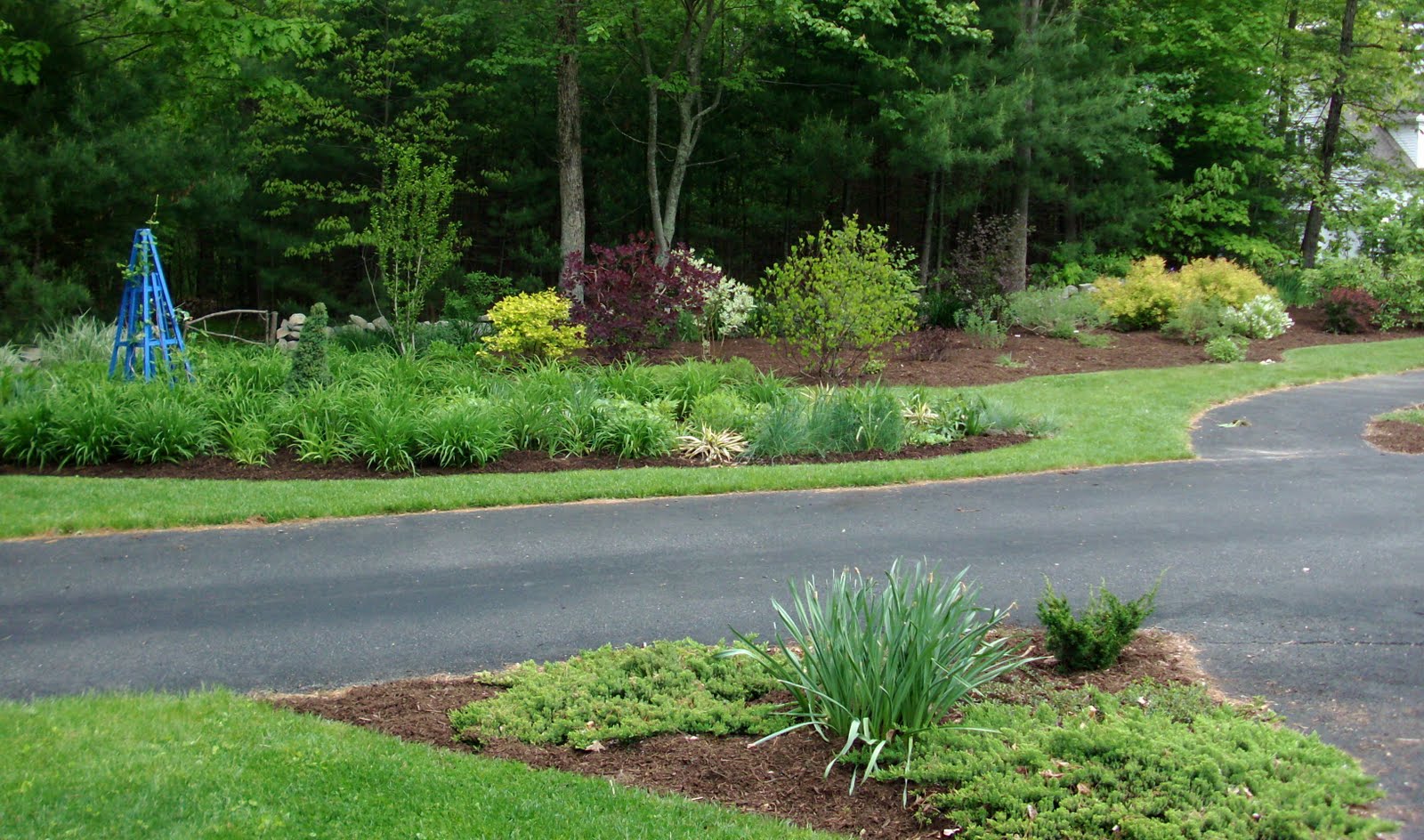
I can state with some degree of confidence that for the first five-plus decades of my life, I never thought much about edging my driveway. I had a string trimmer and, twice a year, I’d dutifully create a moderately straight demarcation between asphalt and grass. On a scale of one to ten of satisfying activities, it was a solid ‘one’.


Then, a few years ago I found myself at Hidcote on a mid-May morning. Hidcote, for the garden-impaired, is one England’s (and the world’s) great gardens. It sprawls across the Cotswold countryside near the village of Chipping Campden and is, as Michelin would put it, ‘worth a journey’.

Anyway, on that May morning, I was savoring the gardens when I happened to look down and see the world’s most perfect pathway edge. Instead of grass butted up against macadam, this path contained an inch-and-a-half wide dirt channel on either side. The grass was crisp and green up to the channel, which was perhaps an inch deep. Nothing grew in the channel.

Can you get rapturous about a ditch?

Yes, the gardens were spectacular, but I had to know about this ideal edge. And so, with Betty rolling her eyes, I went off to find someone who could tell me about how it had been made. I assumed it was done with one of those half-moon edgers wielded by someone with a perfect sense of touch and infinite time.

A docent was pleased by my question, put her finger to her chin, and then pointed to one of the garden ‘rooms’ nearby. “You’ll likely find him working over there,” she offered.

A few hundred feet away, I found a young man wielding a tool with two wheels and what looked like a bicycle chain ring. He easily pushed the tool forward, one wheel on the path. Grass and bits of garden debris sprayed out as it clattered. He did this for perhaps fifty feet, then lay the tool on the sidewalk and swept up the clippings. As he did, what remained was that perfect inch-and-a-half-wide channel.

“I think I know what I want for my birthday,” I said. Betty rolled her eyes again.

Upon returning to the States (when you’ve just come back from England you can say things like that), I made a beeline for Home Depot. There was no such tool, I was assured, but they had something even better - the eight-pound, gas-powered Lawn Boy Micro-Trim, and for the unbelievably low price of just $189.98.  I did what I should have done in the first place and made a beeline for Will’s Hardware, where I am locally famous for my idiosyncratic requests.

The manager, Randy, and I leafed through several catalogs and finally settled on a Deluxe Mechanical Edger ($34.95). It wasn’t exactly what I had seen at Hidcote but it was close enough. A week later, I had it in my hand (birthday we damned - I had to have this thing).
Now, twice a year (more often if there’s a group coming), I get to use my Deluxe Mechanical Edger. It makes the same satisfying clacking sound that I first heard that morning at Hidcote. The channel not only looks terrific, it is practical: it carries away rainwater, preventing ponding on the driveway.

It takes perhaps five hours to do our 220-foor driveway with its curves and parking aprons. I’m spending about an hour each morning this week on the project. It’s eminently satisfying and the result looks like a million bucks. Best of all, for a few hours, I feel I’m back at Hidcote. And that is a very satisfying feeling.

May 23, 2010

The Secret Pleasure of Mulching

In mid-April – a month earlier than it should ever be done in this area – I watched as a lawn maintenance company blew mulch into the beds around a neighbor’s home. The mulch came out of a long, probably eight-inch-diameter hose that snaked back to a large truck. The person doing the mulching haphazardly sprayed the mulch into azaleas and rhododendron, creating piles six inches deep or more. I cringed at the sight, but am long past the stage of saying anything about such behavior on the part of my neighbors or the firms that service their lawns.


I cannot imagine paying someone to spread mulch for me, though this evening my back and shoulders are telling me I did too much work today. To me, there’s a great satisfaction in spreading mulch. In mid-May (when the ground has warmed up in New England), perennials are well established for the new season, early spring bulbs have been reduced to foliage and shrubs are showing their new growth. Spreading mulch is a final step in re-imagining a landscape for the new season.

At our home, mulch must first be inspected before it is purchased. Ten days ago, Betty drove up to Sam White & Sons, where she walked the mulch piles, sifting handfuls before pronouncing it acceptable. Later that day, a dump truck dropped off ten cubic yards in two piles. Six yards went to the beds alongside the street and was spread over two days. Next came the beds along our driveway. Today, at the end of three days of preparatory work, we tackled two beds immediately in front of the house.

During those three days, we ‘edited’ what we call our outer sidewalk bed, a fifty-foot-long, eight-foot-wide curving garden of mixed perennials and shrubs. A summer-blooming phlox that was hidden behind a rhododendron in another bed now has a new, sunny locale. Stands of Ladies Mantle (Alchemilla mollis) that had migrated from its reservation were dug out and sent to the compost heap. The area of Snow-in-Summer (Cerastium tomentosum), though in full bloom, was reduced by half. A dozen perennials were brought back to acceptable boundaries and spurge was grubbed out from dozens of unwanted locations.

When the mulch finally went down this morning, it was top dressing for a bed that, at least to the trained eye, had been subtly re-made. Foliage colors have been re-arranged in a more pleasing fashion and the color scheme that will follow with summer blooms will be equally altered. It was three days well spent.  The final result is shown above.

But the mulch is more than a top dressing. It is also a unifier. A week ago, the outer sidewalk bed looked, frankly, messy. It was a hodgepodge of plants that, because of a season of rampant growth fueled by abundant rain, lacked visual coherence. The dark brown mulch provides the canvas upon which those plants and shrubs are arrayed, plus the contrast to the dark green grass of mid-May is dazzling. Because of the mulch, the eye can easily follow Betty’s planting pattern.

The mulch will be in its current state of perfection for perhaps two or three weeks. Then, inevitably, the sun will bleach the dark brown out of the top-most layer and it will no longer be as ‘special’. But for now, all is perfection. The sidewalk bed is perfectly edged and the mulch is uniform.

So much pleasure from so simple a thing.

May 12, 2010

The Sweet Smell of... Mulch


Ten cubic yards of dark brown mulch were delivered on Monday.  Two-thirds of it has been deposited in the street-side and driveway beds.  No garden ever looks better than when it has been newly mulched.  Here's a photo gallery, taken this morning.

May 3, 2010

The Inmates Take Over the Asylum

For the past decade we have taken advantage of a terrific program offered by our community, in which a town-owned field is plowed and marked into 40, 600-square-foot ready-to-plant garden plots. For the munificent sum of $20 per year, we get water, manure, and a site with ample sunlight. It’s a bucolic site with a 4-H sheep encampment across the road. The soil, once dense and prone to flooding, is now well aerated and heavy with organics.


We never thought much about who managed the enterprise. We received a notice each spring in a town envelope and paid our $40 for a double plot at the information desk of town hall. As the years passed, it became evident that one of our fellow gardeners, Lenny, was the ‘manager’ of the site. His principal responsibility seemed to be to run a gas-powered weed-whacker over the paths to the garden. Other than that, it was all very low key.

Then, last year, there appeared to be a change. The heretofore simple set of guidelines for the garden ballooned into a multi-page manifesto that took on an uncomfortably shrill tone. We read the rules with a sense of amusement and made the assumption that they were the work of one of our neighboring gardeners, a woman who is stridently organic and, well, pushy about her views.

There had also been a few things about the garden that irked us. Two water spigots stopped working and were never repaired. Publicity about the availability of plots was almost non-existent with the result that some gardeners could claim three parcels. Other gardens were quickly abandoned by people who discovered that keeping a plot weed-free required actual time and labor. The result was in a town with a strong interest in fresh foods, there were weed-filled plots next to an oligarchy of triple-plot empires. We brought up the subject with one of our town’s selectmen and followed it with a letter outlining the issues.

In October, Betty and I found ourselves appointed to the Community Gardens Committee (who knew?). More surprising, upon being sworn in (we took the oath of office, administered by the town clerk, in her office), we quickly thereafter discovered ourselves to be the only members of the committee, the long-time chairman having finally found someone willing to take on the role, and so resigning. We asked about the woman whom we suspected had authored the revised garden rules. No, she was not a committee member.

In February, we took our overhaul of the Community Garden rules to the town’s Conservation Commission, who listened and then gave us their blessing.

The garden opened this past weekend. There are now six, half-sized plots for those who want to dip their toe into the water without committing to a 600 square-foot garden. Triple plots had been outlawed. The spigots are being fixed as this is written. An evening seminar on good gardening was held in April and there were multiple newspaper articles announcing availability of plots in the garden. The ‘guidelines’ fit comfortably on one page.

We’re being pushy in one way: if a garden isn’t being worked by the middle of the month, the owner forfeits it to one of the people on the waiting list. There will be no weedy lots this year.

It’s a modest start. When she swore us in, the town clerk warned us that ‘people don’t like big changes’. Maybe we’ll be deposed in a coup d’etat by the rabidly organic crowd. For 2010, anyway, the inmates are in charge of the asylum.

May 2, 2010

Emily Dickinson, Gimmick

What does it take to draw a crowd? What does it take to draw a crowd when you have a hundred thousand members and a gazillion dollar endowment? What does it take to draw a crowd when you have all those things plus it’s the first weekend in May and the most beautiful day of the year?

Apparently, Emily Dickinson.

The New York Botanical Garden is without question one of the finest facilities of its type in the world and I’ve been to no finer one in the United States. I’m pleased to be a member despite living 209 miles from its front gate.

We were there yesterday as part of “members’ weekend”, perhaps a kind of “old home” event on the part of the NYBG marketing staff. Parking was free, use of the tram was free, admission to the rock garden was free. Of course, except for the tram, these things are always free for members anyway. But we also got free admission to “Emily Dickinson’s Garden – the Poetry of Flowers”, except that is also free any other time for members (for non-members, it’s $20). Oh, and everything in the gift shop was 20% off.

It was a glorious day to be at the garden. We arrived at 9:30 and were one of the first dozen cars into the parking lot. We walked the Ladies’ Border and perennial beds in front of the Conservatory in utter seclusion. At 10 a.m. the Conservatory opened its doors and we decided to go see what the fuss was about as regards Ms. Dickinson.

We usually skip the Conservatory during the warm months because there’s so much to see outdoors. That’s a mistake. The Enid Haupt Conservatory is divided into climates representing different regions of the world and, on May 1, it seemed as though the whole world had exploded into bloom. Turquoise pods fell in chains on vines in the rain forest. A cactus in the desert room was covered in vividly yellow flowers. Bougainvillea in hues of red, orange and purple cascaded from the ceiling.

And then we were in the Special Exhibitions area of the Conservatory and in Emily Dickinson’s garden.

It was a nice garden, though why it was mounted indoors is a bit mystifying. It featured the flowers, trees and shrubs that the Belle of Amherst wrote about in her poetry. But it was a tiny, densely packed New England garden with a lot of explanatory text. The plants were of the sort found at any decent nursery. It had a ten-foot-long woodland path; not exactly conducive to the kind of contemplative walks that inspired Ms. Dickinson.

There is no question, though, that Emily Dickinson and flowers are inextricably linked, or that her family’s garden (at The Homestead, an estate in Amherst) stimulated her. Bringing it indoors and compressing it into less than two thousand square feet seems extremely short-sighted.

We spent the balance of our time walking the lilac garden (in full, fragrant bloom) and paying homage to NYBG’s spectacular rock garden, a continuing source of inspiration.

At half past noon we were ready to journey into Manhattan. That’s when we got to observe what happens when you dawdle on members’ weekend. The lines to get in stretched out of the visitor’s center and out into the parking lot. The NYBG parking lot was long since filled to capacity and closed, with a massive traffic jam stretching into the garage at Fordham University across the street.

April 23, 2010

The Time-Value of Gardening Labor

Four years ago I made a unilateral decision to grow potatoes in our community garden plot. I chose premium seed Russets, dusted them properly, dug two mighty trenches and watered them exactly according to instruction. Two weeks later, I was rewarded with dark green potato shoots and, a month later, with vigorous plants that I mounded in a manner that was Victory-Garden worthy.

Somewhere between the shoots and the second mounding, the Colorado Potato Beetle News Network apparently offered a too-good-to-turn-down feed’n’breed excursion fare to Medfield. Though there were no other plots with potatoes in them, I arrived one morning to find my two rows infested with the nasty little things. (The alternative explanation is parthenogenesis and I don’t want to go there.)

For the next three months, I picked potato beetles and smooshed potato beetle egg masses. I stopped by the garden twice each day to get both the early risers and the evening adventurers. Still, they arrived in quantities that defied all logic because I would find dozens of bugs each visit. Finally, in mid-September I dug up the two rows and bagged the resulting production. I figured I had about twenty pounds of spuds.

That very weekend, a Roche Brothers flyer arrived announcing Prince Edward Island potatoes at 99 cents for a ten-pound bag.

I felt compelled to compute the value of my labor. Even excluding travel time (I always weeded other vegetables while at the garden), I spent a minimum of twenty minutes a day on potato beetle duty. I did this for, say, sixty days. That’s 1200 minutes or twenty hours. All to get $1.98 worth of potatoes.

Generously rounded up, that’s ten cents an hour for my labor. And I lied. There were times when there was nothing else to do in the garden except pick beetles.

I have not grown potatoes since.

I have, however, removed a stump. Three years ago, a 60-foot-high, five-stem clump birch was cut down because it was a) considerably taller that our home and b) dangerously close to our septic system. Cutting it down was the easy part. We did it in February and were left with a two-foot high stump. I proposed putting a sundial on it. The idea went nowhere.

We then went looking for someone to either grind out or pull out the stump. Our problem was that the birch was in the middle of a perennial bed with other shrubs in very close proximity. Everyone with whom we spoke said that the stump grinder would have to sit in the bed, destroying perennials that would begin emerging in March. A backhoe would be even more disastrous.

Not knowing what I was getting into, I volunteered to dig out the stump by hand. I figured it was a weekend’s work. It actually took six weeks. Granted, it wasn’t a full-time job, but there were days I spent four hours on the project. In the end, though, the root mass was extracted from a hole of the narrowest possible width and no plants or shrubs were destroyed.  (That's me in the root hole when the job was done.)

What was the value per hour of labor? It’s impossible to say. Because no contractor could meet our requirements, we never got as far as asking for a price. We also got exactly what we wanted in terms of results. Like the MasterCard says, some things are priceless.  Above is a photo of the bed taken today (April 23).

Not so my current project. Last autumn, we had a pair of Norway maples removed from the front of our property. The contractor offered, for an additional $200, to grind out the stumps. We declined for reasons that are ambiguous (I thought we would just throw some dirt over the one stump and call it done).

This past week, I began digging out the one stump that lies in the path of the expansion of our front shrub bed. I am working on it for about ninety minutes a day, after breakfast. Thus far I have, by my count, about eight hours into the project. I’m down 18 inches all around the stump and have cut through some huge roots but it still won’t move. In the meantime I’m getting a great upper-body and cardio workout; a fine antidote to sitting at a computer all day.

I’ll be interested in the time-value of this project. If it comes out over the weekend and I log, say, twelve total hours, my time will have been worth $16.66 an hour. Not that I’m counting, mind you, but I’ve got a lot of high-value make-up jobs to erase that ten cent an hour gig from 2006.

Post Script:  The last of the stump surrendered to the axe at 8:35 on Sunday morning.  A little over twelve hours, total.  You do the math.

April 22, 2010

The season's first mowing

“God bless the lawn mower, he thought. Who was the fool who made January first New Year’s Day? No, they should set a man to watch the grasses across a million Illinois, Ohio, and Iowa lawns and, on that morning when it was long enough for cutting… there should be a great swelling symphony of lawn mowers… People should throw grass spray at each other on the day that really represents the Beginning.”

In Ray Bradbury’s wonderful autobiographical novel, Dandelion Wine, a character opines that it is the year’s first mowing of the lawn that ought to represent the changing of the year, rather than some arbitrary day set down by the Romans two millennia ago. Sadly, it’s one of those impractical sentiments that doesn’t stand up to a lot of scrutiny (were such a law enacted today, it would be 2011 in Georgia two months earlier than in Massachusetts, and California and Florida might be stuck in some eternal 2010).

Those obstacles aside, I have a soft spot for Bradbury’s view because, to me, there’s nothing like that first mowing to demonstrate that spring is unequivocally here to stay. Crocus and daffodils can be reduced to mush by a hard freeze. A late snow can turn the emergent leaves on a tree or shrub a dispiriting black. But when the grass – scratched into life with a spring rake and a dose of lime – gets to be three inches high, it means the new season has truly arrived.

We had our first mowing of the year this week. Instead of the typical quadrangles or up-and-down pattern of our neighbors, we follow the sinuous contours of several perennial beds. It takes longer to mow such a pattern but the effect can be seen for a week afterwards: long swirls of repeating curves with the grass bent ever so slightly one way, then another in a yin-yang pattern that pleases the eye, especially from a second-story window.


Because our lawn is mixed with clover, we cannot (and choose not to) use the broad-leaf weed control products that are found on most lawns. Instead, as I mow, I am constantly on dandelion patrol. I carry a screwdriver in my back pocket and, when I find the tell-tale spiky leaves flat to the ground, I pounce and dig out the offending plant, root and all. I found perhaps two dozen dandelions that first mowing. They won’t be the last. Around here, dandelions rarely make it as far as a flower and never get to a seed head.
Taraxacum officinale, the botanical name for the dandelion, is not allowed in the lawn. Yet, in addition to clover (encouraged) we tolerate violets (white and purple) so long as they don’t spread conspicuously, and we actively make room for an early spring wildflower, scilla siberica, which is attempting to colonize one corner of our lawn. Our tolerance for the scilla is such that I mow around the stems in order to ensure that adequate nutrition gets to the bulb for next spring’s bloom.


We converted to a cordless electric mower last year. It was as much a statement about my dislike of changing oil (and figuring out what to do with the gunk) as it was of ‘going green’. One overnight charge givers us the requisite power to mow the roughly 5,000 square feet of lawn than remain. The new mower makes a cheerful ‘hum’ rather than the clatter of its gasoline-powered cousin. I find I don’t miss the old one at all.

April 8, 2010

The Wisteria That Was

I am continually accused by my wife of being too sentimental about plants. I can’t see throwing away a perfectly good clump of Hemerocallis just because it is being displaced by something more eye-catching. As a result, our ‘nursery bed’ overflows with azalea that became scraggly from too little sun, perennials that became overly aggressive and other, ragtag cultivars that outgrew their homes or failed to thrive where originally planted.


My wife has no such tolerance. “Compost it,” is her succinct, all-purpose advice for what to do with too much of anything.

And so we have tug-of-wars over plants. I’m forever pleading for another season for a given forlorn plant to finally establish itself, or to at least find another, more suitable location. Betty turns a gimlet eye to my softheartedness.

Which is why, when I came back from running an errand yesterday, I found a stump where our wisteria used to be.

Wisteria is, of course, a vine. But with proper nurturing and staking it can be turned into a tree, or at least a tree-shaped vine. We planted the wisteria circa 2003 and, for six years, it stood in a grassy area. (The photo at left shows the wisteria in its prime.)

Well, most of the time it ‘stood’.

In two memorable, back-to-back storms a few years back, the wisteria was blown over. We staked it after the first storm, a summer nor’easter. Two weeks later, a drenching monsoon from the southwest flattened it yet again in the opposite direction. Thereafter, the wisteria acquired an unflattering crutch in the form of a six-foot-high green metal stake.

Whether a function of that storm or some other malady, the wisteria failed to bloom the following spring. It put out dozens of ten-foot-long tendrils and a profusion of leaves, but nothing pretty to look at. Ditto the next year. I was, however, always of the opinion that all it needed was some tender loving care.

Last summer, the 150 square-foot section of lawn in which the wisteria stood was converted into a shrub bed. An andromeda, grown too large for its site as a foundation planting, was moved in. Weston Nurseries had a terrific sale on miniature kalmia (mountain laurel). Two low-growing ilex rescued years earlier from the town library where they had been salted to near extinction by overly-diligent town employees found a permanent home. Some nifty hostas from multiple sources rounded out the new bed.

Betty began eyeing the non-producing wisteria, noting that it ‘didn’t fit’ and that its ‘scale was all wrong’. I began my defense of the imperiled vine. “Give it another year.”

The discussion was made moot by a pruning saw.

We dug out the stump and, in its place, a third ilex, the most damaged of the three rescued shrubs but now fully healed, went into its spot.

Betty is, of course, correct. The wisteria was a failed experiment which ought to have ended years earlier. It was only my whining that kept it in place. Now, the vine and its stump lie alongside an amalanchier (shadbush) that never successfully transplanted, awaiting a dump run.

The great plantsman Allan Armitage says, “If you’re not killing plants, you’re not gardening.” Maybe there ought to be a corollary axiom: if you leave a plant in place just because it’s there, you’re also not gardening.