September 9, 2011

A Great Autumn Container


Back in May, Betty put together some 50 container gardens.  Some contained a single specimen (a hydrangea, for example) but most consisted of from four to seven different cultivars, principally annuals, designed to provide spring and summer beauty around our garden.

It's like having something from a
Mediterranean villa on the back deck...
By September, nature takes its toll on most containers.  ‘Thugs’ take over, crowding out better behaved plants, leaving lopsided designs.  Those plants that cannot take summer heat (Lobelia, for example) wither and die.

But some containers come through the season in fine form and, occasionally, a few get even better with the passage of time, as though created with September in mind.

One of those containers has been on our back deck for the past four months, improving with age.  The dominant or ‘anchor’ plant is a coleus, a Proven Winners ‘Dipt in Wine’.  The tag said it would grow 20 inches to 36 inches; this one seems extraordinarily happy at the lower height.  Above it are a pair of plants to provide the correct height proportion for the container.  One is a Proven Winner cape mallow called ‘Slightly Strawberry’; the other is a Talinum ‘Limon’ with beautiful green-yellow foliage and a spray of tiny ‘berries’ in an airy halo.  At the base are two accent plants, a pink begonia and a Dianthus ‘Ideal Select Violet’.

The container looked great in May and terrific through the summer months.  Now, with cooler weather, it looks like it belongs in a Mediterranean villa.

September 8, 2011

The Rains Came

I took stock of our various gardens when we began battening down the hatches for Irene two weeks ago and liked what I saw.  The precipitation that came at the start of August had been just what we needed to end the month-long dry spell that was beginning to take its toll on shrubs and perennials.  Two weeks later, with Irene threatening, the gardens looked perfect and I hoped against hope that they would be spared the damaging winds of the storm.

This NOAA chart is
current to September 7.
Two additional inches
of rain have fallen
since.
Irene came and went and, as I wrote at the time, we got off lightly.  The storm dropped six inches of rain on Medfield but our trees, shrubs and flowers came through with no damage.  However, Irene left, but the skies cleared for a few days, then clouded up again.  For the last ten days, we have been in a weather system that has dropped monsoon-quantity amounts of water on a part of the country that customarily sees perhaps four inches in a month.  The rain gauge in our yard has been emptied half a dozen times, but the semi-accurate running tally that I keep shows we have had north of twelve inches of rain in the past 30 days.

Medfield is squarely in the
300% of normal
precipitation for the
past 30 days
NOAA backs me up on this.  The two accompanying charts show 30-day precipitation levels across the northeast and variances from normal precipitation for the same time period.  Medfield falls on the border between ten and fifteen inches, and is squarely in the 300% of normal rainfall area.  Since those maps were published, my rain gauge had tallied an additional two inches.

The upshot is that all this rain is putting a premature end to our gardening season. 

The Manhattan bed looks as
though it has been trampled
I went to pick the vegetable garden (in the rain) last evening and found it a sea of mud.  The zucchini aren’t growing; the tomatoes are waterlogged.  In the absence of sun and warmth, the eggplant are the same size they were two weeks ago and the green beans are being chomped by Mexican bean beetles.  The lettuce is thriving but is spattered with mud.

In our main gardens, water ponds during rainstorms; a sure sign the ground is saturated.  The lawn squishes when I walk on it (an audible ‘keep off the grass’ sign).  Plants are drooped over, weighed down by all the water.  Heretofore long-lasting blooms are patches of color on the ground.

I hear that all this rain means a more colorful autumn and longer lasting leaves on trees.  I’ll let you know later if that theory holds…. (oops) water.

September 2, 2011

After the Storm

I’m looking across my garden as I write this.  The grass is brilliant green, the trees and shrubs resplendent in late summer glory.  ‘What hurricane?’ I could easily ask.  My house and garden got off easy: a few broken tree limbs to clean up; an oak with its top cleaved off but so deep in the woods that it need not be dealt with.  A morning’s worth of clean-up.

But half of Medfield lost its power and the surrounding towns of Dover and Sherborn were almost entirely without power (and, hence, water) for days after the storm.  Going shopping a few days ago, I was still struck by the number of roads closed, indicating either trees blocking access, live power lines exposed or flooding.


I promised an 'after' photo.  No damage to the Japanese
waxbells, which will bloom on schedule.  Ditto the
outer sidewalk bed.
Expressed at its simplest, my neighborhood lucked out.  I don’t feel smug about it or believe that there was some divine intervention at work.  Our highest winds were 56 mph.  The tree canopy is near solid and the utilities underground.  We received six inches of rain but the neighborhood is on a knoll; Danielson Pond 30 feet below us.  There was a particularly vicious squall line that missed us by about ten miles.  Had we been in its path, this would be an entirely different entry.

Another reason is simply that the storm tracked farther to the west than was expected even twelve hours earlier.  Just a few days before that, NOAA’s track had the hurricane’s eye going right over us.  We lucked out and upstate New York and Vermont (Vermont!) got flooded.  The next person who calls Irene a ‘dud’ will get nothing but a cold stare from me.

August 27, 2011

Waiting for Irene

I had just turned eleven years old when Hurricane Donna roared through south Florida.  I am told I was born during a hurricane but the 1950s saw no storms of any consequence in Miami.  All that changed on September 9, 1960 when the monstrous Category 4 storm slammed into the Florida Keys, went into the Gulf of Mexico, then stalled and came back across the state (eventually wreaking havoc in New York and New England).  Miami saw ten inches of rain and sustained, hurricane-force winds for nearly 24 hours.

When the storm had passed, I went outside to see a changed world.  Fifty-foot Casurinas (Australian pines) lay across my street like a plank road.  My yard lost a massive Terminalia catappa (tropical almond) and the tops of an avocado and mango tree.  Foliage was stripped from most shrubs.  It was the first time I had ever seen nature’s fury at its worst and it left a lasting impression.

Irene's track as on 11 a.m. on
Saturday morning.  It's down to a
Category 1 hurricane
But it was the kind of impression that eleven-year-old boys are most likely to have; namely, that this was really neat.  We had no electricity for days and my sister and I were charged with the cleanup not only of our yard but that of an elderly neighbor.  School was postponed for a week and, even afterward, there were still yards in my neighborhood where entire trees lay uprooted.

Miami would see several more hurricanes over the next five years, though none like Donna.  As I grew, I came to see hurricanes in a different light: pointlessly destructive and obstacles to pursuing more pleasurable activities.  One, Gloria, came through eastern New England in the mid-1980s.  We lived at the time on a street that was dense with trees and above-ground power lines.  Our electricity was out for nine days and we lost everything in our large freezer.  That experience snuffed out any remaining excitement about tropical storms.

A few days ago, Irene was
predicted to pass right
over us as a much
stronger storm.
As this is written, Hurricane Irene is lashing the Outer Banks of North Carolina and had drawn a bead on New York City, Connecticut and Massachusetts.  Although it will be a minimal force hurricane when it arrives tomorrow, we will be in the northeast quadrant of the storm where the wind and the rain are concentrated.  At least that’s an improvement from Wednesday, when Irene was expected to make landfall in New England as a Category 3 storm and the eye was predicted to pass directly over us.

Yesterday, Betty and I walked the gardens, making note of what needed to be done.  The hosta flowers are nearly spent and so they were cut off, which will give the wind less surface area to damage the hosta leaves close to the ground.  Several large hydrangea were trimmed, obelisks laid on their side and plastic pots collected to go to the transfer station today.  Deck furniture was removed and plans made to relocate the plants on the screen porch, deck and driveway.

This morning, I began the process of bringing containers either up close to the house or, in the case of lightweight pots made from foam or containers with fragile plants or flowers, into the garage.  There they will huddle until after the storm passes.  We stripped the vegetable garden of everything that was remotely pickable.

So, the thrill of seeing trees uprooted has long passed.  Now, it is a dispassionate process of preparation so as to minimize damage to the things we have worked hard to create.  The telephone, cable and electrical wiring in our neighborhood is all underground and we are just off a main street that will likely be a high priority for restoration of power in the event of an outage.  I worry about two trees – both oaks – that could cause damage if they fell in the storm (and it is my experience that trees always fall in the direction of the nearest house).   There is a handsome stand of Kirengeshoma palmata (Japanese wax bells) that are about to display their brief annual bloom.  I suspect that this year, what you see in the accompanying photo, taken a few minutes ago, is all there will be for 2011.
This is our stand of Kirengeshoma palmata as it
appeared today, about to bloom.  I'll show the 'after'
photo on Monday.

A bad storm will put a premature seasonal end to the gardens that surround out house and that would be a shame.  But we can’t stand with blankets in front of dozens of shrubs or perennials.  Nature is going to deliver us a tropical storm.  All we can do is prepare, wait it out, and then put things back where they belong.

And this is the outer sidewalk bed
as of Saturday afternoon.  On Monday
you'll see the storm's handiwork.
But there is one tie that goes back to Donna 51 years ago.  One of my strongest recollections of that storm was opening the hurricane awning that covered our front door and picture window (it was opened and sealed from inside the house).  The first thing I saw was the remnants of a row of purple bougainviella that had lined the sidewalk leading to our front door.  The shrubs had been stripped bare of every leaf, flower and bracht; the remaining stems tangled and broken.  This year, our five bougainviella, which spend the summer in hanging pots on our screen porch, have come inside to their 'winter quarters'.  Come Monday morning, they will look just as fresh as they do today.

August 15, 2011

Come Saturday Morning

The Xeric garden occupies the property's 'hell strip'.  Double-click on
any of the photos to get a full-screen view.

This past Saturday, we opened our property for the Massachusetts Master Gardeners.  It was a beautiful day for a tour; sunny with a high in the low 80s and tolerable humidity.  For six hours, they rambled through the gardens, fueled by tea, lemonade, cookies and chocolate cake.  It was an erudite group that was both appreciative of the garden and full of questions.  All in all, the work to get ready for the event was well worth it.

I thought this would be the right opportunity to provide a visual overview of the garden as it stands in August 2011.  Yes, everything was edged and weeded to perfection, but a garden is more than the sum of its maintenance.  A good garden is never static; it is always a work in progress with new ideas being tried out and new cultivars being lusted after.  Without question, a year from now, our garden will look different.

The Manhattan and Long Island
beds are visible from the street.
I start at the front of the property with two views of what someone driving by our home will see.  The Xeric garden (photo at the top of the blog), occupies what is sometimes known as the ‘hell strip’ - the narrow piece of land between the sidewalk and the street.  The Xeric garden is now in its third full year (pieces of it are five and six years old).  The delosperma is threatening to colonize the sidewalk; the thyme plugs have grown into a solid mass.  The nepeta has completed its first bloom and has been trimmed back severely to promote a September burst of color.  The agastache is a wonderful pale blue and will remain in bloom - and covered with bees - until a hard frost.

The perennial bed (called 'Manhattan' for its shape) and shrub bed (to the right of Manhattan and so called, naturally, 'Long Island') are studies in contrast.  The last of the daylilies in Manhattan passed in late July; that part of the bed is now dull.  But the tall rudbeckia are in full bloom and asters are heading up.  In front of the rudbeckia is an unusual, tall helianthus that is biding its time before a late September display of clusters of daisy-like flowers.  Long Island has half a dozen shrubs in bloom: clethra ‘Miss Ruby Spice’ in pink, white potentilla, and several varieties of caryopteris are blooming a delicate blue.  A towering Rose of Sharon (hibiscus syriacus) is blooming prolifically.
Looking back down the
driveway, the two shade beds.

A copse of trees separates the balance of the property from the street.  A casual observer sees only a winding driveway leading back, but abutting the driveway are a pair of shade beds, shown at right.  The nearer one is principally astilbe (now past bloom but still with attractive foliage) and hosta.  The distant bed includes mostly native perennials (for example, two cultivars of chelonia [turtlehead] including chelonia glabra, the white turtlehead that is the only food of the Baltimore checkerspot butterfly).  Currently in bloom is an Anemonopsis macrophylla (a Japanese forest anemone that was purchased at the New England Wild Flower Society) with delicate pink and white flower.

The inner and outer sidewalk beds.
Here are the inner and outer sidewalk beds (double-click to show at full screen size).  This garden offers a continuing bloom cycle from early April through a hard frost.  The last lilies are fading but Daphne Atlantica is in full show, various phlox are starting their bloom and a pink dinner-plate hibiscus has another week's worth of buds on it.  Over the past several years, Betty has gradually introduced evergreens into the garden to provide winter interest and structure.  This photo shows some of those elements.  You can also see some of the fifty containers that provide splashes of color around the property.
Old Stone Bed

Old stone bed provides a mid-summer display of perennials.  Colorful daylilies and purple veronicastrum have just passed but golden helianthus is in evidence.  At the top of the photo is the beginning of the hosta garden.

The hosta walk
The hosta walk occupies the shady north side of the property.  There are now approximately a hundred named varieties in the garden (though not all in this particular garden).  The removal of a large, but diseased oak last year has opened the area to more light.  The hosta garden has been expanded but more sun-tolerant varieties are now being incorporated.

The four, interconnected rock gardens at the rear of the property continue to evolve.  Several trees that once provided shade to the gardens bent over this past winter and refused to straighten up with the spring and so were removed.   A cornus mas (Cornelian cherry) has been brought into proper form and now dominates rock garden 4.  At the same time, a Chamaecyparis ‘Snow’, also in rock garden 4, has doubled in size and is outgrowing its space.  The individual elements of the rock gardens and the ground covers that bind the slope are in fine form.  The leptinella serrulata (a.k.a. New Zealand fern and visible in the upper right hand frame of the photo at right) is slowly winning the battle over the stonecrop.  Mosses and ground covers are now covering stones and steps, softening the hardscape.

Irish and Scottish moss flank a
dwarf Japanese maple
In summary, the garden looked very handsome for its day on tour.  It will inevitably change because great plants will become available, existing cultivars will outgrow their location, and new ideas will captivate Betty's attention.  I do not pretend to be anything other than the guy who makes the place 'pretty'.  The intelligence is supplied by Betty.  But's that's OK: an undergardener - and even a principal undergardener - knows he's contributing.

August 8, 2011

Summer Rain


Eastern Massachusetts gets about 45 inches of precipitation per year.  Roughly ten inches of that falls as snow, the balance as rain.  Much of our spring rain comes from vast, drenching weather systems that sweep in from the west or up from the south and give us all-day rain ‘events’ that re-charge our ground water and ensure that May and June are brilliant with color.

Precipitation in Eastern
Massachusetts.  Double-click
on the chart to see details.
Then, as the chart at left shows, the rain slows down.  By July, we’re dependent on ‘pop-up’ thunderstorms – highly localized downpours caused by unstable air masses.  The problem is that these thunderstorms are truly hit or miss.  The next town over gets an inch of rain while you get the rumble of distant thunder.  Or, the rain may all fall in a few minutes, meaning water runs off rather than soaking into the soil.  And, this July, the rains did not come at all to Medfield. 

We do not water our lawn and never will.  We water newly planted trees, shrubs and perennials for the recommended periods.  Because they’re annuals, we water our containers and vegetable garden generously.  The primary source of water for our containers is rain barrels – three, 55-gallon drums connected to our downspouts. The secondary source is recycled water from our home.  For example, we keep buckets to capture the three gallons of water from our shower while it warms up in the morning.  We capture the water used to rinse vegetables.  Waterwise, we run a ‘green’ household.

Pop-up thunderstorms.  One town
gets drenched, another gets zilch.
It takes more than 30 gallons of water to drench our 50 containers and, during the hottest days of summer, that needed to be done every other day.  Until last week, we were holding our own despite the lack of precipitation.  Then, I noticed that one of the shrubs in the large bed in front of our property was in distress.  It got the diverted shower water.  Other shrubs and perennials quickly began showing the same distress.  We hauled water in two- and three-gallon containers to the affected plants and poured it slowly, making certain that every ounce went to the roots and none to waste.

But by Saturday evening we were facing an ethical choice.  A week hence, our gardens would be filled with visitors.  Our perennials were limp; there was simply no moisture in the soil.  There was a 70% chance of rain for Sunday but we agreed that, if we didn’t get substantial rain, we would break out of the hoses and watering wand.

Sunday morning, 11 a.m.  Oh, yeah!
Sunday morning we awoke to soft rain – the first in more than 30 days.  The rain gauge showed that four-tenths of an inch had fallen overnight.  An hour later, the rain was steadier and heavier.  By noon, the rain gauge showed more than an inch.  The weather map showed a conduit of moisture passing steadily over Medfield, fed by Atlantic Ocean moisture.  Around 4 p.m., the rain finally stopped; the rain gauge showed a total of 2.4 inches in a twelve-hour period.

This morning, it is as though the month-long dry spell never happened.  The perennials in Old Stone Bed are tall and erect.  Seedeater’s Heaven, which was prostrate a day earlier, has completely recovered.  A quick trowel check of one of the shrub beds shows that there is moisture down at least six inches.

Not every gardener is as serious about water conservation as we are, but then we have to make up for our neighbors who thoughtlessly run their lawn sprinklers despite the watering ban imposed by our town.  Ours is not some holier-than-thou attitude toward water in the garden.  Rather, it’s learning to live by the same common-sense rules that ought to apply to everyone (and what Betty tells the groups that pay her to speak on the subject).  That we have two acres doesn’t give us an exemption.  Enough said.


August 2, 2011

Company's Coming!

There is a gardening aphorism that has always resonated with me.  It goes like this:  “If you have three months to get ready for company, re-design.  If you have three weeks, replant.  If you have three days, put down mulch.  If you have three hours, edge.”

I understand the underlying wisdom embodied in that timeline.  Three years ago, our property was part of the Garden Conservancy Open Days program.  We had the better part of six months to prepare for that day and we attracted several hundred visitors, each of whom paid five dollars admission.  Let me say without hesitation that, had I known what we would spend to ‘get ready’ for our Open Day, I would have come out considerably ahead by simply cutting the Garden Conservancy a check for the amount we would have brought in lieu of actually holding the event.  Of course, we still get to enjoy the ‘improvements’ we made over the course of the winter and spring before our Open Day, but I also remember the labor involved.

I bring all this up because we are hosting another group this month.  This time it is Master Gardeners and I am thrilled because we have only two weeks to prepare. There has been no talk of trees cut down or tree planted, stone walls rebuilt or new garden ‘rooms’ created.  The most labor-intensive project is getting rid of a failed grass walkway between two beds and replacing it with a mixture of stone and ornamental grasses.  Of course, I have yet to actually start this project so the timeline may be moving from dawn’s-early-light cool to mid-morning mugginess, but I can finesse that.

What I cannot control is the bloom cycle of our garden.  That is Betty’s sphere of influence.  Most homeowners are content to see a plant bloom once a year.  Not so in our garden and certainly not so this year.  Certain perennials like salvia and nepeta can be coaxed into a second bloom by judicious pruning.  August is ordinarily a letdown after June and July.  Not so this year.  Our containers – all fifty of them - are getting tender loving care to ensure that the annuals and perennials in them are in their full, late-summer splendor.

Oxalis - a truly nasty weed.
There is also weeding.  Weeding is one of my jobs and I will be the first to confess that in August I start to let my guard down.  Not this year.  I have carefully re-edged and re-mulched one of our major beds and, in the process, found a shameful number of weeds.  They’re gone now, but I know I will go through this process at least one more time before the tour. 

Leptinella serrulata, otherwise
known as New Zealand fern
Out in back, our rock gardens are the scene of an epic battle to control oxalis and an insidious creeping sedum that, given its druthers, would smother everything in its path.  It is my job to keep the paths and steps green, but green with the ‘good’ ground covers like New Zealand fern (which is neither a fern not from New Zealand, but that’s another story) and Scotch moss, and get rid of everything else.  The problem with oxalis is that you can pull it out by its roots on Saturday morning and, by Sunday afternoon, it has all come back.  (The oxalis hitch-hiked in on other plants.  This is why you remove all extraneous greenery from pots.)

My driveway edging tool of choice.
Edging is my strong suit.  Most homeowners (and lawn services) use string trimmers to whack at grass to pull it back off driveways or flower beds and I suppose such tools do a satisfactory job… for most gardens.  My tool of choice is a back-powered piece of 19th century technology that delivers the perfect driveway edge with an inch-wide channel between the pavement and the grass.  Edging perennial beds is done with a straight shovel and the effect is gorgeous.

The psychic benefit of inviting people to your garden cannot be overestimated.  Compliments make the work worthwhile.  Even I have to admit that for August in a dry summer, our garden looks quite good (well, it will look good once I get that pathway done).  But once in a long while, you can hear something that makes you proud to be a gardener.  It happened three years ago: two ladies stood at the front of our property on that Garden Conservancy Open Day.  They had no idea who I was and so they spoke openly.  One turned to the other and said, rather caustically, “They’re lying.  There is no way that two people take care of this garden.”

It was the best compliment I never received.

July 25, 2011

Four and a Half Minutes of Fame... or maybe Flame

Here is the segment as it aired on November 17http://medfield.tv/video/old-house-mass-hort-segment

Sometime in late October or early November, you’re going to turn on This Old House and see homeowner Rebecca Titlow walking with TOH’s landscaping guru, Roger Cook. Rebecca is going to say that she’s been thinking about the need for a vegetable garden at the 1720 house in Bedford that is the subject of the fall season of the venerable PBS program.  Rebecca will say that she wants her daughter to know where food comes from. 

This Old House's Roger Cook takes
homeowner Rececca Titlow on a
walk through Mass Hort's new
vegetable garden...
And then Roger will say, “Well, Rebecca, that’s why I’ve brought you to see this great vegetable garden at the Massachusetts Horticultural Society.  And here’s Betty Sanders to talk to us about vegetable gardening and raised beds and a lot of other great stuff.”  And Betty, who just happened to be doing some weeding, stops what she’s doing and says, “Hi, Roger!  Let me show you around!”

Except that Roger didn’t say ‘Horticultural Society’.  He said ‘Historical Society’.  So the director tells Roger and Rebecca to go back to the top of the garden and have that conversation all over again.

... where they just happen to
encounter Betty doing some work
Welcome to Elm Bank on the second hottest day of the summer.  The temperature is 98 degrees, the humidity is oppressive, and there is not a cloud within 300 miles.  The cast and crew of This Old House have come to film a segment about vegetable gardening for their new season, which starts October 6. 

Mass Hort is thrilled to be asked to participate and Betty is pleased to show off the stunning garden she designed and maintains.

Betty talks knowledgably about
raised-bed gardeing and the
hundreds of kinds of vegetables
that can be grown...
The problem is the weather and how it affects the brains of everyone involved.  The segment director has in mind a four-and-a-half-minute-long tracking shot: one continuous shot that starts with that conversation about knowing where food comes from and then follows Rebecca, Roger and Betty through the garden.  It’s a great concept and one that can impart a lot of information with high-impact visuals.

Except for the heat and the relentless sun.  Instead, each take is a learning experience in how the human mind and body can be subtly altered by the elements.  Betty can’t come up with the word ‘nasturtium’.  Rebecca can’t remember the great question she was going to ask.  Roger flubs the name of some common vegetables.  And the director keeps calling everything ‘cabbage’.

Two and a half hours later, the
segment producer had enough
material for a four-and-a-half
minute segment.  Stay tuned!
Filming was supposed to commence at 11 a.m. and last about an hour, including set-up.  At 10 a.m., the director called to say they were running late and wouldn’t be at the garden until noon.  The first cars arrived at 12:45 and filming actually started at 1:30.  It went on, take after take, until nearly 4 p.m.

Finally, the director was satisfied.  It wasn’t that there had been a single take in which everyone got their lines right.  Rather, I suspect it was that there was a sense that with two and half hours of takes, all the correct information was in there, somewhere.  Some overhead shots were taken from a tall ladder, and then they were done.

My role in all of this was strictly moral support.  If my wife was going to spend an afternoon broiling in the sun, I could at least say I was there by her side, even if ‘there’ meant I was under a nearby tent, socking away bottles of well-chilled water.

I came away with a respect for This Old House and those who agree to be part of it.  It’s a reality show and it’s entertainment, but this isn’t Snooki dumping on her housemates.  Betty had four and half minutes to impart a wealth of information and show viewers that vegetable gardens don’t have to be dull rectangles.

I don’t know if This Old House draws the same-sized audience as it did back before the advent of 500 channels of television.  I hope a lot of people see this segment.  Despite the relentless sun and the heat, it was a class act.

July 16, 2011

Pictures of Lily

Two weeks ago, I wrote of working in the inner and outer sidewalk beds of our garden - the seemingly never-ending series of small chores that are part and parcel of gardening.  At the time I wrote that piece, I perceived the garden as being at or near its seasonal peak.  Boy, was I wrong.
This morning, I walked out to get the Sunday newspapers and was confronted by the image at left: a clutch of two dozen yellow-white lilies nearly five feet tall - taller than the oyydendrum growing next to it.  Framing the lilies, a blaze of red/purple astilbe.  Neither plant was in bloom last week.  It's astonishing what can happen in a garden in less than two weeks.
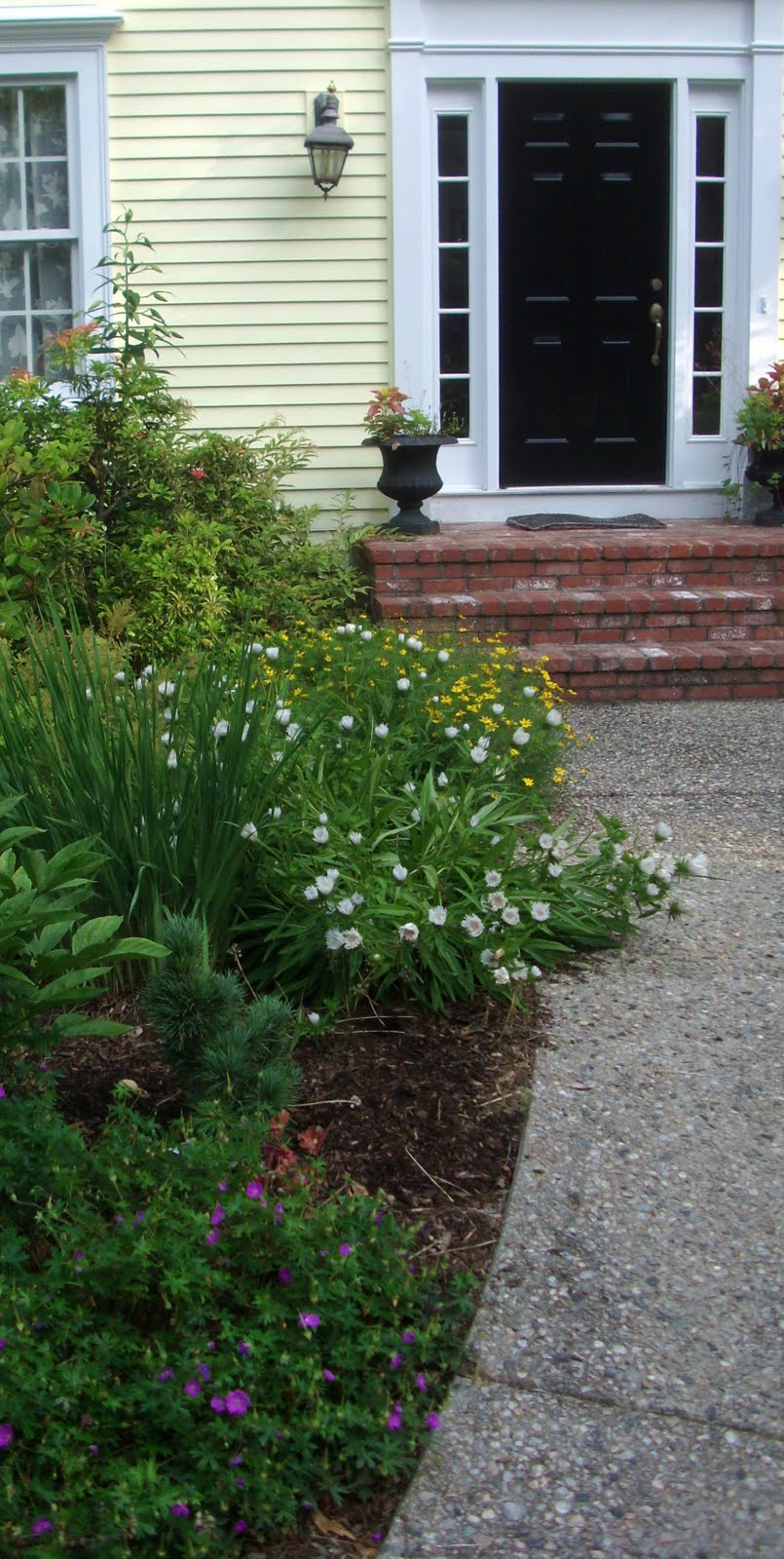
The balance of this relatively small garden area is now in its full mid-July bloom cycle.  The second photo, looking up the front sidewalk, shows the joy of texture and color (double click on any photo to see it at full size).  On the left side of the walkway, there's persacaria 'Painters Palette' and 'Red Dragon' that are thriving and close to four feet high.  Next to them is a yellow-gold variegated artemisia that requires constant attention to keep it from taking over the area.  On the right side of the sidewalk is a golden helenium that, for the monent, dominates the site.  Closer to the camera are sedum and huechera.
Farther up the sidewalk, white and purple Stokesasia (Stoke's Aster) have come into bloom and, beyond them, coreopsis 'Moonbeam'.  A week ago, there was only greenery.  Long blooming purple geraniums are in the foreground, together with the pygmy pine planted earlier this month.  Both the Stokesaia and coreopsis will be cut back after their initial blooms.  We'll get a few reblooms from the former perennial but the coreopsis will put on another, shorter display in September.
Looking away from the house along the perimeter of the outer sidewalk bed, a series of small pleasures show themselves.  There's a striped tiger grass and a Weigela 'My Monet'.  The tall purple plume is a thalictrum rochebrunianum 'Lavender Mist'.  We've continued inching out into the lawn to accommodate the maturing (and spreading) perennials.  Now, as we add more structure to the site, the bed needs to expand to allow for things like our pinus sylvestris 'Hillside Creeper' to more fully establish itself.
Perhaps most remarkable in all of this is that the elements of the bed's late July bloom cycle are already in place.  The hibiscus is showing buds and the Belamcanda Chinesis (blackberry lily) has grown to nearly five feet in anticipation of its own display.  There are tiny panticles on the oxydendrum that will become vividly white by month's end.

July 2, 2011

The Cascade Effect


Hosta Sgt. Pepper - but is it lonely?
Back in September 2009, I wrote about a phenomenon around our garden called ‘The Rule of Three’ which decreed that for every plant introduced onto the property, three holes needed to be dug.  Today, I am able to report on a corollary observable fact which I call ‘The Cascade Effect’.  It works like this:
Last week, Betty was at the American Hosta Society convention.  There, in an act of love and thoughtfulness, she bought for me a hosta called ‘Sergeant Pepper’.  The hosta itself is a delightfully variegated yellow plantain lily of considerable distinction, but its greater worth is in its name: the eponymous album is my favorite of all time.  However, the hosta did not come with any tag indicating the two most important facts needed before it could be planted, namely, how large it will eventually get and how much sun it will tolerate.

We have a home library that has marvelous horticultural resources, but there are more than 3,000 registered varieties of hosta and Hostapedia, the definitive work on the subject, is not among our collection.  An internet search was needed.

We had also recently been to Weston Nurseries which was holding its annual ‘customer appreciation event’ in which ice cream and pizza are liberally dispensed (plus discounts on plants and garden equipment) and among the things we brought home a Pinus strobus ‘Pygmaea’, a small and unusually shaped, slow-growing pine that we agreed would add needed structure to the inner sidewalk bed.

And so we went looking for just the right spot for our new pygmy pine.  As we walked the bed, the Cascade Effect began.  Though it had nothing to do with finding an appropriate site for our new evergreen, the first thing Betty noticed was that some Solidago (goldenrod to the rest of us) had insinuated itself in among our Siberian iris.  We removed it.  That led to her noticing that the last of the peonies had passed, and so the stalks that had held the peonies needed to be trimmed down to better shape the plant for the summer.  That was done.  Removing the peony stalks revealed that a few Allium, long-since past bloom but still with attractive umbrels atop four-plus-foot stalks, had broken over.  The ones with broken stalks were carefully culled.

The removal of the one set of stalks revealed spent bearded iris, which needed to be cut to the nearest leaf nodule and that action brought into sharp focus that several dozen native Columbine had formed seed heads that were about to populate the garden with unwanted progeny.  And, speaking of progeny, the ferns were rapidly overwhelming our stand of Eupatorium ‘Chocolate’ and needed to be brought back into line.  (Please keep in mind that all this activity is in one garden bed of less than 500 square feet.)

Pinus Strobus 'Pygmaea' (red arrow)
The Cascade Effect continued: spent salvia blooms were trimmed back severely and the height of later-blooming perennials were trimmed back to promote stronger growth.  The list goes on.

At last, the perfect spot was found for the pygmy pine.  The location, of course, was already occupied by a long-blooming geranium which needed to be relocated to extend a ‘river’ that flows through the bed.  The geranium was duly moved.  Also, a nearby Stoke’s aster, though not technically critical to the success of the new planting, was dug up and potted as a precaution.  Compost and mulch were brought in and, a mere two hours after the search for a site began, Pinus strobus ‘Pygmaea’ found its permanent home.

What has still not found a home, at least as of this writing, is Hosta ‘Sergeant Pepper’.  It still resides in its pot, awaiting that internet search to determine where on the property it will be happiest.