Showing posts with label oxydendrum. Show all posts

June 3, 2015

Three Down, Eight or Nine to Go....


For the past few weeks, there has seldom been a day when there has not been a copy of William Cullina’s ‘Native Trees, Shrubs and Vines’ or the American Horticultural Society’s ‘Northeast Smartgarden Regional Guide’ open on Betty’s desk.  Alongside those two tomes have been catalogs from several area nurseries.

It isn’t that Betty is expecting to find some heretofore unknown specimen of maple or oak lurking within those books.  Rather, she is looking for roughly a dozen very special trees. Specifically, native trees that will serve as the anchors for a brand new landscape.  The books are akin to audition tapes; a means of winnowing hundreds of candidates down to a few finalists.

Our oxydendrum will have flowers
on distinctive white panticles
We are starting with a blank canvas at our new home.  In the past two weeks we have carted away hundreds of cubic yards of rock and dirt officially classified by the University of Massachusetts Soil Laboratory as incapable of supporting plant life, and replaced it with eighteen inches of organics-rich screened loam.  We topped that loam with several inches of mulch, which now awaits a garden.

The garden is being designed to combine beauty with ecological sensitivity and low maintenance.  “Ecological sensitivity” translates to a strong emphasis on native trees and shrubs that will support the local population of birds and insects.  “Low maintenance” means exactly that: a garden that, once in place, doesn’t require long hours of maintenance to keep it looking attractive. 

This is amalanchier
'Autumn Brilliance'
The trees are the anchors.  There will likely be eleven or twelve of them.  On a recent weekday, we rode with senior horticulturalist Henry Schmidt of Weston Nurseries around their ‘back lot’, looking for the trees on Betty’s list.  The first tree we spotted was an oxydendrum, sometimes called a sourwood tree.  It’s a tree native to the northeast that is seldom seen, and that’s a shame.  An oxydendrum produces white flowers on long, distinctive panticles in midsummer; those panticles remain in place even as the leaves turn a vivid red in fall.  The tree before us was a magnificent specimen, standing nearly twelve feet tall.

Deep in the tree holding area, Henry stopped in from of a group of cornus florida.  Flowering dogwoods can be found everywhere in New England, but most of the dogwoods we see are the Asian kousa varieties, and Massachusetts is considered the northern limit of the native variety. Betty specified one that was not only native but with pink bracts or petals. We found a perfect specimen, more than ten feet tall, and it was duly tagged.  The third tree on the list was an amelanchier, or shadbush.  We spotted a multi-stemmed clumping version of this beautiful ornamental tree that feeds early pollinators, then the birds, and finally turns a rainbow of colors in the autumn. 

Two days later, we returned to the nursery with a borrowed pickup truck and our three purchases were effortlessly loaded by a guy driving a nifty machine that functioned like a giant hand.  The ‘hand’ picked up the tree, tilted it just so, and placed it in the truck.  We got them home.  So far, so good.

Here are first trees planted, our
oxydendrum and cornus florida
The problem was getting them off of the truck.  In the past, we’ve purchased much smaller trees.  If their root balls were wrapped in burlap, the width of the ball was usually a foot to eighteen inches.  These three trees, by contrast, had root balls two feet wide or even larger.  Moreover, they were wet.  I tried lifting one.  It would not budge.

After ten minutes of flailing and grunting, Betty grudgingly allowed me to go across the street to where our neighbors – a family roughly half our age – were entertaining some muscle-bound friends.  It turns out they had been watching our travails and were discussing whether to offer their assistance unprompted.  They were pleased to be asked to pitch in.  Even so, it took three of us to get the trees to their planned planting sites.  Had it not been for their intercession, those trees would likely still be on the truck.

Digging holes for the trees was another revelation.  Current theory says that you should dig “a saucer, not a teacup”.  Once upon a time, you dug a hole slightly larger than the root ball, lowered the tree into the hole, and filled the hole with enriched soil and water.  The problem with that practice was that the tree roots would get to the edge of that rich soil, encounter the lesser-quality surrounding stuff, and decide to stay put; resulting in a stunted tree with a poor root system.

Hence the saucer, which provides the tree with ample room to stretch out its roots.  The problem is that it require removing two to three times as much soil as the “saucer” technique.  The hole for each tree required up to an hour of digging, despite all that new loam.

But the trees are in.  They all stand up straight and face in the correct direction.  My one piece of advice to all assistant tree planters reading this is to always make certain that the Chief Tree Planter has specifically signed off on the tree direction, even at the risk of annoying the Chief Tree Planter by asking that unseemly question, “Are you sure?”  The alternative is trying to wrestle a tree’s root ball in a morass of mud; an exercise that can result in the uttering of many Bad Words.

And, did I mention that out expedition produced three trees?  And that there are eight or nine more to be located?  It’s going to be a long June….

October 23, 2012

A Welcome Burst of Late Autumn Color


We’ve had a great autumn here in New England.  Rainfall was close enough to normal that trees and shrubs were not stressed, and there were no heavy storms in September or October to strip plants of their foliage.  While it’s now slightly past peak, the colors this year have been delightful.

Our oxydendrum
Our property offers a tutorial in the use of uncommon trees and shrubs that extend the season’s color.  For example, the sourwood (oxydendrum) we planted four years ago in the inner sidewalk bed has started to hit its stride, growing by about a third in size this year.  The unexpected delight, though, is the brilliant, multiple-shades-of-red to which its previously green leaves have turned in the past two weeks.  We’re not counting on the show to last past the end of the month but, for now, it’s an eye-catching display.

The left-hand side of the shrub bed.  That's the smokebush in purple at farthest
left with 'Miss Rubyspice' in front of it.
The shrub bed that lies at the front of our property has the best autumn display. The bed is comprised mainly of drought-tolerant natives, and it gets a great deal of sun and wind.  Stretching more than a hundred feet from end to end, it provides space for roughly 30 specimen shrubs.  Here’s how it looked this morning (October 23) There’s a purple smokebush (Cotinus coggygria) with purple-brown leaves that soar above the bed.  In front of it is a clethra ‘Miss Rubyspice’ with brilliant yellow leaves.  The brown theme is continued with a small Enkianthus, a slow-growing Asian native that has settled happily into the bed.  There are two Devil Ninebarks (Physocarpus opulifolius), a ‘Diablo’ with burgundy-colored foliage that will linger well into November, and a Dart’s Gold that will keep its golden leaves for another one-to-two weeks.

Fothergilla Mt. Airy; each leaf
is like a painting
Scattered among the shrubs in the bed are several that retain their leaves – and striking color - for an extended period.  One of my favorites is Fothergilla.  We have two in the shrub bed:  Blue Shadow and Mt. Airy.  Both produce a dazzling palette of autumn colors on each leaf and both are long-lasting.  Our Carolina sweetshrub (calycanthus) now shows with large, lemon-yellow leaves that will reward us with color well into November.  Our two wigelia ‘Wine and Roses’ have turned a speckled dark red and will stay that way until the weather turns bitter.  

Spirea Ogon Mellow Yellow is just
starting its long-lasting autumn turn
The two champs, though, are an itea ‘Henry Garnet’ (sometimes called a Virginia sweetspire) and a spirea ‘Ogon Mellow Yellow’.  We have two iteas on the property.  They’re a pretty green from spring through September, then begin a metamorphosis to a coppery color with specks of red, yellow and brown.  Last year, the one at the front of the property eventually went bare sometime in late December.  The second itea is in a sheltered area behind our house, and it lost its foliage only when the new leaves pushed out in late April.

‘Mellow Yellow’ puts on two shows each year.  The first is in very early April when it flowers a pale white-yellow when little else is in bloom.  Now, its profusion of small leaves have turned a specked yellow red and orange.  Those leaves will still be in place for Christmas.

Two other deciduous shrubs are still green: a viburnum ‘Catskill’ will not turn yellow until the beginning of November.   Its color will last about three weeks.  Finally, an oakleaf hydrangea (hydrangea quercifolia) will stay stubbornly green until well in November, after which its leaves will gradually become a mottled brown.

Ours was not an ‘instant’ landscape.  The shrub bed, like everything else, has evolved organically over a dozen years with lots of trial and error.  But now, in late October, it appears as a coherent whole.  Someone looking at that bed today might conclude that we put it together with the purpose of showing visitors how to have late-autumn color with a variety of leaf textures and sizes.  They’d be wrong, but I wouldn’t correct their perception.
The right-hand side of the shrub bed.  The large yellow shrub is calycanthus.

July 16, 2011

Pictures of Lily

Two weeks ago, I wrote of working in the inner and outer sidewalk beds of our garden - the seemingly never-ending series of small chores that are part and parcel of gardening.  At the time I wrote that piece, I perceived the garden as being at or near its seasonal peak.  Boy, was I wrong.
This morning, I walked out to get the Sunday newspapers and was confronted by the image at left: a clutch of two dozen yellow-white lilies nearly five feet tall - taller than the oyydendrum growing next to it.  Framing the lilies, a blaze of red/purple astilbe.  Neither plant was in bloom last week.  It's astonishing what can happen in a garden in less than two weeks.
The balance of this relatively small garden area is now in its full mid-July bloom cycle.  The second photo, looking up the front sidewalk, shows the joy of texture and color (double click on any photo to see it at full size).  On the left side of the walkway, there's persacaria 'Painters Palette' and 'Red Dragon' that are thriving and close to four feet high.  Next to them is a yellow-gold variegated artemisia that requires constant attention to keep it from taking over the area.  On the right side of the sidewalk is a golden helenium that, for the monent, dominates the site.  Closer to the camera are sedum and huechera.
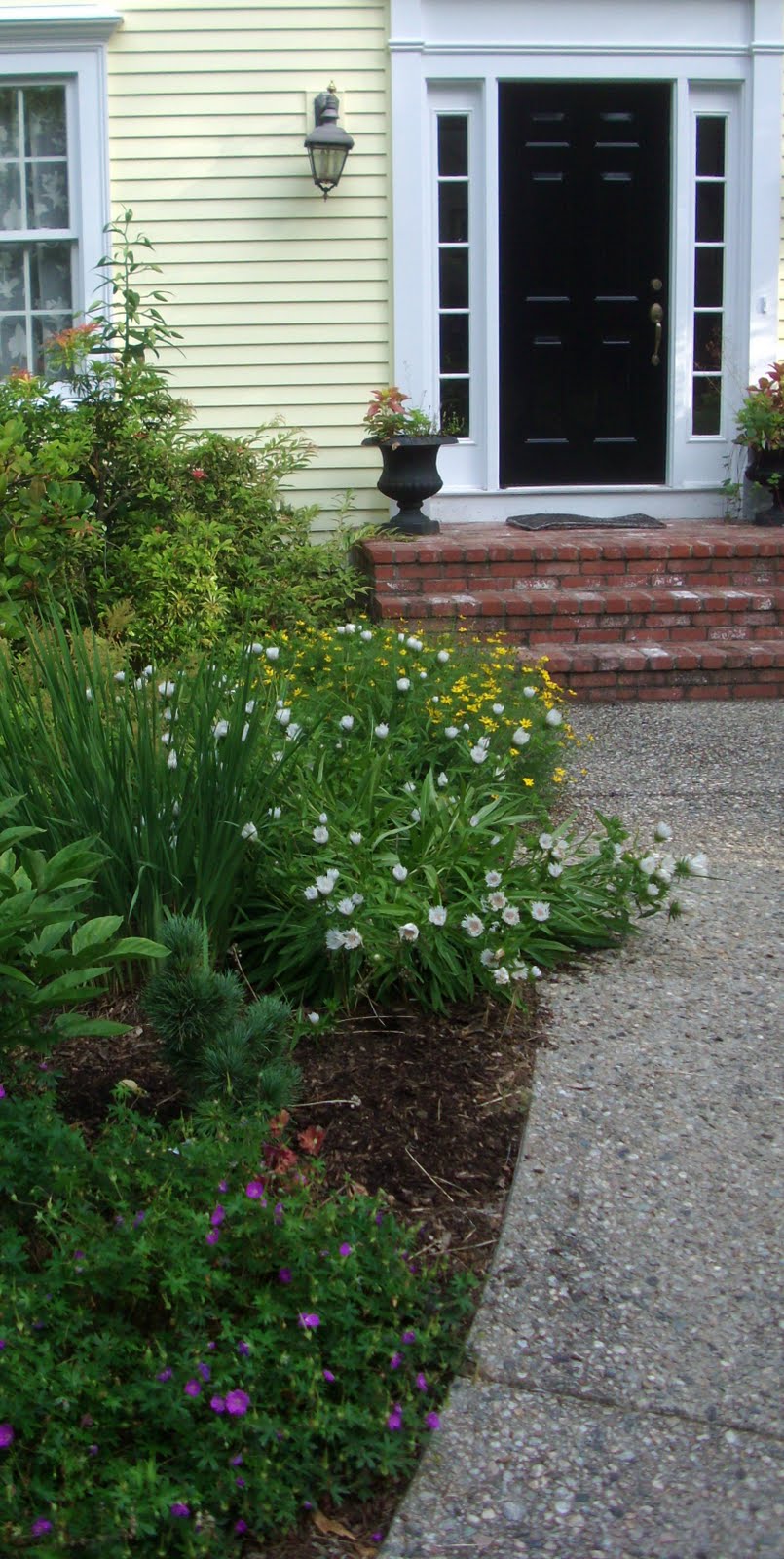
Farther up the sidewalk, white and purple Stokesasia (Stoke's Aster) have come into bloom and, beyond them, coreopsis 'Moonbeam'.  A week ago, there was only greenery.  Long blooming purple geraniums are in the foreground, together with the pygmy pine planted earlier this month.  Both the Stokesaia and coreopsis will be cut back after their initial blooms.  We'll get a few reblooms from the former perennial but the coreopsis will put on another, shorter display in September.
Looking away from the house along the perimeter of the outer sidewalk bed, a series of small pleasures show themselves.  There's a striped tiger grass and a Weigela 'My Monet'.  The tall purple plume is a thalictrum rochebrunianum 'Lavender Mist'.  We've continued inching out into the lawn to accommodate the maturing (and spreading) perennials.  Now, as we add more structure to the site, the bed needs to expand to allow for things like our pinus sylvestris 'Hillside Creeper' to more fully establish itself.
Perhaps most remarkable in all of this is that the elements of the bed's late July bloom cycle are already in place.  The hibiscus is showing buds and the Belamcanda Chinesis (blackberry lily) has grown to nearly five feet in anticipation of its own display.  There are tiny panticles on the oxydendrum that will become vividly white by month's end.