Showing posts with label coreopsis 'Moonbeam'. Show all posts

May 10, 2012

Lookin' Out My Front Door

(Update:  On May 28, the three robin nestlings turned into fledglings.  As robins do not return to a nest, we have the use of both our library and the inner sidewalk bed again.)

For the past two weeks, I've been unable to use my library.  The problem is that a robin has built a best in the thuja occidentalis just outside, and everytime I open the door to the library, it spooks the robin sitting on three eggs.  I do not know how robins choose their nesting sites but a western red cedar right up against a house seems like a reasonable choice.  The nest is on the 'house' side of the tree and the foliage is quite thick.  But the nest is just four feet off the ground and the thuja rises more than 15 feet at this point.

Our piers andromeda with its new
pinot noir-colored foliage.  Behind it
is the pink rhododendron that just
bloomed this week.
Just outside another of the library's windows is a beautiful sight:  a pieris (andromeda) in its spring glory.  We planted the pieris a decade ago because it's an ideal foundation shrub for New England.  It's an evergreen and keeps its white canticles well into winter.  Our specific cultivar has lightly speckled leaves that give it added visual interest.  But the real payoff is in April when it produces new foliage: a red the color of a pinot noir.  That red will linger into mid-May when the leaves begin to turn green.

Looking left, four
dependable foundation
shrubs: ilex, pieris and
rhododendron.
Just in front of the pieris is a rhododendron that burst into bloom just this week.  The rhodie is the only thing in that part of the garden (the inner sidewalk bed) that survives from before our ownership of the house.  For the first seven years of its existence, the rhodie sat in the perpetual shadow of a five-clump river birch.  The birch was dug out by hand (as opposed to by machine) in order to save the many perennials in the bed.  I made a point of preserving the rhododendron's root system during the excavation.

The rhodie has repaid our kindness by thriving.  It has tripled in size and bloomed prolifically ever since.  Behind the pieris and the rhodie in the photo above is the newly-leafing-out oxydendrum.  This is the first year it is starting the season with the same branches from past year.  In each of the past four years, snow had taken out as much as a third of the existing branch system.

Looking left from the front door you see an ilex (holly) in the foregound; a peony growing quickly; another, much less auspicious andromeda, and a leucothoe.  At the corner is a pair of rhododendron blooming white.  All four shrubs are great foundation plants for cold climates; all are evergreens and all have thrived with their southeastern exposure.  The shrubs have been repeatedly moved as they have grown; the area once sported another ilex and a smaller rhodie.  The leucothoe and pieris have expanded into their places.

The inner and outer sidewalk beds,
as viewed from the front door. 
Double-click on the image to see
details.
Looking straight out the door is a winderful sight that will grow and change as the season progresses: the inner and outer sidewalk beds.  On the right, starting closes to the camera, is the first growth of coreopsis 'Moonbeam'.   Just beyond it are a growing family of Stokesia laevis, or Stokes' Aster, which will bloom a prolific white and blue in June.  To their right is white astilbe.  There are at least a dozen peonies growing in this bed together with Siberian iris and heuchera.  I'll show them as the season progresses.  The blue flowers you see are muscari, more commonly known as grape hyacinth.

On the left, in the outer sidewalk bed, are geranium, heuchera of every color, alchimella or lady's mantle, phlox, and literally dozens of specimen perennials that will make themselves know as the season progresses.  There's a daphne Atlantica that is starting to overhang the sidewalk.  To its left is a now-golden, but soon to be red Japanese maple.

These beds have undergone a gradual transformation over the past few years.  Once almost all perennials, lower-maintenance shrubs have been introduced and less aggressive perennials introduced.  I promise to continue to update the images as the season progresses.

July 16, 2011

Pictures of Lily

Two weeks ago, I wrote of working in the inner and outer sidewalk beds of our garden - the seemingly never-ending series of small chores that are part and parcel of gardening.  At the time I wrote that piece, I perceived the garden as being at or near its seasonal peak.  Boy, was I wrong.
This morning, I walked out to get the Sunday newspapers and was confronted by the image at left: a clutch of two dozen yellow-white lilies nearly five feet tall - taller than the oyydendrum growing next to it.  Framing the lilies, a blaze of red/purple astilbe.  Neither plant was in bloom last week.  It's astonishing what can happen in a garden in less than two weeks.
The balance of this relatively small garden area is now in its full mid-July bloom cycle.  The second photo, looking up the front sidewalk, shows the joy of texture and color (double click on any photo to see it at full size).  On the left side of the walkway, there's persacaria 'Painters Palette' and 'Red Dragon' that are thriving and close to four feet high.  Next to them is a yellow-gold variegated artemisia that requires constant attention to keep it from taking over the area.  On the right side of the sidewalk is a golden helenium that, for the monent, dominates the site.  Closer to the camera are sedum and huechera.
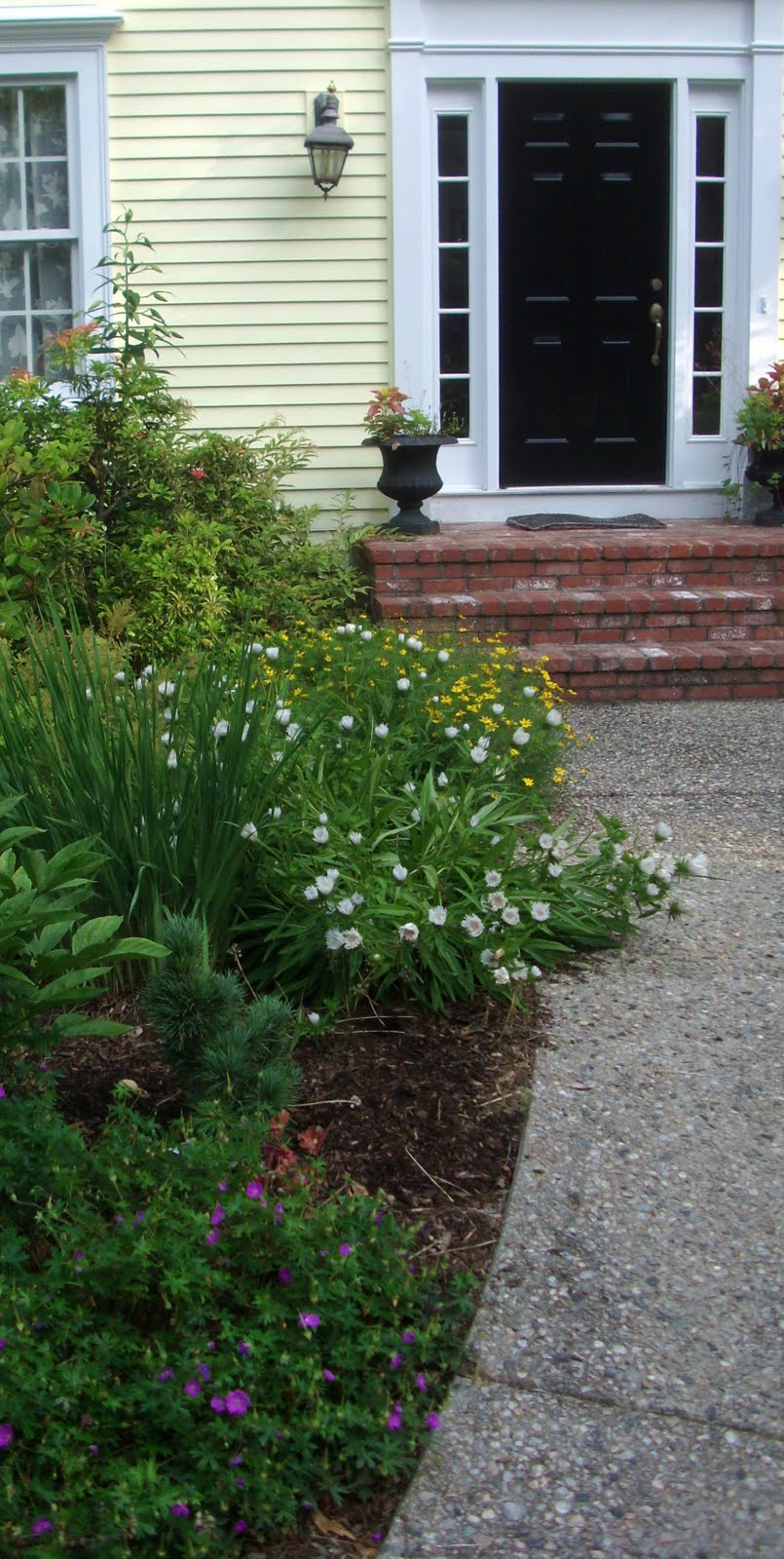
Farther up the sidewalk, white and purple Stokesasia (Stoke's Aster) have come into bloom and, beyond them, coreopsis 'Moonbeam'.  A week ago, there was only greenery.  Long blooming purple geraniums are in the foreground, together with the pygmy pine planted earlier this month.  Both the Stokesaia and coreopsis will be cut back after their initial blooms.  We'll get a few reblooms from the former perennial but the coreopsis will put on another, shorter display in September.
Looking away from the house along the perimeter of the outer sidewalk bed, a series of small pleasures show themselves.  There's a striped tiger grass and a Weigela 'My Monet'.  The tall purple plume is a thalictrum rochebrunianum 'Lavender Mist'.  We've continued inching out into the lawn to accommodate the maturing (and spreading) perennials.  Now, as we add more structure to the site, the bed needs to expand to allow for things like our pinus sylvestris 'Hillside Creeper' to more fully establish itself.
Perhaps most remarkable in all of this is that the elements of the bed's late July bloom cycle are already in place.  The hibiscus is showing buds and the Belamcanda Chinesis (blackberry lily) has grown to nearly five feet in anticipation of its own display.  There are tiny panticles on the oxydendrum that will become vividly white by month's end.