Showing posts with label Master Gardeners. Show all posts

March 17, 2026

Gardeners Getting Together


There is a parallel universe in which, for $25, you can get an entire day of gardening education, including lunch. Last Saturday, I had the good luck to find myself in that universe.

Me, presenting. Double-click to see
at full screen size and resolution

Master Gardeners are a self-selected group of amateurs who take gardening seriously. They study for and have to pass a fairly rigorous set of courses to qualify; but that’s just the beginning. They start giving back through volunteering and through continuing education. The best part is that they’re almost always smiling.

In Kentucky, Master Gardeners are organized through the University of Kentucky Extension Service and, according to the KEMG website, sixty-three counties have programs. One of those is Hardin County where the Lincoln Trail Master Gardeners make their home.

This year, the Lincoln Trail Master Gardeners organized an event titled, ‘Can U Dig It?’ at the Hardin County Extension Service in Elizabethtown. The building is a palace. It has classrooms that will comfortably seat a hundred, state-of-the-art projection, soaring atria, and ample public spaces. Kentucky is a state that apparently takes agriculture seriously.

Valerie Hicks, looking
slightly frazzled

I had spoken in Kentucky quite a few years earlier at the state’s Garden Club Federation annual meeting. Someone remembered me from that event and thought it might be nice to offer some comic relief to close out the day. An energetic lady named Valerie Hicks got in touch and we worked out a special program titled, ‘Real Life Is Not a Walt Disney Film’. The presentation was promoted as telling the true story of two people on Social Security (and I am quoting the program) “doing what no one in their right mind should undertake: building a half-acre pollinator-friendly native plant garden that contains not a square inch of grass.”

Peggy Cornet at her presentation

I had several tough acts to follow, but the one that riveted my attention was one titled ‘Rooted in the Past 250 Years’. The talk was delivered by Peggy Cornet, who has the title of Curator of Plants at Monticello. Monticello is, of course, Thomas Jefferson’s estate in Virginia. Ms. Cornet took us on a tour of the garden and, more important, a tour of the mind of Mr. Jefferson; who was at least as interested in horticulture as he was in writing the Declaration of Independence. She shared with the audience his hand-written notes on blooming times and the plant specimens that most interested him.

My immediate reaction after her talk concluded was that I should fake a sudden illness and plead to be released from my speaking obligations. She was that good.

Me, peddling books

As I interacted with the attendees that day, what was most striking was their enthusiasm and energy coupled with the reality that these people were having an exceptionally good time. The laughter was unforced. The stories they exchanged were acknowledged with many nods of agreement and “I’ve been there, too,” expressions on their faces.

These were dedicated gardeners in their natural elements. It was an honor to be there, even though I was technically hired help.

 A few of the CanUDigIt? attendees

Except I never felt for even a moment that I was merely being tolerated. I was included in all manner of discussions, especially over lunch (ham on a croissant with lettuce, tomato, and smoked honey) where gardeners asked me how things were done in New England. I even had my own private wonderful tour guides – Keith and Karlene Well – who introduced me to home-made bourbon ball ice cream at Drewster’s, a local shop where the staff is as friendly as the product is delicious.  It was sufficiently delectable that I insisted on stopping there on the way back to the airport.

Perhaps the best part is that I can hope to have a repeat experience in just a few weeks. Another group of Master Gardeners, this one in McHenry County, Illinois (northwest of Chicago) has invited me to present at their ‘Gardenfest and Expo’ the second Saturday in April in Crystal Lake. While I’m not a Master Gardener, I do have a badge that says I’m a Master Gardener Groupie.  I intend to wear it proudly.


July 7, 2018

Garden Tour at the Sanders'!


Garden tours are educational and instructive.  They open your eyes to new vistas and ways of thinking about horticulture.  They are, in short, wonderful.

Except when it’s your garden that’s on tour.  I know this because, last month, our garden was the one everybody wanted to see. 

Three years ago it was a blank slate
Betty and I began planting our ‘dream retirement garden’ in June 2015.  As readers of this column know, we started with a true ‘tabula rasa’ – we had taken out 947 cubic yards of what could politely be called ‘builder’s crud’ and replaced it with 18 inches of screened loam into which we would plant trees, shrubs and perennials… and not a single blade of grass.

On the back patio
Fending off requests to see the garden was easy for the first two years – there really wasn’t a lot to see.  Last year, we pleaded for more time with the explanation that, well, we needed more time.  Trees needed to grow some more; shrubs still had to spread out their roots, and perennials were just starting to fill in the gaps between them.

The back garden
But this is the start of the garden’s fourth year.  That old but accurate aphorism about “sleep, creep, leap” has proven true.  And so, Betty agreed to open our garden for two hours for Master Gardeners. 

You would think that having a group in your garden would be a snap… put out signs, bake some cookies and set out the lemonade.  No, that’s not the way it happens.  And it especially doesn’t happen that way if the group in question has more than a passing knowledge of horticulture and a keen eye for detail.

The view from the bench
For three weeks before the event, Betty labeled plants.  We have three viburnums behind the house.  We even know what kind of viburnums they were because we’ve saved all their paperwork.  But which one is which?  This is why Google Images exists, and I suspect the fine folks in Mountain View are compiling quite an interesting, if puzzling dossier about our internet search habits.  And, of course, common names are so… common.  Why call it an ‘arrowwood viburnum’ when ‘Viburnum dentatum’ is more botanically correct?

Shasta daisies are at the 'leap' stage
And then, of course, there’s the weeding and deadheading.  Every bed was gone over multiple times, and paths were plucked of everything even resembling a weed.  Of course, our paths are also supposed to be ‘natural’.  Our heucheras and tiarellas are prolific self-seeders.  One especially fecund cultivar had cute brown and gold seedlings popping up everywhere.  How many stayed and how many were composted was a question being answered up to the morning of the tour.

The asclepias bloomed just in time
There is also the ‘prayer factor’, otherwise known as “will it bloom in time?” and “will it still be in bloom?”  We have a stand of gorgeous Asclepias tuberosa, also knows as butterfly weed.  It is golden yellow and is a magnet for every pollinator in town.  Up until Saturday morning, it appeared as though only a single stem would be showing color.  But nearby, an entire colony of Asclepias syriaca – rose milkweed to the rest of us – blossomed with white flower clusters that, while not as showy as its cousin, perfumed the air magnificently.  They were a perfect complement to the Asclepias tuberosa, which opened a dozen flowers just as cars began arriving.

No one seemed to believe there's
not a blade of grass on the property
Finally, there was the scourge of parking.  We are on a narrow, winding road that is a favorite of bicyclists and walkers.  We have a parking pad at the front of the property that will hold three cars and a driveway that will accommodate four more.  Fearing being blocked in, no one wanted to use the driveway and, when the pad filled up, visitors began parking on the street (Betty had provided detailed instruction of how to park at a nearby elementary school). 

A river of geranium
Visitors ignored the school parking option.  They not only parked on the street; they parked on both sides of this narrow, winding road.  It did not take long for the local police to take notice and we soon had two cruisers, one with flashing lights, in front of our house.  It took all of Betty’s charms and persuasive powers to get everything back to normal.  I am in awe of her for this.

Was it worth it?  Of course.  The compliments were both genuine and numerous.  People said they learned and called what Betty has created, ‘the new American yard’.  Am I in a hurry to do it again soon?  If you have to ask….
And then, we had the garden to ourselves again!

May 15, 2018

The Little Garden That Could

Medford, in the upper left corner
of this map, is just five miles
from Boston's Financial District.
The garden is located in that
first 'e' in Medford.

Three years ago, Joan Parker was feeling frustrated.  A long-time volunteer at a church-run food cupboard in Medford, Massachusetts, each week she parceled out canned and packaged foods to the mostly Haitian immigrants served by the charity.  While what she provided helped needy families stretch meager resources, Joan felt she should be doing more.

It wasn’t that Joan didn’t know how to grow vegetables.  As a Master Gardener, Joan helped maintain a 6,000-square-foot vegetable plot at the Elm Bank headquarters of the Massachusetts Horticultural Society.  Most of the output of that garden made its way to food banks in towns adjacent to Wellesley, where Mass Hort is located.  Joan began to wonder if it might it be possible to create such a garden in Medford, a city just a few miles north of Boston’s Financial District?

Joan Parker
At the Mass Hort garden, Joan worked alongside Susan Hammond.  (I should add at this juncture I have known Susan for the better part of a decade.  Susan was Betty’s ‘protégé’ and the person to whom she handed off responsibility for that garden when Betty’s growing Garden Club Federation responsibilities took her in a new direction.)

Joan and Susan talked about the potential challenges of an urban, food-cupboard-oriented garden.  As it turned out, changes in the focus and direction of the Mass Hort garden made that project less attractive to the volunteers who worked there.  The Medford project seemed like a more freewheeling ‘re-boot’ for gardeners looking for a challenge.

The garden hugs one side
of the church and several
sites around the Rectory
Joan and Susan set about to design a model garden smack in the center of Medford.  Their sponsor was the Unitarian Church of Medford, a venerable institution that also sponsored the food cupboard where Joan volunteered.   Initial plans were for a very low budget garden, funded by the volunteers, using the existing soil and adding compost.  The site would be the (mostly) sunny lawn of the church rectory.  Master Gardener volunteers would run the garden.  A few hundred dollars seemed more than adequate to get the garden up and running, buy seeds, all those sorts of things, and a drip irrigation system could wait for a while.

Because the soil contains high levels
of lead, all planting is in raised beds.
That's Susan Hammond at right.
Which was when reality reared its ugly head.  The first problem was the site.  The grass lawn turned out to be integral to the church’s ministry. Groups met there and services were held there.  Joan and Susan regrouped.  They proposed a dispersed garden utilizing bits and pieces of church property.  ‘Terrific!’ was the response.  Soil tests were performed and plans were made to begin plowing up the ground to start the garden.

Then, those soil tests came back.  The soil contained toxic levels of lead.  All that lead paint and lead from other sources had left the ground utterly unsuitable for the growing of anything planned for human consumption.

To ensure no bed lies
fallow, these cups hold
spaces where a squash
crop will be planted next
OK, they concluded, we’ll do taller raised beds.  On further investigation, the raised beds would need to be kept completely apart from the soil underneath them.  OK, they thought, double-height raised beds with impermeable barriers between the beds and the soil. 

There went the budget. However, there was still a need for this garden, so the food pantry applied for and received a $1,000 grant from the Massachusetts Master Gardener Association.

In the meantime, other Master Gardeners were eager to start on the project.  They surveyed food cupboard recipients and got input on what kinds of fresh vegetables would be most welcome.  A request for exotic seeds went to Master Gardener Deb Haley, who investigated and sourced Haitian varieties.  Master Gardener Gretel Anspach provided access to large quantities of onions and leeks including specialty cooking onions.

This weekend, I finally got to see the garden I’ve heard about for three years.  The Master Gardeners opened it for visitors, and I was part of a tour group led by Susan Hammond. 

The ollas buried in these 'bag beds'
provide continuous moisture to
the vegetables growing there.
The garden is a small masterpiece.  It hugs one side of the church with raised beds for vegetables and an in-ground perennial garden.  Across the street at the rectory, three sets of distinct vegetable beds ring that grass lawn while leaving the center available for church functions.  All the tricks of the trade are used to coax the maximum production of vegetables from the site, including succession planting and space holders for second crops even as the first round are little more than seedlings.  Ollas, ceramic jugs embedded in the soil, provide continuous moisture because the drip irrigation system can be used only when volunteers are present (the faucet upon which the drip system is dependent has an unfortunate leak).

These handful of beds, with the help of
ten volunteers, delivers a bounty
of fresh produce every week.
This year’s first distribution of vegetables – pea greens – will be made in mid-May.  Thereafter, every week, a growing cascade of Haitian favorites comes to the food cupboard, with ten volunteers working the garden on a regular schedule.  The last distribution coincides with Thanksgiving, when the last of the autumn cornucopia is handed out.

It is an urban success story; proof that, with perseverance and resources, gardeners can overcome almost any obstacle.  It isn’t ‘The Little Garden That Could’; it’s The Little Garden That Does.

March 13, 2013

A Winter Respite III

Boston had an inch of rain last night.  That soaking, coupled with temperatures in the 40s, has produced a landscape of ugly, brown snow banks and six-inch-deep puddles that coat all cars with grey grime.  In a word, ugh.

I have spent the past four days at the Seaport World Trade Center creating a small taste of spring.  In 1200 square feet, Paul Miskovsky has created a vignette of an idyllic May day in the country, complete with chickens.  His small crew, aided and abetted by a phalanx of Master Gardeners, built the display between Saturday morning and Tuesday noon.  And, right up until Carolyn Weston shooshed everyone off the floor in advance of the judges, we were primping and grooming plants, spreading compost and removing anything that had even a whiff of imperfection.

That's Paul Miskovsky, sweeping the
area around the exhibit before
sweeping the awards
Being only a Master Gardener Groupie, my job was spreading mulch (Saturday), hauling plants (Sunday), lifting plants (Monday) and spreading compost (Tuesday).  But I can point to the exhibit and say that I had a hand in it.

Tuesday evening, we all gathered together for a quiet party in the exhibit: a well-deserved celebration.  Paul's exhibit fairly well swept the awards, including 'Best of Show', the topmost one.

If you live within a few hour's drive of Boston and desperately need proof that the wet, dreary winter is almost at an end, please go to the Boston Flower & Garden Show.  It is a marvelous event.  Paul's exhibit is just one of two dozen such vignettes.  There are also stunning floral design competition, a knock-your-socks-off photography competitions, rooms full of amateur horticulture (including a blue ribbon croton from Betty Sanders), and vendors selling everything under the sun that has anything to do with gardening.

These photos were all taken on Tuesday at noon.  They show the exhibit as it was just before judging, with everything designed to be at the peak of horticultural perfection.  Double-click on any photo to see it at full-screen size.

March 23, 2012

The Brief Life But Enduring Legacy of a Flower Show Garden


It is not part of my formal curriculum vitae but, for the past three years, I have been chairman of Blooms! at the Boston Flower & Garden Show.  The word ‘chairman’ implies some honorific: it sounds as if I wrote a large check and an organization – in this case, the Massachusetts Horticultural Society – gave me a title with no responsibilities other than to write another, presumably larger, check at some point in the future.

That is not the case.  I became chairman because someone needed to organize Mass Hort’s multiple efforts at the show which came into being after the demise of the much beloved but startlingly unprofitable New England Spring Flower Show.  A for-profit trade show group created the Boston Flower & Garden Show; Mass Hort was retained to produce the ‘amateur horticulture’ elements of the show.  I took on the task of running ‘Blooms!’ (the collective name for those elements) when it became apparent no one else wanted, much less would accept, the job (not the least because the sum total of the remuneration for a thousand hours of work is reimbursement for parking while at the show).

Saturday morning at 8 a.m.  There's
nothing but a cavernous hall and
a show-polish line (double-click on
any photo to see it full-screen size)
At the 2012 Boston Flower & Garden Show, Blooms! comprised two divisions of floral design competition (114 designs over two entry days), a large Ikebana display (28 displays over two entry days), a photography competition (36 exquisite entries from around the country), miniature gardens (a fascinating and highly specialized corner of horticulture), a book store, 400+ individual entries of amateur horticulture and nine group collections arrayed in structures. It also encompassed a display garden, and it is that garden about which I write today.

When you or I create a garden for our home, we may sketch it out on paper, walk our property and consider the views, and then visit nurseries and garden centers to find the trees, shrubs, perennials and annuals that will form the garden.  We will add benches, planters and other hardscape elements; changing things as we go until we are satisfied with the result.  And, if we are not pleased, we dig out the trees and re-arrange them until we get it right.
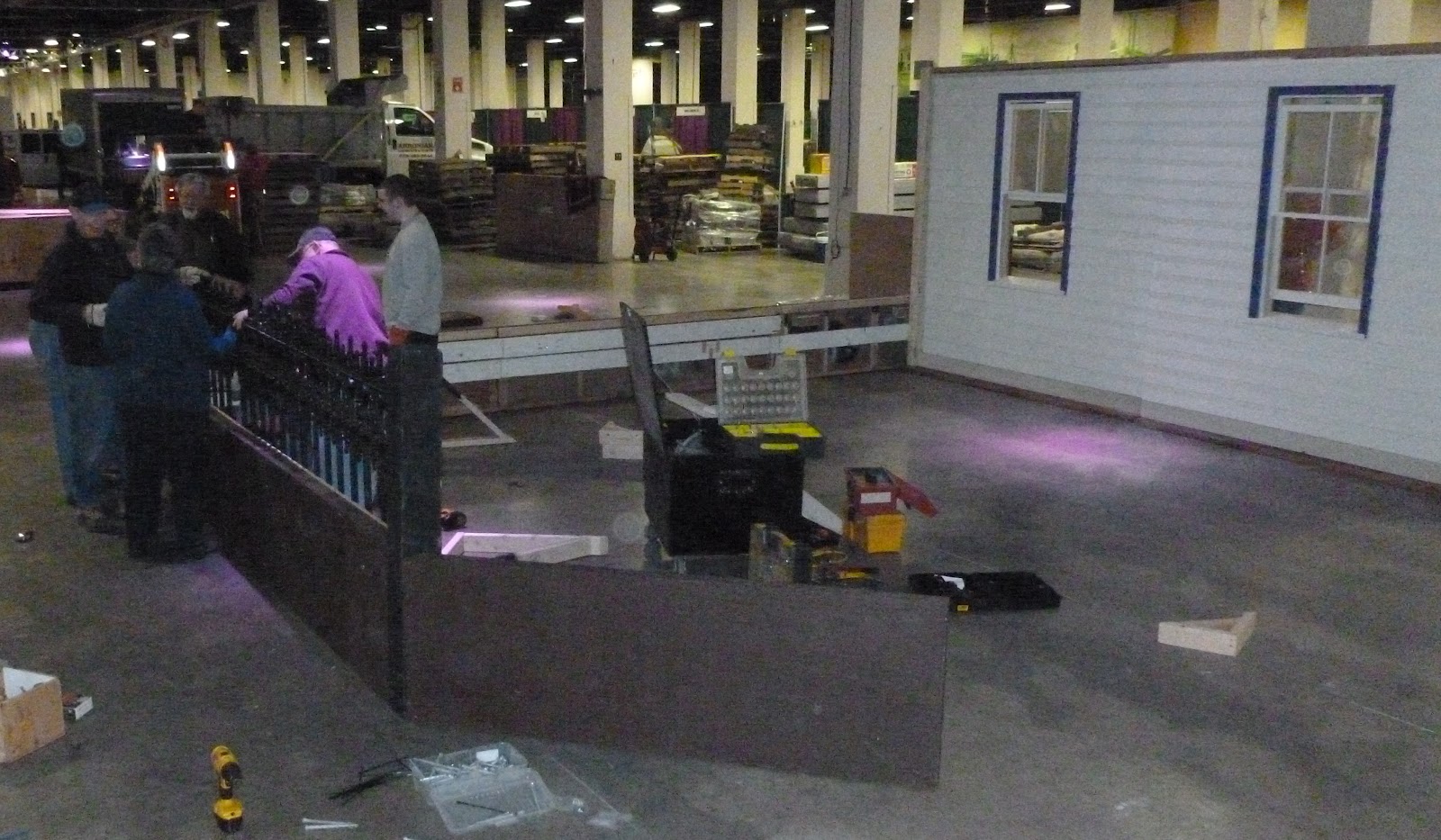
The wrought iron fence starts
to take shape
A garden at a flower show incorporates almost none of these conventional elements.  Instead, it is gardening as theater; except that, because the garden would bear Mass Hort’s name, it was also gardening as education.  Not even the size of the garden was fixed: as exhibitors were added and dropped out, Mass Hort’s allotted garden space grew from less than 400 square feet to eventually encompass nearly 1200 square feet of floor space.

The key differences between that garden in your side yard and one on the floor of a flower show are these:  first, the flower show garden must be built from scratch in three days, exist for five, and then be torn down in one.  And, second, the garden must be in full, glorious bloom for those five days.

The first segments of the townhouse
are raised onto the concrete wall
These were the parameters and obstacles that I faced when planning began for Mass Hort’s garden.  In turn, I had four secret weapons in my arsenal.  One was Paul Miskovsky, a Cape Cod landscaper who is a veteran of dozens of flower shows.  The second was my wife, Betty, who knows floral design had created gardens for five previous flower shows.  The third was Clark Bryan, Mass Hort’s Director of Operations, whose unique combination of organizational skills and mechanical competence is unparalleled.  The fourth is the Massachusetts Master Gardener Association, a group of people for whom horticulture is a passion and who collectively possess the skills to build anything from a garden shed to, probably, an aircraft carrier.

Behind the townhouse, a mass of
stabilizers kept it in place
I should also mention at this point that a flower show garden is a horrendously expensive undertaking.  A thousand-square-foot exhibit can cost between $50,000 and $75,000 in labor and materials.  My budget for the garden was $6,000 (unless I wanted to give up my parking stipend, in which case the budget could be expanded to about $6,084).  In other words, creating this garden would involve a lot of begging.

Every flower show has a theme and the one for the 2012 Boston Flower & Garden Show was ‘First Impressions’.  I knew that I wanted a house as the backdrop for the exhibit, and I described the quest to build that backdrop back in January (see, ‘Would You Like a Townhouse to Go with that Garden?’).  Assembling the plant material was touch and go:  Paul Miskovsky agreed to supply most of the ‘big’ items – the trees and shrubs, especially.  Betty and some of her more larcenous Master Gardener buddies prowled New England Grows and came away with hundreds of smaller shrubs, perennials and annuals.  Various growers with a soft spot for Mass Hort offered flats of plants.

A small portion of the plants planned
for use in the exhibit
Why so much?  Because the rule of thumb is to start with three times the plant material you think you’ll need.  Come show time, one-third won’t be blooming (or be past bloom) and another third won’t look right in the exhibit.

At 8 a.m. on Saturday, March 10, Betty, Clark and I assembled at the Seaport World Trade Center.  We found a cavernous, empty hall.  On the floor, Paragon’s Show Director, Carolyn Weston, has put down the ‘shoe polish line’ (double-click on the top photo to see the shoe-polish line); white marks indicating the corners of our exhibit.  The rest was up to us, and luck.

Clark Bryan, at left
This would be a good time to say a little more about Clark Bryan.  His role as ‘Director of Operations’ at Mass Hort is something of a misnomer.  ‘Chief Magician’ would be a more appropriate title.  His job for the past four years has been to make things happen without the use of actual money.  If I said I needed that aircraft carrier mentioned a few paragraphs above, three things would happen: first, he would roar that what I wanted was impossible, and he would stomp off in a huff.  Second, he would re-appear, three days later, with a thick binder containing plans for an aircraft carrier and little slips of paper indicating favors owed to him for things done decades ago.  And, two weeks later, I would come to Mass Hort and find a working, Nimitz-class aircraft carrier outside his office, which he would say he whipped up at home over the weekend.  He is the ultimate can-do guy.

At 8:20 a.m., trucks began rolling into the hall.  Out came the segments of the townhouse, ready to be assembled like a Tinkertoy set; a pre-built, ready-to-screw-together kickboard; a hundred concrete blocks and 200 bricks; 40 feet of antique, wrought-iron fence; and enough braces, clamps, screws, and ancillary tools to stock the grand opening of a Home Depot.  By 8:30, a cadre of volunteers working under Clark’s direction was building the two-foot-high concrete block wall on which the townhouse would rest.

The kickboard was a giant jigsaw
puzzle, ready to be bolted together
We worked steadily though the day.  Ten hours later, the kickboard was in place and the town house rose a majestic 16 feet from the floor of the convention hall.


Sunday morning brought the plants.  A truck from Olsen’s Greenhouse, to which we had paid $1,000 of our precious budget for nearly 200 pots of perfectly color-coordinated tulips and daffodils, was already parked outside.  An hour later, the first of three trucks bearing plants, trees and shrubs appeared.  Two days earlier, Betty and two fellow Master Gardeners had gone through two Mass Hort greenhouses, marking plants that looked like they would be at the right state of bloom for the show.  Now, she unloaded them, segregating plants into ‘front and center’ perfection and ‘background’. 

Monday afternoon, 20 Master
Gardeners worked to complete
the display's vegetable garden
Paul Miskovsky’s trucks arrived, bearing both good and bad news.  Twenty ‘Light-O-Day’ hydrangeas had been tinged with frost while loading them.  They would be unusable for the show.  Fortunately, Paul packed along lots of extra plants - that "three times what you need" rule at work.

Now began the actual design of the garden.  We knew we wanted a few set pieces – an enormous Heptadcodium miconiodes (Seven Son tree), a Picea orientalis ‘Horstmann’s Gen’, and a Picea omorika ‘Pendula’ (weeping Siberian spruce) – and knew approximately where they would go.  But everything else was done on the fly, with 45 cubic yards of mulch arriving a scoop at a time.  Betty and Paul would review the available plant material and then argue over what ought to go where.  It was a case of two people with very different design aesthetics working in the same small space.  Paul is more of a showman with a flamboyant style that wins awards and the praise of big-budget clients.  Betty is more attuned to the interweaving of color and texture and creating spaces for real-world budgets.  At various times, each one retreated to fume at the other’s intransigence. It was Betty’s garden but Paul deserved a say.  In the end, they collaborated with delightful results.

The Townhouse Garden.  Double-click for a full-screen view
At the end of another ten-hour day, the town house garden was largely in place.

The townhouse garden, though, was only one-third of the exhibit. Next to it was a backyard vegetable garden.  Work began on it in earnest on Monday morning as twenty volunteers planted, pulled out, and re-planted displays of exotic vegetables that can be grown in New England.  And, on the right, the ‘secret space’ began to take shape.  The Mass Hort garden is about education but it is also, ultimately, a tool for attracting members.  One way to get those members is to invite them to have their picture taken.

Paul Cook, Master
Gardener, an incredibly
competent carpenter, was
indispensible to creating
the exhibit
For two years, I brought in an enormous chair that normally resides in a children’s garden at Mass Hort’s Elm Bank headquarters.  Wanting not to get stale, I asked for something different for 2012.  Clark knew a guy who was closing his flower shop in Allston and, in December, Mass Hort became the proud owner of a beautiful arched trellis.  Betty saw the arch and decreed that she knew just the bench to sit under it – the one in our side yard.  Add all those tulips and daffodils plus a bank of Rhododendron ‘Dora Amateis’ in full white bloom, and you have a magnet for people with cameras and cell phones.  While a volunteer snapped photos, a membership specialist gave the ‘elevator pitch’ to become a Mass Hort member.  It worked.
People lined up all day to have their
photo taken in the 'secret garden';
many became Mass Hort members

That last piece of the display garden – the Secret Corner – was completed around 11 a.m. on Tuesday. 

The result was, by all accounts, a fantastic garden and one that was useful to someone looking for ideas. (By contrast, the vignette next to Mass Hort’s garden was a relaxing space atop a ten-foot-high  ‘hill’ with a waterfall.  It was both a crowd- and a judge-pleaser, but it unlikely that anyone took it for anything other than entertainment.)  We attracted tens of thousands of show-goers who lingered and asked questions.  It was, in short, a class act.

A final look at Betty's miraculous
garden
The Boston Flower & Garden Show closed Sunday at 6 p.m.  We put tape around the exhibit (to keep out ‘light fingers’ and disassembled it on Monday, starting at 8 a.m. and concluding by mid-afternoon.  When it was all over, there was nothing but a pile of mulch.  Tuesday morning, another shoe-polish line went down for the next show.


A garden for education
But the exhibit left behind memories and ideas.  It inspired, it taught.  More than 50 volunteers worked on it at one point and twice that number were involved all together.  Like good theater, it was hard work.  Like great education, it was worthwhile.

I have hung up my ‘Chairman’ badge for the year and, indeed, for the last time.  Three years is enough.  But this particular garden, which lasted just five days, will endure in my mind for a lifetime.

November 1, 2011

Getting Wet for a Good Cause

I don’t know if it’s just me, but it seems that working around Paul Miskovsky is an invitation to get wet.  Very wet. 

You may remember that back in July, I helped Paul build an exhibit for the Newport Flower Show.  On the last day of the 'build', it rained so hard that I squished all the way home.  I eventually ended up with a cold that lasted two weeks.  But I digress.

Paul's original whiteboard sketch
Three months ago, I watched with fascination as Paul sketched on a whiteboard in a classroom at the Massachusetts Horticultural Society in Wellesley.  He had just come from a non-descript parcel of land between the Society's main parking lot and its entry gate, where he had wielded two cans of orange spray-paint on the scraggly grass, pines and scrub oaks that were the principal occupants of the site. 

He was sketching out a new, 800-square-foot garden to serve as the entryway to the Society's Elm Bank complex and, as part of a weekly lecture series, was now soliciting ideas as to what this new garden ought to look like from the 40 or so people assembled .  He drew circles and ovals and reeled off the Latin names of plants as easily as if he were an emissary of the Holy Roman Empire.  The room full of people watched, alternately transfixed and shouting out plant names that Paul accepted or countered.

Two and a half months went by and Paul’s landscaping business on Cape Cod took front and center stage.  Yes, it mostly rained in Wellesley during August and September, but at least it was warm rain.  I circled tentative work dates on my calendar and the dates were wiped out because some kettle hole in Wellfleet or estate in Weston cried out for a transformation.
Paul Miskovsky at the
site of the new garden

Then, a month ago, Paul called and said he would be at Elm Bank with a back hoe and some rocks and could I stop by to help?  I did, and three massive rocks went into place.  Fifty cubic yards of premium topsoil quickly followed. 

Two weeks later, Paul again called and said he had some plants for the site.  A group of us – primarily Betty's Master Gardener pals - shoved and nudged a half-dozen massive specimen trees into place and planted 30 hydrangeas.  For many gardens, the work would have been deemed to be done.  For Paul, of course, it was just beginning.  Ten days later, a 36-foot box truck rolled up, this one crammed with two additional varieties of hydrangea, boxwood and forsythia, plus fifteen flats of Japanese forest grass.  This time, of course, it was pouring rain.

Some of the volunteers who helped
build the garden.  Double-click on
the inage to get a better sense of
the cultivars being used.
When it rains and the temperature is, say, 45 degrees, an army of volunteers can shrink to a handful.  In this case, the corps of workers consisted of three very dedicated Master Gardeners, Betty, and me, plus Mike Falzone, a member of Paul’s full-time crew.  In the course of four hours, we planted at least four dozen full-sized shrubs and three topiary trees, re-contoured the site and made it look attractive for an evening event.  Paul dug holes with a Bobcat, then pitched in to complete the plantings.  Having forgotten his rain slicker, Paul did his work wearing a pair of fetching, black trash bags.

The garden is still not finished.  There remains a slate walk to be laid and small shrubs to be integrated into the site.  But the vision created on a whiteboard in July has been turned into a reality.  Now, as people approach the gates of the Elm Bank gardens, they’ll have had a foretaste of what is to come.  It is a garden that will be rich in color and texture and one that has appeal twelve months of the year.  It won’t have the size of the 'name' gardens inside the Society's gates, but it will tell the visitor that there are more treasures inside. 

August 15, 2011

Come Saturday Morning

The Xeric garden occupies the property's 'hell strip'.  Double-click on
any of the photos to get a full-screen view.

This past Saturday, we opened our property for the Massachusetts Master Gardeners.  It was a beautiful day for a tour; sunny with a high in the low 80s and tolerable humidity.  For six hours, they rambled through the gardens, fueled by tea, lemonade, cookies and chocolate cake.  It was an erudite group that was both appreciative of the garden and full of questions.  All in all, the work to get ready for the event was well worth it.

I thought this would be the right opportunity to provide a visual overview of the garden as it stands in August 2011.  Yes, everything was edged and weeded to perfection, but a garden is more than the sum of its maintenance.  A good garden is never static; it is always a work in progress with new ideas being tried out and new cultivars being lusted after.  Without question, a year from now, our garden will look different.

The Manhattan and Long Island
beds are visible from the street.
I start at the front of the property with two views of what someone driving by our home will see.  The Xeric garden (photo at the top of the blog), occupies what is sometimes known as the ‘hell strip’ - the narrow piece of land between the sidewalk and the street.  The Xeric garden is now in its third full year (pieces of it are five and six years old).  The delosperma is threatening to colonize the sidewalk; the thyme plugs have grown into a solid mass.  The nepeta has completed its first bloom and has been trimmed back severely to promote a September burst of color.  The agastache is a wonderful pale blue and will remain in bloom - and covered with bees - until a hard frost.

The perennial bed (called 'Manhattan' for its shape) and shrub bed (to the right of Manhattan and so called, naturally, 'Long Island') are studies in contrast.  The last of the daylilies in Manhattan passed in late July; that part of the bed is now dull.  But the tall rudbeckia are in full bloom and asters are heading up.  In front of the rudbeckia is an unusual, tall helianthus that is biding its time before a late September display of clusters of daisy-like flowers.  Long Island has half a dozen shrubs in bloom: clethra ‘Miss Ruby Spice’ in pink, white potentilla, and several varieties of caryopteris are blooming a delicate blue.  A towering Rose of Sharon (hibiscus syriacus) is blooming prolifically.
Looking back down the
driveway, the two shade beds.

A copse of trees separates the balance of the property from the street.  A casual observer sees only a winding driveway leading back, but abutting the driveway are a pair of shade beds, shown at right.  The nearer one is principally astilbe (now past bloom but still with attractive foliage) and hosta.  The distant bed includes mostly native perennials (for example, two cultivars of chelonia [turtlehead] including chelonia glabra, the white turtlehead that is the only food of the Baltimore checkerspot butterfly).  Currently in bloom is an Anemonopsis macrophylla (a Japanese forest anemone that was purchased at the New England Wild Flower Society) with delicate pink and white flower.

The inner and outer sidewalk beds.
Here are the inner and outer sidewalk beds (double-click to show at full screen size).  This garden offers a continuing bloom cycle from early April through a hard frost.  The last lilies are fading but Daphne Atlantica is in full show, various phlox are starting their bloom and a pink dinner-plate hibiscus has another week's worth of buds on it.  Over the past several years, Betty has gradually introduced evergreens into the garden to provide winter interest and structure.  This photo shows some of those elements.  You can also see some of the fifty containers that provide splashes of color around the property.
Old Stone Bed

Old stone bed provides a mid-summer display of perennials.  Colorful daylilies and purple veronicastrum have just passed but golden helianthus is in evidence.  At the top of the photo is the beginning of the hosta garden.

The hosta walk
The hosta walk occupies the shady north side of the property.  There are now approximately a hundred named varieties in the garden (though not all in this particular garden).  The removal of a large, but diseased oak last year has opened the area to more light.  The hosta garden has been expanded but more sun-tolerant varieties are now being incorporated.

The four, interconnected rock gardens at the rear of the property continue to evolve.  Several trees that once provided shade to the gardens bent over this past winter and refused to straighten up with the spring and so were removed.   A cornus mas (Cornelian cherry) has been brought into proper form and now dominates rock garden 4.  At the same time, a Chamaecyparis ‘Snow’, also in rock garden 4, has doubled in size and is outgrowing its space.  The individual elements of the rock gardens and the ground covers that bind the slope are in fine form.  The leptinella serrulata (a.k.a. New Zealand fern and visible in the upper right hand frame of the photo at right) is slowly winning the battle over the stonecrop.  Mosses and ground covers are now covering stones and steps, softening the hardscape.

Irish and Scottish moss flank a
dwarf Japanese maple
In summary, the garden looked very handsome for its day on tour.  It will inevitably change because great plants will become available, existing cultivars will outgrow their location, and new ideas will captivate Betty's attention.  I do not pretend to be anything other than the guy who makes the place 'pretty'.  The intelligence is supplied by Betty.  But's that's OK: an undergardener - and even a principal undergardener - knows he's contributing.