Showing posts with label Massachusetts Horticultural Society. Show all posts

July 29, 2014

Bruce Smith


The Massachusetts Horticultural Society lost an unsung hero this week.  He was a reluctant hero and a somewhat improbable one, but a hero all the same.  His name was Bruce Smith.

In 2008, Bruce was happily retired from a career in finance with Raytheon.  His wife, Linda Jean, was rising through the leadership of the Garden Club Federation of Massachusetts.  By custom, the Federation has a chair on Mass Hort’s Board of Trustees and, from 2007 to 2009 that chair was occupied by the Federation’s First Vice President, who happened to be Linda Jean.

2008 was the year Mass Hort imploded.  A venerable institution was found to be millions in debt and with an endowment that had been drained to pay everyday expenses.  The Executive Director resigned, three-quarters of the Society’s employees were let go and, in a move that sent shock waves through the region, Mass Hort announced the cancellation of the 2009 New England Spring Flower Show.

In hindsight, the implosion may have been inevitable.  The Executive Director who resigned was just the most recent of a line of hires with questionable management skills.  Mass Hort had already sold off its patrimony (Horticulture magazine and Horticultural Hall in Boston) to keep itself afloat.  As Boston magazine put it rather indelicately in an article a few months after the implosion, perhaps the Massachusetts Horticultural Society had simply outlived its usefulness.

A group of trustees and long-time volunteers thought strongly otherwise.  They dug into their own pockets and began a salvage operation.  They rallied every friend they could muster.

And into this storm stepped Bruce Smith. 

I know from personal experience what it is like to be married to an officer of the Garden Club Federation.  Your spouse’s causes become your causes.  Whatever skills you possess become available to the Federation and the causes your spouse supports.  It’s all there, tucked between the lines of your wedding vows.

Bruce possessed financial skills.  Moreover, he had no allegiances and no history.  There would be no sacred cows.  He held no formal title and certainly received no salary.  He did it for the challenge and, perhaps, because Linda Jean asked him to.

I knew Bruce because I, too, was drawn into Mass Hort by my wife, Betty.  She, too, was rising through the Federation ranks but she was also a Master Gardener who had done her training and internship at Mass Hort’s Elm Bank headquarters.  My contribution was to organize and run Mass Hort’s activities at the Boston Flower & Garden Show, a new venture that could bring badly needed cash to the Society.  Bruce and I got along because when he talked about ‘GAAP’ I knew he meant Generally Accepted Accounting Principles and not a place to buy jeans.  We also got along because I knew how to make a budget and stick to it.

Bruce faced ledgers that did not balance, drawers that were filled with unpaid bills, and a paucity of incoming cash.  He was not entirely alone; the trustees had found an organization that helped distressed non-profits and that group lent additional managerial expertise.  Another volunteer with an accounting background also stepped into the breach.

Bruce made decisions.  Many of them were unpopular and a few of them were bull-headed.  He doled out cash with an eye dropper and took a personal hand in collections.  But his actions stopped the hemorrhaging and, slowly, Mass Hort began to stabilize. 

Bruce was also blunt to a fault and spoke what he felt.  He had few friends at Mass Hort and he made enemies of those to whom he said ‘no’, most of whom were unaccustomed to hearing that word when they wanted to spend money on something.  More than once he stormed out Elm Bank vowing not to return.  There came a time when he finally kept that vow.

I am one of the many people who admired Bruce.  I firmly believe that, had he not stepped in when he did, the organization would have foundered and sank.  He was not a Man for All Seasons but, in Mass Hort’s season of dire need, he was there.

Bruce survived a bout of cancer last year but suffered a massive stroke on Saturday.  He died two days later.  He was 72.  He leaves behind his wife, Linda Jean; a son and two daughters and their families. 

November 7, 2012

Thoughts While Planting Daffodils Along the Greenway


Planting daffodils on the Greenway.
That's Betty hiding under the
baseball cap.
This past Saturday morning, Betty and I joined a group of about 20 volunteers assisting an organization called Friends of the Greenway to plant several thousand daffodil bulbs at a site on the Rose Fitzgerald Kennedy Greenway adjacent to Boston’s venerable North End neighborhood.  It was three hours of work for a worthy cause.  Because planting bulbs is not especially a brain-intensive task, it gave me some time to reflect on the Greenway.

The Central Artery circa 1980.
The Rose Fitzgerald Kennedy Greenway is the tangible benefit of somewhere between $20 billion and $24 billion (the number varies, but always rises) spent to place Interstate 93 below grade through Boston’s financial district.  The tunnel project was completed in 2009 and the Greenway formally dedicated in October of that year.  From the time of its inception it has been a political football and a prize.  It is a story with few heroes and a lengthy cast of villains.  Placing I-93 underground was proposed in the 1980s as a $4 billion solution to the malignant eyesore that was the Central Artery, a 1950s-era elevated highway that divided the financial district from the historic North End, South Boston, and the harbor.  The thinking was that in one act of public works, Boston would gain 22 acres of parks atop the expressway as well as a new airport access tunnel.  Under the guiding hand of then-Speaker of the House Thomas P. ‘Tip’ O’Neil, the necessary billions of dollars were diverted to the project.

The Garden Under Glass, as conceived
by the Massachusetts Horticultural
Society.
There’s no point dwelling on the chicanery that went on underground (subtract the original price tag from the finished one and you get a good idea of what happened).  Instead, I’ll address what is occurring aboveground.  Originally, there was to have been a Center for the Arts and Culture, a YMCA, a Museum of Boston, and a ‘Garden Under Glass’, interspersed by parks.  One by one, the civic buildings were scrapped as a soured economy made would-be benefactors close their wallets.  (Incompetence on the part of fundraisers doubtlessly contributed to the problem.)  In the end, there were no museums, only a large, linear open space, all administered by an organization called the RFK Greenway Conservancy. (Rose, mother of John F., Ted, and Robert F. Kennedy is revered in Boston.  Naming the park the Rose Fitzgerald Kennedy Greenway was an act of sheer political genius.)

Part of the five-acre garden planted
by Mass Hort.  I spent about a
hundred hours as a volunteer.
The Massachusetts Horticultural Society was to have built the massive indoor garden.  It was formally abandoned in 2008 but Mass Hort instead built something else, and perhaps superior.  Because of a decade’s worth of mismanagement, the organization was functionally bankrupt by 2008.  However, using sheer willpower, hundreds of volunteers, donated materials, and an outstanding design from Craig Halvorson, the five acres that would have been ‘under glass’ became an outdoor garden.  I know all this because, in 2008, I was one of those volunteers. The design was a stunning success; an intelligently conceived space that invited people into it. The specimen trees were beautiful, the choice and placement of perennials exciting.  Mass Hort pulled the project together for about $750,000.

In February 2009, control of all development parcels on the Greenway passed to the Greenway Conservancy, and the Conservancy’s first action was to request that Mass Hort cease all improvements to the five-acre garden and remove anything that identified the project as having been created or maintained by Mass Hort.  Mass Hort had no choice but to comply.

Here are two blocks of the Greenway
as it is today - grass and concrete.
To judge by what has transpired on the Greenway since that date, it is evident that horticulture has always been down near the bottom of the Greenway Conservancy’s list of priorities.  The emphasis has been on hardscape – straight-as-an-arrow concrete walks, fountains, and walls.  There’s a carousel and a visitor’s center.  Where there are narrow strips of gardens, they lack imagination – think boxwood hedges with interior plantings of daylilies and echinacea.  The Mass Hort garden (now ‘the Fort Point Channel Parcels’) are poorly maintained and have been ‘improved’ by the addition of sculptures.

This is what the Conservancy has
planted... sculptures.
What the Greenway Conservancy does exceptionally well is spend money on administration. It has a budget of $4.7 million of which – as critics point out – less than $50,000 is spent on plants.  Five Greenway Conservancy officials have salaries in excess of $100,000 annually.  The Conservancy also lobbies hard for more state money (they say their budget should be more like $10 million a year).  The Conservancy also dreams of grandiose plans for various sites along the Greenway.  The plans, though, are never horticultural.  Rather, they’re for pavilions by world-class architects.

The daffodils we planted on Saturday were supplied by the Friends of the Greenway – not by the Greenway Conservancy - and the project was organized by the Friends group.  However, our work was overseen by Conservancy staff, who haphazardly threw out hundreds of bulbs into spaces that could accommodate a few dozen.  Fortunately, most of the volunteers working that day were Master Gardeners who know better.

Something has to change. 
While we were planting, Betty pointed out to one staff member that delicate, slow-growing arborvitae were being engulfed by much faster-growing yews.  The staffer – ostensibly part the Conservancy’s horticultural department – just shrugged and said that the parcel’s designer wanted contrasting texture in the hedge and that it was not for him to change things.

But something needs to change, and soon.  Four years ago, Boston received a precious gift of open space.  That space is being allowed to decay into blandness because, to the organization that oversees it, the ‘Green’ in the Greenway is money, not horticulture.


August 1, 2012

The Bressingham Garden Turns Five

For the 150 people who were there, August 3, 2007 is one of those days they’ll remember for a very long time.  The temperature was in the upper nineties, the humidity was unbearable, and the sun beat down relentlessly.

The 'souvenir' yellow shirt
given to everyone who
worked that day
That was the day the Bressingham Garden at the Massachusetts Horticultural Society was born.  And those 150 people weren’t there to dedicate the garden.  They were there to build it.  I know all this because I was one of them.

Most gardens are built over months or even years.  The acre-plus Bressingham Garden was planned to be built in a single day. (It wasn’t, and more about that in a moment.)  The idea of the garden came together over several months.  To better acquaint Americans with the spectacular cultivars being developed by U.K.’s Blooms of Bressingham, renowned plantsman Adrian Bloom had hit on the successful idea of creating small demonstrations gardens around the United States.  ‘Small’ meant approximately 4,000 square feet, such as one at Ohio State University, also completed in 2007.  All were built in a day by volunteers.

In the spring of that year, Mass Hort approached Adrian about creating one of his signature gardens at Elm Bank, and Adrian agreed.  Sketches were exchanged and the project grew.  A 4,000-square-foot garden became a 10,000 one, and then 20,000.  By the time Adrian arrived in Boston to oversee its construction, the ‘canvas’ had become 45,000 square feet; slightly over an acre.

The site was a pancake-flat field of grass, part of which had once been a clay tennis court.  In the days before those 150 people assembled, that field was sculpted into sinuous mounds of earth and hundreds of truckloads of soil were brought in.  Boulders were added as visual anchor points and a handful of specimen trees were planted.

At the end of day one, less than half
of the garden had been planted
(double-click to see the photo
at full-screen size)
The scale of the project can best be summed up with numbers: 100+ trees, 300+ shrubs, and 8,000 perennials.  For each item, a hole had to be dug, the item conditioned and planted, then the area raked and watered.

There were a few unforeseen problems with the project. First, 150 people cannot be properly employed at one time in a one-acre site.  They bump into one another and step on plants.  Second – and this was both good news and bad – Adrian Bloom came with one plan on paper, but devised a better one as he saw the site.  Implementing this better plan meant that Adrian would walk around, look at an area, and say, ‘get me fifty of those (fill in the name) perennials’.  A runner would fetch the plants, a spotter would carry a plant to the starting point specified by Adrian, and then the fifty plants would be arranged according to his specification.  Areas would be left blank so that he could come back an hour later, evaluate the look of the bed, and then call for thirty of a different plant to complement the adjacent area. 

A third problem was that the searing heat baked the top inch of the loam into which we were to plant those perennials and shrubs to the consistency of terra cotta pottery.  My enduring memory of that day was jumping up and down on a shovel, trying to break though that outer shell.

The Bressingham Garden
in 2012.  Mature, yet
subtly changing
The net result was that at the end of the day, less than half of the garden had been planted.  The accompanying photo (above) shows the site at the end of day one.

Thirty of us came back for a second day, and this time we started at 7:30 a.m.  We were now ‘seasoned’ volunteers who knew what we were doing, or at least we followed Adrian’s directions to his satisfaction.  And, there was a new secret weapon added: several power augurs capable of making a hole a foot wide and a foot deep in about twenty seconds.  By the end of day two, we had more than 6,000 perennials in the ground.  Not bad for heat-stricken, sunburned volunteers.

It would take several more weekends of work to complete the garden according to Adrian’s plan.  In the intervening years, much more work has been done on the garden (including accounting for the pesky remnants of that clay tennis court). 

In early July, Adrian was back at the Bressingham Garden as part of a tour of Elm Bank by the Perennial Plant Association’s national convention.  Today, the garden is thought of as mature yet, even in its maturity, it subtly changes.  Seeing and appreciating those changes are what make it worth coming back to, year after year.

March 23, 2012

The Brief Life But Enduring Legacy of a Flower Show Garden


It is not part of my formal curriculum vitae but, for the past three years, I have been chairman of Blooms! at the Boston Flower & Garden Show.  The word ‘chairman’ implies some honorific: it sounds as if I wrote a large check and an organization – in this case, the Massachusetts Horticultural Society – gave me a title with no responsibilities other than to write another, presumably larger, check at some point in the future.

That is not the case.  I became chairman because someone needed to organize Mass Hort’s multiple efforts at the show which came into being after the demise of the much beloved but startlingly unprofitable New England Spring Flower Show.  A for-profit trade show group created the Boston Flower & Garden Show; Mass Hort was retained to produce the ‘amateur horticulture’ elements of the show.  I took on the task of running ‘Blooms!’ (the collective name for those elements) when it became apparent no one else wanted, much less would accept, the job (not the least because the sum total of the remuneration for a thousand hours of work is reimbursement for parking while at the show).

Saturday morning at 8 a.m.  There's
nothing but a cavernous hall and
a show-polish line (double-click on
any photo to see it full-screen size)
At the 2012 Boston Flower & Garden Show, Blooms! comprised two divisions of floral design competition (114 designs over two entry days), a large Ikebana display (28 displays over two entry days), a photography competition (36 exquisite entries from around the country), miniature gardens (a fascinating and highly specialized corner of horticulture), a book store, 400+ individual entries of amateur horticulture and nine group collections arrayed in structures. It also encompassed a display garden, and it is that garden about which I write today.

When you or I create a garden for our home, we may sketch it out on paper, walk our property and consider the views, and then visit nurseries and garden centers to find the trees, shrubs, perennials and annuals that will form the garden.  We will add benches, planters and other hardscape elements; changing things as we go until we are satisfied with the result.  And, if we are not pleased, we dig out the trees and re-arrange them until we get it right.
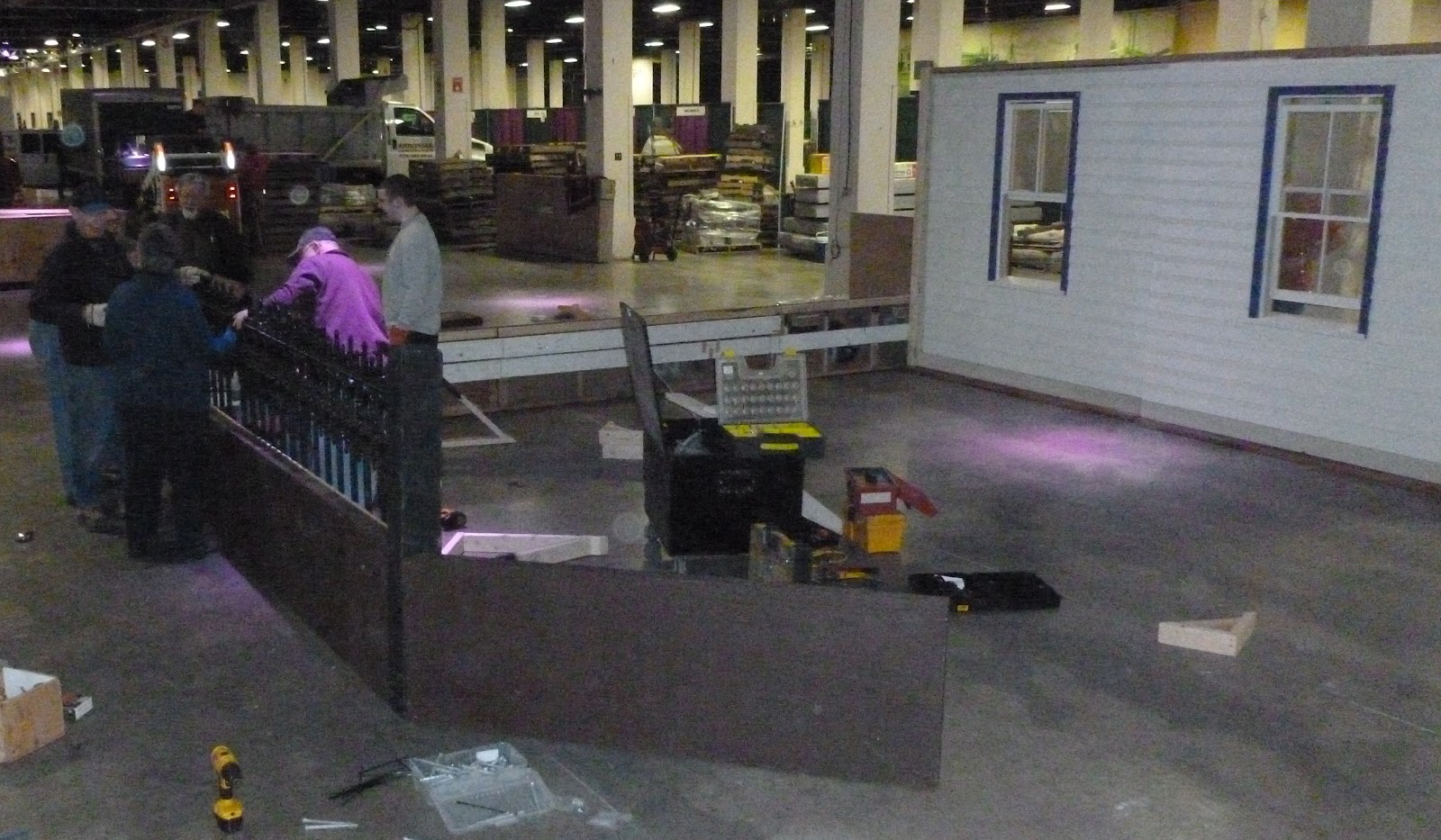
The wrought iron fence starts
to take shape
A garden at a flower show incorporates almost none of these conventional elements.  Instead, it is gardening as theater; except that, because the garden would bear Mass Hort’s name, it was also gardening as education.  Not even the size of the garden was fixed: as exhibitors were added and dropped out, Mass Hort’s allotted garden space grew from less than 400 square feet to eventually encompass nearly 1200 square feet of floor space.

The key differences between that garden in your side yard and one on the floor of a flower show are these:  first, the flower show garden must be built from scratch in three days, exist for five, and then be torn down in one.  And, second, the garden must be in full, glorious bloom for those five days.

The first segments of the townhouse
are raised onto the concrete wall
These were the parameters and obstacles that I faced when planning began for Mass Hort’s garden.  In turn, I had four secret weapons in my arsenal.  One was Paul Miskovsky, a Cape Cod landscaper who is a veteran of dozens of flower shows.  The second was my wife, Betty, who knows floral design had created gardens for five previous flower shows.  The third was Clark Bryan, Mass Hort’s Director of Operations, whose unique combination of organizational skills and mechanical competence is unparalleled.  The fourth is the Massachusetts Master Gardener Association, a group of people for whom horticulture is a passion and who collectively possess the skills to build anything from a garden shed to, probably, an aircraft carrier.

Behind the townhouse, a mass of
stabilizers kept it in place
I should also mention at this point that a flower show garden is a horrendously expensive undertaking.  A thousand-square-foot exhibit can cost between $50,000 and $75,000 in labor and materials.  My budget for the garden was $6,000 (unless I wanted to give up my parking stipend, in which case the budget could be expanded to about $6,084).  In other words, creating this garden would involve a lot of begging.

Every flower show has a theme and the one for the 2012 Boston Flower & Garden Show was ‘First Impressions’.  I knew that I wanted a house as the backdrop for the exhibit, and I described the quest to build that backdrop back in January (see, ‘Would You Like a Townhouse to Go with that Garden?’).  Assembling the plant material was touch and go:  Paul Miskovsky agreed to supply most of the ‘big’ items – the trees and shrubs, especially.  Betty and some of her more larcenous Master Gardener buddies prowled New England Grows and came away with hundreds of smaller shrubs, perennials and annuals.  Various growers with a soft spot for Mass Hort offered flats of plants.

A small portion of the plants planned
for use in the exhibit
Why so much?  Because the rule of thumb is to start with three times the plant material you think you’ll need.  Come show time, one-third won’t be blooming (or be past bloom) and another third won’t look right in the exhibit.

At 8 a.m. on Saturday, March 10, Betty, Clark and I assembled at the Seaport World Trade Center.  We found a cavernous, empty hall.  On the floor, Paragon’s Show Director, Carolyn Weston, has put down the ‘shoe polish line’ (double-click on the top photo to see the shoe-polish line); white marks indicating the corners of our exhibit.  The rest was up to us, and luck.

Clark Bryan, at left
This would be a good time to say a little more about Clark Bryan.  His role as ‘Director of Operations’ at Mass Hort is something of a misnomer.  ‘Chief Magician’ would be a more appropriate title.  His job for the past four years has been to make things happen without the use of actual money.  If I said I needed that aircraft carrier mentioned a few paragraphs above, three things would happen: first, he would roar that what I wanted was impossible, and he would stomp off in a huff.  Second, he would re-appear, three days later, with a thick binder containing plans for an aircraft carrier and little slips of paper indicating favors owed to him for things done decades ago.  And, two weeks later, I would come to Mass Hort and find a working, Nimitz-class aircraft carrier outside his office, which he would say he whipped up at home over the weekend.  He is the ultimate can-do guy.

At 8:20 a.m., trucks began rolling into the hall.  Out came the segments of the townhouse, ready to be assembled like a Tinkertoy set; a pre-built, ready-to-screw-together kickboard; a hundred concrete blocks and 200 bricks; 40 feet of antique, wrought-iron fence; and enough braces, clamps, screws, and ancillary tools to stock the grand opening of a Home Depot.  By 8:30, a cadre of volunteers working under Clark’s direction was building the two-foot-high concrete block wall on which the townhouse would rest.

The kickboard was a giant jigsaw
puzzle, ready to be bolted together
We worked steadily though the day.  Ten hours later, the kickboard was in place and the town house rose a majestic 16 feet from the floor of the convention hall.


Sunday morning brought the plants.  A truck from Olsen’s Greenhouse, to which we had paid $1,000 of our precious budget for nearly 200 pots of perfectly color-coordinated tulips and daffodils, was already parked outside.  An hour later, the first of three trucks bearing plants, trees and shrubs appeared.  Two days earlier, Betty and two fellow Master Gardeners had gone through two Mass Hort greenhouses, marking plants that looked like they would be at the right state of bloom for the show.  Now, she unloaded them, segregating plants into ‘front and center’ perfection and ‘background’. 

Monday afternoon, 20 Master
Gardeners worked to complete
the display's vegetable garden
Paul Miskovsky’s trucks arrived, bearing both good and bad news.  Twenty ‘Light-O-Day’ hydrangeas had been tinged with frost while loading them.  They would be unusable for the show.  Fortunately, Paul packed along lots of extra plants - that "three times what you need" rule at work.

Now began the actual design of the garden.  We knew we wanted a few set pieces – an enormous Heptadcodium miconiodes (Seven Son tree), a Picea orientalis ‘Horstmann’s Gen’, and a Picea omorika ‘Pendula’ (weeping Siberian spruce) – and knew approximately where they would go.  But everything else was done on the fly, with 45 cubic yards of mulch arriving a scoop at a time.  Betty and Paul would review the available plant material and then argue over what ought to go where.  It was a case of two people with very different design aesthetics working in the same small space.  Paul is more of a showman with a flamboyant style that wins awards and the praise of big-budget clients.  Betty is more attuned to the interweaving of color and texture and creating spaces for real-world budgets.  At various times, each one retreated to fume at the other’s intransigence. It was Betty’s garden but Paul deserved a say.  In the end, they collaborated with delightful results.

The Townhouse Garden.  Double-click for a full-screen view
At the end of another ten-hour day, the town house garden was largely in place.

The townhouse garden, though, was only one-third of the exhibit. Next to it was a backyard vegetable garden.  Work began on it in earnest on Monday morning as twenty volunteers planted, pulled out, and re-planted displays of exotic vegetables that can be grown in New England.  And, on the right, the ‘secret space’ began to take shape.  The Mass Hort garden is about education but it is also, ultimately, a tool for attracting members.  One way to get those members is to invite them to have their picture taken.

Paul Cook, Master
Gardener, an incredibly
competent carpenter, was
indispensible to creating
the exhibit
For two years, I brought in an enormous chair that normally resides in a children’s garden at Mass Hort’s Elm Bank headquarters.  Wanting not to get stale, I asked for something different for 2012.  Clark knew a guy who was closing his flower shop in Allston and, in December, Mass Hort became the proud owner of a beautiful arched trellis.  Betty saw the arch and decreed that she knew just the bench to sit under it – the one in our side yard.  Add all those tulips and daffodils plus a bank of Rhododendron ‘Dora Amateis’ in full white bloom, and you have a magnet for people with cameras and cell phones.  While a volunteer snapped photos, a membership specialist gave the ‘elevator pitch’ to become a Mass Hort member.  It worked.
People lined up all day to have their
photo taken in the 'secret garden';
many became Mass Hort members

That last piece of the display garden – the Secret Corner – was completed around 11 a.m. on Tuesday. 

The result was, by all accounts, a fantastic garden and one that was useful to someone looking for ideas. (By contrast, the vignette next to Mass Hort’s garden was a relaxing space atop a ten-foot-high  ‘hill’ with a waterfall.  It was both a crowd- and a judge-pleaser, but it unlikely that anyone took it for anything other than entertainment.)  We attracted tens of thousands of show-goers who lingered and asked questions.  It was, in short, a class act.

A final look at Betty's miraculous
garden
The Boston Flower & Garden Show closed Sunday at 6 p.m.  We put tape around the exhibit (to keep out ‘light fingers’ and disassembled it on Monday, starting at 8 a.m. and concluding by mid-afternoon.  When it was all over, there was nothing but a pile of mulch.  Tuesday morning, another shoe-polish line went down for the next show.


A garden for education
But the exhibit left behind memories and ideas.  It inspired, it taught.  More than 50 volunteers worked on it at one point and twice that number were involved all together.  Like good theater, it was hard work.  Like great education, it was worthwhile.

I have hung up my ‘Chairman’ badge for the year and, indeed, for the last time.  Three years is enough.  But this particular garden, which lasted just five days, will endure in my mind for a lifetime.

November 1, 2011

Getting Wet for a Good Cause

I don’t know if it’s just me, but it seems that working around Paul Miskovsky is an invitation to get wet.  Very wet. 

You may remember that back in July, I helped Paul build an exhibit for the Newport Flower Show.  On the last day of the 'build', it rained so hard that I squished all the way home.  I eventually ended up with a cold that lasted two weeks.  But I digress.

Paul's original whiteboard sketch
Three months ago, I watched with fascination as Paul sketched on a whiteboard in a classroom at the Massachusetts Horticultural Society in Wellesley.  He had just come from a non-descript parcel of land between the Society's main parking lot and its entry gate, where he had wielded two cans of orange spray-paint on the scraggly grass, pines and scrub oaks that were the principal occupants of the site. 

He was sketching out a new, 800-square-foot garden to serve as the entryway to the Society's Elm Bank complex and, as part of a weekly lecture series, was now soliciting ideas as to what this new garden ought to look like from the 40 or so people assembled .  He drew circles and ovals and reeled off the Latin names of plants as easily as if he were an emissary of the Holy Roman Empire.  The room full of people watched, alternately transfixed and shouting out plant names that Paul accepted or countered.

Two and a half months went by and Paul’s landscaping business on Cape Cod took front and center stage.  Yes, it mostly rained in Wellesley during August and September, but at least it was warm rain.  I circled tentative work dates on my calendar and the dates were wiped out because some kettle hole in Wellfleet or estate in Weston cried out for a transformation.
Paul Miskovsky at the
site of the new garden

Then, a month ago, Paul called and said he would be at Elm Bank with a back hoe and some rocks and could I stop by to help?  I did, and three massive rocks went into place.  Fifty cubic yards of premium topsoil quickly followed. 

Two weeks later, Paul again called and said he had some plants for the site.  A group of us – primarily Betty's Master Gardener pals - shoved and nudged a half-dozen massive specimen trees into place and planted 30 hydrangeas.  For many gardens, the work would have been deemed to be done.  For Paul, of course, it was just beginning.  Ten days later, a 36-foot box truck rolled up, this one crammed with two additional varieties of hydrangea, boxwood and forsythia, plus fifteen flats of Japanese forest grass.  This time, of course, it was pouring rain.

Some of the volunteers who helped
build the garden.  Double-click on
the inage to get a better sense of
the cultivars being used.
When it rains and the temperature is, say, 45 degrees, an army of volunteers can shrink to a handful.  In this case, the corps of workers consisted of three very dedicated Master Gardeners, Betty, and me, plus Mike Falzone, a member of Paul’s full-time crew.  In the course of four hours, we planted at least four dozen full-sized shrubs and three topiary trees, re-contoured the site and made it look attractive for an evening event.  Paul dug holes with a Bobcat, then pitched in to complete the plantings.  Having forgotten his rain slicker, Paul did his work wearing a pair of fetching, black trash bags.

The garden is still not finished.  There remains a slate walk to be laid and small shrubs to be integrated into the site.  But the vision created on a whiteboard in July has been turned into a reality.  Now, as people approach the gates of the Elm Bank gardens, they’ll have had a foretaste of what is to come.  It is a garden that will be rich in color and texture and one that has appeal twelve months of the year.  It won’t have the size of the 'name' gardens inside the Society's gates, but it will tell the visitor that there are more treasures inside. 

July 25, 2011

Four and a Half Minutes of Fame... or maybe Flame

Here is the segment as it aired on November 17http://medfield.tv/video/old-house-mass-hort-segment

Sometime in late October or early November, you’re going to turn on This Old House and see homeowner Rebecca Titlow walking with TOH’s landscaping guru, Roger Cook. Rebecca is going to say that she’s been thinking about the need for a vegetable garden at the 1720 house in Bedford that is the subject of the fall season of the venerable PBS program.  Rebecca will say that she wants her daughter to know where food comes from. 

This Old House's Roger Cook takes
homeowner Rececca Titlow on a
walk through Mass Hort's new
vegetable garden...
And then Roger will say, “Well, Rebecca, that’s why I’ve brought you to see this great vegetable garden at the Massachusetts Horticultural Society.  And here’s Betty Sanders to talk to us about vegetable gardening and raised beds and a lot of other great stuff.”  And Betty, who just happened to be doing some weeding, stops what she’s doing and says, “Hi, Roger!  Let me show you around!”

Except that Roger didn’t say ‘Horticultural Society’.  He said ‘Historical Society’.  So the director tells Roger and Rebecca to go back to the top of the garden and have that conversation all over again.

... where they just happen to
encounter Betty doing some work
Welcome to Elm Bank on the second hottest day of the summer.  The temperature is 98 degrees, the humidity is oppressive, and there is not a cloud within 300 miles.  The cast and crew of This Old House have come to film a segment about vegetable gardening for their new season, which starts October 6. 

Mass Hort is thrilled to be asked to participate and Betty is pleased to show off the stunning garden she designed and maintains.

Betty talks knowledgably about
raised-bed gardeing and the
hundreds of kinds of vegetables
that can be grown...
The problem is the weather and how it affects the brains of everyone involved.  The segment director has in mind a four-and-a-half-minute-long tracking shot: one continuous shot that starts with that conversation about knowing where food comes from and then follows Rebecca, Roger and Betty through the garden.  It’s a great concept and one that can impart a lot of information with high-impact visuals.

Except for the heat and the relentless sun.  Instead, each take is a learning experience in how the human mind and body can be subtly altered by the elements.  Betty can’t come up with the word ‘nasturtium’.  Rebecca can’t remember the great question she was going to ask.  Roger flubs the name of some common vegetables.  And the director keeps calling everything ‘cabbage’.

Two and a half hours later, the
segment producer had enough
material for a four-and-a-half
minute segment.  Stay tuned!
Filming was supposed to commence at 11 a.m. and last about an hour, including set-up.  At 10 a.m., the director called to say they were running late and wouldn’t be at the garden until noon.  The first cars arrived at 12:45 and filming actually started at 1:30.  It went on, take after take, until nearly 4 p.m.

Finally, the director was satisfied.  It wasn’t that there had been a single take in which everyone got their lines right.  Rather, I suspect it was that there was a sense that with two and half hours of takes, all the correct information was in there, somewhere.  Some overhead shots were taken from a tall ladder, and then they were done.

My role in all of this was strictly moral support.  If my wife was going to spend an afternoon broiling in the sun, I could at least say I was there by her side, even if ‘there’ meant I was under a nearby tent, socking away bottles of well-chilled water.

I came away with a respect for This Old House and those who agree to be part of it.  It’s a reality show and it’s entertainment, but this isn’t Snooki dumping on her housemates.  Betty had four and half minutes to impart a wealth of information and show viewers that vegetable gardens don’t have to be dull rectangles.

I don’t know if This Old House draws the same-sized audience as it did back before the advent of 500 channels of television.  I hope a lot of people see this segment.  Despite the relentless sun and the heat, it was a class act.