August 8, 2011

Summer Rain


Eastern Massachusetts gets about 45 inches of precipitation per year.  Roughly ten inches of that falls as snow, the balance as rain.  Much of our spring rain comes from vast, drenching weather systems that sweep in from the west or up from the south and give us all-day rain ‘events’ that re-charge our ground water and ensure that May and June are brilliant with color.

Precipitation in Eastern
Massachusetts.  Double-click
on the chart to see details.
Then, as the chart at left shows, the rain slows down.  By July, we’re dependent on ‘pop-up’ thunderstorms – highly localized downpours caused by unstable air masses.  The problem is that these thunderstorms are truly hit or miss.  The next town over gets an inch of rain while you get the rumble of distant thunder.  Or, the rain may all fall in a few minutes, meaning water runs off rather than soaking into the soil.  And, this July, the rains did not come at all to Medfield. 

We do not water our lawn and never will.  We water newly planted trees, shrubs and perennials for the recommended periods.  Because they’re annuals, we water our containers and vegetable garden generously.  The primary source of water for our containers is rain barrels – three, 55-gallon drums connected to our downspouts. The secondary source is recycled water from our home.  For example, we keep buckets to capture the three gallons of water from our shower while it warms up in the morning.  We capture the water used to rinse vegetables.  Waterwise, we run a ‘green’ household.

Pop-up thunderstorms.  One town
gets drenched, another gets zilch.
It takes more than 30 gallons of water to drench our 50 containers and, during the hottest days of summer, that needed to be done every other day.  Until last week, we were holding our own despite the lack of precipitation.  Then, I noticed that one of the shrubs in the large bed in front of our property was in distress.  It got the diverted shower water.  Other shrubs and perennials quickly began showing the same distress.  We hauled water in two- and three-gallon containers to the affected plants and poured it slowly, making certain that every ounce went to the roots and none to waste.

But by Saturday evening we were facing an ethical choice.  A week hence, our gardens would be filled with visitors.  Our perennials were limp; there was simply no moisture in the soil.  There was a 70% chance of rain for Sunday but we agreed that, if we didn’t get substantial rain, we would break out of the hoses and watering wand.

Sunday morning, 11 a.m.  Oh, yeah!
Sunday morning we awoke to soft rain – the first in more than 30 days.  The rain gauge showed that four-tenths of an inch had fallen overnight.  An hour later, the rain was steadier and heavier.  By noon, the rain gauge showed more than an inch.  The weather map showed a conduit of moisture passing steadily over Medfield, fed by Atlantic Ocean moisture.  Around 4 p.m., the rain finally stopped; the rain gauge showed a total of 2.4 inches in a twelve-hour period.

This morning, it is as though the month-long dry spell never happened.  The perennials in Old Stone Bed are tall and erect.  Seedeater’s Heaven, which was prostrate a day earlier, has completely recovered.  A quick trowel check of one of the shrub beds shows that there is moisture down at least six inches.

Not every gardener is as serious about water conservation as we are, but then we have to make up for our neighbors who thoughtlessly run their lawn sprinklers despite the watering ban imposed by our town.  Ours is not some holier-than-thou attitude toward water in the garden.  Rather, it’s learning to live by the same common-sense rules that ought to apply to everyone (and what Betty tells the groups that pay her to speak on the subject).  That we have two acres doesn’t give us an exemption.  Enough said.


August 2, 2011

Company's Coming!

There is a gardening aphorism that has always resonated with me.  It goes like this:  “If you have three months to get ready for company, re-design.  If you have three weeks, replant.  If you have three days, put down mulch.  If you have three hours, edge.”

I understand the underlying wisdom embodied in that timeline.  Three years ago, our property was part of the Garden Conservancy Open Days program.  We had the better part of six months to prepare for that day and we attracted several hundred visitors, each of whom paid five dollars admission.  Let me say without hesitation that, had I known what we would spend to ‘get ready’ for our Open Day, I would have come out considerably ahead by simply cutting the Garden Conservancy a check for the amount we would have brought in lieu of actually holding the event.  Of course, we still get to enjoy the ‘improvements’ we made over the course of the winter and spring before our Open Day, but I also remember the labor involved.

I bring all this up because we are hosting another group this month.  This time it is Master Gardeners and I am thrilled because we have only two weeks to prepare. There has been no talk of trees cut down or tree planted, stone walls rebuilt or new garden ‘rooms’ created.  The most labor-intensive project is getting rid of a failed grass walkway between two beds and replacing it with a mixture of stone and ornamental grasses.  Of course, I have yet to actually start this project so the timeline may be moving from dawn’s-early-light cool to mid-morning mugginess, but I can finesse that.

What I cannot control is the bloom cycle of our garden.  That is Betty’s sphere of influence.  Most homeowners are content to see a plant bloom once a year.  Not so in our garden and certainly not so this year.  Certain perennials like salvia and nepeta can be coaxed into a second bloom by judicious pruning.  August is ordinarily a letdown after June and July.  Not so this year.  Our containers – all fifty of them - are getting tender loving care to ensure that the annuals and perennials in them are in their full, late-summer splendor.

Oxalis - a truly nasty weed.
There is also weeding.  Weeding is one of my jobs and I will be the first to confess that in August I start to let my guard down.  Not this year.  I have carefully re-edged and re-mulched one of our major beds and, in the process, found a shameful number of weeds.  They’re gone now, but I know I will go through this process at least one more time before the tour. 

Leptinella serrulata, otherwise
known as New Zealand fern
Out in back, our rock gardens are the scene of an epic battle to control oxalis and an insidious creeping sedum that, given its druthers, would smother everything in its path.  It is my job to keep the paths and steps green, but green with the ‘good’ ground covers like New Zealand fern (which is neither a fern not from New Zealand, but that’s another story) and Scotch moss, and get rid of everything else.  The problem with oxalis is that you can pull it out by its roots on Saturday morning and, by Sunday afternoon, it has all come back.  (The oxalis hitch-hiked in on other plants.  This is why you remove all extraneous greenery from pots.)

My driveway edging tool of choice.
Edging is my strong suit.  Most homeowners (and lawn services) use string trimmers to whack at grass to pull it back off driveways or flower beds and I suppose such tools do a satisfactory job… for most gardens.  My tool of choice is a back-powered piece of 19th century technology that delivers the perfect driveway edge with an inch-wide channel between the pavement and the grass.  Edging perennial beds is done with a straight shovel and the effect is gorgeous.

The psychic benefit of inviting people to your garden cannot be overestimated.  Compliments make the work worthwhile.  Even I have to admit that for August in a dry summer, our garden looks quite good (well, it will look good once I get that pathway done).  But once in a long while, you can hear something that makes you proud to be a gardener.  It happened three years ago: two ladies stood at the front of our property on that Garden Conservancy Open Day.  They had no idea who I was and so they spoke openly.  One turned to the other and said, rather caustically, “They’re lying.  There is no way that two people take care of this garden.”

It was the best compliment I never received.

July 25, 2011

Four and a Half Minutes of Fame... or maybe Flame

Here is the segment as it aired on November 17http://medfield.tv/video/old-house-mass-hort-segment

Sometime in late October or early November, you’re going to turn on This Old House and see homeowner Rebecca Titlow walking with TOH’s landscaping guru, Roger Cook. Rebecca is going to say that she’s been thinking about the need for a vegetable garden at the 1720 house in Bedford that is the subject of the fall season of the venerable PBS program.  Rebecca will say that she wants her daughter to know where food comes from. 

This Old House's Roger Cook takes
homeowner Rececca Titlow on a
walk through Mass Hort's new
vegetable garden...
And then Roger will say, “Well, Rebecca, that’s why I’ve brought you to see this great vegetable garden at the Massachusetts Horticultural Society.  And here’s Betty Sanders to talk to us about vegetable gardening and raised beds and a lot of other great stuff.”  And Betty, who just happened to be doing some weeding, stops what she’s doing and says, “Hi, Roger!  Let me show you around!”

Except that Roger didn’t say ‘Horticultural Society’.  He said ‘Historical Society’.  So the director tells Roger and Rebecca to go back to the top of the garden and have that conversation all over again.

... where they just happen to
encounter Betty doing some work
Welcome to Elm Bank on the second hottest day of the summer.  The temperature is 98 degrees, the humidity is oppressive, and there is not a cloud within 300 miles.  The cast and crew of This Old House have come to film a segment about vegetable gardening for their new season, which starts October 6. 

Mass Hort is thrilled to be asked to participate and Betty is pleased to show off the stunning garden she designed and maintains.

Betty talks knowledgably about
raised-bed gardeing and the
hundreds of kinds of vegetables
that can be grown...
The problem is the weather and how it affects the brains of everyone involved.  The segment director has in mind a four-and-a-half-minute-long tracking shot: one continuous shot that starts with that conversation about knowing where food comes from and then follows Rebecca, Roger and Betty through the garden.  It’s a great concept and one that can impart a lot of information with high-impact visuals.

Except for the heat and the relentless sun.  Instead, each take is a learning experience in how the human mind and body can be subtly altered by the elements.  Betty can’t come up with the word ‘nasturtium’.  Rebecca can’t remember the great question she was going to ask.  Roger flubs the name of some common vegetables.  And the director keeps calling everything ‘cabbage’.

Two and a half hours later, the
segment producer had enough
material for a four-and-a-half
minute segment.  Stay tuned!
Filming was supposed to commence at 11 a.m. and last about an hour, including set-up.  At 10 a.m., the director called to say they were running late and wouldn’t be at the garden until noon.  The first cars arrived at 12:45 and filming actually started at 1:30.  It went on, take after take, until nearly 4 p.m.

Finally, the director was satisfied.  It wasn’t that there had been a single take in which everyone got their lines right.  Rather, I suspect it was that there was a sense that with two and half hours of takes, all the correct information was in there, somewhere.  Some overhead shots were taken from a tall ladder, and then they were done.

My role in all of this was strictly moral support.  If my wife was going to spend an afternoon broiling in the sun, I could at least say I was there by her side, even if ‘there’ meant I was under a nearby tent, socking away bottles of well-chilled water.

I came away with a respect for This Old House and those who agree to be part of it.  It’s a reality show and it’s entertainment, but this isn’t Snooki dumping on her housemates.  Betty had four and half minutes to impart a wealth of information and show viewers that vegetable gardens don’t have to be dull rectangles.

I don’t know if This Old House draws the same-sized audience as it did back before the advent of 500 channels of television.  I hope a lot of people see this segment.  Despite the relentless sun and the heat, it was a class act.

July 16, 2011

Pictures of Lily

Two weeks ago, I wrote of working in the inner and outer sidewalk beds of our garden - the seemingly never-ending series of small chores that are part and parcel of gardening.  At the time I wrote that piece, I perceived the garden as being at or near its seasonal peak.  Boy, was I wrong.
This morning, I walked out to get the Sunday newspapers and was confronted by the image at left: a clutch of two dozen yellow-white lilies nearly five feet tall - taller than the oyydendrum growing next to it.  Framing the lilies, a blaze of red/purple astilbe.  Neither plant was in bloom last week.  It's astonishing what can happen in a garden in less than two weeks.
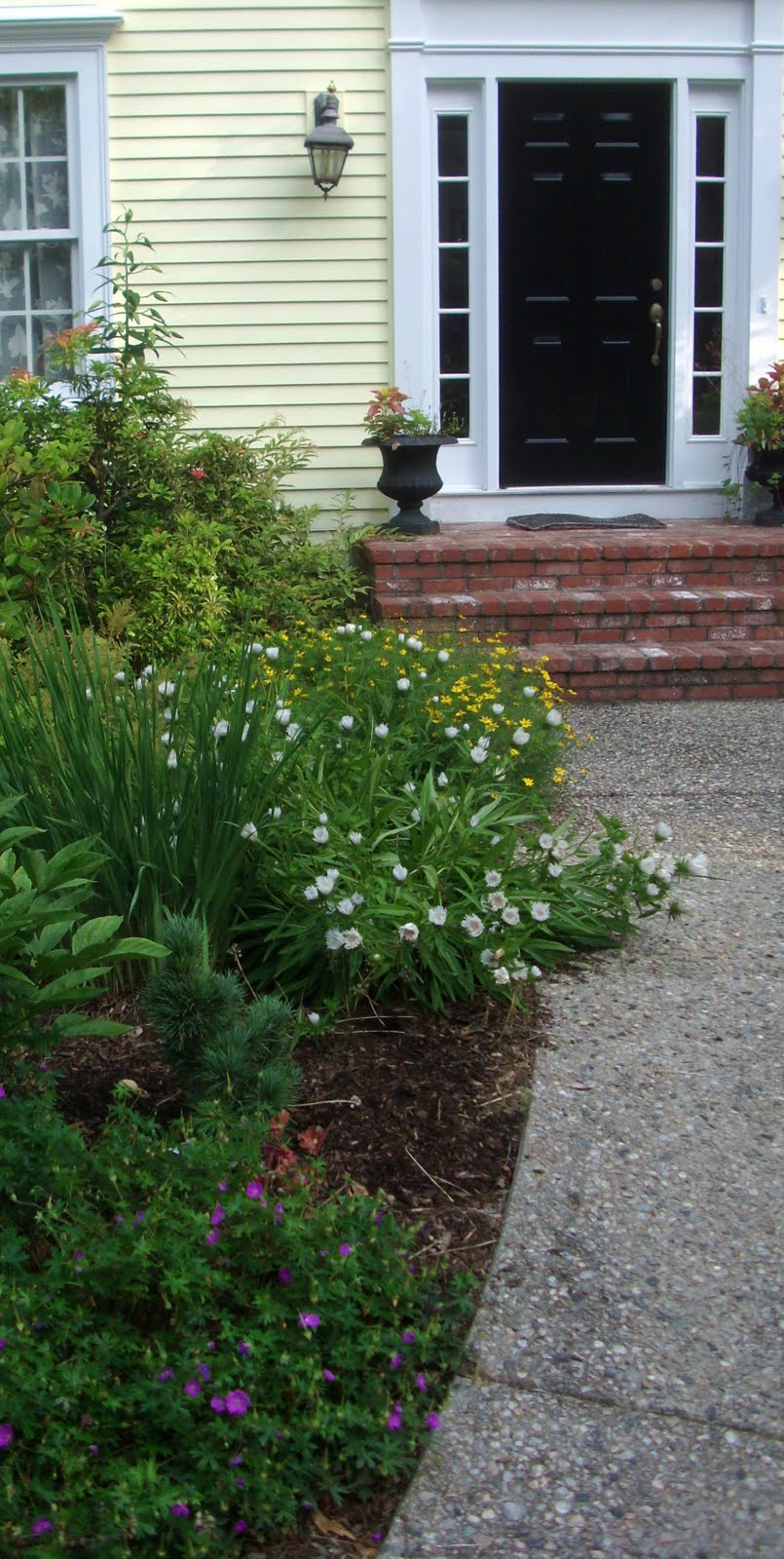
The balance of this relatively small garden area is now in its full mid-July bloom cycle.  The second photo, looking up the front sidewalk, shows the joy of texture and color (double click on any photo to see it at full size).  On the left side of the walkway, there's persacaria 'Painters Palette' and 'Red Dragon' that are thriving and close to four feet high.  Next to them is a yellow-gold variegated artemisia that requires constant attention to keep it from taking over the area.  On the right side of the sidewalk is a golden helenium that, for the monent, dominates the site.  Closer to the camera are sedum and huechera.
Farther up the sidewalk, white and purple Stokesasia (Stoke's Aster) have come into bloom and, beyond them, coreopsis 'Moonbeam'.  A week ago, there was only greenery.  Long blooming purple geraniums are in the foreground, together with the pygmy pine planted earlier this month.  Both the Stokesaia and coreopsis will be cut back after their initial blooms.  We'll get a few reblooms from the former perennial but the coreopsis will put on another, shorter display in September.
Looking away from the house along the perimeter of the outer sidewalk bed, a series of small pleasures show themselves.  There's a striped tiger grass and a Weigela 'My Monet'.  The tall purple plume is a thalictrum rochebrunianum 'Lavender Mist'.  We've continued inching out into the lawn to accommodate the maturing (and spreading) perennials.  Now, as we add more structure to the site, the bed needs to expand to allow for things like our pinus sylvestris 'Hillside Creeper' to more fully establish itself.
Perhaps most remarkable in all of this is that the elements of the bed's late July bloom cycle are already in place.  The hibiscus is showing buds and the Belamcanda Chinesis (blackberry lily) has grown to nearly five feet in anticipation of its own display.  There are tiny panticles on the oxydendrum that will become vividly white by month's end.

July 2, 2011

The Cascade Effect


Hosta Sgt. Pepper - but is it lonely?
Back in September 2009, I wrote about a phenomenon around our garden called ‘The Rule of Three’ which decreed that for every plant introduced onto the property, three holes needed to be dug.  Today, I am able to report on a corollary observable fact which I call ‘The Cascade Effect’.  It works like this:
Last week, Betty was at the American Hosta Society convention.  There, in an act of love and thoughtfulness, she bought for me a hosta called ‘Sergeant Pepper’.  The hosta itself is a delightfully variegated yellow plantain lily of considerable distinction, but its greater worth is in its name: the eponymous album is my favorite of all time.  However, the hosta did not come with any tag indicating the two most important facts needed before it could be planted, namely, how large it will eventually get and how much sun it will tolerate.

We have a home library that has marvelous horticultural resources, but there are more than 3,000 registered varieties of hosta and Hostapedia, the definitive work on the subject, is not among our collection.  An internet search was needed.

We had also recently been to Weston Nurseries which was holding its annual ‘customer appreciation event’ in which ice cream and pizza are liberally dispensed (plus discounts on plants and garden equipment) and among the things we brought home a Pinus strobus ‘Pygmaea’, a small and unusually shaped, slow-growing pine that we agreed would add needed structure to the inner sidewalk bed.

And so we went looking for just the right spot for our new pygmy pine.  As we walked the bed, the Cascade Effect began.  Though it had nothing to do with finding an appropriate site for our new evergreen, the first thing Betty noticed was that some Solidago (goldenrod to the rest of us) had insinuated itself in among our Siberian iris.  We removed it.  That led to her noticing that the last of the peonies had passed, and so the stalks that had held the peonies needed to be trimmed down to better shape the plant for the summer.  That was done.  Removing the peony stalks revealed that a few Allium, long-since past bloom but still with attractive umbrels atop four-plus-foot stalks, had broken over.  The ones with broken stalks were carefully culled.

The removal of the one set of stalks revealed spent bearded iris, which needed to be cut to the nearest leaf nodule and that action brought into sharp focus that several dozen native Columbine had formed seed heads that were about to populate the garden with unwanted progeny.  And, speaking of progeny, the ferns were rapidly overwhelming our stand of Eupatorium ‘Chocolate’ and needed to be brought back into line.  (Please keep in mind that all this activity is in one garden bed of less than 500 square feet.)

Pinus Strobus 'Pygmaea' (red arrow)
The Cascade Effect continued: spent salvia blooms were trimmed back severely and the height of later-blooming perennials were trimmed back to promote stronger growth.  The list goes on.

At last, the perfect spot was found for the pygmy pine.  The location, of course, was already occupied by a long-blooming geranium which needed to be relocated to extend a ‘river’ that flows through the bed.  The geranium was duly moved.  Also, a nearby Stoke’s aster, though not technically critical to the success of the new planting, was dug up and potted as a precaution.  Compost and mulch were brought in and, a mere two hours after the search for a site began, Pinus strobus ‘Pygmaea’ found its permanent home.

What has still not found a home, at least as of this writing, is Hosta ‘Sergeant Pepper’.  It still resides in its pot, awaiting that internet search to determine where on the property it will be happiest.

June 24, 2011

That's What Friends Are For

When last I wrote of Paul Miskovsky, Betty and I were pulling plastic for a greenhouse in Falmouth – in the middle of January, with a wind chill down around zero degrees Kelvin.  We recovered and went on to live a more or less normal life.  This past week, I was again helping out Paul with a ‘little’ garden project.

The venue for this garden is the Newport Flower Show in Newport, Rhode Island.  The Boston Flower & Garden Show (or, for that matter, the old New England Spring Flower Show) draws throngs of winter-weary visitors with the promise of a day’s worth of ersatz spring in the middle of March.  In late June, by contrast, everything that can possibly be in bloom is in bloom.  Why pay $25 to see flowers when they’re all around you?

One reason is that Newport is, well, Newport.  The Vanderbilts and Astors may have decamped for other climes in some diaspora of the wealthy, but their mansions still line Bellevue Avenue, and it is the Newport Preservation Society that maintains that tangible legacy of the Gilded Age.  All proceeds from the show go toward the ongoing restoration and maintenance of those mansions’ grounds.

Another reason is that the Preservation Society puts on a heck of a good show.  I know a little bit about how flower shows are run, and Newport does a first-class job (except for the photography display, which is decidedly sub-par).  If entertainment value is the ultimate pricing arbiter, Newport definitely delivers.  

10 a.m. Wednesday.  That's
Paul in the green shirt.
At the aforementioned Boston flower shows, garden vignettes are the big draw (that first whiff of spring).  At Newport, they’re a relatively recent addition and the gardens I remember from previous years tended to be heavy on cut stone and topiary and light on, well, ‘wow’ factor.  Enter Paul Miskovsky.  Paul is an über-landscaper, a guy who can take a kettle hole on Cape Cod and turn it into a horticultural fantasy land.  Add David Haskell.  Dave’s late father, Alan Haskell, was widely considered to be one of New England’s great horticulturalists.  David is filling those large shoes quite admirably.  Neither one had ever exhibited at Newport.  This year, they did a joint entry.

The stone wall goes up...
... and gets a lavender garden
There are three problems with doing a landscape garden at Newport.  The first is time pressure.  Trucks were allowed on the grounds mid-day Tuesday.  The exhibits had to be ready for judging Friday morning.  The Boston Flower & Garden Show provides a full four days for garden ‘builds’.  Two and a half days isn’t a lot of time.  The second problem is footprint.  The Miskovsky/Haskell exhibit was allocated a 20’x40’ space.  By the time I got to the build site on Wednesday morning, the dimension had already been ‘cheated’ out to 25’x50 feet.  So, an 800 square foot vignette had been summarily enlarged to 1250 square feet, yet it still had to be built in the same time frame.  The first photo shows what I saw when I arrived at 10 a.m. on Wednesday (except that the rocks were still in skids).  To see these photos in greater detail, just double-click on them.

Which illustrates the third problem with Newport… the garden vignettes are all outdoors.  Which means working at night is problematic.  And, if it rains, things can really get messed up.

Thursday, 2 p.m., just before
the deluge...
Thursday, 4 p.m.  The garden wasn't
finished, but I was.
Paul is a friend and working on his projects is very educational.  Let me be very clear that no money changes hands in this, although I do get to eat as much pizza as I want.  On Wednesday, we unloaded rocks, built a handsome rock wall around the perimeter of a massive purple beech, laid plywood to define the shape of the garden, mulched it all to a depth of two inches, positioned four lemon trees around the corners of the garden and then added bluestone to form the ‘patio’ of the exhibit.  That was a full day’s work for eight people.  I went home with a very sore back.

On Thursday, a crew of about 15 was on hand to build the garden.  There were Master Gardeners eager to learn from two top-notch professionals, two knowledgeable crews blessed with terrific upper body strength... and me.  We installed a wonderfully scented circle of lavender and cleome around the base of the beech and unloaded a 26-foot-long box truck filled to the brim with plant material.  We spread yet more mulch.  We built a kickboard.

Then, the heavens opened up (that third drawback to Newport).  I’m not talking about a little rain.  I’m talking Weather Channel red with spots of purple surrounded by yellow and deep, deep green.

Paul Miskovsky's and David Haskell's
completed garden.
We, of course, kept building.  Plants were moved in and re-arranged.  I lifted, carried, arranged furniture and shoveled mulch.  At 4 p.m., though, I was soaked to the skin.  The exhibit was mostly built, but I was down for the count.  I left with profound apologies and the offer of a dry towel from Paul.

The flower show opened to the public on Friday at noon, a photo of the finished garden is at left.  Betty and I visited Paul's and David's garden Friday evening, where we found it being admired by a large crowd.  Perhaps more telling, the exhibit was crowded inside.  People were seated on the couches, engaged in animated conversations while the other exhibits with their formal gardens and metal chairs were deserted. 

Working with Paul and David is an education, even if it will take a few weeks for my back to fully recover.

June 8, 2011

4000 hits, yet I still have no idea who you are!

(Note: there have been more than 750 pageviews of this post since it first appeared on June 8, but still no takers for the free polo shirt offer.  What are you waiting for?)

This morning, the counter on my blog showed that 4000 people have visited it since July 2010 (the blog is older, but Google didn't provide a counter before last July).  Last month, the number of visits was 500, for an annual run rate of 6000.  I know that, by the standard of many websites, that's extremely small potatoes.  But to me, it's nothing short of amazing.

This Principal Undergardener polo
shirt can be yours.  act now!
My problem is that I have no idea of who visits the site.  No one leaves comments and I seldom encounter someone who notes that they saw something on this blog.  Google supplies some cursory information, such as the country of origin (U.S., Canada, U.K., Germany, Japan and the Netherlands, in that order), and some of the search queries that got people here.  But who are you?

High quality and in your choice
of four colors.
I'd like to know, and I'm offering a prize - three prizes, actually, to find out.  If you're reading this, email me at n_h_sanders (at) yahoo.com.  I'll send a 'Principal Undergardener' polo shirt to the first person who responds in three categories:  1) someone who knows me, 2) someone who lives in the U.S. but who doesn't know me, and 3) someone from outside of the U.S. who doesn't know me.

You can have a shirt in light or dark green, or light or dark blue.  we can work out the details of size and color.  Shipping is on me.

June 6, 2011

A tale of two arboreta… and a botanic garden

Betty and I had the opportunity over the Memorial Day weekend to visit three very different horticultural collections.  Here are some thoughts.
Two years ago, we heard Claire Sawyers, the Director of the Scott Arboretum at Swarthmore College, speak about landscape design and her book, ‘The Authentic Garden’.  Hearing her enthusiasm and wanting to see how it was implemented, we put a visit to the Scott Arboretum on our ‘wish list’ of places to explore.  Last week, Betty had to be at a convention in Washington, D.C.  I offered to tag along and, rather than doing the sensible thing of flying the 450 miles from Boston, we elected to drive, in part to fulfill that desire to see the arboretum, which is outside Philadelphia.

The Scott Arboretum and the inner
campus of Swarthmore College
are one and the same.
A 'pocket garden' within the
Scott Arboretum
In researching the visit, I kept running into an obstacle… where exactly on the campus was the arboretum?  The Scott Arboretum’s headquarters were clearly identified as was parking for it, but we couldn’t find it on a campus map.  We put it down to an idiosyncratic web site.  When we arrived at Swarthmore on a blazingly hot afternoon, we walked into the headquarters, asked for a map, and discovered to our amazement that the arboretum encompasses the whole of the ‘inner’ campus – 300 acres.  It is both the individual gardens – two dozen of them – and the incorporation of that ‘whole’ into the fabric of the campus.  It is that integration that is the genius of the design.

Some of the Scott Arboretum gardens are extensive and free-standing (the rose garden, for example).  Others are pocket gardens that occupy a specific space in front of a building or between two structures.  No two are alike or serve the same purpose.  Rather, each is specific to its site – shade, a narrow space, a need to collect water, etc. 

The Rose Garden within the Scott
Arboretum is one of the few
'free-standing' gardens
The arboretum was formed in 1929; Ms. Sawyers has been its director and guiding light since 1990.  The Swarthmore website lists no budget but shows an arboretum staff of 23, though that includes motor pool assistants and interns.  It is clear that a large group of volunteers (called the ‘Scott Associates’) is also involved.  I mention those numbers because the arboretum is maintained exquisitely, marked intelligently and is in a constant state of renewal. 

I was captivated by the arboretum and, even on an afternoon when the temperature and humidity were both above 90 and I had driven more than six hours, I was reluctant to leave.  It was an afternoon of having my notion of what constitutes an ‘arboretum’ challenged and re-defined.  Ms. Sawyers has done a magnificent job.

* * * * *

Friday morning, we continued south and made the two-hour drive down to Washington, D.C. On our way into the city, stopped at the National Arboretum. 

Here are some facts from its website:  The National Arboretum covers some 446 acres, has an annual budget of $12.2 million, a staff of 76 augmented by 140 volunteers and interns, and supported by the American Nursery and Landscape Association, Friends of the National Arboretum, Garden Club of America, Herb Society of America, National Bonsai Foundation, National Capital Area Garden Clubs, Inc., National Capital Orchid Society, National Garden Clubs, Inc., Society of American Florists, and Woman's National Farm & Garden Association.

A container garden at the gift shop;
one of the few areas that showed
continuing care or upkeep.
The arboretum occupies a superb site, an area of high ground in the northeast part of the city.  There are areas of forests and valleys; rolling hills punctuated with beautiful vistas of the city.  The site, chosen in 1927, provides a green oasis in a large metropolitan area.

That, unfortunately, is the extent of the nice things I can say about the National Arboretum.  Here is the rest of it: the gardens are uninspired, outdated and very poorly maintained.  Weeds overrun beds and plant identification is spotty at best.  The grounds crew mows around trees, but no one is pruning or shaping those trees and so they are formless blobs.  The azalea gardens, neglected for decades, were about to be ripped out until a public outcry prevented their destruction.  However, despite the outcry, the neglect continues.  In fact, I saw only one major re-building project underway at the arboretum: a renovation of the administration building. 

This is a horticultural site with a serious case of misplaced priorities.  Compare the size of the staff with that of the similarly sized Scott Arboretum and the magnitude of the lost opportunity becomes clear. 

* * * * *

We originally set aside Saturday morning to see several sites along the Mall, including the U.S. Botanic Garden adjacent to the Capitol.  As with our other destinations, I had downloaded a map and other visitor information.  The basic map showed a Conservatory and a fountain and, based on those two elements, I envisioned a site that might encompass about an acre.  I had also met Holly Shimizu at an awards function and was impressed by her energy and enthusiasm.

Bartholdi Park with the USBG
Conservatory in the background.
Every square foot is intensely planted.
Double-click on the image to
see the intensity of the site.
Let me make this clear: even if I had done a better job of researching my visit, I wasn’t prepared for what I found.  I was expecting something tourist-oriented and filled with platitudes.  I was expecting a garden that dealt with the familiar.  In short, I was expecting the lowest common denominator of urban parks.

What I found was a garden and a conservatory that rank with the best I have ever seen:  stunning design and execution, and curated better than any garden I have ever visited – and that includes Kew and NYBG. 
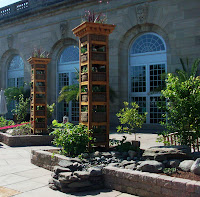
These vertical container gardens
are a visual delight.
The site, including Bartholdi Park, encompasses about six acres – the conservatory and fountain were significantly larger than anything I could have envisioned – and every square foot is used. 

I lived in the Washington area for eight years in the 1990s and have no recollection of the Bartholdi fountain, which means it was likely surrounded by grass and so disappeared into the streetscape.  No longer.  It is intensely planted in a series of gardens that, taken individually, could be replicated by a homeowner.  It is stuffed full of ideas ready to be copied.

Double-click on the sign.
The National Garden, built with $11 million of ‘private donations’, lies to the west of the Conservatory and incorporates a series of regional gardens, a butterfly garden and a rose garden.  It was here, I think, that I began to grasp the idea that the garden was intended to educate as much as please.  I was walking along a path when I spotted one of about a dozen green signs marked on, by hand, with white chalk.  The sign was next to a rather badly abused palmetto.  But the sign (reproduced at right) gave me an explanation of why this palmetto was important.  Someone had taken the time to walk the garden and choose a few things worth explaining.  I have no doubt but that were I to go back this week, those signs would adorn a different set of plants.

When there's something special
to see, like an unusual plant in
bloom, there is special signage.
In the Conservatory, those signs are joined by ‘look here’ markers indicating something interesting in bloom or otherwise out of the ordinary.  There’s also a cell phone tour for those who want in-depth information about specific plants.  In short, it’s an extraordinary place.

The USBG web site shows a staff of 66, though there is no breakdown of how many of those are horticulturalists and how many are administrative people.  It is under the joint auspices of the Library of Congress and the Architect of the Capital.  No budget is given.

*  *  *  *  *

The USBG packs an enormous
amount of horticulture into a
small footprint.  Double-click
on the chart to see full size.
Inevitably, two questions have to be asked.  The first is, why is the U.S. Botanic Garden a stunning success while the National Arboretum is no better than a county park?  Part of the answer is geography: the U.S. Botanic Garden sits at the foot of the Capitol.  It ‘has’ to be a showcase (yet, for many decades it was apparently a mess).  Because of its visibility, it gets attention.  Part of the answer likely has to do with Ms. Shimizu.  She is an articulate horticulturalist and probably a fund raiser par excellence.  The National Arboretum is part of the U.S. Department of Agriculture and, maybe, that’s the root problem.  But the National Arboretum also lists a ‘Who’s Who’ of affiliate organizations that, at least in theory, ought to be able to deliver both horticultural excellence and access to external funding.  That, in turn, takes me back to Swarthmore’s Scott Arboretum, which achieves order-of-magnitude better results on a comparably sized facility with less than a third of the staff. 

The overarching question is whether Washington D.C. needs both the U.S. Botanic Garden and the National Arboretum.  Betty and I debated this question on the drive home.  Her opinion is an energetic ‘yes’.  Mine is much more qualified and, after a week’s reflection, comes down on the side of ‘no’. 

There are multiple arboreta and botanical gardens within an hour’s drive of Washington. They look better and are not investing their resources in renovating headquarters buildings.  They are focused on education and their collections.  In Northeast Washington, I saw nothing that inspired and certainly no evidence of leadership or of mission.  When you’re that far off the mark, perhaps it’s time to pack it in.

June 1, 2011

June Is Bustin’ Out All Over

I’m a huge fan of Fourth of July fireworks.  I love the way that they start with a few ‘teaser’ rockets, then simmer down to an occasional burst that makes the audience appreciate the beauty of an individual, colorful display.  Then, there is the ‘peppering’ of loud, staccato shells with their bright, white flashes.  It’s all a dance leading up to that grand finale when the Grucci family throws everything they’ve got into the sky all at once, and all you can do is stand there, slack-jawed in wonder.
In the 'Inner Sidewalk' bed, there are three colors of iris,
Amsonia, giant Allium, peonies, dianthus and salvia -- all
in bloom simultaneously
I feel that way about my garden this morning.  We went away for a few days at the end of May.  It has been a cool, damp spring and, while the narcissus made April a showy month, our ornamental plum had flowered on schedule in early May and the forest pansy redbud had put on its best bloom ever, it had been largely a ‘green’ spring.

The 'Outer Sidewalk'
Bed is just as colorful.
Sunday morning, though, I walked outside to find that five days of hot weather had pushed everything that could possibly bloom to do so simultaneously.  Two dozen rhododendron are weighed down with football-sized clusters of flowers.  Three Weigela – a ‘Wine and Roses’,  ‘Pink Princess’ and ‘My Monet’ – that have never bloomed in the same month much less the same week are all masses of flowers.  An adjoining Deutzia and Potentilla are both snow white with blossoms.  Out by the street, a ‘Carolina Moonlight’ Baptisia is in its full glory and a carpet of bright pink Delosperma threatens to engulf the sidewalk.  Even a Scotch Broom that is prone to skipping years has a beautiful, polychrome display.

Looking across the xeric bed, where
nepeta is in full bloom, a Potentilla
and Deutzia both are laden with
white flowers.
But it is the perennials that are the real attention grabbers.  In just one small garden, white peonies, three colors of Siberian and bearded iris, two of Amsonia, giant lavender Allium, plus geraniums, dianthus and salvia all jostle to be the showiest plant. 

In a perennial border, Cerastium, better known by its colloquial name, ground hugging ‘Snow-in-Summer’ is a mass of white flowers and silver leaves while above it bloom multiple cultivars of Columbine, a Daphne Atlantica, and still more iris, geranium and salvia.

'Carolina Moonlight' Baptisia in the xeric bed (front) and
an overpoweringly fragrant 'Miss Kim' lilac (rear).
This is June in the New England garden.  The wonderful part is this isn’t the end of it.  It isn’t even the beginning of the end of it.  Like that fireworks concert, the peonies and rhodies will pass, but the giant poppies and meadowrue already have flower heads fully formed and hundreds of astilbe have sent up spikes that will bloom pink and white before month’s end.

And those are just the perennials.  The exotic annuals in our newly potted-up container gardens are still getting their roots firmly established.  Once that feat is accomplished, we’ll have a summer’s worth of luscious color from that source.

Next month, I’ll still seek out a fireworks display to enjoy under what I hope will be a canopy of stars.  But this month, I’ve got one going on in my own garden.  To my way of thinking, life doesn’t get any better than that.