March 15, 2020

Requiem for a Flower Show


The 11th Annual Boston Flower & Garden Show ended after a run of three days (of its scheduled five) this past week.  The stated reason was concern for crowds amid the COVID-19 contagion. 

The Master Gardeners booth in 2011
The Coronavirus threat was certainly real and likely doomed the show before it opened.  Volunteers were afraid to come in and work on exhibits or to take in amateur horticulture; and amateur horticulturalists were afraid to bring in their plants for display.  Master Gardeners, always a popular stop for visitors, elected at the last minute not to have a presence.  The Massachusetts Horticultural Society formally withdrew its participation just before the opening and had an exhibit, but no people explaining it or soliciting memberships.

Bayside Expo Center; it leaked, but
you couldn't beat the location
But it did not matter because there were no crowds. 

Ten years ago, the Seaport World Trade Center was a suitable compromise for a flower show.  While substantially smaller than the decrepit Bayside Exposition Center in Dorchester, where the defunct New England Spring Flower Show held forth for about two decades of its 137-year existence, Seaport had certain advantages: it was available and it was surrounded by a sea of cheap parking (think $6 to $10 a day).  The Seaport World Trade Center was itself the remnant of a1950s-era cruise ship terminal, leased from the Massachusetts Port Authority and spiffed up by Fidelity Investment, which had several thousand employees in the area. 

The Seaport area in 2010
The move to Seaport also opened the tantalizing opportunity of drawing after-work crowds from Boston’s Financial District, about a mile away.  The ‘old’ flower show, while nominally in a string of city venues dating back to Horticultural Hall, was always thought of as a ‘suburban’ show.  Now, the spanking-new Silver Line could deliver city residents and office workers to the show’s doorstep.

Me, in front of Mass Hort's
2012 display garden
For the first few years, everything clicked.  Mass Hort ran all aspects of the amateur horticulture side of the show – two classes of floral design competitions, Ikebana, photography, a bookstore, miniature gardens, plant displays – and the Paragon Group, a professional event management firm, ran everything else.  I know all this because, for three years, I was the guy who volunteered to plan, manage and shepherd Mass Hort’s presence at the show.

This was a parking lot as late as 2016
By 2013, though, the parking lots were giving way to new office construction as the ‘Seaport District’ was born as the preferred home for upstart technology companies and the more staid professional firms that wanted a hipper image. The handful of remaining surface lots demanded $20 for any part of a day, and parking in office and hotel garages was a staggering $36. The suburban core of show-goers complained of extortionate parking changes or mile-long walks.  Despite well-planned promotions, the after-five crowd never really materialized.

The question of whether to stay at Seaport was made moot when, in 2019, Fidelity announced it would close Seaport in mid-2020 and re-build the site for office use.  If it was to continue, the Boston Flower and Garden Show needed to find a new home. 

The Boston Convention Center
There was one seemingly obvious choice: the nearby Boston Convention and Exhibition Center.  The problem was, the Boston Flower & Garden Show did not fit the profile of an event the BCEC was built to to host.  BCEC was built to draw big conventions to Boston.  If you fill enough hotel rooms for enough nights, you can have the space for free (think an international medical convention for nine days).  The flower show, unfortunately, draws a local audience and so fills very few rooms.  Even if BCEC could fit the show into the schedule, the price would be exorbitant.  Paragon began its search and negotiations as soon as Fidelity made its announcement, with a goal of announcing a new venue before the 2020 show.  That hasn’t happened. 

Floral design competitions
ended in 2018
The question is why there has been no announcement.  There are two reasonable answers.  The first is this: BCEC is either too expensive or cannot commit to a same-week-each-year schedule that allows vendors to save the date.  Paragon is widening its search across the region to find a suitable location that still keeps it as a ‘Boston’ show.  The answer makes sense.  There is no existing 150-250,000 square foot space in the immediate area with adequate parking or public transit access.  And, you can’t create one.  The old Bayside was a failed 1960s shopping center.  When it closed, it sat dormant until the Expo Center idea came along.  In 2019, twenty miles south of Boston, the Hanover Mall emptied out.  It is already being carved up for high-density apartments and a ‘lifestyle’ center.

The second reasonable answer is that Paragon has concluded a hybrid horticulture/flower/garden show in Boston is a concept that has passed its sale-by date.

Everything I’ve written to this point had been factual.  What follows is personal observation:

Mahoney's Garden Center 2012 exhibit
In the past three or four years, the show has noticeably declined in quality.  The number of landscape exhibits has fallen to a handful (in its heyday, there were 20 or more ‘serious’ landscape displays), and the horticultural content of many of the remaining ones is minimal.  Creating a first-class landscape is expensive, driven by the cost of forcing high-quality plants, some of which will likely become mulch after the show closes.  As a savvy landscaper putting together an exhibit once told me, “It don’t cost anything to force stone.”  Many of the displays at recent shows were lots of attractive stonework and a handful of flowering plants; some of them barely leafed out and not even close to being in flower.

Garden clubs once vied to have a
window display at the flower show
The ratio of horticultural vendors has fallen.  The Mass State Treasury and Shelf Genie are not what visitors pay $20 to see.  Such vendors fill in the outer fringe of any consumer-oriented show.  When they encroach into the second ring of booths, they cast a pall over the ‘legitimate’ vendors with quality gardening-centric goods to sell.

Eight years ago, there were two floral design divisions: both with up to eight classes; each with four designs.  Visitors saw as many as 64 floral designs and, if they came back three days later, there would be 64 different designs by another group of amateur designers. But times change.  Floral design does not attract nearly as many fresh faces.  Many of the older designers now spend March in warm-weather climates.  Despite valiant efforts, last year, the Garden Club Federation of Massachusetts threw in the towel and said they would no longer be part of the flower show.  The result was, at the 2019 show, there were a handful of themeless, individual designs. 

Amateur horiculture circa 2011
When the show was at Bayside, amateur horticulture overflowed its allotted space.  Yes, as a plant enthusiast you sat on the Southeast Expressway for half an hour, but you got your plants entered and, for eleven days, the public ‘oohed’ and ‘aahed’ over them because AmHort was front and center because the Massachusetts Horticultural Society put it there.  There were window displays and club displays and entire collections from plant societies.  There were also six, glorious ‘miniature gardens’: an entire landscape captured in a space two feet on a side and viewed through a window. 

The pool of miniature gardens
designers, alas, aged out
When the show moved to Seaport, all that changed.  Paragon allocated AmHort space in a large meeting room beyond the glass windows that marked the ‘end’ of the exhibit hall.  No amount of signage could induce people to go through multiple sets of doors to get there. The owners of those plants did not want to make the trip through interminable Boston traffic to drop off and pick up their prized plants.  Year by year, the volume (though not the quality) of AmHort declined.  Last year, there was so little it made no sense to keep it in the conference center. At the same time, the never-large coterie of miniature garden designers ‘aged out’ and the number of entries fell to four and then, eventually, none.

The Philadelphia Flower Show is
alive and well
It isn’t that the era of ‘serious’ horticulture-centric flower shows is over.  Anyone who has been to the Philadelphia Flower Show sees an extravaganza that has lost none of its luster.  It isn’t even a New England problem: a flower show has arisen in Portland, Maine in the past six years that is both serious and fun.  The Connecticut Flower Show holds its own and it, too, takes place in the heart of a city.  The Newport Flower Show (held in June) is chockablock with high-quality amateur horticulture.

But, perhaps the underlying problem for Boston is that commercial, profit-centered businesses ought to run ‘patio and garden’ shows, and simply shed the idea of incorporating horticulture.  I do not know if Paragon (an organization with people I greatly respect) has turned a profit on the last few shows.  I do know that vendors complained of poor show traffic (and being miffed at having sellers of skin care products as their neighbor across the aisle).

The Massachusetts Horticultural Society has new leadership. Perhaps it is time the organization charts a new course for a horticultural event of its own design.


March 4, 2020

An Ogre's Work Is Never Done


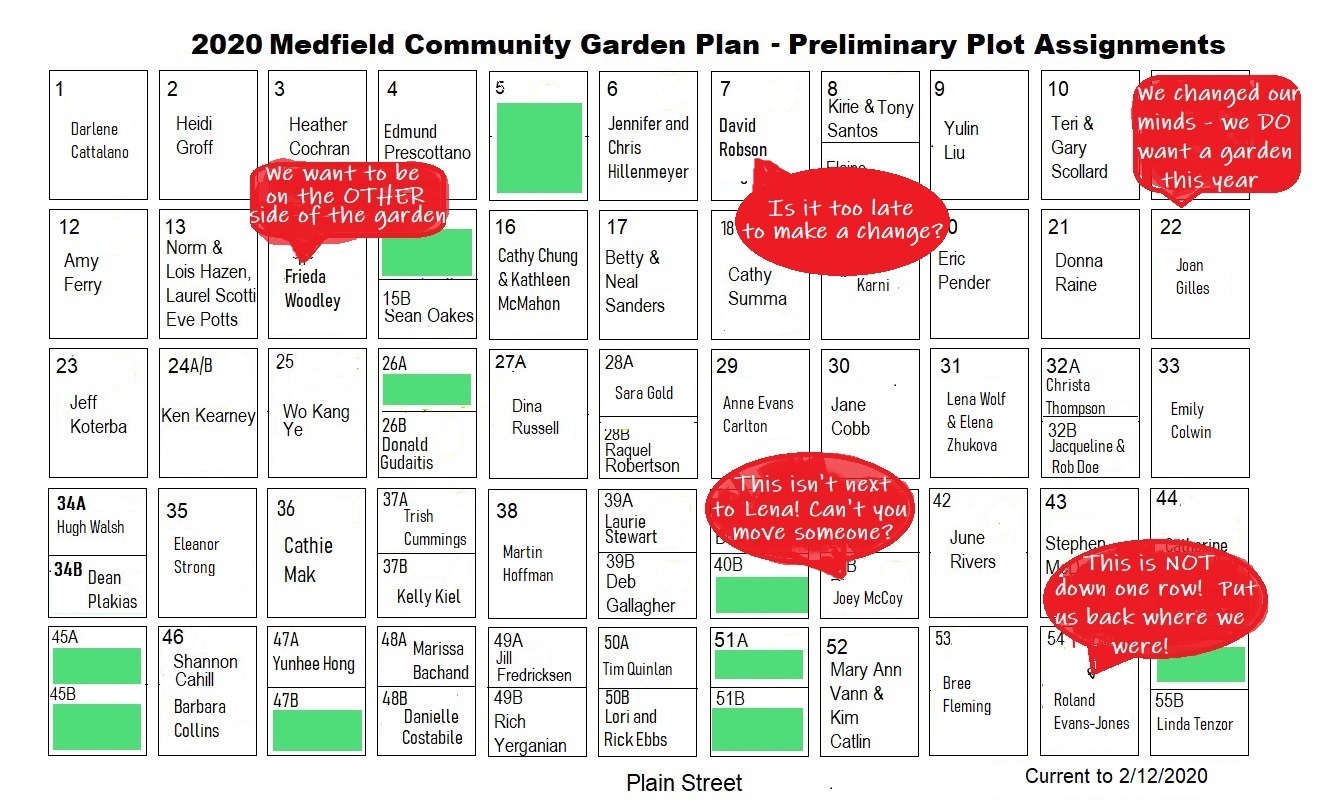
As readers of this blog know, Betty and I have been co-managers of Medfield’s Community Garden for more than a decade.  For Betty, it is a wonderful job: her role is to educate gardeners.  She freely answers all questions and passes on advice, articles and her abundant horticultural wisdom.  In turn, the 75 gardeners who have plots make it a point to say ‘hello’ to her whenever she is in the garden, and to praise her latest missives. It is not a stretch to say she is thought of as the Garden Princess.

The Community Garden.  Double-click
for a full screen view of this and the
accompanying plot plan progressiom.
With all the good designations taken, the title left to me is that of Garden Ogre.  I send out stern reminders to keep squash vines in check and keep garden fences taut.  I am the Weed Police: when a gardener fails to keep his or her aisles free of weeds, I send out OgreGrams with an ever-increasing level of threats and promises of dire consequences.  As a result, gardeners avoid me.

You would think the Garden Ogre would hibernate in the winter; stay in his cave until the first gardeners appear with their plants and then make my appearance to frighten them into submission.  You would be wrong.  My job description also includes keeping the garden filled. 

Every year, a certain number of
gardens become available
We have an acre of land divided into 55, 600-square-foot plots; many of which are subdivided into a pair of 300-square-foot gardens.  These plots are not hereditary.  Each year, gardeners must re-apply and pay a fee.  Inevitably, there is turnover.  People ‘age out’ or they move.  Some gardeners originally took plots to ensure their children knew where food came from.  Now that the kids are in middle school, the lesson is deemed learned and the plot becomes available.

Each January, I send out an email to ‘gardeners in good standing’ and ask if they would like to return for the coming season. I also ask if they would like to move up or down in plot size, and if they would prefer a different part of the garden.  Even Ogres can have a sensitive side.

And, every year gardeners want
to shift plots
This year’s response was about normal.  Eleven gardeners indicated they were moving or otherwise not coming back, three gardeners wanted larger spaces and four gardeners asked to move forward or back. (The back gets all-day sun, but it means threading your way through up to four tiers of gardens in front of you.)

I try to accommodate everyone...
I set to work with my plot diagram and produced a draft plan for 2020.  The three gardeners got their full plots.  Those who wanted to move (including one guy who wanted to be closer to two lady gardeners – who knew?) also got their wish.  I sent around the draft, expecting compliments and thanks.

... but as soon as I do, I immediately
get more complaints
That’s not the way it works in the Ogre trade.  One gardener was aghast I had moved her to the ‘wrong side’ of the garden in order to get a sunnier plot.  Her friends were on the ‘good side’ and could I please move her back?  I had no idea a single acre of land could have ‘desirable’ neighborhoods and agricultural slums.  Another said I had moved him too far toward the front and, if the correct row wasn’t available, would I return him to his original space?  Yet another didn’t want to be in the back row, having heard there were ‘woodchuck issues.’ (It’s a garden in the middle of a former farm.  The woodchucks spend the winter planning their spring campaign of destruction.  No garden is safe.)

Which sets off another round
of requests!
Then came the second wave.  Gardeners who had been perfectly happy with their spaces looked at the revised plot plan and discovered there were greener pastures available.  A prize spot in the center of the garden was being vacated by a long-time pair of gardeners relocating for retirement.  Five people emailed me asking if they could claim that spot and give up their own space.  I chose the ‘winner’ on the basis of the email’s time stamp, informed the losers, and was immediately told it was ‘unfair’ and should have been decided by a lottery.  (Ogres do not believe in lotteries.)  Another gardener noticed his plot-mate had moved to a full plot and asked if he could have the other half as well.  (No, it was claimed by someone who wanted to ‘move back’ for more sun.)

All is quiet for the moment.  The last returning gardener submitted payment for his or her plot by the February 29 deadline.  But, now I have just opened the floodgates to new gardeners … many of whom seems to have learned (incorrectly) from friends that there are ‘secret plots’ with all-day sun available with the right code word.

There are probably community gardens where everyone is deliriously happy just to have a plot.  Once upon a time, spaces in the Community Garden were assigned by standing in line outside Town Hall on a specified Saturday morning (including in snow) in mid-March and taking whatever space was available.  We live in enlightened (and entitled) times.  As long as there are computers and retirees willing to take on the running of gardens, we will have the current state of affairs.

I just wish people wouldn’t address the envelopes containing their renewal checks to ‘Garden Ogre’. 

February 26, 2020

Dan Jaffe's Home Run


I had a recurring dream through high school.  I would walk into my first class of the morning, sit down, and immediately be told ‘the test’ was about to start.  What test?  I haven’t studied for it!  Then I noticed my feet were cold because I wasn’t wearing shoes.  Oh, and I had forgotten to put on clothes.  And everyone was pointing and laughing.  I dealt with that nightmare by always verifying I had on clothing before I walked out the door.
For the past eight years, I’ve had a different kind of nightmare.  In this one, I walk into a room and everyone is waiting for me to talk.  Except I can’t find my computer with the program on it.  And my projector’s bulb has died.  And the cables to connect the two aren’t there.  And everyone is drumming their fingers, waiting for me to begin because I’m also half an hour late.  To prevent that nightmare from coming true, I approach every presentation with a set of preparations that Betty says has more checklist items than packing for a two-week vacation.
Dan Jaffe in his natural element
Last night, I accompanied Betty to a meeting of the Norwood Evening Garden Club where a terrific horticulturalist named Dan Jaffe was scheduled to hold forth on the subject of native plants.  Dan has a file-folder-full of programs with names like ‘Kill Your Lawn!’.  To his acolytes, it doesn’t matter which program he is doing because they’re all endlessly fascinating and jammed full of information encapsulated in humorous anecdotes.
Dan arrived a few minutes before 7 p.m. for a 7:30 presentation. 
Dan's book...
The venue was the meeting hall of a vintage-early-20th Century church and a screen was already in place.  As the club held its business meeting, I could sense an animated conversation going on in one corner.  Dan’s laptop computer was open, but I didn’t see a projector.  Several minutes later, a projector appeared.  His back was to me, but I sensed all was not well.  A second laptop appeared.  A member of the garden club with apparent technical skills began working with the second computer – probably her own – and two cell phones.  All I could see was a screen that kept saying ‘no internet connection available’.
The business meeting ended and all eyes fell on Dan.  He told the group, as the dragooned IT specialist’s fingers flew across the keyboard, “If this doesn’t work, we’re going to have one of the most interesting presentations I’ve ever been part of.”
For lack of a connector between the
old and the new....
As he said this, I saw the dreaded ‘no connection’ flash on the screen.  As I later learned, Dan thought the club was supplying a projector, and the club thought Dan was bringing his own.  Dan told me he usually keeps his projector in his car, but stops doing so during the dead of winter when sub-freezing temperatures are common.  The projector that showed up – from which good Samaritan, I never learned – was indeed a digital projector, but one not accepting input from a now-standard HDMI-format cable.  (Part of my ‘pack everything’ checklist is an octopus of a converter that bridges incompatible formats. I have never used it myself but once loaned it out for a state garden club convention.)
Dan could have responded in a number of ways.  He could have apologized and said the presentation would have to be rescheduled.  He could lay responsibility at the foot of the club (I have been in attendance at such a presentation).  But he did neither.  Instead, he asked his audience – somewhere between 35 and 40 people – to form a circle around him with their chairs.  And, for the next hour, he proceeded to give his presentation in the round, holding out his laptop for everyone to see photos of the plants as he discussed them.
The Norcross Wildlife Center
straddles Massachusetts
and Connecticut
The presentation was a wonder.  Dan – who is horticulturalist for the Norcross Wildlife Center, an 8,000 acre preserve in south central Massachusetts set up to protect and propagate native flora and fauna – knows native plants as few speakers do.  And, he speaks in a conversational manner that never intimidates. 
This talk, perhaps because it was unencumbered by having to talk to a large screen, was freewheeling, full of anecdotal asides, and incorporating far more interaction with the audience than in a ‘normal’ presentation (when questions are usually asked at the end).  Few speakers of my acquaintance – and I certainly do not number myself among them – can pull a rabbit out of a hat the way Dan did at that meeting. 
It was, in short, a home run.  A master class in how to turn adversity into an education for everyone attending.  Bravo!

February 12, 2020

Spreading the Doug Tallamy Gospel

Doug Tallamy

I had the pleasure last week of hearing one of the clearest and most compelling voices on the intertwined topic of ecology, landscaping, native plants, and survival of wildlife (including humans).  Then, this week, I heard a second voice… one of someone who just doesn’t get it.
The first voice was that of Doug Tallamy.  He spoke at the Harvard Science Center in Cambridge.  His talk was given in the building’s largest auditorium, which seated 500, and every seat was filled with an additional 75 attendees standing or seated on the floor.  The talk was sponsored by Grow Native Massachusetts, a group with goals closely aligned with those of the guest speaker.  The audience gave him a sustained standing ovation at the conclusion of his talk.
Tallamy writes and speaks lucidly on the environment and how ‘citizen biologists’ can effect change for the better.  He’s a professor of etymology at the University of Delaware, though I suspect he spends more time on the road than in the classroom.  A few years back, he wrote what I thought was the defining book on the importance of native plants to support the native food chain.  Bringing Nature Home was and is a highly readable and thoroughly researched treatise on why we can’t just plant what’s ‘pretty’. 
Soft-skinned worms and
caterpillars are the most
nutritious foods for baby birds
For example. oak trees abound with hundreds of species of native caterpillars which, in turn, are the preferred food for birds, and just about the only food for their nestlings.  Conversely, the Bradford pear – a Chinese import despite its anglicized name – supports no native species of any kind.  Yet, homeowners (and municipalities) continue to plant Bradford pears because they provide a well-proportioned, uniform tree for streetscapes. 
Bringing Nature Home ought to have brought about a revolution in America’s thinking about what is planted and where.  It made an impact, but climate change and species extinction require more than just ‘an impact’.
So, Tallamy had written another book, Nature’s Best Hope, with the telling subtitle, ‘A New Approach to Conservation That Starts in Your Yard’.  Like its predecessor, it is a page-turner and rife with practical suggestions along with supporting statistics.  Tallamy is no prophet of gloom; rather, he is a self-described optimist.  He offers concrete solutions; not just horror stories.
In his new book, Tallamy takes aim at the absence of biological ‘corridors’ in 21st Century America.  Wildlife is increasingly relegated to isolated pockets, and those pockets are not sustainable.  Species extinction is as much a product of lack of habitat as of climate change (though the two are linked).
Collectively, America's lawns
are the size of New England
The solution, he writes, is at our feet: the lawn.  The U.S. has 40 million acres of lawn (an area the size of New England), and it is growing at 5,000 acres a year.  Lawns are sterile, they use 30% of the available water in the East and 60% in the West. Moreover, in our efforts to maintain perfectly green and manicured lawns, we pour carcinogens on them, and 40% to 60% of those chemicals make their way into the surrounding surface or groundwater.  Lawns are the ultimate lose-lose proposition.
The perfect lawn is an ecology desert
But, he said, our love affair with turf is not necessarily unbreakable.  Once upon a time, everyone smoked.  Today, cigarettes are considered filthy and smoking is banished to parking lots.  Coats of sealskin and other rare furs were status symbols.  Today, they’re shunned.  All it takes is for public opinion to determine a practice is ‘bad’.  Vast lawns are a bad habit that needs to be broken.  Once broken, those biological corridors will thrive.
What should replace most of those lawns is native plantings that will feed native moths and other insects that will lay eggs that will produce juicy caterpillars that will feed native birds… the ultimate virtuous cycle. 
Which brings me to the second part of the story; the voice that just didn't get it.  
Betty teaching
My wife, Betty, is a Doug Tallamy acolyte.  She has absorbed his writings.  She has put his tenets into practice at our home.  And, she packages what she had learned into talks for garden clubs and libraries.  One in particular, ‘Healthy Lawns and Alternatives’ is a 45-minute distillation of Tallamy’s observations, aided and abetted by Betty’s own study and practice.
She gave the talk this morning to a garden club, and I had the opportunity to observe part of it.  The conclusion of her talk is a graphic of an average suburban property; a house, a driveway, some trees and foundation plantings, and lots and lots of grass.  She points out the problems: why maintain a narrow strip of grass alongside a driveway, or where a side of the house is near a property line.  Why not replace those areas with native trees, shrubs, ground covers, and perennials?  No one plays on front lawns, so why not reduce the space and add to the plantings?  In the back of the house, how about a permeable patio on which to entertain, and a vegetable garden? In three slides, a property that was 80% grass became 20%.
The graphic that incensed an attendee
double-click for a full-screen view
As soon as her talk was finished, a hand shot up.  A woman said such a scheme might be workable for some people, but would be impossible in her own case.  Her husband believes a vast expanse of lawn is the natural scheme of things.  I happen to know this woman and I have seen her property.  Her lawn is measured in acres, interspersed by an occasional perennial bed.
The woman said they entertain on the lawn and her husband practices golfing on the lawn.  He would never change his views, she said, and to achieve marital harmony, the lawn had to stay.
Betty handled the question (there was no question; just a justification for the woman’s own gardening practices) admirably.  Betty carefully said everyone had to make their own choices.  But they should do so with all the facts in hand; including the ones that point to acres of lawn as creating an ecological desert.  Perhaps, Betty suggested, she could work from the margins; gradually shrinking the lawn. 
Based on the balance of the questions, I have a suspicion Betty made headway with most of the audience.  She presented not just a rationale for change, but a specimen list of native plants that have all the glory of the sterile ones she wants to replace.  She came home to an inbox filled with additional questions.

January 28, 2020

The Allure of the Spring Gardening Catalogs


I remember it well.  It was one of those awful days at the end of December.  Sleet changed to rain and back again in a meteorological tug-of-war that seemed to have sapping the post-holiday spirit as its lone purpose.  At mid-day, I trudged out to the mailbox at the end of our driveway, managing to turn an umbrella inside out when a gust of wind caught it as I reached in for whatever the postman had seen fit to leave on such a dreary afternoon.  Back in the house, I plunked the mail down, un-inspected, on the kitchen counter and went off to finish my book. 

The catalogs are all marked up, and
two orders are already in.
I came downstairs an hour later and found my wife at the dining table.  There was the aroma of a freshly-brewed pot of tea.  Across the table’s surface were catalogs and magazines – specifically gardening catalogs and magazines.  One had already been marked up with pages folded over and items circled.  Another was undergoing the same scrutiny.  The third and fourth waited in the wings.

Regardless of what the calendar says, with the arrival of those glossy, color catalogs, the spring gardening season is officially underway.  And, the winter gloom seems to have lifted just a little.

Darcus Daria, a fancy name for
Queen Anne's lave
White Flower Farm featured Daucus ‘Dara’ on its cover.  To me, it’s Queen Anne’s Lace, but if someone wants to call it by some unfamiliar name and label it a ‘hard-to-find’ annual, that’s fine with me.  ‘Dara’ offers delicate flowers ranging in color from white to maroon.  By the vehemence of the circling, I have every reason to believe it will grace our garden this spring and provide a burst of color beginning in July.

Scabiosa is a perfect 'picking' flower
Scabiosa, better known as pincushion flower, has one of the least attractive names ever appended to a beautiful flower.  Johnny’s of Maine features a ‘Pincushion Series’ featuring a mix of color from almost black to creamy apricot and lavender blue.  The wonderful thing about scabiosa is they’re near perfect for cutting.  They can simultaneously grace a garden as well as a dining table.

Betty’s heart never wanders far from the vegetable garden, and I found a dozen pages folded over in Pinetree Seeds’ 2020 catalog.  After several disappointing tries, we had great success with fennel this past year.  I don’t know if ‘Florence’ fennel is the same variety we grew in 2019, but this one promises a one-pound bulb twice the size of its nearest competitor, yet delivering sweet, anise-like flavor.

My love of okra - and its hibiscus-like
flower knows no bounds
She also grows okra because my southern roots demand I have it as part of my diet.  This year, she circled one called ‘Jambalaya’ (the perfect name, in my view) that promises dark green pods in 55 days.  Because it can’t be planted until the soil temperature is close to 80 degrees, getting from seed to fruit in under two months sounds about perfect for New England. 

Ultimately, gardening catalogs are a lifeline between the past and the future.  We’ve chosen to live in a climate where fruit, flowers, and greenery are compressed into five or six months that are equal parts precious and spectacular.  Looked at from an outdoor gardener’s viewpoint, January is the year’s nadir, not its start.  It has been three months since the garden was alive with color, and it will be three months until it again begins to show its promise.  Those catalogs are tangible proof spring is just a few months away.

January 5, 2020

Everything I Thought I Knew About Feeding Birds Was Wrong


I really hate it when my cherished illusions are shattered.  Having a car would finally make me popular with girls.  The Beatles would get back to together – with or without Ringo.  It always snowed Christmas Eve in New England.  All proved wrong, some painfully so.

Our feeder visitors include a 
mated pair of northern cardinals
Now, I’ve just learned everything I thought I knew about feeding birds was hooey.  It turns out they don’t need us.  We’ve spent a fortune on suet, seed, and squirrel baffles for naught.

The authority of this truth is a gentleman named Christopher Leahy, whose credentials are hard to dismiss.  He is the Gerard Bertrand Chair of Natural History and Field Ornithology (emeritus) at Mass Audubon.  His means of disabusing me of my sense of noblesse oblige toward the avian community is an article in the winter edition of ‘Native Plant News’, published by the Native Plant Trust.

Ounce for ounce, hummingbirds are
the nastiest creatures on earth
Betty and I have two near-year-round feeding stations on our property.  From May to September, we limit ourselves to a pair of hummingbird feeders.  We have learned from having those feeders that hummingbirds are the nastiest, most territorial and, ounce-for-ounce, lethal creatures on earth; but that is a different story.  Come winter, we pull out all the stops with two sunflower seed feeders and two suet cages.  Both stations are protected by squirrel-proof baffles, and I will admit that my enjoyment of watching rodents with bushy tails spend hours trying to defeat our defenses runs a close second to that of watching birds alight and partake of our largesse.

A flicker can consume a suet cake
in an afternoon
Mr. Leahy wastes no time in puncturing my ‘good human deed’ balloon.  “Many, if not most people who feed birds do so under the impression that they are providing necessary sustenance, without which many birds would perish, especially during our harsh northern winters,” he writes.  Then adds, “This is simply untrue.”

It turns out birds feed themselves perfectly well without our help.  Evolution has provided them with ‘an exquisitely sensitive metabolism’ and a ‘highly effective insulation system’ to find all the food they need.  It takes a Field Ornithologist to write a put-down like that.

So, the idea of ‘the hungry bird’ is just a myth, born in the mid-19th Century when human ignorance, greed, and depredation (those are Mr. Leahy’s highly accurate words) were causing many bird species to be hunted to the point of extinction.  One solution was to create bird sanctuaries as safe havens.  Another was to import plants that grew quickly, had thick foliage, and produced lots of fruit.  The first idea yielded the Aubudon Society and its many sanctuaries, which also became educational centers.  The latter yielded such unloved additions to our landscapes as oriental bittersweet, Japanese barberry, and burning bush.

We have transformed our 
property into a bird-friendly site
Today, 55 million Americans annually purchase 3 billion pounds of seed, suet, mealworms and such; not to mention spending $800 million on feeders, poles, and baffles.  It is all for our own human enjoyment.  We have set up the equivalent of fly-through McDonalds in our back yards that make it easy for birds to get exactly the same stuff they would have found on their own.  Actually, I’m not so certain of that.  This afternoon, I watched a flicker consume the better part of a suet cake at one sitting.  Where, exactly, is there suet in January?  Maybe I don’t want to know the answer.

Mr. Leahy offers an ecological alternative to feeders: turning your property into a bird-friendly habitat. I’m pleased to report we check nearly all of his boxes.  His suggestions:

This ilex verticulata provides 
winter food for many birds
Kill your lawn or let it go to seed.  Instead of a lawn, we have native ground covers and wildflowers.
Leave an area of rank grasses and wildflowers.  The back border of our property is a continuous ribbon of wildflowers, and we leave the seed heads up specifically to feed the birds.
Don’t over-prune trees or, better yet, don’t prune them at all.  We started with a sterile half-acre of pines, with nothing on the forest floor except burning bush and swallowwort.  We now have a dozen specimen trees – all natives – but none are as yet remotely mature.  However, an additional acre of our property is untouched, mature oaks and pines.
Leave dead trees standing and, when they fall, leave them on the ground.  Check and double check.  We will admit, however, to ‘rearranging’ fallen trees to look more artistic.
Retain areas of heavy brush.  The wetlands behind our home do just that.
Encourage insects with appropriate plantings.  Most of our front garden is a pollinator paradise.
Plant native fruit-bearing shrubs and eliminate invasive species.  Double check.
Avoid garden chemicals.  Check.
Keep your cats indoors.  No feline member of our family has ever been allowed to run free outdoors.


Instead of a lawn, wildflowers
I do wonder about one thing Mr. Leahy does not touch on:  by feeding the birds in winter, are we ‘training’ them to come looking for insects on our property the rest of the year?  Our evidence is only anecdotal, but we see and hear a lot of birds in the non-feeding months.  I like to think they think we have a nice place to hang out.


December 6, 2019

A Walk in the Pine Forest


Geology is destiny, and geology is a product of time plus luck.  I failed to absorb that lesson back in college, but it was finally made clear when I was recently part of a group taking a hike through the Myles Standish State Forest.
12,000 years ago, Massachusetts was
under a mile's thickness of ice.
Double-click for a full-screen slideshow
It took until the later half of the 19th Century for scientists to understand the role of ice-age glaciation.  Until that time, ‘Noah’s Flood’ (I promise I am not making this up) was the accepted source for the creation of everything from the Great Lakes to Cape Cod.  The notion that the top half of North America was under more than a mile of ice was something we humans couldn’t wrap our minds around. 
Glaciers, we gradually came to understand, advanced and ebbed over tens of thousands of years, finally retreating to the poles and high mountains about 11,000 years ago.  It was a messy business.  Acting as hundred-mile-wide bulldozers, glaciers pushed debris out in front of them, forming moraines when the sheet of ice reversed course.  Cape Cod is visible evidence of that final push, as is Long Island.  The glaciers’ retreat was quite uneven, with glacial remnants settling into low areas scraped out when the ice advanced hundreds or thousands of years earlier.  We call those pockets ‘kettles.’  If they have water, they’re ‘kettle ponds.’
Myles Standish State Forest  survived
as a native plant habitat because the
land was unsuitable for crops.
The inland part of Southeastern Massachusetts got the fuzzy end of the glacial lollipop.  Instead of dumping rocks and silt to break down into soil to support vegetation, the glaciers retreating from the area that is now Myles Standish State Forest left behind sand dozens of feet deep, plus more than its quota of kettle holes, where frost could be found 11 months of the year.
Which is all to say it was rotten farmland.  Settlers came, planted, saw their crops wither for lack of nutrition (sand is notably lacking in nutrients) and water (which just perked down to the aquifer in minutes), and left for greener pastures.  As a result of this benign neglect, the area is a near-perfect repository of the plants that would have been encountered when the first Europeans arrived.  It was pine forest plus scrubby vegetation in 1616, and so it was when the state forest was created 300 years later.
Bryan Connolly, left, provides
an introduction to the Pine Barrens
That near-pristine provenance is why I was part of a groups of about 15 amateurs and two experts walking fire trails through the forest – technically called the pine barrens – on a Saturday morning.  Our leaders were Bryan Connolly and Meredith Gallogly.  Bryan has many titles.  One of them is Assistant Professor at Framingham State University (sadly, being a full-time native plant naturalist requires multiple part-time gigs).  He is also one of the authors of ‘The Yellow Book’; an exhaustive index by region of plants native to the Commonwealth.  Meredith has the good fortune to be the Manager of Programs for an organization called Grow Native Massachusetts, more about which in a moment.  She is one of the group’s two employees.
This kettle, about seven acres in size, has frost 11 months of the year
We, the amateurs, walked and tried to keep up – physically and intellectually – with our two professionals who spoke largely in Latin binomials.  We started with the overview: Myles Standish State Forest encompasses 12,400 acres (19 square miles) of pine barrens; the third largest such preserve in the world.  Apart from some ill-conceived efforts to plant ‘useful’ (read: commercially harvestable) red pines by the Works Progress Administration in the 1930s, the land is as it was when the Wampanoag were its residents.  The red pines, incidentally, have almost all vanished, leaving behind the native pitch pine that somehow finds sustenance in the sand.  We learned the pines need to burn periodically to reproduce, and forest managers periodically burn areas of the barrens to ensure the next generation of trees.
The really good stuff, though, was underfoot.  What might appear to the uninitiated as ‘weeds’ and ‘brush’ was instead a Noah’s Ark of native plants plus a few uninvited interlopers.  A few plants were easy to identify, like native blueberries and dewberries (a cousin to blackberries).  Otherwise, we were like a gaggle of kids, pointing to plants and saying ‘What’s this?’
A rest stop along the walk. 
Meredith Gallogy in the red hat,
looks up an unidentified plant
We learned to identify white dogbane (Apocymum cannabinum) by its delicate pink flower, and tiny sickle-leaved golden asters (Pityopsis falcata).  We found lots of miniature Baptisia and even a clutch of mayflower (Epigaea repens), Massachusetts’ state flower. 
And it wasn’t all ground covers.  The forest hosts large stands of Kalmia latifolia, the native rhododendron or mountain laurel, and sweet pepperbush (Clethra alnifolia).  They’re especially lush around the kettle ponds.  Over two hours, we learned a lot of botany.
Which brings me to the real reason for this blog entry.  An old friend, sadly now deceased, accumulated enough money that organizations used to come calling asking for donations. To each one, my friend would ask one question: if your organization did not already exist, why would it be started today?
The question flummoxed many visitors because, truth be told, their missions overlapped those of dozens of other organizations.  Other non-profits had long outlived their purpose and continued on because of they were ‘brand name’ charities.  He gave to those that passed his litmus test of knowing why they were in existence, and why what they were doing was unique.
Grow Native Massachusetts is such an organization.  It is now ten years old and came into being at a time when ‘native plants’ was a marketing phrase used by the landscaping industry to foist off things that stretched the definition of ‘native’ beyond the snapping point.  Grow Native Massachusetts has the most comprehensive website on the subject of any I have seen, puts on seminars (especially Evenings with Experts but also smaller events like the one of which I was a part).  In this season of giving, it is well worth supporting.