Showing posts with label gardening psychology. Show all posts

August 25, 2020

Seeing the Garden... and All of its Weeds

Our doorbell rang last week for the first time since early March.  Peering out through a window, we saw an anxious-looking, casually attired middle-aged woman with face mask in place.  Curious, we opened the door.

“I’ve been biking past your garden for months,” the woman said.  “I finally worked up the courage to ask if we could see it.”  She motioned behind her to a similar-aged man standing next to a car parked out on the street.

This is how our garden appeared
from the street in July 2020
Betty and I looked at one another.  “Sure,” I said.  A few minutes later, we were all standing, masked and socially distanced, on our sidewalk.

The woman explained she and her husband had grown tired of their grass lawn and wanted to make an ecological statement.  Our garden was the closest thing they had seen to what they envisioned.  Flattery, I guess, will get you everywhere.  For the next hour, we walked the couple through our property and explained how, over five years, we created our native garden from what had been a thicket of pines and nasty, invasive plants and shrubs. 

One of our stands of Monarda - in July
The woman was enchanted by what she saw; her husband, somewhat less so.  He kept asking about wildflower blends that could be purchased, sown, and cause their lawn to turn into a colorful meadow.  Betty carefully explained that ‘gardens in a can’ don’t take into account the reality of differing rates of growth or the aggressiveness of certain plants.  “You really have to start with lots of pots,” she said; almost but not quite apologetically.

The same Monarda in late August
after six weeks of drought and heat
While Betty pointed out and enumerated specific trees, shrubs and perennials – the names of which were entered into the woman’s phone; I was making a different list.  Mine was of tasks we had let slide during the debilitating, six-week-long heat wave that seemed a fitting accompaniment to our Covid-19 year.  Our guests thought the garden looked wonderful.  All I could see was the neglect.  Spent perennials had not been trimmed back and weeds were everywhere.  Paths were barely passable because of overgrown plants, and summer-blooming perennials were obscured by rangy shrubs.

I know Betty was seeing the same to-do list because, as soon as our guests left, she pointed out everything I had noticed, plus a few more problem areas.

One of our foundation plantings. To us
it looked terrible (oxalis highlighted).
Which, I guess, is the key difference between those who are visiting gardens and those who maintain them.  It’s a forest-and-trees thing: the visitor sees a pleasing green fuzzy ground cover with cute, tiny yellow flowers.  The gardener sees opportunistic and unwanted oxalis encroaching into every open space.  A dozen arching but clearly spent liatris can be viewed as a graceful, visual destination point; or they can be recognized as the husks of once-attractive perennials waiting to dump tens of thousands of seeds that will mean pulling out the same number of seedlings from every corner of the garden next spring.

The same area, after an hour's
work this morning
With the arrival of cooler temperatures, we’ve spent the first two-plus hours after dawn each morning bringing the garden back into some semblance of order.  As I fill buckets with the detritus of that cleaning, though, I’m also trying to keep in mind the genuine sense of appreciation those visitors had for what we’ve accomplished.  All too frequently, we dwell on the warts: all the things we’ve not done (and whether it’s a good trait or a personality flaw is a subject for another discussion).  

The spent liatris: a 'visual destin-
ation point' or a disaster
unless cut down immediately?

I strongly believe we need to leaven that ingrained dissatisfaction with a dollop of reality: real gardening is hard.  Whether it’s a small vegetable garden in the back yard or a manicured estate, creating something takes time and patience, and maintaining it requires a commitment measured in seasons rather than hours.

My back ached after pulling multiple buckets of weeds this morning, and the well-earned shower afterwards felt wonderful.  The best feeling of all, though, was looking past the newly cleaned areas to admire the half of the garden that still requires attention, and thinking to myself with a grin, ‘I had a hand in making all of that happen.’

July 6, 2020

The Return of the Cascade Effect

Our garden is now getting full.  This
is what it looked like on July 5, 2020.

Some years back, I proposed a modest theory: that going into the garden to do any one thing begets a need to do at least half a dozen other things before the first thing can be done.  I called it 'The Cascade Effect' and learned horticulturalists took my observation seriously.  A few noted field researchers confirmed my findings. 

But, over time, my theory was consigned to the margins.  “It may happen in a few, rare instances,” one Midwest critic wrote, “but there is no evidence this occurs outside of a handful of gardens, mostly in New England.  The vast majority of gardeners will never experience this phenomenon, and it certainly never happens in Illinois.”

Shopping for plants 
with a mask
This spring of 2020 has been like no other.  Nurseries and garden centers did not open their doors until mid-May and, even then, admitted just a trickle of customers (and some only by appointment).  Betty was offered (and turned down) opportunities to email in her order and have curbside pickup.  The idea of having someone else ‘select’ your plants gets no traction in our household. 

When Massachusetts finally opened up just a crack, the pent-up demand in our home resulted in a horticultural explosion – more than 50 shrubs, perennials, and container-bound annuals were acquired over a space of 30 days.  Naturally, they all had to be quickly gotten into the ground (a plant in a pot is an orphan in need of a home). 

Polystichum acrostichoides
The container plants went quickly, but we had also purchased roughly twenty perennials and a few shrubs.  Our garden – five years ago a sea of loam topped with mulch – has filled in.  But what has also happened is a few early decisions proved to be, well, less than prophetic.  Here is what happened when we set to plant three, small Polystichum acrostichoides (Christmas ferns):

1.     We identified an excellent, semi-shady site behind our house. The ferns would help to further define a border between a moss path and a shrub-and-perennial bed.  The pots were set in an arc, identifying where holes would be dug.

2.    Betty immediately noted several tiarellas and a hosta were in the process of being overgrown by a viburnum a few feet away from the planting site.  The tiarellas and hostas were dug out to await a new home.

Not part of the plan - removing 10
square feet of Carex pennsylvanica

3.   Roughly 10 square feet of carex pennsylvanica was dug out and soil was brought in to replace what clung to the roots of the carex.  While the grasses were not in the path of the three ferns, it was decided the carex was a mistake from the start and needed to be removed before it spread further.  As a side note, this cultivar is notoriously fickle: it usually dies or refuses to spread.  Ours, on the other hand, was lush and seeding freely.

Columbine seeds freely
4.   Also seeding freely were nearby Aquilegia (columbines).  We topped more than 50 plants - none of them close to the site of the ferns - that had completed their bloom and were getting ready for their offspring to take over the garden.

5.   Holes were dug and the first fern was planted.  It didn’t look right.  So, instead, the homeless hosta and tiarellas were planted where the ferns were to have been installed.  Colorful language was used.

6.    It was decided the ferns would look better on an adjacent walkway.  A small clump of solidago was dug out to make way for the ferns. Holes were dug.

Ripening blueberries
7.    Betty noted the five, high-bush blueberries behind the site of the ferns were laden with fruit, though still unripe.  She also noted the squirrels, chipmunks, and birds were patiently watching the bushes for every indication of ripening.

8.    We collected spun fabric, landscape staples, posts, and clothespins, and netted our blueberries.  Some items came out of our gardening inventory.  Others needed to be acquired.  I made note that blueberries were selling for $2.50 a pint at our local supermarket, and the cost of 'new' materials exceeded the value of the crop on our five shrubs by a considerable margin.

The three Christmas ferns in their new home...
plus, the 
blueberries with their new tents.
9.    After two mornings work to install the tents over our blueberries, we finally planted the three ferns; and went on to the next set of plants to go into the ground.

Make no mistake... the Cascade Effect is real.  But it is also the natural result of gardening in the real world with finite resources.  Sure: with a blank slate and an unlimited budget, it may be possible to create a garden on paper, hand the plan to a good landscaper, and get exactly what you want.  On the other hand, the idea of drawing up a plan and marching into an existing garden with the expectation of flawlessly executing it is the stuff of fiction.  

All 'real' gardening is ultimately done on the fly.  All plans are subject to change.  And, anyone who says different has never been the Principal Undergardener to a serious gardener.


March 4, 2020

An Ogre's Work Is Never Done


As readers of this blog know, Betty and I have been co-managers of Medfield’s Community Garden for more than a decade.  For Betty, it is a wonderful job: her role is to educate gardeners.  She freely answers all questions and passes on advice, articles and her abundant horticultural wisdom.  In turn, the 75 gardeners who have plots make it a point to say ‘hello’ to her whenever she is in the garden, and to praise her latest missives. It is not a stretch to say she is thought of as the Garden Princess.

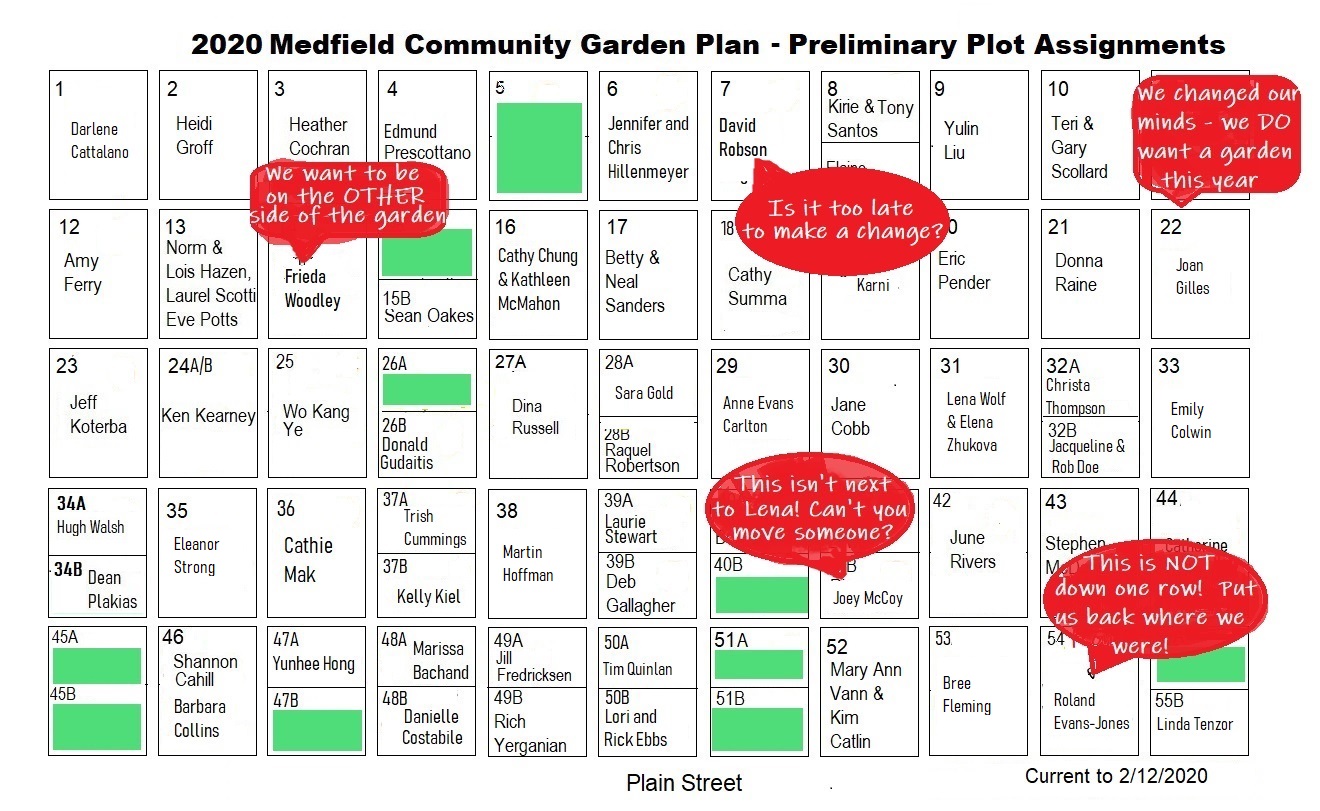
The Community Garden.  Double-click
for a full screen view of this and the
accompanying plot plan progressiom.
With all the good designations taken, the title left to me is that of Garden Ogre.  I send out stern reminders to keep squash vines in check and keep garden fences taut.  I am the Weed Police: when a gardener fails to keep his or her aisles free of weeds, I send out OgreGrams with an ever-increasing level of threats and promises of dire consequences.  As a result, gardeners avoid me.

You would think the Garden Ogre would hibernate in the winter; stay in his cave until the first gardeners appear with their plants and then make my appearance to frighten them into submission.  You would be wrong.  My job description also includes keeping the garden filled. 

Every year, a certain number of
gardens become available
We have an acre of land divided into 55, 600-square-foot plots; many of which are subdivided into a pair of 300-square-foot gardens.  These plots are not hereditary.  Each year, gardeners must re-apply and pay a fee.  Inevitably, there is turnover.  People ‘age out’ or they move.  Some gardeners originally took plots to ensure their children knew where food came from.  Now that the kids are in middle school, the lesson is deemed learned and the plot becomes available.

Each January, I send out an email to ‘gardeners in good standing’ and ask if they would like to return for the coming season. I also ask if they would like to move up or down in plot size, and if they would prefer a different part of the garden.  Even Ogres can have a sensitive side.

And, every year gardeners want
to shift plots
This year’s response was about normal.  Eleven gardeners indicated they were moving or otherwise not coming back, three gardeners wanted larger spaces and four gardeners asked to move forward or back. (The back gets all-day sun, but it means threading your way through up to four tiers of gardens in front of you.)

I try to accommodate everyone...
I set to work with my plot diagram and produced a draft plan for 2020.  The three gardeners got their full plots.  Those who wanted to move (including one guy who wanted to be closer to two lady gardeners – who knew?) also got their wish.  I sent around the draft, expecting compliments and thanks.

... but as soon as I do, I immediately
get more complaints
That’s not the way it works in the Ogre trade.  One gardener was aghast I had moved her to the ‘wrong side’ of the garden in order to get a sunnier plot.  Her friends were on the ‘good side’ and could I please move her back?  I had no idea a single acre of land could have ‘desirable’ neighborhoods and agricultural slums.  Another said I had moved him too far toward the front and, if the correct row wasn’t available, would I return him to his original space?  Yet another didn’t want to be in the back row, having heard there were ‘woodchuck issues.’ (It’s a garden in the middle of a former farm.  The woodchucks spend the winter planning their spring campaign of destruction.  No garden is safe.)

Which sets off another round
of requests!
Then came the second wave.  Gardeners who had been perfectly happy with their spaces looked at the revised plot plan and discovered there were greener pastures available.  A prize spot in the center of the garden was being vacated by a long-time pair of gardeners relocating for retirement.  Five people emailed me asking if they could claim that spot and give up their own space.  I chose the ‘winner’ on the basis of the email’s time stamp, informed the losers, and was immediately told it was ‘unfair’ and should have been decided by a lottery.  (Ogres do not believe in lotteries.)  Another gardener noticed his plot-mate had moved to a full plot and asked if he could have the other half as well.  (No, it was claimed by someone who wanted to ‘move back’ for more sun.)

All is quiet for the moment.  The last returning gardener submitted payment for his or her plot by the February 29 deadline.  But, now I have just opened the floodgates to new gardeners … many of whom seems to have learned (incorrectly) from friends that there are ‘secret plots’ with all-day sun available with the right code word.

There are probably community gardens where everyone is deliriously happy just to have a plot.  Once upon a time, spaces in the Community Garden were assigned by standing in line outside Town Hall on a specified Saturday morning (including in snow) in mid-March and taking whatever space was available.  We live in enlightened (and entitled) times.  As long as there are computers and retirees willing to take on the running of gardens, we will have the current state of affairs.

I just wish people wouldn’t address the envelopes containing their renewal checks to ‘Garden Ogre’. 

April 5, 2018

Qui Hortos?


What kind of a person gardens?  What attracts them to gardening?  Every year at this time, I get to answer those questions anew as 70 to 75 gardeners either sign up for or return to the community garden I help run.  There’s no application to fill out and so there is no line titled ‘occupation’.  I’ve certainly never demanded to know what people do with their time when they’re not gardening.  But some people tell me and sometimes their emails betray an occupation.  Others let the cat out of the bag gradually.

The Medfield Community Garden.
From the air, it looks quite orderly.
For example, we have a surgeon and at least two nurses.  I’ve gotten to know the surgeon fairly well.  For him, a few hours in the garden on a Sunday morning is what he needs to let go of the inevitable stress from his livelihood.  His garden is neat and orderly; something I like to see in someone who is going to make an incision in me.  Our resident school nurse also runs a tight ship, though her husband is an engineer, which might skew the results just a bit.  Another medical professional – an operating room nurse – has a garden so weed-free it’s spooky.

We also have an elementary school principal.  Her vegetables tended toward the ‘free range’ variety, but the veggies and flowers are all healthy and growing.  ‘Well-nurtured’ is an apt description, and I have a hunch that also describes her educational charges.

Our gardener who is an immigration
lawyers doesn't want to fences to
constrain his vegetables
The most inventive and exploratory gardens belong to our horticulturally-inclined scientists.  One is an academician whose plot runs to things like tomatillos and eye-wateringly hot peppers.  Another plot gardened by a chemist grows nine different types of lettuce and has precise squares of corn planted ten days apart.  I feel as though I am watching experiments unfolding.

It is my observation that attorneys do not necessarily make superior gardeners.  One of our number specializes in immigration.  His vines conspicuously meander all over his unfenced garden, as though he is loathe to limit vegetable mobility.  Another is in corporate law.  She’s just expanded from a half plot to a full one; perhaps the product of a successful takeover.

We’ve had a veterinarian for two years and are about to get a second one.  Our established vet keeps a great garden with exceptionally healthy plants that are kept free of disease and pests.  I can’t wait to see how the second one fares – especially given that her spouse is a conservation biologist.

This gardener has kids in middle
school.  I think her mind is elsewhere.
We have one banker in our midst.  And another one whose email identifies the individual as being a sales manager.  The less said about those two gardens, the better.

Our retirees fall into two categories.  The first is those for whom gardening forms a significant part of their recreation and weekly exercise.  They are a pleasure to have as gardening neighbors.  The condition of their plots bespeaks a life well lived, they grow copious amounts of produce, and they are quick to share their bounty with our local Food Cupboard.  The second group travels frequently and their gardens are, well, something of an afterthought.  They tend to sign up for a plot, plant it all at once, and water it too heavily and too often.  In mid-summer, they become annoyed by my asking them to weed their aisles.  After a year or perhaps two, they move onto the next retirement time-filler.

The final category are the stay-at-home moms and dads (and, yes, we have a few of the latter).  I thought there was no correlation between gardening and full-time parenting until I looked at the ages of the children accompanying their parents.  Those with toddlers and pre-school kids are terrific gardeners.  They use their plots as educational tools.  But, as the children age, the parental gardening skills decline.  By the middle school years, the weeds sprout with abandon (I have learned to take this into account when sending out reminders).  Equilibrium is miraculously restored with high school graduations.

I don’t believe these observations are colored by preconceptions.  I like all of my gardeners because they’ve chosen to garden.  In a world of choices, they’ve elected to get their hands dirty, and to do so among a crowd of like-minded people.  So, what kind of gardener am I?   A satisfied one.

February 1, 2017

The Huddled Masses, Leaning Toward the Sun

They are camped out around our home, unwilling refugees, far from their tropical and subtropical origins, gathered by windows and leaning toward a feeble sun for sustenance. They huddle together to preserve precious water in a house where the humidity is in single digits. 
With its east and south-facing windows, our library
is a favored spot for wintering houseplants

What we do to our houseplants. We take growing things whose ancestors never experienced a frost and transport them to environments where, for six months of the year, all that separates them from death by frozen capillaries is a pane of glass. And all this for…. What?
Why do we have houseplants? I typed that question into Google, ordinarily a bastion of reason and well-marshaled information. The first response was a query right back at me: ‘How can I get rid of gnats?’ Not ready for a Socratic dialog so early in the morning, I declined to provide an answer. Five pages of scrolling later, I had not found any erudite responses from horticulturally-inclined sociologists, although I uncovered an online survey indicating that our home’s houseplant population puts us dangerously outside the bell curve (the average number is five).
One of our 'guest' orchids.  It hogs
two windows in my office
.
And so, I am left to come up with my own answers. The first one is obvious: they’re green and they sometimes flower. It’s February in New England.  The world outside my window this week is relentlessly brown. Who wouldn’t want to have something nearby that reminded us that winter is not some Game-of-Thrones-style permanent condition?
Another answer is that houseplants are undemanding. Water them once a week. Check them for insects (including, yes, gnats). Re-pot them once a year. Compared to your average pet, they’re self-sufficient. My aunt kept a snake plant (Sansevieria trifasciata) in a darkened hallway that, to the best of my knowledge, was never watered, only dusted occasionally. It lived for decades.
A wintering bougainvillea and an
array of plants in Betty's office.
A third answer is that houseplants are your friends.  We have deployed a small army of Peace lilies (Spathiphyllum) around our home.  They not only produce a handsome, long-lived flower, but they also cleanse the air of multiple toxins.  Many other houseplants perform similar functions.
Plants can surprise you. We have friends who have decamped for South America for a lengthy vacation.  We agreed to ‘babysit’ two of their orchids.  Our friends arrived for dinner in late December bearing the two biggest plants I have seen outside a botanical garden.  For two weeks, those orchids simply occupied space in our home; one of them hogging an entire twin set of casement windows.  They were nothing but greenery.  Then, one morning two weeks into our plant-sitting exercise, we awakened to find our guests in spectacular blooms of pink and white.  They’re still brightening our home and are welcome to stay as long as they wish.
This croton has been
with us for two
decades
.
Finally, plants get to become family. We have two wonderfully colorful crotons that has been around so long they are practically family retainers.  Our various bougainvillea have been in residence for so many years that I can predict their flowering cycles to within a few days. Betty was given a ‘bunny ears’ cactus (Opuntia microdasys) almost a decade ago.  Every year, it rewarded us with a new ‘ear’, growing like an oblong floor of an oddly-shaped building.  When the cactus broke over under its own weight, Betty thought it might be a goner.  Instead, the area from which it broke produced two ears, each of which is now happily adding to the plant’s bulk.

So, why do we have houseplants?  I think it’s because they’re a year-round reminder that, no matter our station in life, we all ultimately came from the land.  A few generations ago, our forebears farmed to survive.  Today, we exchange our labor for money and, if we ‘farm’ at all, we call it ‘gardening’ and we do it for pleasure.  In short, houseplants keep us rooted.