Showing posts with label moving. Show all posts

April 8, 2015

Tabula Rasa

What on earth have I gotten myself into?

Back at our old home, the snow is quickly melting off the lawn and gardens, revealing grass that awaits only a light raking to spring to new life.  Daffodils, warmed by the house’s foundation, are heading up for a mid-April bloom.  The buds, too, are swelling on hundreds of mature flowering trees and shrubs.

The house is finished, but now it
needs a garden....
This morning, I gazed out the window of our new home where, also, the snow is receding.  But what is revealed is… mud.  Nothing but mud.  Gray mud that last fall was compressed into the consistency of concrete by trucks, trailers and cranes parked for weeks at a time.

This is the site of our new garden. 

 Let us backtrack a few months.  Last year we found the ideal location for the home we plan to reside in until we are carried out, feet first.  It was a wonderful site but sitting on it was a dilapidated house.  Around that house was a forest of aging pines, a thicket of invasive barberry and burning bush, plus a lush garden of poisonous black swallowwort.

We had the house torn down and a wide area of trees and undergrowth removed.  Betty began planning a low-maintenance garden.  Then winter set in and our gardening plans were played in abeyance.

Now, we are ready to begin turning that tabula rasa into a garden, or at least begin gardening when the ground thaws.

To turn that concrete-like dirt into gardening soil we have a rototiller.  AARP just sent it a membership application.  We purchased our Troy-Bilt EconoHorse in 1980 and used it happily for ten years.  Then we moved and then moved again, taking along our rototiller because it had served us so well and we expected that one day we would use it again.  The last time either one of us can definitively remember using it was during the Clinton administration.

Our circa 1980 rototiller
Two weeks ago we hauled our rototiller to the place that has kept our snow blower running for a decade and asked whether the EconoHorse could be saved or should it be put down.  A group of employees gathered around it and gazed, awestruck that such a machine could still exist and not have been reduced to rust.  A technician gave a tentative pull on the engine and said there was hope. 

Three days ago our aging rototiller came home, renewed with a host of sparkling new belts, hoses, and other parts, and ready to do its best.

But while the machine is the same, the man behind that TroyBilt is not the same guy who, in 1980, created a 50 by 200 foot garden in a single weekend of sweaty, muscular grit and determination.  That was more than half a lifetime ago.  He is 35 years older and those muscles, while they have exactly atrophied, aren’t what they were once upon a time.

And, tilling that dirt is just the first step toward turning it into soil.  There needs to be truckloads of compost worked into it plus whatever else a soil test tells us it needs.  Then, there are dozens of shrubs to plant, grasses and perennials to place, and paths to create.

Like I wrote at the beginning of this essay, what have I gotten myself into?

We do these things out of love.  We also do these things because we want to prove to ourselves that we still possess the stamina to carry out a major project that is long on physical effort.  Mostly, we do these things because we want to be able to say that we had a hand in creating something beautiful.  But, all the same, get ready to pass the Advil.

June 30, 2014

Watch This Space


Two years ago, Betty and I came to the conclusion that our home was just too big for two people.  Like many aging Baby Boomers, we decided it was time to downsize. 

But being an avid gardener makes downsizing complicated.  Neither of us wanted anything to do with those ‘active adult communities’ where gardening is restricted to what you can put in a pot on your front porch, or where the ‘community garden’ is shared with, well, the community.  We needed some property to go along with that new home.  An acre at least.  And maybe two.

The old house we found.  Note that the
center of the roof is two feet lower
than the sides.
Have you gone looking for raw land in eastern Massachusetts recently?  Maybe we’re too picky, but after 18 months of looking at lots bisected by wetlands, lots sidled up to utility long-distance transmission lines, and lots where the roof peak would sit at eye level with the street, we made the reluctant determination that the lot we wanted probably already had a house on it.

Six months ago we found that perfect site.  A private acre and a half on a winding street.  A sad, 74-year-old house beyond repairing.  A neighborhood of attractive older homes of the same size we want to build.

We were, of course, promptly outbid for that property by a developer, who had in mind to erect a grand Starter Castle suitable for a family of ten.  But we persevered and in early June we found ourselves the proud owners of a now-vacant lot.  This autumn, our new ‘right-sized’ home will rise on the site.

What has happened since we signed the purchase and sale agreement says a lot about who we are.  Most people would throw themselves full-time into designing the perfect compact house, worrying about how furniture will fit into fewer rooms and pondering choices of paint colors.  We’ve done our share of that, but an equal amount of time has been devoted to siting a raised-bed vegetable garden, determining which if any trees on the property are worth keeping and positioning a porch that will provide three seasons of natural light for houseplants.

A very small part of the transplant
garden now taking shape along
one side of our house
Meanwhile, back at our current home, a vast project is underway to populate the new garden even before the adjacent house’s foundation has been dug.  We have already divided and conditioned upwards of a hundred hostas.  They sit in a special bed, potted and identified.  Other perennials have been divided or marked for division in the fall. 

The runners of favorite shrubs, once unceremoniously pulled up and composted, are now lovingly potted with the maximum amount of root.  One especially prized and uncommon shrub, a chamaecyparis ‘Snow’ that has grown to monumental proportions in our back garden, has a now-four-inch-high, well-rooted cutting. 

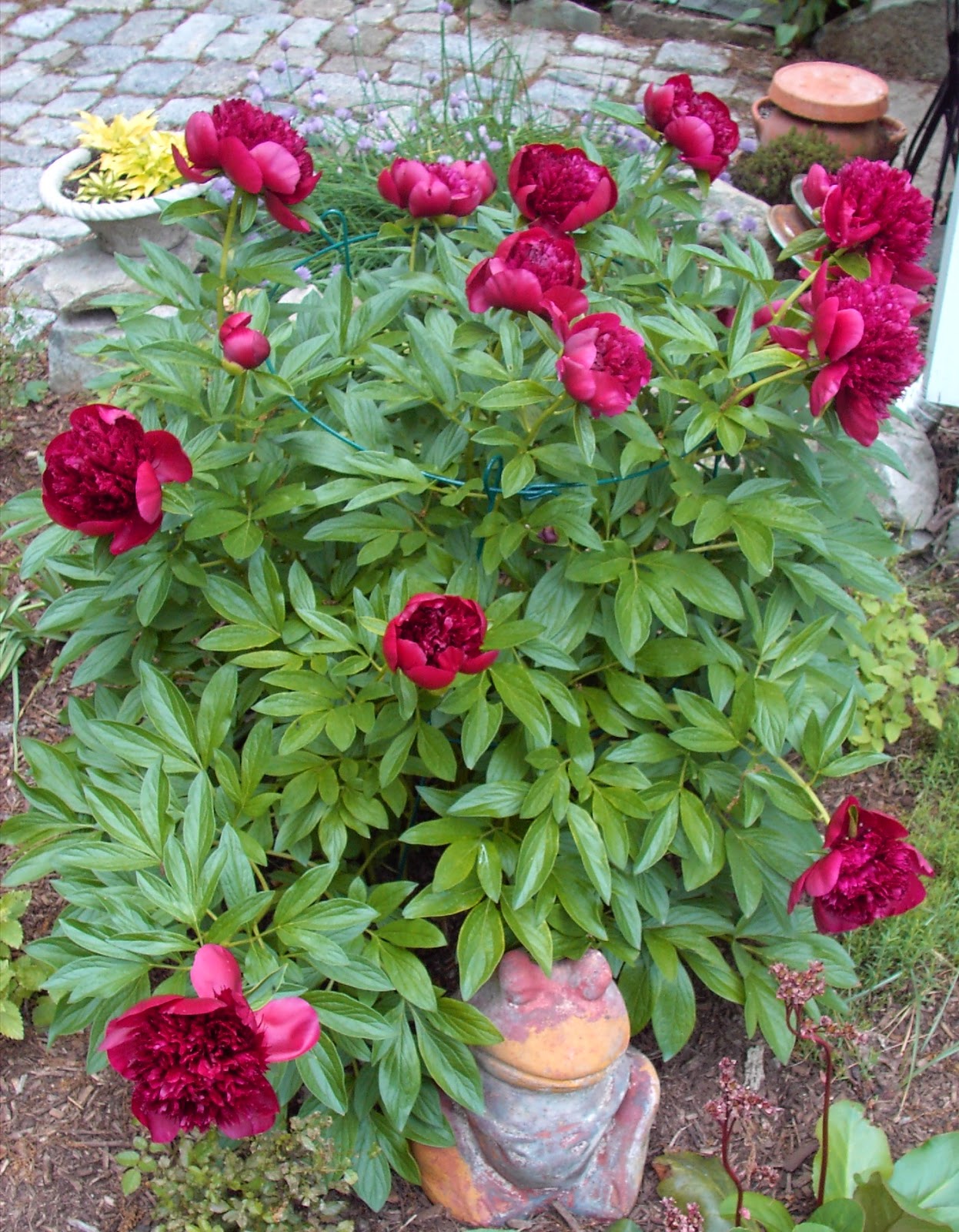
This peony Alfred's Crimson'
came with us to Medfield
from Alexandria.  It will follow
us to our new home.
Fifteen years ago, we did this on a much more modest scale.  A few favorite perennials were dug up and thrown into pots.  They rode from our home in Virginia to our new one in Massachusetts along with those household belongings (e.g., wine) we refused to entrust to movers.  The aquilegia (columbine) ‘Biedermeier’ and peony ‘Alfred’s Crimson’ we brought from Alexandria are still part of our landscape a decade and a half later, and will have honored locations at our new home.


This beautiful chamaecyparis
'Snow" and itea 'Henry
Garnet' stay with the house.
Cuttings and runners go
with us.
The satisfaction in going through this admittedly time-consuming process has little to do with saving money.  What is in our transplant bed is just a down payment on a landscape.  Betty all but stopped adding to our garden a year ago and, instead, started making lists of trees, shrubs and perennials she will purchase in the spring of 2015.  Populating a 60,000-square-foot property is going to make the owners of a few select nurseries and garden centers very, very happy.


This is what we will be leaving behind.
The good news is that it will look
just this good for the next owner.


No, the satisfaction is that we are doing a favor for whoever purchases our home.  For example, a wonderful patch of delicate blue Siberian iris is just now passing out of bloom.  That Siberian iris needs to be divided.  It is now eighteen inches in diameter and has a small but definitely ‘bald’ center.  This fall, we will take up the entire colony, clean out the center and break the resulting ring into three or four segments.  One of those segments will go with us to our new home. The remaining iris will be replanted with a fresh helping of compost.  Like the hostas we have already divided, the re-planting should be good to 2019 or 2020.

The best part is that when we begin planting that new garden in earnest next spring, we will intermix a group of familiar old friends with a larger cast of new ones.  Those old friends will be touchstones; a reminder of what we left behind.