Showing posts with label dividing plants before moving. Show all posts

December 1, 2014

The Fine Art of Moving a Garden


Moving furniture from one house to another is a snap.  You call a moving company, you sign a check, and experts do the rest.  On the appointed time and day, your furniture shows up at your new home.

Moving plants is a little more difficult.  To be completely accurate it is a lot more difficult.

The house - and garden - we will be
leaving behind.  Beautiful, but too
large for two people.
Last July I wrote of our plans to downsize; to leave the beautiful house we have called home for fifteen years in favor of a smaller abode in which we can (attention euphemism police!) ‘age in place gracefully’.  But this would be no ordinary home.  Its garden would be front and center in the planning process.

Our new home... maybe this month?
The house is now rising quite nicely on an acre and a half of land.  We optimistically think we’ll have an occupancy permit some time in December.  Our current home is on the market and we are equally optimistic that the right buyer will walk through the door any day now.

In preparation for our move we spent more than a hundred hours this autumn digging up and dividing plants – in addition to the hours Betty spent during the spring and summer doing exactly the same thing.  More than a hundred hosta divisions went into one- and two-gallon pots as did numerous Siberian iris.  Plugs of ginger and ground covers found their way into quart-size pots.

We have been dividing plants for the
past year.  Then the pace stepped up.
When we ran out of things to put plants in, we put out a plea to gardening friends who responded with an avalanche of pots – some of them gigantic.  Cuttings Betty made in the spring of climbing hydrangea had, by early October, formed strong root systems.  We now have an entire tub of climbing hydrangea, ready to cling to our new porch.  The largest containers became the home for grasses, peonies, epimedium and astilbe, all of which had migrated from their original planting sites and needed to be culled in order to restore order to the garden. 

By mid-October our portable garden – with pots spread out to allow leaves to soak up sun and water – had outgrown the fifteen-foot-by-forty-foot transplant bed and was spilling out into the walkways beyond.  We went to our neighbors and asked if they could take in the overflow.  When they agreed the potting continued. 

In the meantime, Betty created a dual tracking system for the plants.  Each pot bears a small wooden stick on which is written the name of the plant.  It also gets a second stick with nothing but a number on it.  In Betty’s computer is a growing list of what numbers correspond to which cultivars of plants.

The overflowing trench for the plants
that will be a small part of the
new garden.
In late November we began transporting our plants to their new home.  A Bobcat was being used to fill the trench created to bring in our water and sewer.  I cajoled its driver into carving out an eighteen-inch-deep hole ten feet wide and thirty feet long.  Four truckloads of plants later – and even pushing round pots so tightly they became squares – I had to hand-dig a second plant repository.

Next came the loads of leaf mold and pine needles.  This is to provide additional insulation against the winter wind and temperatures.  Then came soil to fill in any holes between pots.  Then more leaves. 

You should keep in mind that, while we’re lavishing this attention on our plants, we have not yet chosen colors for rooms in the actual house.

With the ground now beginning to freeze, the garden work at our current home is done.  We realize we are doing its next owners a huge favor:  for at least a year, there will be little need to do anything beyond routine garden maintenance.  Perennials will have room to stretch out their roots.  Shrubs will find less competition for light and nutrients.

For the past two months, the soil
around our new home has been
contacted into lifelessness.
Conversely, the work at our new home is just beginning.  All those plants now in their protective trenches need to find permanent homes come March or April.  The top two feet of our homesite’s soil has been compacted into an oxygen-free brick by a succession of cranes, trucks and bulldozers.  It will need to be coaxed back into life through aeration and augmentation. 

And, of course, the contents of those trenches are just a small fraction of what will be needed to fill a new garden.  Come the spring of 2015, the real work begins.
 

June 30, 2014

Watch This Space


Two years ago, Betty and I came to the conclusion that our home was just too big for two people.  Like many aging Baby Boomers, we decided it was time to downsize. 

But being an avid gardener makes downsizing complicated.  Neither of us wanted anything to do with those ‘active adult communities’ where gardening is restricted to what you can put in a pot on your front porch, or where the ‘community garden’ is shared with, well, the community.  We needed some property to go along with that new home.  An acre at least.  And maybe two.

The old house we found.  Note that the
center of the roof is two feet lower
than the sides.
Have you gone looking for raw land in eastern Massachusetts recently?  Maybe we’re too picky, but after 18 months of looking at lots bisected by wetlands, lots sidled up to utility long-distance transmission lines, and lots where the roof peak would sit at eye level with the street, we made the reluctant determination that the lot we wanted probably already had a house on it.

Six months ago we found that perfect site.  A private acre and a half on a winding street.  A sad, 74-year-old house beyond repairing.  A neighborhood of attractive older homes of the same size we want to build.

We were, of course, promptly outbid for that property by a developer, who had in mind to erect a grand Starter Castle suitable for a family of ten.  But we persevered and in early June we found ourselves the proud owners of a now-vacant lot.  This autumn, our new ‘right-sized’ home will rise on the site.

What has happened since we signed the purchase and sale agreement says a lot about who we are.  Most people would throw themselves full-time into designing the perfect compact house, worrying about how furniture will fit into fewer rooms and pondering choices of paint colors.  We’ve done our share of that, but an equal amount of time has been devoted to siting a raised-bed vegetable garden, determining which if any trees on the property are worth keeping and positioning a porch that will provide three seasons of natural light for houseplants.

A very small part of the transplant
garden now taking shape along
one side of our house
Meanwhile, back at our current home, a vast project is underway to populate the new garden even before the adjacent house’s foundation has been dug.  We have already divided and conditioned upwards of a hundred hostas.  They sit in a special bed, potted and identified.  Other perennials have been divided or marked for division in the fall. 

The runners of favorite shrubs, once unceremoniously pulled up and composted, are now lovingly potted with the maximum amount of root.  One especially prized and uncommon shrub, a chamaecyparis ‘Snow’ that has grown to monumental proportions in our back garden, has a now-four-inch-high, well-rooted cutting. 

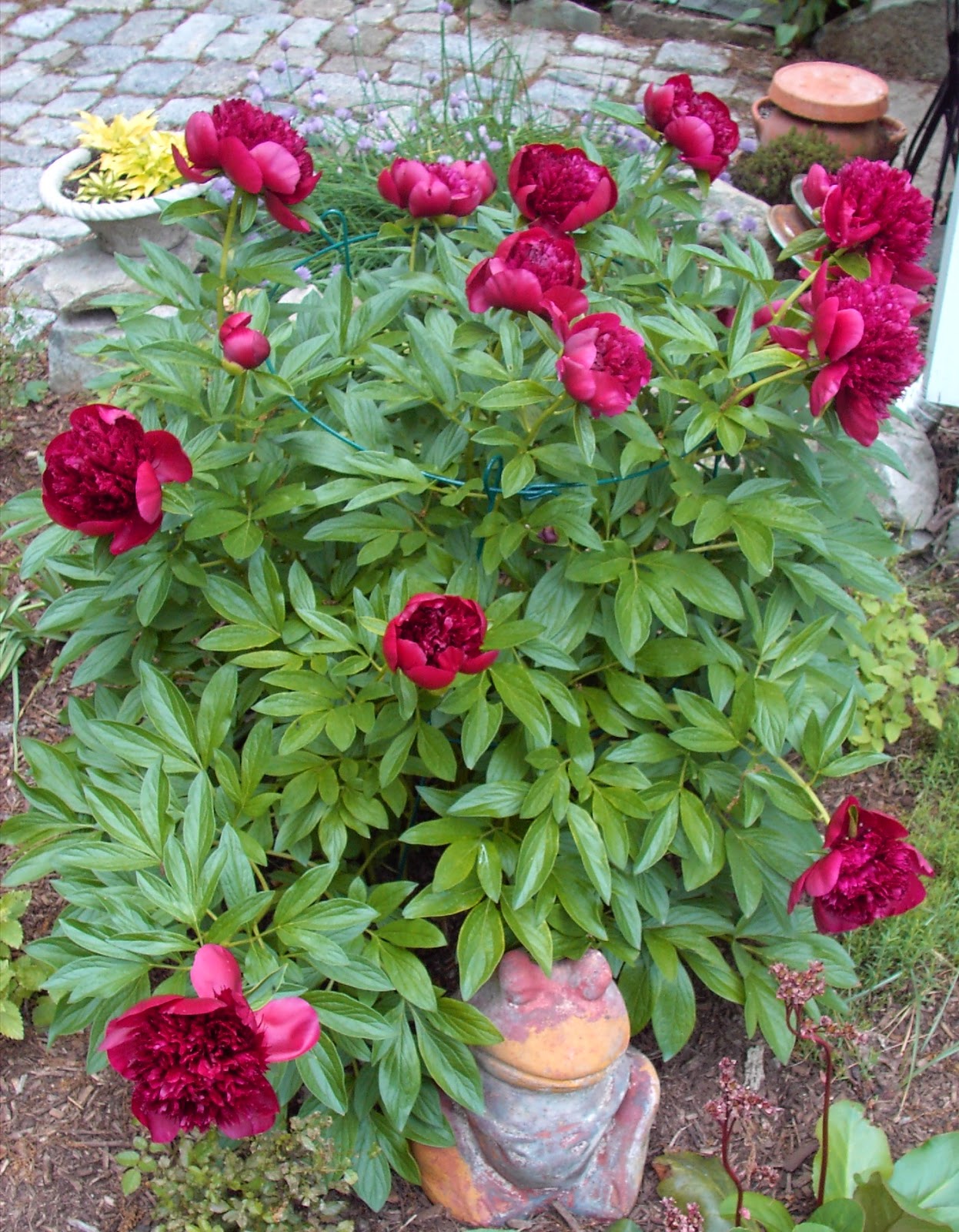
This peony Alfred's Crimson'
came with us to Medfield
from Alexandria.  It will follow
us to our new home.
Fifteen years ago, we did this on a much more modest scale.  A few favorite perennials were dug up and thrown into pots.  They rode from our home in Virginia to our new one in Massachusetts along with those household belongings (e.g., wine) we refused to entrust to movers.  The aquilegia (columbine) ‘Biedermeier’ and peony ‘Alfred’s Crimson’ we brought from Alexandria are still part of our landscape a decade and a half later, and will have honored locations at our new home.


This beautiful chamaecyparis
'Snow" and itea 'Henry
Garnet' stay with the house.
Cuttings and runners go
with us.
The satisfaction in going through this admittedly time-consuming process has little to do with saving money.  What is in our transplant bed is just a down payment on a landscape.  Betty all but stopped adding to our garden a year ago and, instead, started making lists of trees, shrubs and perennials she will purchase in the spring of 2015.  Populating a 60,000-square-foot property is going to make the owners of a few select nurseries and garden centers very, very happy.


This is what we will be leaving behind.
The good news is that it will look
just this good for the next owner.


No, the satisfaction is that we are doing a favor for whoever purchases our home.  For example, a wonderful patch of delicate blue Siberian iris is just now passing out of bloom.  That Siberian iris needs to be divided.  It is now eighteen inches in diameter and has a small but definitely ‘bald’ center.  This fall, we will take up the entire colony, clean out the center and break the resulting ring into three or four segments.  One of those segments will go with us to our new home. The remaining iris will be replanted with a fresh helping of compost.  Like the hostas we have already divided, the re-planting should be good to 2019 or 2020.

The best part is that when we begin planting that new garden in earnest next spring, we will intermix a group of familiar old friends with a larger cast of new ones.  Those old friends will be touchstones; a reminder of what we left behind.