Showing posts with label grass-free landscaping. Show all posts

June 25, 2023

A Late June Walk in the Garden

 Sleep. Creep. Leap.

The garden at 26 Pine Street, June 2023.
Double-click for the slideshow.
Those are the words all gardeners learn to live by. You put something in the ground. You pamper it, water it, weed it, and keep it free of disease and interlopers. And, in return, you get… nothing (at least for that first year and, sometimes, for two or three years).  Everything is going on below ground: your plant/tree/shrub is establishing roots. It is exploring its surroundings. It doesn’t care that you want instant gratification. Ultimately, you accept that, at least above the soil line, that thing you planted is sleeping.

Itea 'Little Henry' in full
flower. Three shrubs have
merged into a single mass
Then, after a few years, you see the tangible growth. Your frustration eases – except that you wish you could get more flowers/branches/fruit. Your precious plant is ‘creeping’.

Finally, one spring morning you come out and find you can’t believe your eyes. That scrawny plant is now gorgeous. The awkward teenager has come of age. It flowers in profusion, its branches are sturdy, and its fruits hang heavy. You know all those years of pampering have paid off.  You are proud as punch.

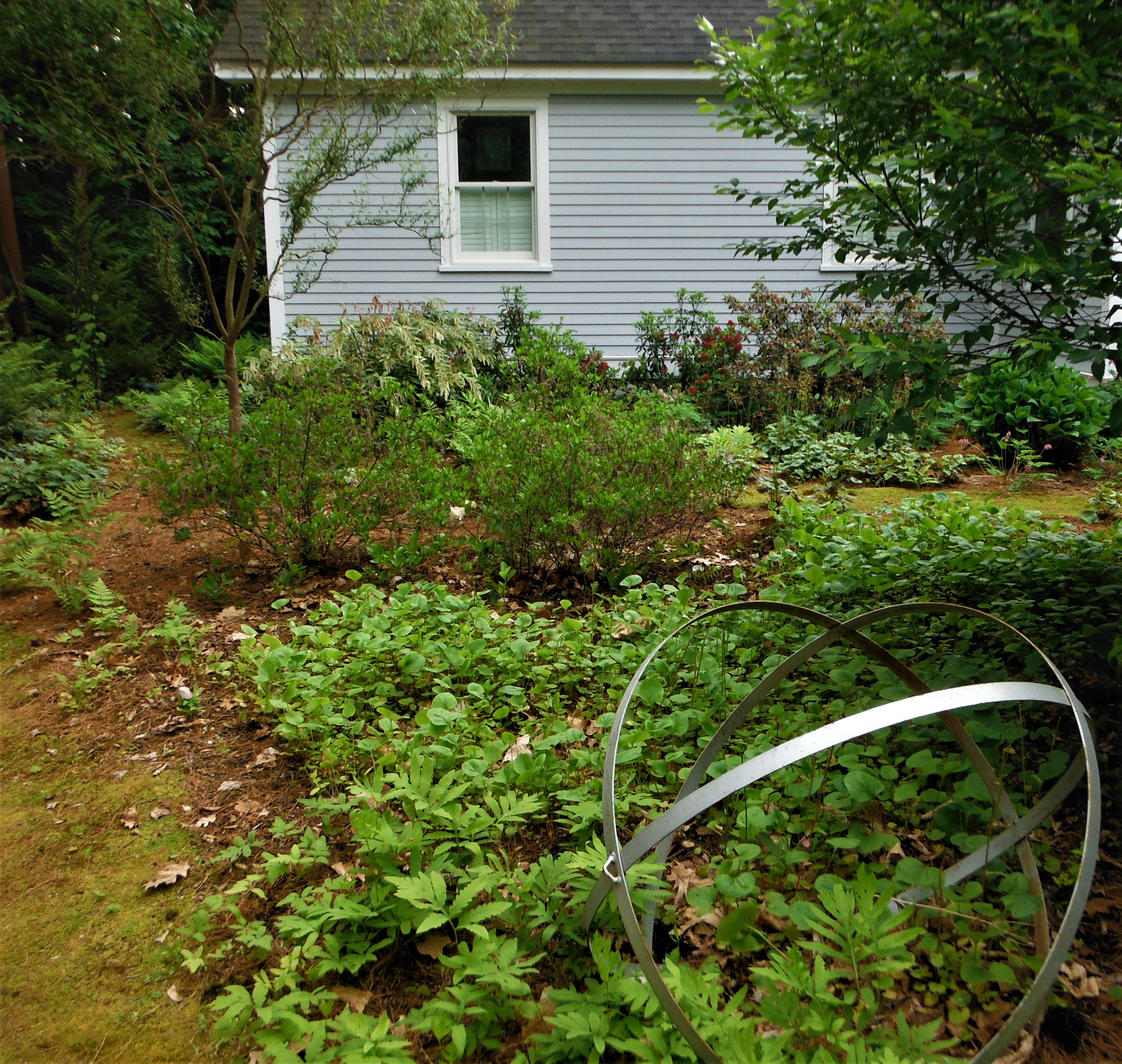
The garden at 26 Pine Street has reached, if not full maturity, a grown-up status. Eight years after the first trees and shrubs were placed, they look as though they’ve always been there. Shrubs planted on three-foot centers with what seemed like yawning chasms between them are now a glorious, full-leafed mass. Trees that were slender saplings are twenty feet high and limbs are touching their neighbors.

The sidewalk's hard edges are
softened by border plants
Best of all are the surprises: the bluestone sidewalk’s edges are softened by geraniums and lavender. A dozen, bare-root asclepias ‘Hello Yellow’ milkweed plants that seemed doomed not to make it through their first year have multiplied to become a glorious colony, dense with flowers – and butterflies. An original plan to use metal borders and gravel for paths within the garden fell by the wayside when moss thrived where we walked. Today, those moss paths traverse the property; gloriously unplanned but far superior to the original concept.

Carolina lupine and asclepias
'Hello Yellow' milkweed
We have taken chances on ‘un-pedigreed’ plants and have been rewarded for being adventurous. Betty spotted Thermopsis villosa – Carolina lupine – at a Grow Native Massachusetts plant sale three years ago. We put it in the front of the garden where it would get full sun. It grew to an impressive seven feet with spikes of brilliant yellow flowers. We let some of the seed pods remain in the soil. This year, a dozen specimens form a brilliant cluster.

Moss walkways weren't part of the
original plan - they were a better idea
Betty was recently asked to give a talk about the garden at a convention in Michigan. Her sponsors made a request that her talk include ‘mistakes’. Betty and I put our heads together and made a list. We started with a reliable one: accepting gifts from friends. While Betty intended the garden to be nearly-all native, she graciously accepted an Asian interloper: a variegated Petasites japonica. It forms a lovely, visually arresting mound of green-and-white leaves. We placed it in a shady site adjacent to a clump of Podophyllum peltatum – Mayapples. All went well that first year. The next spring, we noted with pleasure the Mayapple’s range had almost doubled in size. The Petasites, however, had tripled in area, including a foray into the Mayapples.

Petasites. Now long gone,
and good riddance.
It took three years to completely dislodge the last vestige of the Petasites.

Another error – and it is one we have made with every garden we have had – is to not be sufficiently stern with what I call ‘the Cute Little Interlopers’; plants that hitch-hiked onto the property. At 26 Pine Street, the CILs are the violets. They emerge in early March and are quickly in flower… and almost as quickly in seed. My task each April and May is to grub out every trace of those violets; which by now have insinuated themselves with and intertwined their root into hundreds of ‘good’ plants.

Be wary of Packera aurea
The third mistake is to believe that all native plants are well-behaved. They are not. Exhibit ‘A’ is a thug called Packera aurea, or golden ragwort. Because we have no grass in the garden, we need something else – actually many something elses – to provide a pleasing, low-growing ground cover. Most of these have been quite successful. For the bed comprising our black birch and clump of Clethra (aka summerweet) ‘Hummigbird’, we purchased four pots of Packera.

The dominant ground cover plants in the
rear garden are strawberries, tiarella,
and astilbe.
It is indeed a pretty groundcover with dense, dark green leaves and an attractive golden flower on a tall spike. What is not pretty about it is its intention to take over the entire garden. Three times a year, I venture out with a large cloth barrel and remove Packera from underneath the summersweet, the walkways and half a dozen other places far removed from the mother plants. If you are ever tempted to grow this hoodlum, run – do not walk – to the nearest nursery exit. And, if you already have it growing in your garden, never ever let that golden flower turn into a dandelion-type seed head.

Eight year ago, this is all 
there was...
But the garden is a joy as the accompanying photos will attest. Except for the Petasites photo and this Google Earth view of the garden from September 2015, all images were taken on June 24, 2023 – almost exactly eight years after the first specimen trees were placed in this, their new home.

February 29, 2016

Spring Ahead

The scene exactly one year ago.  We
had run out of places to put snow.
What a difference a year makes.  In early March of 2015 we were desperately looking for places to put snow around our house and driveway.  Our roof groaned under more than three feet of solidly packed snow (our skylights would reap our failure to take action).  Meanwhile, alongside the Convention Center in South Boston, a snow mountain 70 feet tall had taken up residence. Its lease would not expire until the middle of July. 
This year the ground
is bare and we are
days away from
having crocuses.
On the last days of February 2016, Betty and I created a stupendous pile of broken pine and oak branches from the month’s twin storms – rain- and wind-driven rather than snow – while treading carefully to avoid sinking into mud on the paths around our home.  In picking one branch I uncovered the dark green of crocus foliage; with flowers to follow by mid-month.  Snow?   Yes, we remember it snowing this winter.  Vaguely. 
This El NiƱo winter is giving us a much-needed head start on completing the landscaping we began last summer.  Then, the later-than-expected completion of our home and unplanned requirement for replacing a quarry’s worth of loose rock with usable topsoil meant that, by the time we were ready to start landscaping, the “good” trees we wanted were out of stock.  Rather than put in second-choice saplings, we left empty spaces.
You can still see the carnage caused
by a mid-February storm.  This is
our neighbor's property.
Now the problem, naturally, is that the nurseries we favor won’t have in their stock of trees and shrubs until mid-March.  We have a shopping list.  (Boy, do we have a shopping list.)  Betty spent the winter reading up on recent introductions of native plant cultivars.  As a result, what was once a quest for the perfect forest pansy redbud (cercis canadensis) has broadened into wanting to inspect a gold-leafed variation on that hardy native tree before settling on the one that will occupy a place of honor in front of our house.  Multiply that example by four trees, 40 shrubs, and an army of perennials, and you get a sense of what is our future by way of choices – and work once the choices are made.
Our "lawn" is a parfait of
chopped leaves and mulch.
There is also a “small” question about what surrounds those trees and shrubs.  The default choice at most homes is, of course, a grass lawn.  We’re holding fast to our principled decision regarding a lawn-free property.  Last summer we spread a thick covering of bark mulch over our topsoil, with packed-soil pathways separating beds.  At the end of autumn, we begged fifty bags of leaves from our neighbors and mowed those leaves into a fine mulch.  This spring, we’ll rototill those two mulches into the top few inches of soil, then top that parfait with leaf mold.  This is what comes from adhering to principles.

But early spring is also for dreaming.  If you're reading this and you live in New England, your best way of kick-starting those dreams is to head for the Boston Flower & Garden Show.  If I’ve learned one thing over the years, it is that no two editions of the Flower Show are alike.  Each one brings new ideas, new gadgets, new things to gawk at.  You'll come away with some new vision of how to make your garden a more interesting place.
Oh, and if you're at the show on Friday, March 18th, I'll be speaking at 11:30 a.m. on the lecture stage with 'Gardening Will Kill You'.  Betty follows at 1:30 p.m. with her 'Dirt on Your Hands, Soil in Your Garden' talk.

June 23, 2015

The Pine Street Status Report


A year ago this month a dilapidated, 70-year-old-house surrounded by end-of-life pines, burning bush, and swallowwort was torn down.  In the town where I live, such demolitions are the precursor to the building of a grand house, typically four thousand square feet (or more) in size.  Surrounding the foundation of that house will be a fringe of evergreen shrubs and, beyond that, a perfect green lawn with a handful of ‘usual suspect’ trees.  The care and maintenance of the property will left to a landscaping company that will deliver on its promise of a verdant, manicured lawn and a mailbox surrounded by annuals.

Part of the 30 cubic yards of mulch
we've put down.  That's Magnolia
'Elizabeth' in the center.
Our new home has not followed that script.  It is just 400 square feet larger than the 1700-square-foot house it replaced.  It is that size because we moved out of a so-called ‘starter castle’ when its size no longer suited our needs (if it ever did) or our lifestyle.  In our new home, we actually use every room.

But if the new house that rose from the debris of the old one pleased our neighbors, it is the landscaping now taking shape that is drawing stares. 

My contribution is a stone wall that
will be the backdrop for a perennial
border
I’ve already chronicled the transformation of the ‘builder’s crud’ on the site into a suitable gardening medium (here and here).  Now, we’re starting to populate the roughly half acre of ‘usable’ (i.e., not wetlands) property with plants, trees and shrubs.  Ours is a street filled with walkers, and the number of ‘thumbs up’ we get from passers-by is gratifying.

The biggest hurdle people have is the notion that there will be no lawn.  What isn’t planted is mulched – a beautiful, dark brown wood mulch that holds in the moisture and keeps the weeds at bay.  Once down, it is zero-maintenance.  The mulch, in turn, will improve the soil; adding organics as it breaks down.  We’ve spread thirty cubic yards so far with an additional fifteen waiting in the wings.

Construction of the sidewalk, patio
and driveway start tomorrow.  Until
they're finished, most of the
perennials will stay in pots.
Already visible are the paths within the mulched area that divide the garden into distinct planting zones.  Eventually, those paths will be pea gravel; for now, they’re just beaten-down soil.  Each zone, in turn, is anchored by a native specimen tree.  The oxydendrum, amalanchier, and cornus florida have now been joined by a Magnolia ‘Elizabeth’ (already truncated to ‘Liz’ in honor of one of my fictional sleuths), a blue-green concolor fir, and a cladrastis kentuckea – the same Yellowwood I described from the West Roxbury Garden Tour. 

We found the latter tree at Weston Nurseries where it had sat unsold because no one was certain of its name and, therefore, of its growing habits.  Betty took one look at the now-past wisteria-like racemes and squeezed my hand so tightly it nearly broke a bone.  We planted it this morning.

The shrubs are going in according to a scheme that Betty is devising as she walks the property.  Perhaps thirty shrubs are now in place, scattered in various beds as she determines that they ‘look right’.  It is a small fraction of the eventual population.

Next week, this will look quite
different!
Perennials are mostly being held in abeyance for the construction of the sidewalk, patio, and driveway.  We’ve installed a few of the peonies and amsonia, but there is an army of heuchera, tiarella, and hosta awaiting the ‘all clear’ signal on the construction front (which commences tomorrow and will last about a week).

My own contribution to this effort is the building of a stone wall.  It is roughly fifty feet long and rises to a maximum height of about three feet.  Every stone came from the property; a remnant of that ‘builder’s crud’ we removed.  It will soon be the backdrop of a perennial border.