June 21, 2021

One Day in June

This is the bed anchored by our
yellowwood tree (Cladrastis
kentuckyea) with Penstemon
'Husker Red' in the foreground
The garden at 26 Pine Street received its first ten specimen trees six years ago this month.  By the end of that first season (late September), we had planted perhaps 40 shrubs and the few dozen perennials that survived being part of the Mole and Vole buffet of the winter of 2014-2015.

The well-known garden mnemonic is 'sleep, creep, leap'. Perhaps, for the sixth year of a garden's existence, there ought to be a fourth entry: 'reap'. It's the time when the garden coheres; when everything comes together and all the digging, dividing, nurturing, and editing swell into the orchestra that is a mature garden.  For our garden, June 2021 is that 'reap' moment.  

We hosted several groups this month - a product of making our garden known to Grow Native Massachusetts and to the state's garden club federation. In its listing, we stress the garden is 'only half an acre' and, because there are no grass expanses upon which gaggles of gardeners can congregate (we have only moss paths), we limit the size of visiting groups to about a dozen or so people. 

Cladrastis flowered this year
What that relative handful of members of the gardening world see is, finally, what we hoped for when we (primarily meaning Betty) set off to create a site that would be a) pollinator friendly, b) overwhelmingly native, and c) low-maintenance for its two caretakers.

Take, for example, the bed anchored by our yellowwood tree (Cladrastis kentuckyea), shown in the top photo (please double-click on the photo for a full-screen slide tour). Betty wanted one as soon as she saw a specimen on a garden tour in Boston's Jamaica Plain neighborhood eight or nine years ago. It was a monster of a tree; probably a century old - and it was in full bloom with droops of white flowers. We found the one we wanted, already twelve feet tall, at Weston Nurseries. Knowing it would need room, Betty settled on trios of fothergilla 'Blue Shadow' and clethra 'Hummingbird' to flank it at a safe distance; then an almost-yellow spirea, pink-blooming mountain laurel (kalmia), and a host of perennials, led by tall, blue-blooming Liatris spicata and Penstemon 'Husker Red'.  Oh, and a couple of hundred daffodil bulbs for early season color, whose dying foliage would be hidden by Alchemilla mollis (lady's mantle).

Competing color in the bed anchored
by Cornus florida and Oxydendron
For the first several years, the bed made me wince because it was so... empty. Then, the Liatris - its common name is 'blazing star' - began to fill in with self-seeded offspring, and the Penstemon ('beardtongue' for reasons I cannot discern), not to be outdone, set out to colonize every square inch of space not already occupied by something else. This year, Cladrastis produced its first significant flowering - a shower of pink-yellow panticles (see second photo above).

In the bed (shown above, left) anchored by our Cornus florida (American dogwood, which bloomed white and pink in May) and Oxydendron (sourwood, which will bloom white in August), blue and yellow Baptisia compete for the eye's attention, as do the pink blooms of Physocarpus (ninebark) 'Little Devil' and the emerging flowers for our two Quercifolia (oakleaf) hydrangea. As a backdrop, the purple-leafed Cercis canadensis (redbud) 'Burgundy Hearts' gracefully sprawls with its now-15-foot breadth. I could have only imagined it would all look this beautiful in 2015. I had no inkling it would be so colorful.

The Magnolia bed
The bed closest to out house is anchored by a Magnolia 'Elizabeth' that flowered soft yellow in May. Now, the bed's color palette has changed dramatically, with Kalmia (mountain laurel) in reds and scarlets, a 'river' of long-blooming Johnson Blue and Rozanne geraniums, both upright and climbing Lonicera (honeysuckle), and the last of our peonies and blue-blooming Amsonia.  Here also are also the most visible of the roughly 20 container gardens Betty created for this year. The bright yellow-flowering container in the foreground is one of a pair flanking the front porch, and incorporate both fragrant Nemesia and prolifically-flowering lemon Calibrachoa.

The back garden has taken the full six years to come into its own. It gets less than half the sun of the front of the property and is planted accordingly. The photo at left shows the Pennsylvania flagstone patio, now filled in with fern and moss, the Chioanthus virginicus (American fringetree) in full, white-flowered bloom, multiple specimens of native Viburnum in flower and, in the right background, six Vaccinium (highbush blueberries) laden with un-ripe fruit. This part of the garden backs up to protected wetlands. The area is alive with nesting birds.

All of these photos were taken on the same June day in 2021.  I could only have imagined how beautiful it would be after so relatively few years. I'm proud to be Betty's 'Principal Undergardener' and to have played a role in seeing it come to fruition.


May 18, 2021

Direct Democracy


Norman Rockwell's 
'Freedom of Speech'
If you are reading this from anywhere outside New England, you are likely familiar with the phrase ‘town meeting’ only from old Norman Rockwell paintings or obscure novels. In my adopted town of Medfield, Massachusetts, the town meeting is alive and well. Last evening, I witnessed a demonstration of the power of the ‘direct democracy’* town meetings encapsulate.

Medfield - a thinly disguised 'Hardington' in seven of my mysteries - is justifiably proud of its school system, which is consistently ranked as one of the best in the state. It has fewer than 3000 students in pre-kindergarten through twelfth grade, but delivers high quality education on a budget of a little over $30 million a year.

The existing Dale Street School
It also needs a new elementary school. The Dale Street School is one of three in town and houses students in the fourth and fifth grades. It dates to an era of heating oil at twenty cents a gallon and classes in rigid rows of desks. Renovating the school is not an option.

The question has always been where to build the new school and, to a lesser extent, how large it should be. In any other time, there would have been numerous public meetings to hear comments, ask and answer questions, and gauge the direction of public sentiment. In an era of Covid, those meetings were Zoom calls with little audience interaction. When there were questions, too often the answer was ‘we’re still waiting for that information’. Apparently, no one on the committee making the decision could sense the uneasiness or frustration of the townspeople on the other end of those Zoom sessions.

The Dale Street School is an easy walk
to the center of town
There were always just two realistic site options. One would be to build a new school on the same land as the existing Dale Street School, which sits opposite the town’s school housing pre-K, kindergarten and Grade 1. The site is easy walking distance to the center of town and is in the most densely populated part of Medfield. The second option would be to build adjacent the Wheelock School housing grades two and three.

The Wheelock School is in a rural area
Each site has plusses and minuses. For the Dale Street site, it would require two years of temporary classrooms while the new school was constructed, but a lower overall cost because the school would tap into the town’s existing infrastructure. For the Wheelock site, because of the rural setting, some $10 million of infrastructure would be required to accommodate the building, but grades two through five would be housed on one campus.

The decision was made by an 18-member School Building Committee which held, according to the school system's website, "seven public community forums, 28 open meetings of full committee, 34 meetings of the Communications Subcommittee, and 11 meetings of the Sustainability Subcommittee."  All were held via Zoom.

'Dale at Wheelock'. The new school is shown
behind the existing building
It was only at one of its final meetings at the end of September 2020, the School Building Committee announced its decision and unveiled the school’s design and price tag.  An $80 million facility would be constructed adjacent to the Wheelock School.

That is when, as they say, all hell broke loose. One member of the Select Board was quoted in the local paper saying, “I get the feeling it’s being jammed down their throats.” The Select Board member also said, “I’m worried about support” of the project at the Town Meeting.

Signs were everywhere
For the past seven months, the School Building Committee has moved ahead assuming the hubbub would die down. At the same time, signs for an organization called ‘Dale@Dale’ began appearing on lawns.  Their goal: to convince the School Building Committee to reverse its decision.

The new school has always faced two hurdles. The first is a two-thirds vote at a special town meeting, planned for this fall, to formally approve the project. The second is a special election to approve higher taxes to pay for the school. If either vote fails, Medfield goes to the back of the line for state funding that would pay about $28 million of the cost, and the delay is usually measured in years. A proposal for a new school in the nearby town of Hopkinton failed twice when residents balked at the price.

‘Dale@Dale’ successfully petitioned to include an Article in the Warrant for last night’s Town Meeting. Article 29 asked to see if the “Town will vote to recommend (the committees) amend its proposal to the (state funding authority) to keep Dale Street School at its current site.”

Over those months, using social media, mailed flyers, and email exchanges, ‘Dale@Dale’ laid out its objections to the Wheelock site which had been dismissed by the School Building Committee.  The School Building Committee responded by saying its decision-making process has been ‘completely transparent’, the town had already spent $800,000 on design and feasibility studies, and any changes at this point would derail the project’s funding.

Town Meeting was held on a football field
Usually held in the high school gymnasium at 7 p.m., the Town Meeting convened at 5 p.m. on the high-school football field. At the start of the meeting, the temperature was about 75 degrees under sunny skies. By the time Article 29 was brought up for discussion three-and-a-half hours later, the temperature had dropped to 63 degrees and it felt ten degrees colder sitting out on the field with social distancing. For 45 minutes, proponents repeated their mantra: the site is fine and it is too late to change. Opponents countered with their own studies and statistics, one of which was that, in two public surveys conducted by the School Building Committee, respondents favored the Dale Street site, as had the annual Town Meeting three years earlier.

To me, one of the most telling arguments was made by someone who counted ‘more than 50 bikes’ out in front of the Dale Street School that morning. The Wheelock site would be biking distance for only relative handful of students, and walking distance for even fewer.

The one-lane bridge over Mine Brook
I had my own reason for voting in favor of the Article, and it has to do with human nature. The Wheelock school is located on Elm Street, possibly the most scenic road in Medfield. It is a narrow, winding street dotted with Colonial era homes, and a narrow bridge over a brook. If the Wheelock ‘campus’ comes into being, it is only a matter of time before a group of parents begin advocating – in the name of the children’s safety – to widen and straighten the road, add sidewalks, and build a safer bridge. When that happens, the Elm Street I cherish will disappear forever.

The Henry Adams House on Elm St.
built in 1652
When the question was called, a show of hands did not make the outcome clear. We then stood while ‘counters’ tallied row by row. In the end, the vote was 229 in favor of the Article; 212 against. The Town has now voted to formally ask the School Building Committee to reconsider its decision.  The vote also casts a long shadow over the two future votes. As plebiscites go, it is one for the ages.

Will the School Building Committee change its mind? Will the Select Board weigh in?  A message from one Select Board member this morning noted only that the vote was “basically slightly favoring” the Dale Street location, and downgraded the language of the Article to merely “an advisory ‘sense of the town meeting' opinion.”

Where will all this land? I don’t know. But I’m proud to live in a place where direct democracy is still practiced. I wish more people had that same opportunity.

----------------

* This is the primer for those of you who have forgotten what you learned in Civics or, worse, are of an age where Civics was no longer on the curriculum.  We have what is called a 'representative democracy': we elect people who, in turn, make the laws we live by.  The ancient Greeks had the real thing: a system in which every citizen (read 'adult, free-born male) was expected to show up and vote on whatever needed to be decided.  When English colonists settled New England, they wanted a system that would bind the citizenry together. Thus was born the Town Meeting in which every citizen (read 'adult, land-owning male') got together at least once a year to approve budgets, enact laws, etc. The practice has been slowly dying out as towns got too large, or achieving a quorum became harder.  Medfield (pop 12,000) is near the upper end of towns with Annual Town Meetings.


May 10, 2021

Lord of the (Peony) Rings

 As part of our continuing reality series, ‘Neal Knows More than Martha’, we are soliciting questions from readers who need to know more about how to garden.  Today’s question comes from reader Lew Faircloth of Whatchamacallit, ME.

Hi, Neal. When is the best time to install rings around your peonies? Lew Faircloth

Peonies are genetically bred to flop
Hello, Lew. The best time to install peony rings is right after you’ve been declared incompetent and strapped into a strait jacket. Failing that, install peony rings immediately before an errant falling Chinese rocket is about to hit your town. In short, there is never a good time to install peony rings, because these devices’ lone purpose is to demonstrate there are certain tasks that are beyond the grasp of mortal man.

The basic problem with peonies is that, like bumblebees, they are aerodynamical impossibilities that nevertheless exist. Think about a flower that, when fully open, is the size of a Mamie Eisenhower corsage. Now, place it on a stem designed to hold the weight of a helium-filled balloon. Next, make that stem grow to the height of a Celtics point guard. Finally, put several dozens of these flowers on a plant with a base that may be as tiny as the waist of a ballerina, or as big around as Donald Trump.

We install peony rings because peony stems have a tendency to break over under four conditions:

1.      Excess wind

2.      Heavy rain

3.      Light, southerly breezes

4.      Morning dew

No matter how carefully
they are stowed, peony rings
get tangled
I can state these facts with certainty because, just this past weekend, I attempted to place rings around the peonies in my own garden. It took three hours and the result looks like something a three-year-old with Attention Deficit Disorder would have constructed.

You approach the task of installing a peony ring with trepidation because there are two types of peony rings – single height and double height – available to fit roughly 85 combinations of peony plant sizes. Because single-ring holders have a stake height of roughly 18 inches, but must be driven six-plus inches into the ground to be stable, the height of the ring will be barely a foot above the ground.  Double-height peony rings are 36 inches high, but have a hoop diameter of about 14 inches. There are no peony plants in existence that fit either of these configurations.

Getting your peony rings out of your garage or basement is also an exercise in futility. No matter how carefully you stored them away last year, all peony hoops will have interlocked with their neighbors, and you will spend the better part of an hour disassembling and re-assembling enough hoops and staves to complete your task. Amazingly, even as they lie in your driveway, some hoops will again manage to intermingle. For inanimate objects, they’re awfully frisky.

This svelte peony
required a single hoop
The first peony I tackled was of the slim-waisted variety. I selected a single height ring with a 12-inch diameter, and pushed the first of the three staves into the ground. It went in about an inch before hitting a rock.  So, I moved the stave a few inches and found it would go in two inches and then promptly bend. No matter where I moved the stave, I found two-inches-and-bed to be the limit of the system design. So, I got out a handy piece of steel rebar and, in ten seconds, pounded it six inches into the soil. I then spent the next five minutes trying to remove the rebar, which had determined this was where it wanted to spend eternity. I settled on a system of driving down and removing the rebar an inch at a time.

Elapsed time to install the first peony ring: 45 minutes.

This Trumpian peony required a double-
height ring and two joined hoops
The second peony was of the Donald Trump variety. For this one, I determined I would use a double-height ring and join two, 12-inch hoops together. I installed five staves in about ten minutes. Now, all I had to do was thread the conjoined hoops through the eye-of-a-needle size loops without damaging peony stalks or leaves. Twenty minutes later – and with the assistance of a pair of needle-nosed pliers – I had a passable construction. Excerpt I had missed one stave. The correction took an additional twenty minutes and allowed me to plumb the depths of my bad-words vocabulary to express my frustration.

With a steep learning curve behind me, I completed three more peonies in about 45 minutes.

All of this, of course, will be for naught. The peonies are well-enclosed for the present, but those stems will continue to grow. A peony at our former home produced a stalk four feet long topped with a softball-size bloom. No peony ring in existence could safely encase such a beast. I secured it with two six-foot stakes and it still flopped. I already know my recent efforts will be insufficient.

Alas, the Chinese rocket has fallen into the Indian Ocean. Your best hope, Lew, is for an errant meteor.

Good luck,

Neal Sanders, The Principal Undergardener.

April 22, 2021

This is the Difference Between a Spade and a Shovel

 From the New York Times:

Before the pandemic, the actress Drew Barrymore was not exactly known for her gardening skills. Still, last spring, she planted her first lawn. She bought some chickens, grew tomatoes, and “felt really empowered,” she told The Times. And now, she is among the celebrities capitalizing on the pandemic-induced gardening boom: She is the face of a lawn-care subscription service.

Many people turned to gardening last year, fueled by a desire for a hobby, self-sufficiency, or both. Celebrities and other brands took notice: Kate Hudson’s vodka brand teamed up with a plant delivery service to release a potted “love fern.” HGTV added shows on gardening, like “Martha Knows Best,” Martha Stewart’s reality series about life on her estate in Bedford, N.Y., and a coming topiary competition series.

Celebrities are vying for the lucrative role of guide to the growing audience of garden enthusiasts, as Ronda Kaysen writes in The Times. “Someone needs to explain the difference between a shovel and a spade.”

* * * * *

Hello, new gardening enthusiast! My name is Neal Sanders and I’m going to be your guide to the fabulous and lucrative world of home gardening. I am excited about this opportunity and I want you, as a consumer, to know my advice will not be tainted by any lawn-care subscription service sponsorship that might come along, nor my prospective affiliation with a premium vodka brand which I hope will sponsor me as soon as I develop a taste for the stuff.

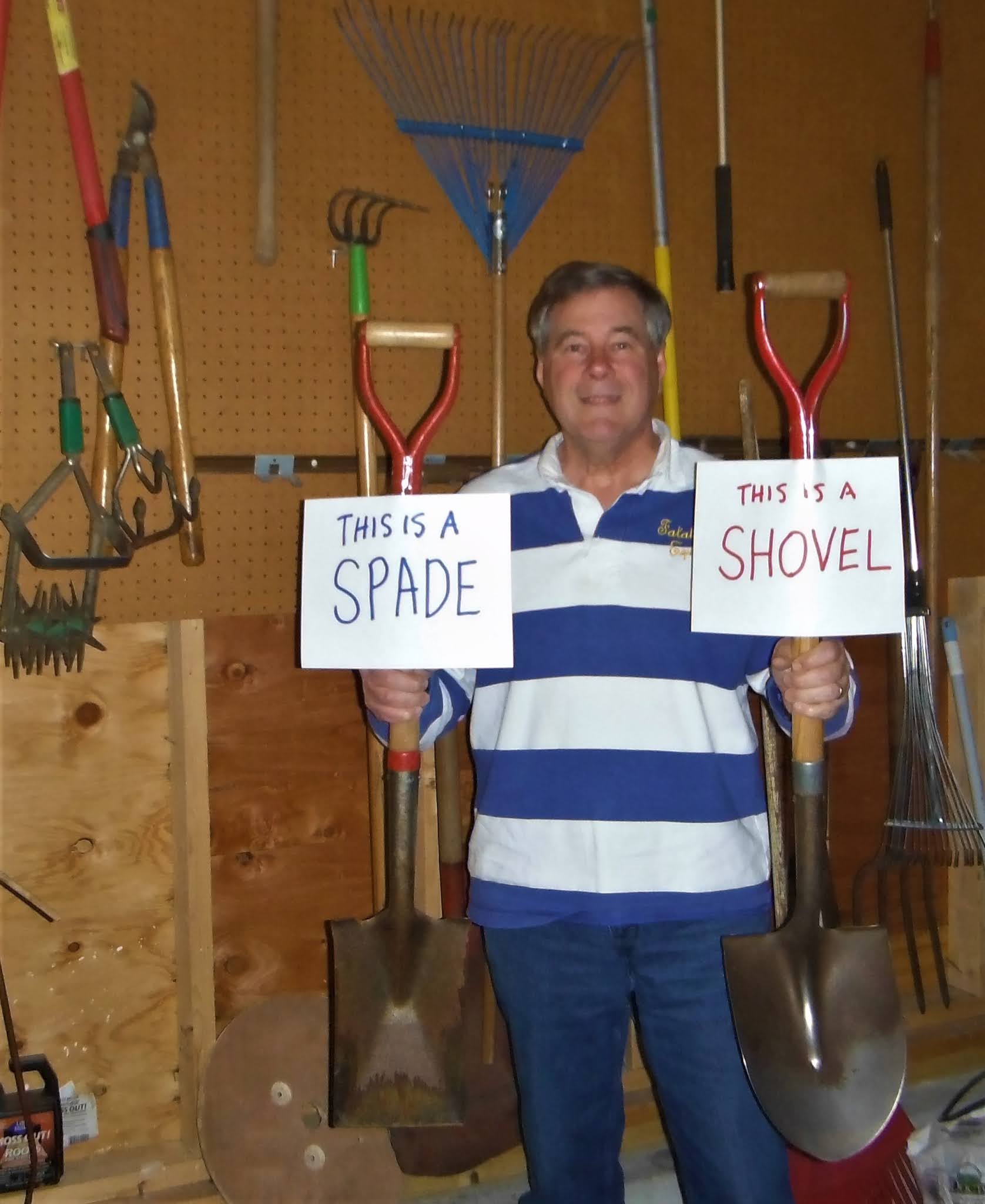
Let us start with the question that apparently perplexes all novice gardeners: the difference between a shovel and a spade.  I’ll be honest here and admit that, until I looked it up on Wikipedia just now, I did not know there was a difference between the two.  But I’ll be damned! A spade is always shorter than a shovel and has a flat blade, while a shovel is angled and has a rounded scoop. You use a spade to edge stuff; you use a shovel to injure your back by digging out rocks. Spades are terrific for digging trenches (provided you don’t encounter any big rocks, which are called ‘potatoes’ in the trade). Shovels are best for leaning on while you consume quantities of ibuprofen (brand name sponsor to be substituted for generic drug).

Double-click for a larger image
Now, you could have learned this information by opening Google and typing in ‘difference between a spade and a shovel’, and it would even show helpful photos on the first screen. But you novices don’t seem to trust Google. You’d rather flood the HGTV message boards with a request for the answer or, better yet, hear it from a celebrity like me! That’s fine, and it gives me ample material for my forthcoming reality series, ‘Neal Knows More Than Martha’.

Real gardens are filled with rocks
I’m going to let you in on a secret: Martha doesn’t have a real garden. How can I be certain? When Martha puts a spade down into the soil to plant something (or, should she use a shovel?), she comes up with a rich mixture of loosely packed loam and compost, and plants a peony in two minutes. Real gardens – at least those anywhere close to New England, and Bedford, NY is nestled right up to the Connecticut border – aren’t like that, folks. In a real New England garden, your spade sinks down half an inch and hits a rock. And you spend the next two hours pulling out rock after rock, and then find there’s not enough soil to fill the hole and you spend two more hours searching for soil. After which your wife spots the leftover rocks and suggests you use them to mend one those quaint walls you fell in love with when you bought the property. But that’s another episode of my reality series, and it will likely require some caution for use of colorful, family-unfriendly language.

What else can we cover before our time runs out? How about this one: What exactly is a ‘Love Fern’, why would Kate Hudson be offering to deliver one, what does vodka have to do with it, and why would a gardener care?

Kate Hudson's Love Fern
Well, once upon a time (18 years ago), there was a film called, ‘How to Lose a Guy in Ten Days’ and Ms. Hudson was its female lead. In one scene, she walks in on her boyfriend’s poker game and spots a fern that has seen better days. She cries out, ‘our Love Fern!’ and takes it to the kitchen for resuscitation or, more likely, a proper burial. What does vodka have to do with it? Well, vodka is an exceptionally effective killer of ferns, which is something every gardener ought to know.  Beyond that, I have absolutely no information.

Maybe Martha can cover that one on her reality show.

April 20, 2021

Year 7 Begins


Our dream retirement home, April 20, 2021
On April 8, 2015, Betty and I moved into our ‘dream retirement home’; the abode we have every expectation of being our residence until we’re dragged out by our feet after our demise. The house was our own design: built to allow two adults to ‘age in place’.

We began in 2015 with a blank slate
Like the house, the garden began as a tabula rasa – a blank slate upon which to create ‘one last great garden’; built from the knowledge gained from predecessors dating back four decades. Betty is the architect of the garden; I am the guy who digs holes and moves rocks.

This final garden is designed to fulfill two purposes. The first is that it should be low-maintenance. For too many years, we had gardens that, in season, required upwards to 20 hours each week for maintenance. Betty’s goal was to have a property that required most of its care at the beginning and end of the season, and would both show well and need minimal care through the balance of the gardening year. In short, a garden that could be managed by a retired couple with lots of outside interests.

A flicker at our suet cage
The second – and perhaps more important – purpose, is that the garden should be pollinator and bird friendly. It should, to the greatest extent possible, use native plants and should be an extension of the conservation land we abut. Trees, shrubs, and perennials have been chosen for how well they fit the ‘pollinator-friendly’ requirement. There’s no grass – not a blade – nor are there any of the garden-center staples like Bradford pears (from China), Norway maples (from the Carpathians), or Kousa dogwood (from Asia). If it doesn’t host native birds, bees, or butterflies, it has no place in the garden.

Which doesn’t mean the garden is dull. Our trees put on spectacular shows, and our shrubs and perennials become blankets of durable bloom. You’ll see those photos over the next several months.

Our amelanchier about to bloom
The garden has grown organically.  In our first year we planted the specimen trees and a few dozen shrubs. The second year saw many shrubs and lots of perennials. Everything wasn't perfect: shrubs changed locations as we got to know where we had the best shade and sun. Some perennials simply didn't like the location. Others became too aggressive. It has been a learning experience.

This, the garden’s sixth season, should be the one when the vision becomes reality. We went to Garden in the Woods last week and came home with a single Ceoanthus americanus (New Jersey tea). In Aprils past, we would return with a car stuffed with shrubs and perennials. My goal this year is to document the garden as it reaches its mature status.

Our hyacinth border
I begin with bulbs. We have planted more that 4000 of them. We readily recognize they’re the most ‘foreign’ aspects of the garden (most spring bulbs originated in western Asia) but, if they are aliens, they’re friendly ones and, better still, they’re ephemeral. We are also cultivating our share of natives, like Mertensia virginica (Virginia bluebells), which have established themselves in the shadier spots of the back of the property, along with Jeffersonia diphylla (Twinleaf) and Trillium.

Twinleaf (white flower)
and bluebells
Our bulbs provide the first color of the season, and are placeholders until our flowering trees and shrubs begin putting on their displays.  Today (April 20), we have an Amalanchier ‘Autumn Brilliance’ just a day or two away from being a blizzard of white flowers.  The maples, in turn, all are showing their proto-leaves. Our native Dicentra (bleeding hearts) are doubling in size every few days and will be flowering before the end of the month.

So, sit back, enjoy the photos, and check back regularly.

March 22, 2021

Remembering Sandy Robinson


A wonderful lady and treasured friend passed away early this morning: Sandra Kay Robinson - Sandy to everyone who knew her - lost a near two-year-long battle with cancer.

Sandy installs Betty as GCFM President
I first met Sandy on June 2, 2015. I can say that with certainty because, the following day, Sandy installed my wife, Betty, as President of the Garden Club Federation of Massachusetts. Sandy was herself the newly installed President of National Garden Clubs, Inc. (NGC); the umbrella organizations for garden clubs across the United States and with affiliates throughout the Americas.

Sandy had progressed through the garden club ranks in her home state of Kentucky, then stepped onto a treacherous ladder that included a competitive, six-year ‘apprenticeship’ that culminates with being elected as national president.  The national president is the visible face of the organization, and the title comes with a back-breaking travel schedule: she is expected to visit all 50 states and a slew of South American countries during her two-year term.

Sandy at the Newport
Flower Show
The next day, I gave Sandy a couple of my books for her upcoming flights (over the next two week she would install half a dozen presidents).  She dutifully put them into her tote, and the look on her face was one that said, ‘Oh, my God, something else I don’t have room to pack…’. I imagined my precious books being abandoned next to air sickness bags on flights all over the east coast.

But something amazing happened.  Sandy read them.  And then passed them on to friends with glowing recommendations. I would begin to get notes from strangers in far-flung locations asking when my next book was coming out.

With Betty now going to NGC events and with me in tow peddling books, Sandy’s and my path crossed several times a year. I came to know a woman who both took her NGC role seriously, and who also took life with a large dollop of humor.  One of the perks of being NGC president is to choose a national theme (hers was ‘Leap Into Action’) and, along with that theme, to work with professional writers and illustrators on a children’s book.  Sandy had a life-long affinity for and fascination with frogs and so a wonderful book with an environmental theme was produced: The Frightened Frog. It sold extraordinarily well, including in Massachusetts. Sandy, in turn, was deluged with frog-themed paraphernalia, which both delighted and overwhelmed her.

David Robson and Sandy
at Coastal Maine BG
When I met Sandy, my writing and speaking credentials petered out at the borders of the six New England states. I credit much of my success beyond the region to Sandy’s speaking well of me, though she never saw a presentation of ‘Gardening Is Murder’ until I addressed the annual meeting of the Garden Club of Kentucky. It was my first talk in front of a group of people who had no frame of reference for New England gardening – or humor. Afterward, Sandy said I was ‘even weirder than (she) already thought I was.’

At Crane Beach
In 2019, Betty and I were able to reciprocate some small part of Sandy’s friendship. In June of that year, she and David Robson were invited to judge the Newport Flower Show. We invited them to come a few days early, allowing us to show them some of ‘our’ New England, including an all-day trip to the Coastal Maine Botanical Garden (she had seen it once before – for 40 minutes – as part of a whirlwind tour of horticultural sites), Crane Beach, Long Hill, and Farnham’s fried clams (even though she had a seafood allergy).

Her sense of humor
on display
That was also the last time Betty or I would see Sandy, though we spoke with her periodically. That autumn, she received her first cancer diagnosis. A spring 2020 speaking swing through the Midwest that would have included a detour to Kentucky to see her was scrubbed when Covid-19 reared its head.

She was a remarkable lady who leaves an enduring legacy. Since hearing the news of her death this morning, we have heard a cascade of remembrances of kindness, activism, friendship and, above all, devotion to the garden club community.

March 5, 2021

Getting the Gang Back Together Again


Medfield's Community Garden
For the past dozen years, I’ve performed an end-of-winter task that is equal parts sheer joy and pulling teeth: I’ve re-assembled an ever-growing coterie of vegetable-growing enthusiasts for the Medfield Community Garden.

If you take the responsibility seriously, managing any community garden is not for the faint of heart.  Managing one with 75 plots and 80 demanding gardening families is grounds for keeping a defibrillator close at hand, especially in an era when acceptable out-of-door activities are few and far between.

A woodchuck hole in
one of our gardens
For me, the process began at the end of January with a review of the ‘Gardening Guidelines’.  Don’t try to impose ‘rules’ on gardeners. ‘Rules’ smack of dictatorships. ‘Rules’ are totalitarian. ‘Guidelines’ are things everyone can agree to do, especially if they fit on one page. As we do every year, Betty and I reviewed and re-wrote the Guidelines with a view to addressing things that went wrong in 2020.  For example, a woodchuck wrought destruction in one garden, so burying fences six inches was elevated from a ‘nice thing to do’ to something expected of every plot holder.  Because of overwhelming scientific evidence, plastic mulch (ground covers) went from being ‘discouraged’ to ‘banned’.

the Guidelines
Once the Guidelines were ready, I emailed those gardeners who had left their plots in good condition at the end of the 2020 season. I told them to read the Guidelines and, if they were in agreement with them, they could claim their old plots for a new year. That was on February 1, and I gave them to the end of the month to get a check to me.

That’s when the ‘special requests’ began flooding in.  Gardeners with half plots wanted to move up to full ones. Gardeners with full plots wanted to move to sunnier locations. Families that had co-gardened with other families wanted plots of their own.

Oh, and as all this was happening, the town asked how we could make the garden compliant with the ADA – the Americans with Disabilities Act.

Many community gardens allow
permanent fences, which inhibits turnover
While not an official requirement, our goal in the Community Garden is to bring in new blood each year. Too many towns, we found, have gardens that, intentionally or not, are essentially hereditary.  To us, that wasn’t fair and, to that end, we’ve expanded the garden twice and split large gardens in half.  Our problem is that people don’t want to leave and, as noted above, many of those half-plot holders want to move up to full plots.

In an average year, though, 15-20% of gardeners move from town, lose interest, or ‘age out’ (including children reaching an age that being with Mommy in the garden has lost its magic).  In 2020, roughly ten gardeners dropped out due to Covid concerns. Those plots were immediately snapped up by a dozen replacements. This year is turning out to be anything but average. The renewal rate from 2020 is above 90% which means, if we give the ten gardeners who want to move up from half plots to full ones, there isn’t any room for new gardeners.

ADA compliance will require we offer
some plots with beds raised to
wheelchair-accessible height
In the end, we had ten, 300-square-foot plots to offer new gardeners.  On the morning of March 1, I put out a single notice on Medfield's 'Concerned Citizens' Facebook page and had responses within 15 minutes.  By March 3 at 6 p.m., I had checks in hand for all ten gardens - and a waiting list for those who did not comprehend the opening sentence of the 'Gardening Guidelines' that plot assignments are not final until paid for.

And so, we’re trying to expand the garden yet again – add an additional ten full-size plots. Ground is supposed to be broken this month, but it’s weather-dependent and this has turned out to be a snowier-than-expected winter.  We're doing a final walk-through with the town's Conservation Commission next week and I am crossing my fingers everything goes as planned because I’ve also put out the word to prospective new plot-holders.  If it doesn't happen, I have visions of my head on a pike.

One option for compliance
The ADA compliance question is also turning out to be a surprise.  We cast a fairly wide net looking for examples to follow. Almost all responses we received were of the ‘What a great idea!’ variety, and a few added, ‘Please let us know what you do so we can replicate it’, which was an encouraging reply but not especially helpful. 

As it turns out, accommodating gardeners with disabilities has not been on many town’s radar screens.  We did find the gardens constructed as part of the Southwest Corridor project have special wheelchair-accessible raised beds, as does the Audubon Society’s Nature Center in Boston.  We’ve submitted a proposal to the Conservation Commission and, last evening, it was warmly received.  The timing is anything but set in stone but, once it happens, it appears we’ll be trailblazers once again.

February 17, 2021

Introducing my latest book: ‘Murder Brushed with Gold’

When I retired 15 years ago, I thought I’d try my hand at writing a mystery.  It took six months, and it taught me the difference between ‘thinking about doing something’ and actually doing it. That book, ‘A Murder in the Garden Club’ turned out to be very popular and, even better, gave me a cast of interesting and likeable characters whom I could incorporate into subsequent stories.

No suburban sprawl in Hardington

What I didn’t realize back then was one of my most important ‘characters’ was the book’s locale: Hardington, Massachusetts.  In other parts of the country, Hardington seems idyllic (except for all those murders): a small New England town, yet just a short commute to Boston. It’s a town without big-box stores or strip malls. It is surrounded by open space and has a near-four-century-long history. It’s the anthesis of the typical big-city suburb, where you know you’ve crossed municipal boundaries only because there’s another Home Depot.

Hardington and Medfield
are both southwest of Boston
Hardington is a lightly fictionalized version of the town my wife and I have called home (off and on) since 1980: Medfield, Massachusetts.  Medfield has just a handful of traffic lights and no streets wider than two lanes, yet it is just 17 miles from the center of Boston. It has about 13,000 residents scattered over 15 square miles. More than half the town’s land is off limits to development.

For ‘Murder Brushed with Gold’, I mined two nuggets of Medfield’s history.  First, for several years in the late 1800s, the town had a small artist’s colony focused on impressionist, plein air painting.  No less a figure than Isabella Stewart Gardner touted Medfield as having vistas comparable to Monet’s Giverny.  And, second, in 2006, AOL (then, a powerhouse internet service provider) tried to get permission from a judge to dig up a yard in Medfield. Why? Because the company believed a young internet spammer had buried millions of dollars of gold bars in his parents’ lawn. (There is some stuff you can’t make up.)

The roadside cottage still exists
I freely admit a soft spot for art.  It figures prominently in ‘Deadly Deeds’ and ‘A Murder at the Flower Show’. For my new book, I re-created that colony in the summer of 1889 and populated it with a mix of real and fictional artists. One of the real people is Dennis Miller Bunker, a gifted artist who died tragically young. One of his enduring paintings, which resides in the National Gallery of Art, is of a humble roadside cottage in Medfield.  I had a fictional artist, Alan Churchill Lawrence, paint a first version of it.
'The Pool, Medfield' by
Dennis Miller Bunker (1889)

Every good story needs a ‘heavy’, and mine is another fictional artist: Edward Merrill Cosgrove. He is already famous, powerful and wealthy with an oceanfront estate in Maine, yet he deigns to pay a visit to Hardington for reasons that become clear as the book progresses. 

After three days, though, two men appear at the boardinghouse’s door seeking an audience with Cosgrove. They do not get it. An agitated Cosgrove disappears for a day and, late that evening, Lawrence witnesses what he believes is the burial of the two men by Cosgrove and an accomplice behind the cottage Lawrence painted just a few days earlier.

'Gray Day on the Charles' by
John Leslie Breck (1889)
Lawrence knows Cosgrove is not a man to be crossed, yet he must be brought to justice. Lawrence adds a conspicuous spot of color to the painting and sends it off, along with pages from his journal, to his agent in Boston with instructions to find a way to get the material into the hands of the police.

Skip ahead 132 years. Liz Phillips (the amateur sleuth in the series) is accompanying her good friend, antiques dealer Roland Evans-Jones, to Boston’s Museum of Fine Arts where, in exchange for having his painting cleaned, he is lending Alan Churchill Lawrence’s ‘Wayside Cottage’ for an upcoming MFA exhibition on New England plein air art colonies.  In MFA’s conservation studio and in the presence of the curator mounting the exhibit, the painting is taken out of its frame for the first time.  Out pops Lawrence’s journal, together with a plea by Lawrence to his art dealer for his help.

Isabella Stewart Gardner
as painted by Sargent
The curator immediately recognizes the journal as a powerful, historical artifact.  Cosgrove’s standing as the ‘Father of American Impressionism’ could be shaken to its foundation. She immediately sends PDFs of the journal to researchers for their comment.  Liz Phillips suggests digging up the site identified in the painting (the building still stands, little changed, from the time it was immortalized). Volunteers are recruited.  Detective John Flynn (the series’ other protagonist) gets involved to coordinate things. Hardington’s police chief even invites the media to record what is found.

Which, or course, is when all hell breaks loose. The heirs of Edward Merrill Cosgrove say the journal is a sensational forgery created by a publicity-seeking ‘used furniture dealer’. They demand the painting and journal be turned over to their experts for scrutiny.  And then, those volunteers at the wayside cottage sink their shovels down into the soil behind the wayside cottage… and strike something very unexpected.

Oh, and you’re only about a quarter way through the book.

How it all started

If you’ve not read the five ‘Hardington’ mysteries that precede this, you’ll find ‘Murder Brushed with Gold’ a satisfying stand-alone read with lots of humor, twists and turns; along with plot points turning on art, museum politics, robocalls, fractional jets, and some other things that would be spoilers to mention.

If you’ve kept up with the series, you’ll finally get Roland Evans-Jones’ back story, meet Liz’s daughter, Detective John Flynn’s wife, and get another helping of Felicity Snipes. And, for those who have been rooting for two lost souls to admit their attraction for one another… well, let’s say there’s some of that, too.

You can purchase print or Kindle copies of ‘Murder Brushed with Gold’ through Amazon, or print copies directly from the author at https://the-hardington-press.square.site/, or by contacting me directly. You can read the first chapters at www.TheHardingtonPress.com.