March 20, 2023

Acts of Kindness on a Southern Sojourn

My best guess is that it fell off the back of one of the campers racing toward a weekend on the Gulf of Mexico. I had seen several such caravans in the preceding hours: chairs, bicycles, umbrellas and other bric-a-brac that had no assigned storage space, and so were tied or bungee-corded to the vehicle. If you hit enough bumps and don’t inspect your lashings every time you take a break from the road, something will inevitably come loose.

The ’something’ was an aluminum beach chair; the kind you can buy at Ocean State Job Lot for ten bucks. The chair had already been struck at least once; likely by a high-riding SUV or truck which crushed and bent it. In the instant I saw the object before our car, too, ran over it, I remember the gaudy colored plastic mesh that formed the seat and back of the chair.

A Prius rides very low to the ground
Our vehicle, though, is a Prius; and part of the design of the Prius that adds to its well-deserved fuel-sipping reputation is that it rides lower to the ground than those ubiquitous SUVs and pickups. When one of our tires passed over the debris, one or more pieces of aluminum obeyed the laws of physics and angled upward, snagging the undercarriage of our car. Betty and I heard the crunch but assumed we had merely further flattened the carcass.

Fifteen seconds later, our assumption was proven wrong. HYBRID DRIVE COMPROMISED – PULL OVER IMMEDIATELY AND SEEK ASSISTANCE appeared on the Prius’ display. We quickly did so, guiding our vehicle to the breakdown lane. Getting out of the car, we discovered a clear liquid was puddling underneath it.

Thus began eight days of discovering that there is a stunning amount of kindness in this world.

We were on that road – Interstate 59 in Hattiesburg, Mississippi – because, a year earlier, I had accepted an invitation from the Deep South Region of National Garden Clubs to be the speaker at the Friday luncheon of their annual convention, to be held in New Orleans. I would present ‘Gardening Is Murder’ to an audience where few (if any) of the attendees knew of me or my books. I was being presented with an opportunity to reach 150 prospective readers by delivering a humorous talk about gardening from a spouse’s point of view.

Our 1526-mile drive. We almost made it.
It is 1526 miles from Medfield, Massachusetts to New Orleans (22 hours and 48 minutes of driving, according to Google Maps) and Jet Blue will get you there in 3 hours and 40 minutes. But, in addition to providing laughter coupled with a modicum of horticulture to a receptive audience, my mission was also to sell books. The cost of separately shipping books, displays, and banners would make the trip economically impractical. With a vehicle that averaged 64 miles per gallon though, I could make the trip within the travel stipend agreed to by the convention organizers.

Betty made it clear there was no way I going to make the journey alone. We would share driving duties; leaving our home early on Wednesday, stopping overnight in Tennessee, and arriving in New Orleans in time for a 4 p.m. reception on Thursday.  It was a good plan and, but for that beach chair, we would have made it with an hour to spare.

A call to AAA got us a tow to Toyota of Hattiesburg. I had already been on the phone with one of the dealership’s service advisors, Michael Metzger. He quickly understood our predicament and offered to intercede to help with a car rental. Ordinarily, such a task would be easy; but this was the beginning of spring break for area colleges and all cars in the region were spoken for. Through a series of direct calls to local agencies rather than through impersonal call centers, he found a vehicle we could have for two days; but must be returned to Hattiesburg by noon Saturday. Once our Prius was at the dealership, Mike also got us to the car rental agency ten minutes before its 5 p.m. closing time.

The second kindness came from the organizers of the convention, and especially from Convention Co-chair Elizabeth McDougald, who had hired me a year earlier. We arrived after 7 p.m. – long after that reception and also as dessert was being served at the evening awards dinner.  We were quietly seated and fed, our room key already in our hand. The following morning as I set up my books display, I found everyone at the conference knew of our on-the-road travails; a general announcement had been made. It would not be an overstatement to say more than a hundred people said they were glad me made it to the convention and wished us a safe return home.

We were left with a dilemma, however. Our Prius had been thoroughly examined early Friday morning. The lawn chair had damaged our radiator, A/C coolant line, fans, and fan housings. None of these were in-stock parts; all had been ordered but would not arrive until at least Monday. Repairs and road testing would push our departure to Tuesday at the earliest - possibly until Wednesday - and Thursday if additional problems were found. Our rental car had a hard return time of Saturday at noon. We could be stuck in a hotel room in Hattiesburg with no means of transportation for at least four days; possibly six.

Better this than five days in a
Hattiesburg motel room
Thus came the third kindness. While I delivered my lunch presentation, Elizabeth McDougald’s husband, Glenn, researched travel options. By 3 p.m., Betty and I had seats on a Jet Blue flight back to Boston leaving that evening. Elizabeth offered to gather and store all the books and other paraphernalia we would be unable to take with us on the flight. The McDougalds also said they would arrange for the return of our rental car.

Once at the airport, we emailed our neighbor, Jane Cobb, who was performing cat-sitting duties, to let her know we were arriving home a day early and so she need not give Abigail her morning feeding. Ten minutes later, our cell phone rang asking what time out plane landed at Logan Airport and how did we plan to get home? We said we would take a taxi because of the post-midnight arrival. Jane replied she would meet us outside baggage claim and would not take ‘no’ for an answer.

On Monday morning, Mike Metzger let us know the parts were in hand and a body shop was already straightening out housing brackets. Mike suggested our Prius could be ready as early as Tuesday afternoon. I have never known a repair to go so quickly. We had assumed we would fly into New Orleans, use an Uber to collect our stranded belongings from the McDougalds, and then continue in the Uber to Hattiesburg at some astronomical price.

An act of kindness
Instead, we had yet additional acts of kindness. If we could fly into Mobile, Alabama, instead of New Orleans, Elizabeth and Glenn would meet us at that airport with our peripatetic possessions and drop us off in Hattiesburg on their way back to New Orleans. A quick look at a map showed Hattiesburg is ‘on the way’ to New Orleans from Mobile in the same way Albany is on the way from Boston to New York City. We gratefully agreed to the offer.

Our final hurdle: 20 minutes to go 
3600 feet (2/3 of a mile)
More kindnesses: Jane Cobb’s spouse, Dennis Amtower, drove us to Logan for an 8:00 a.m. flight (for which you leave Medfield at 5:45 a.m. to cope with morning rush hour traffic and TSA inspection). We made our connection in Charlotte – a 3600-foot sprint – with just minutes to spare and arrived in Mobile just after noon. Mike Metzger had our car prepped and ready when the McDougalds dropped us off in Hattiesburg. We were on our way back to New England at 2:30 p.m.

So many things could have gone wrong along the way. But they didn’t. And, thanks to a group of people – most of whom we had never met before last week – what could have been an unmitigated disaster was instead only a time-consuming (albeit expensive) mishap. I have three more speaking ‘road trips’ on my schedule this Spring, with destinations in South Carolina, Illinois and Michigan.

There are three more 'road trips' 
scheduled this Spring.
In hindsight, at 1500+ miles each way, New Orleans was probably too far to drive. Illinois will almost be certainly done by air, and I will figure out a way to ship books ahead of schedule. But Myrtle Beach is an (almost) leisurely 850 miles and Michigan (819 miles) features a dual speaking engagement with me at noon and Betty at 2 p.m.

Though I have lived 'up north'  for almost all of my adult life, I am a son of the South, and this trip reinforced the notion there is something both real and very special about 'Southern Hospitality'. No matter how the rest of this speaking season goes, I will forever remember the kindness we discovered on our sojourn to New Orleans.

March 6, 2023

Gardeners Wanted

For the past 14 years, Betty and I have performed an end-of-winter task that is equal parts sheer joy and pulling teeth: We’ve filled a community vegetable garden with gardeners. This year, we’re finding that job isn’t an easy one.

In an age of sticker shock in the vegetable aisle,
a garden ought to be a no-brainer
In an age of sticker shock in the vegetable aisles and an emphasis on eating wholesome foods, you would think that finding 75 gung-ho gardeners ought to be as easy as announcing the availability of plots and then jumping back to avoid being trampled… especially when 90% of your gardeners from last year tell you in November they’re ‘definitely coming back’.

The reality, for reasons I’ll attempt to explain, is quite different. Let’s start with the 90% ‘count-us-in-for-next-year’ rate. If that statistic held true, we would be looking for seven or eight new gardeners each year. Why did that handful of last year’s gardeners drop out? Mostly, they tried the garden for a season and discovered it was harder than they thought, or not as much fun. That is to be expected. In addition, at least one or two gardeners ‘age out’ each year because of their own decreased mobility. There’s also another kind of ‘aging out’ in which six-year-olds who once thrilled at the idea of going to play in the dirt with Mommy were now tweens who would rather lose their screen privileges for a week than be seen in a vegetable garden – and Mommy’s biggest reason for having the garden was to educate her children. That scenario plays out several times a year.


The other problem is that people’s lives get in the way. Over the winter, three full-plot holders – all excellent gardeners – moved out of town and so are no longer eligible for a space. Two other long-timers are having Big Events this summer and need to take the year off. A mother and daughter who had separate plots decided to share one. Add to all those stories the three abandoned plots that became food pantry gardens last year and we found ourselves with twenty vacant spaces for the 2023 season.

Fortunately, three long-time gardeners who until this year had made do with half-plots (300 square feet) asked to upgrade to full ones. I quickly emailed them and granted their wish. In theory, all I was doing was swapping one vacancy for another; I still need to find a new gardener for their old plot. Well, yes, but I’ve filled a vacant full plot that might otherwise be carved into two smaller ones (as a policy, we ask first-year gardeners to begin with a half-plot).

To fill these twenty spaces, we started a media blitz. Medfield has a weekly ‘shopper’-style newspaper delivered to every home. I wrote an article and submitted some great photos. We made the front page! There is an online news outlet called Patch dedicated to all things Medfield which published a second article. There are also two or three Facebook groups dedicated to things going on in Medfield. Those sites are being peppered with photos of happy gardeners, lush gardens, and cornucopia of perfect vegetables.

The result of that publicity barrage, as of this morning, is eight gardeners who have sent checks and a few more who promise to do so. Which leaves nine gardens still to fill.

'Weeding' went to the top of the
'Gardening Guidelines'
There have been other queries. Everyone who calls or emails is sent a peppy, encouraging response that encourages would-be gardener to take the next step. But my response also includes an attachment – the Garden Guidelines.

We don’t have ‘rules’. ‘Rules’ smack of dictatorships. ‘Rules’ are totalitarian. ‘Guidelines’ are things everyone can agree to do, especially when they fit on one page. Each year Betty and I review and re-write the Guidelines with a view to addressing things that caused problems the previous season.  For example, a woodchuck wrought destruction in one garden, so burying fences six inches was elevated from a ‘nice thing to do’ to something expected of every plot holder.  Weeding aisles was also a problem last year. The gardener’s obligation to keep aisles weeded went from the middle of the page to the top.

We make certain everyone
knows the gardens do
require work.
Do the Guidelines scare off would-be gardeners? I think a more accurate description is that they are a reality check. A few years ago – and I promise I am not making this up – a husband and wife seeking a plot for the first time informed me they intended to plant their garden in mid-May but were thereafter going to their vacation home in Maine for six weeks with no plans to return to Medfield until late June at the earliest. Betty (who is the family diplomat) gently told them their expectation they would return to a weed-free garden lush with ready-to-pick vegetables was probably unrealistic. The couple passed on the garden.

In an average year, though, all the plots are filled by the second week in March and we have started a wait list for the inevitable handful of people who change their minds about gardening after the season begins.

The world has re-opened
This year, I have a queasy feeling those last plots are going to hard sells. During the pandemic, we had a virtual monopoly on ‘acceptable’ outdoor mask-free activities. Even if you were tepid about the idea of vegetable gardening, the idea of getting out of your house and into the sunshine three or four days a week for a few hours was irresistible.  Three years later, the world has re-opened and Spain or Yellowstone National Park or New Zealand beckon. Being tied to a garden is an obligation fewer people are willing to undertake.

We will make it work. As noted above, last year’s abandoned plots became gardens dedicated to growing produce for food pantries. That turned out well because of the dedication of half a dozen participants with hearts of gold. Let’s see how this year unfolds.

February 4, 2023

The Fifteenth Season Begins

An abandoned plot. 'Mom' apparently
had other ideas for the summer
Please double-click on any image, including
the video, for a full-screen view.
In August 2008, Betty and I were spitting mad. It was our fifth year with a plot in the Medfield Community Garden. Two spigots were non-functional and two others leaked a continuing stream of water because of degraded gaskets. Half a dozen abandoned spaces among the 40 plots were growing up in weeds. Yet, in the center of this dystopian landscape, three gardens rose like plantation houses above the sharecropped fields. The smallest occupied two plots; the largest, four. Sprinklers, forbidden to us serfs, soaked those gardens. Contraband bags of weed killer lay in plain sight.

One member of our town’s Select Board (think Town Council) also happened to be our attorney. We went to him with our grievances. He said he would look into the matter. Two weeks later, the Town Clerk asked us to come to the Town House (think Town Hall) to be sworn in as members of the Town Garden Committee. When we were duly installed, we asked whom we should contact about attending the next meeting. The Town Clerk, with a perfectly straight face, informed us all the members of the committee had resigned. We were on our own.

The inmates were left in charge of the asylum.

We informed the Select Board what we wanted to do and they said, ‘fine, whatever’. We ripped up the eight-page ‘Garden Rules’ and wrote a set of ‘Guidelines’ that fit on a single page (so no one could say they didn’t have time to read them). The spigots were repaired, all plots were weeded under penalty of expulsion, and no one could have more than one plot. The garden expanded three times to become 75 plots in two sizes.


The last expansion came in 2021 – amid Covid – after we could not accommodate all the town residents who wanted in. Last year, with Covid restrictions largely gone and people again free to travel, we nearly concluded that last growth spurt was a mistake. Seven plots were surrendered early in the season, only four gardeners were on our wait list, and repeated entreaties via social media yielded no takers. In a ‘Hail-Mary-pass’ moment, we turned the three tenant-less plots over to volunteers to grow produce for the Medfield Food Cupboard.

Part of one delivery to a food pantry
The idea not only worked; it was a touchdown. When our town’s food pantry turned away a donation, we discovered a nearby town would happily take everything we could grow. The volunteers labored just as diligently on the ‘food insecure’ sites as they did on their own. We were onto something.

At the end of last season, the lingering question in Betty’s and my mind was, like a ‘dot-com’ company that hires too many people and takes on too much real estate only to find its customers have moved on to something newer and shinier, whether community vegetable gardening was a bubble doomed to burst?

We got our first inkling of an answer when we sent out our ‘straw poll’ in November and found just ten of our 75 plot holders didn’t plan to return – and two of those who declined were doing so because them were moving. Moreover, three half-plot (300 square feet) gardeners said they would like to move up to a full (600 square feet) space. Maybe it’s the astronomical prices of vegetables, but interest in community gardening appears to be as strong as ever.

Those ‘Gardening Guidelines’ have always been an evolving document. This year, we inserted language into it specifically encouraging our members to plant more than they need for their own families, and plan to share the rest with food pantries. We are also recruiting for someone to take on the time-consuming task of setting up for food pantry collections, picking up the donated produce, and transporting it to the correct site. (As with other garden volunteer jobs, the ‘salary’ is a free plot for the season – a $25 value!)

We also start this fifteenth season with a third member of the Community Garden Committee. No less a sage than Leonard Cohen wrote, ‘Seventy is not old age; it is the foothills of old age’. Both Betty and I check that box and, while we certainly don’t feel ‘old’, we know the baton will need to be passed at some point. Whether our new ‘Ogre Understudy’ is the person to take the reins or that task falls to someone (or several someones) who have yet to raise their hands, we want the Community Garden to not just be around, but to thrive for the next generation of folks who want to get their hands dirty.

November 6, 2022

November Surprise

 The drought of 2022 and total water bans that left most New England lawns brown barely affected 26 Pine Street. 'Tough natives' is one answer why our garden remained green. Rain barrels refilled during the infrequent rains is another. After our 250-gallon rainwater reserve was gone, we resorted to 'grey water' from showers and kitchen use.

We also practiced triage. Already-bloomed perennials were left to their own devices. Our scant water was lavished on the late summer and autumn bloomers. We watched with dread as immature tiarellas and heucheras withered - and hope they will return from their roots next spring.

The biggest surprise, though, came with the shortened days of October. We have had a vivid, long-lasting autumn. The photo at the top of the page is of Fothergilla gardenii 'Blue Shadow'. We have nine specimens in groups of three around the property. We purchased and planted them in 2015 because of their blue-green leaves and long-enduring white bottlebrush flowers in June. Autumn color was not part of the buying decision. But the brilliant yellow-gold leaves fairly require sunglasses. More than a few walkers have stopped, pointed, and asked, "are those real?" The answer: yes, they are.

Itea 'Little Henry' with Magnolia 
'Elizabeth' in the background.
Our Itea 'Little Henry' is also putting on a dramatic show. Virginia sweetspire is well-known for its long-lasting autumn transformation from glossy green leaves to speckled red, orange, and gold ones. It is also the last deciduous shrub to drop its leaves; and inclusion of multiple specimens of the cultivar was on our shopping list from the first draft. 

Itea's dirty little secret is that it is not well-behaved. It sends out runners to colonize any nearly open area. and patches of the shrub have become thickets. We have allowed it semi-free rein in just a few areas. One is by our garage and adjacent to our Magnolia 'Elizabeth'. Both the Itea and magnolia are in full autumn regalia in the photo just above.

Rhus aromatica (fragrant sumac)
Rhus aromatica, better known as fragrant sumac, is usually planted because of its pleasant scent, white (but short-lived) flowers, and spreading habit. The 'Gro-Low' cultivar also made our plant list because it grows in marginal soil and we wanted it to cap and grow down the small hillock between our house and the street. The idea was it would be the neutral background for the more interesting specimens (Ilex and Azalea, primarily) rising above the stone wall. As the photo at left shows, our Rhus has ideas of its own. The photo is taken from the street to show what walkers and bikers see when they pass by. And, as you can see, it is also obediently beginning to trail down the hillside.

Some trees have already dropped their leaves: the Magnolia shown in the second photo is an exception. In time, our Oxydendron (sourwood) will have a colorful autumn display; but it is still too immature to look like anything other than the gangling teenager it resembles. At the base of our Betula nigra (dwarf black birch), though, is a stunning perennial Aconitum, variously called wolf's-bane or monkshood.  It is one of the plants we lavished water on back in July and August, and it has rewarded us with a flowering of vivid blue purple flowers. It has grows from a single plant to a small colony. 

Viburnum Winterthur
In our back garden, our two specimens of Viburnum 'Winterthur' have had their purple berry clusters picked clean by our colony of overwintering  birds, but their show continues with leaves now red-purple at the top of the shrub and green/yellow/pink at the base. Adjacent to those specimens are our six Vaccinium corymbosum - highbush blueberry by any other name. They've been red and gold for more than a month and are now in their final glory days; their color complements and frames the maples and oaks in the woods beyond.

highbush blueberry
It's a remarkable display and, yes, in a few weeks it will be just a memory.  But, for a month or so, New England has something no other places can boast: a riot of color, all produced by Mother Nature as part of her preparation for winter.  We're delighted our small garden shows so well and pleases so many of those passing by. 

Author's note: all photos were taken on November 5, 2022

September 22, 2022

The Summer of Giving Back

A carload of produce
For more than a decade, the community garden my wife, Betty, and I manage has had a good working relationship with our local ‘food pantry’, which provides a grocery-store-type experience for Medfield’s food-insecure families. Until this year, though, apart from contributions from our own plot, my involvement was primarily posting (via email to our member gardeners) a pickup schedule provided by one of our gardeners who is also on the food pantry’s board. I knew we were ‘doing good’ but had little insight into the process.

In March, that gardener notified me she needed to take the 2022 season off and asked if could Betty and I could fill in for her. Without hesitation, we said, “sure.” That’s when we found out what ‘being involved’ really means. It is a lesson that will stay with us for a very long time.

Our 75-plot community garden formally opens in April; but until early May the ground is too cold to grow much of anything except leaf greens. Our first collection of 2022 was little more than a few bags of lettuce and arugula.

This abandoned plot was planted
specifically for food pantry use
Something else, though, had also happened in the first month of the gardening season: several gardeners dropped out, and we had already exhausted our wait list. Our inspirational solution was to turn those vacant plots over to volunteers willing to plant crops specifically for the food pantry. Three plots were quickly covered in seeds, plugs, and plants.

I also confess my dormant business background was aroused from its 17-year-long slumber. For years, donations for the food cupboard went into two wheelbarrows at the garden’s main entrance. There are, however, no fewer than five entrances from the street. Thanks to a mechanically inclined member of the garden, we have at least ten working carts and wheelbarrows. I deployed all of them in such a way it was impossible to enter or leave the garden without passing at least two barrows.

To enter or exit the garden, you have
to walk by wheelbarrows
Further, specific ‘sweep’ times were established. The Medfield Food Cupboard requests a single delivery at 3 p.m. on Tuesday. Because gardeners have varying work and life schedules, Betty and I made certain everyone knew we would pick up produce from the wheelbarrows on Monday at sunset, Tuesday morning after the ‘early shift’ gardeners had left, and Tuesday afternoon at 2:30. And, if you couldn’t get to the garden, a volunteer would carefully pick you plot in your absence.

Suddenly, we had a carload of produce for each distribution.

We were aware there was a smaller distribution organized on Saturdays for home-bound clients of the food cupboard. One Friday morning, we offered produce for it and were told it wasn’t needed. “But,” our food cupboard contact told us, “you might see if the food pantry in Medway can use it.”

The Medway Village Food Pantry
with our produce on display
The Medway Village Church Food Pantry was indeed interested. On some weeks we were now organizing twice-weekly drives. How could we keep gardeners interested in contributing more frequently? Betty’s innate marketing skills came into play. We began soliciting photos of our produce arrayed for the two towns distributions. We emailed these beautifully composed photos, together with testimonials, to our gardeners. Contributions rose apace.

We are now in the final third of September. The Great Zucchini Glut is behind us and tomatoes no longer fill an entire crate; but I see winter squash ripening in plots, kale continuing to grow, and an emerging bounty of spinach and greens. We’ll keep contributing until there is a hard freeze.

We send our gardeners photos of
their contributions on display
This has been a learning experience; an eye-opener of major proportions. I get urgent emails from gardeners who couldn’t get to their plots but who don’t want their green beans to go to waste. Can we pick them? Yesterday, a gardener fretted her eggplant, though ripe, are still too hard and so might be rejected by food cupboard clients. I told her what the head of the Medway pantry told me: not only does every vegetable go; they’re the first thing to disappear off the tables.

By Betty’s count, we’re making as many as twelve trips a week to the community garden to collect produce, devoting additional hours to harvesting gardens that are not our own, turning over a corner of our basement to be a vegetable sorting and packing center, and making at least one delivery every week to a food pantry. It has been a busy summer and a satisfying season of sharing.

June 2, 2022

A Remarkable Garden Begins its Eighth Season

Our 'garden' in June 2015 

Double-click on any photo to see a full-screen slideshow

In early June 2015, the firm of Scott Dolan & Company carried out an unusual project: instead of creating a landscape for a new residence (his usual assignment), Scott was charged with removing one. Over the course of two weeks, he removed the top 18 inches (947 cubic yards) of what is accurately called 'builder's crud' and brought in 950 cubic yards of screened loam. He also built a permeable, crushed-stone driveway; an elegant, geometric sidewalk; and a Pennsylvania flagstone patio. When his crew departed, there was half an acre of ready-to-plant soil; lately covered with two inches of brown mulch, but nary a hint of green.

The Magnolia bed
When we designed our 'dream retirement house' Betty made it clear she had in mind a very different landscape: a native plant garden without a blade of grass anywhere within its perimeter. I said it was a great idea, and I would provide at least half the labor. By the end of that first summer we had planted nine specimen trees to serve as anchors for beds, and several dozen shrubs. It looked, frankly, rather forlorn. Each year we added additional shrubs, together with bulbs, perennials and ground covers. Gradually, the garden began to form a coherent whole. Year by year, Betty's vision became more apparent.

The same view in 2022
The garden has now reached something approaching maturity. In a month it will be dominated by sweeps of flowering perennials as rudbeckia, penstemon, monarda, shasta daisies, and betony bring their colorful blooms. Right now, though, there is something different (and, in its own way, more elegant) to see: dabs of color made by shrubs, ground covers, and early-blooming perennials collectively forming an every-shifting canvas.

Viewed from the front porch
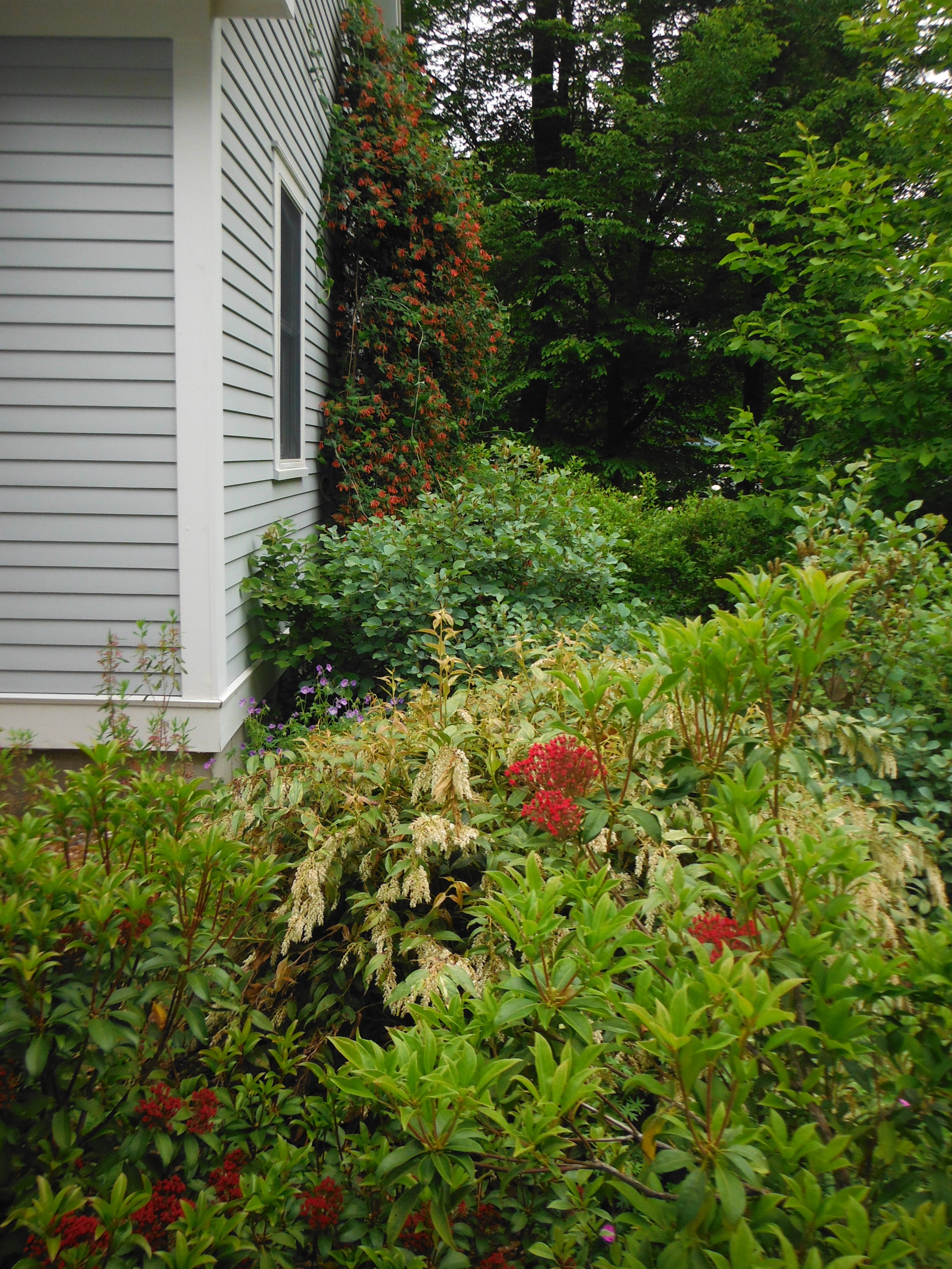
In the 'Magnolia bed' closest to the house, from one vantage point there is a succession of blue-flowering Amsonia, behind which are white and yellow peonies; all framing a flaming red honeysuckle (Lonerica sempervirens) that climbs fifteen feet up one wall of our garage. Walk up the sidewalk a few feet and that same honeysuckle is now the backdrop for white Baptisia, a yellow-flowering bush honeysuckle, and purple and blue geraniums.  Getting closer to the front porch (see photo at left), the color comes from flowers of  brilliant red mountain laurel (Kalmia 'Sara') and the multi-colored foliage of Leucothoe 'Girard's Rainbow' with its tiny, ivory flowers.

Our redbud with Baptisia
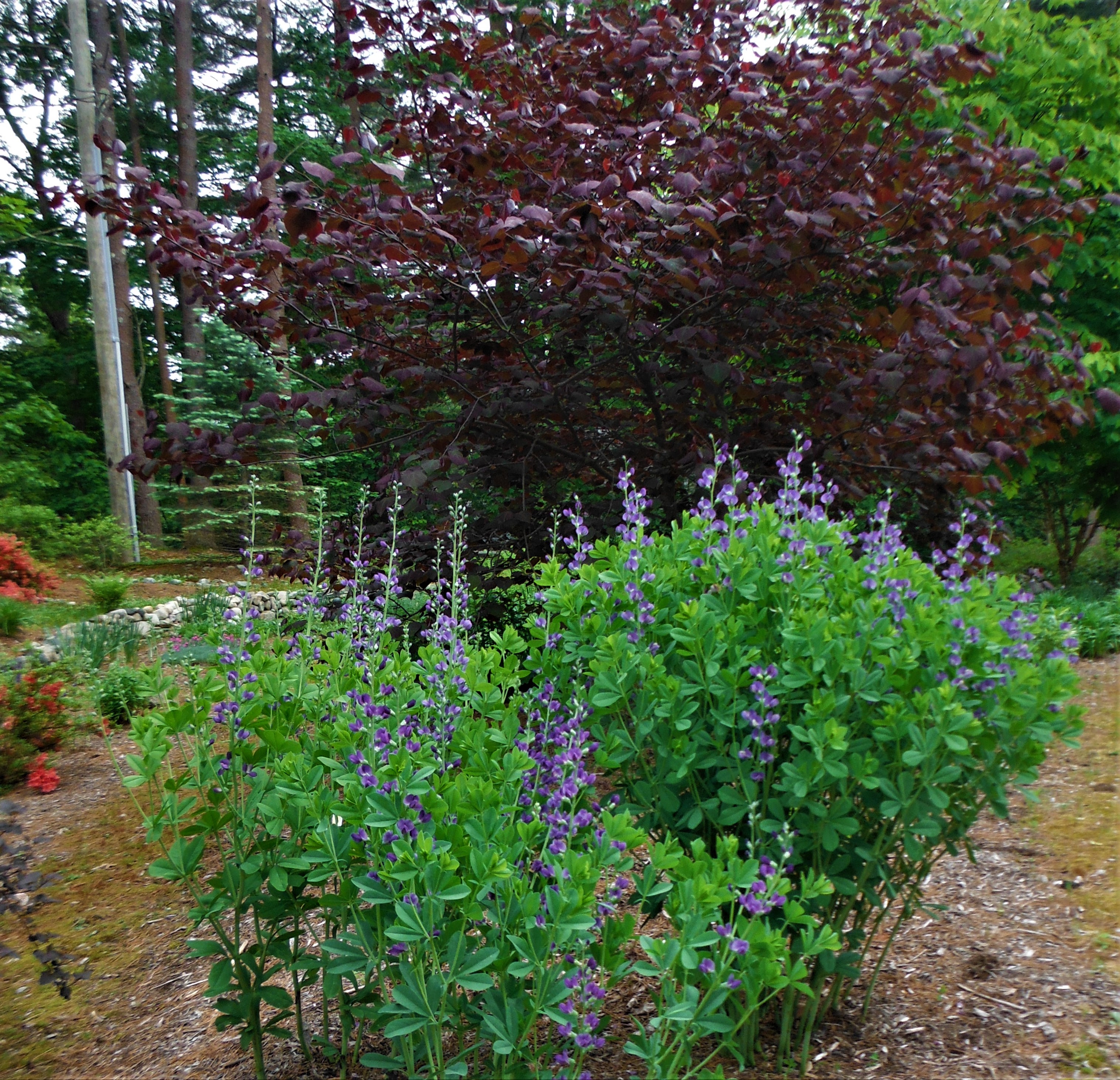
Elsewhere in the front garden, our redbud (Cercis canadensis 'Burgundy Hearts') has show-stopping dark red foliage. Depending on which path you take through the garden, it can be the backdrop to a stand of blue Baptisia, the stark white flowers of a maple-leaf Viburnum, or the brown leaves and pink-white flowers of a pair of ninebarks (Physocarpus opulifolius 'Diablo'). At the far corner of the front garden, a dwarf black birch (Betula nigra 'Little King') presides over a brilliantly yellow bed of golden ragwort (Packera aurea). 

The rear garden with fringetree in bloom
In the rear garden, our diminutive fringetree (Chionanthus virginicus) bloomed with white flowers for the first time this year. Beyond it is a sea of unusual, colorful groundcovers ranging from columbine to phlox to false strawberry (Potentilla indica) and blue ajuga. Multiple viburnums are coming into flower.

This essay is being written from that porch
All this was just Betty's vision in June 2015; a gamble, really. Could a retired couple in their mid-60s possibly plant such a large space?  How would they maintain it? Who would every buy it if they had to sell? Well, we did manage to plant it on our own (thank you, ibuprofen) and its maintenance is considerably less than a 'traditional' lawn and shrubs (and a lot more fun). As to selling it, we built a home into which we could age gracefully. We only wish everyone could have a garden as well-planned for long-term enjoyment coupled with ease of care... and a home with views as beautiful as the ones we enjoy every day.

April 4, 2022

Rites of Spring

 Two important events marking the arrival of spring took place over this past weekend. The first involved a cast of a dozen intrepid gardeners. The second was a more personal one for Betty and me.

The Medfield Community Garden
This is our (gulp) thirteenth year managing the Medfield Community Garden. Before we became the lone members of the Community Garden Committee (the existing members all resigned), town employees handled almost all aspects of the garden; collecting fees, mowing the perimeter and, especially, marking out the garden plots. One by one, we assumed those duties or, in the case of mowing, doled them out to gardeners in exchange for waiving plot fees. The result is an extremely high degree of self-sufficiency. We ask the town to deliver supplies of wood chips. Other than that, we’re on our own.

Town Department of Public Works employees marked out the garden the first few years. Then, Betty and I tried it on our own, with painful (literally and figuratively) results. When an entire weekend is devoted to the task of pounding 160 stakes into the ground, something is profoundly wrong. So, we asked for volunteers and the task became easier.

There are three-foot aisles
around each garden
As the garden expanded from 40 plots to 50, more volunteers were invited to join the effort, sometime with comical results. All gardens have a three-foot-wide perimeter around them. One year, an enterprising volunteer with an inexact grasp of the concept of elasticity brought a six-foot bungee cord to allow three plot corners to be marked simultaneously. A one-inch error in a 30-foot measurement is forgivable. When the fifth plot measurement was off by a cumulative ten inches, we were forced to declare the use of bungee cords non grata.

My staking diagram
This year, we had 60 plots to mark, and 11 volunteers in addition to the two of us.  Two-thirds of the crew assembled on Saturday morning were veterans armed with yardsticks, mallets, tape measures unspooling in lengths up to 100 feet. I brought 240 stakes, 60 pie plates with names and plot numbers already affixed, and – most important – a Plan. Betty and I had already laid out two long strings indicating the axis of the garden. Now, using the corner plot where the strings intersected, I showed how using the outward faces of the stakes was crucial to ensuring accuracy. Everyone nodded their understanding.

Then, I produced my singular act of genius: a flow chart. While Group 1 put down pie plates (held in place with heavy rocks) in each plot, Group 2 would move southward along the first row of plots, and Group 3 would begin marking the westward column. When Groups 2 and 3 had each marked their second plots, Group 4 would go to work laying out the second row!

And so, we staked the garden
And, lo and behold, it worked. The entire garden – more than an acre – was completed in almost exactly two and a half hours.

We thanked everyone profusely, went home, and took a long nap.

Then, on Sunday morning, we started the task of waking up our own home garden.

Beneath these leaves and pine needles,
perennials are waiting to emerge
Conventional wisdom – at least according to people who make a living taking care of other people’s lawns and gardens – is that at the end of the season, grass and shrubs should be pristine and free of leaves. That belief is horribly wrong on multiple counts, not the least of which is that leaf ‘litter’ protects bulbs and the roots of shrubs, while providing overwintering homes for valuable insects.  Accordingly, in late October and early November, we not only ‘allow’ leaves to congregate under our shrubs, we also deposit pine needles and chopped leaves over our perennial beds.

During the winter, much of that garden detritus breaks down by the natural actions of temperature, bacteria, and precipitation to become future soil and compost. In early April, we remove the excess from our home garden. Leaving everything in place isn’t really an option: a layer of wet leaves will form a mat that keeps the ground cold and prevents air, water and light from getting to the sleeping bulbs and perennials under them.

The stone wall, partially cleared
I began at the long stone wall at the south end of our property.  It collects a lot of leaves. I work with 50-gallon plastic bags, and I filled three of them jump-in-and-stomp-down full (the leaves are emptied into the woodlands that make up the back acre of our property). In front of that wall is a long perennial bed with multiple clumps of spring bulbs.

Each gentle pull of the rake revealed a waiting surprise: Nepeta (cat mint) putting out its first tendrils, wood ferns looking for sun, and daffodil shoots trying to push through the leaf mats. Three Polemonium caeruleum (Jacob’s Ladder) plants we added last spring not only made it through their first winter, but were half again as large as what we planted in the spring of 2021.

This clutch of white crocus was
under a covering of leaves
Betty began her tasks in a different part of the garden, removing leaves from areas where bulbs and perennials were pushing up. In the process, she gave clutches of yellow, white, and purple crocus; scilla, brilliant yellow winter aconite; and Chionodoxa an opportunity to show their colors.  The long border of Muscari (grape hyacinth) was freed of a winter’s worth of blow-in detritus. In a few weeks, we will be rewarded with a two-foot-wide, seventy-five-foot-long sea of blue.

Over the course of the next week, we will tackle each bed in turn, removing excess leaves and trimming perennial stalks we left up so seeds were available for birds. We do all this to please ourselves and the hundreds of walkers that pass by each week, smiling and waving their thanks.

The best part of this garden-awakening process is, when May arrives and our neighbors get out their lawnmowers for the first of a six-month cycle of weekly cuttings, we will be out on the porch enjoying the view, and admiring the very different path we took with our own property.

January 31, 2022

The Blizzard of '22 (or was it '21? Well, it was twenty-something)

They don’t make blizzards the way they used to.

The blizzard of '78 shut down Route 128
How did they make them once upon a time? On February 5, 1978, my wife, Betty, and I boarded a 7:30 a.m. flight from Chicago’s O’Hare Airport to New York LaGuardia. The forecast for New York was ‘light snow’. As we circled LaGuardia waiting to land, our pilot announced the airport had just closed and we were being diverted to Hartford. There, we were the last plane to land before Bradley Field was also closed. The airline put us on a bus, which skidded off snow-and-ice-covered I-91 15 miles south of Hartford. A second bus got as far as New Haven and we were told to take the train for the rest of the trip into the city. We managed to squeeze ourselves and our luggage onto the only Boston-to-New-York train that completed its run that day. We arrived at Penn Station at 8 p.m. with New York reeling under two feet of unplowed snow. And, we were the lucky ones: an untold number of motorists were trapped in or abandoned their cars on Boston’s Route 128 when snowplows were unable to keep up with the three feet of snow that fell.

That was a blizzard. It came, seemingly, out of nowhere; catching everyone by surprise. It created real-life tales of hardship endured and heart-warming stories of families taking in strangers. Forty-four years later, The Blizzard of ’78 is still one of the life-defining events for those who were there.

We had a blizzard here in Massachusetts over the weekend. It came complete with white-out conditions for hours on end, hurricane-force winds along the coast, and up to 30 inches of snow with drifts as high as a Boston Celtics center. Medfield, where I live, got about 20 inches over twelve hours – about half of it falling in a three-hour period in mid-afternoon.

This map was published three days
before the storm hit
The difference was, we knew it was coming. In fact, we knew the storm’s track six days earlier when it was nothing more than some scattered snow showers over the Pacific Northwest. Aided by sophisticated computer models, forecasters predicted this system would intensify as it moved east, then dip south to pick up energy from the Gulf of Mexico, combine with a low-pressure system that would form off the North Carolina, dump modest amount of snow in the Appalachians, then explode east of Long Island in something called ‘bombogenesis’.

Two days before the storm
The storm did exactly what forecasters said it would do. The only question was what would happen when it passed over some longitude and latitude marker south of Nantucket. Like a ‘Y’ intersection, it could take the left fork and dump its load of snow over one part of New England, or the right fork and clobber Cape Cod. The only speculation was over the site of the ‘jackpot zone’, which turned out to be the towns of Sharon and Stoughton, some twelve miles east of here. Something called ‘the European Model’ got the track exactly right 72 hours before the first flakes fell.

The day before the storm
Obedient to the forecast, we stocked up on groceries and wine two days before the storm. Knowing the storm’s duration (8 a.m. to 10 p.m. Saturday), I did not go out and shovel when there was a lull. The electricity never went out (and we have a whole-house generator to back up Eversource). With a warm house full of books and streamed entertainment, we could fairly ignore what was going on outside.

And, apart from snow, what was going out outside? Nothing. The highways were empty of traffic. Our favorite bakery had a notice on its website they would be closed on Saturday, but re-open Sunday at 6 a.m. No one showed up at our door seeking shelter.

Is it still a blizzard if there’s no uncertainty concerning its outcome?

If you live on the coast...
There are some for whom the above is an outrageous statement. If you live on an ocean or bay – or worse, on a barrier island – every storm is an existential threat. But living in such a location is a conscious decision. You knew what you were getting into when you built or purchased your home, and have been reminded of that bargain every time a house up the shore from you disappears in a hurricane or nor’easter.

Me, shoveling Sunday morning
But I digress. The simple fact is, I just went through the first New England blizzard in three years, and it felt like a re-made-for-Netflix version of a movie I’ve seen a dozen times before. With Betty still incapacitated from her foot surgery, I dutifully used our snow blower to clear the driveway Sunday morning then, with a shovel, tackled the sidewalk, mailbox, and end-of-driveway plug of ice deposited by the town’s plows. My reward for three hours work was my first cup of hot chocolate of the season... and lots of ibuprofen.

It’s a sad state of affairs when you can go through a day-long snow storm and know with great certainty that, a year from now, you’ll have absolutely no recollection of it. The National Weather Service now gives winter storms names. This one should have been called, ‘Meh’.