March 22, 2019

Where Does the Boston Flower Show Go From Here?

Me, way back when.  You
can double-click on the
photos to see a slideshow.

Before I go further, I need to say I have a strong interest the Boston Flower and Garden Show (BF&GS), as well as its predecessor, the New England Spring Flower Show (NESFS).  It’s an emotional investment: I ran the Massachusetts Horticultural Society’s activities at the BF&GS for three years, and helped build flower show exhibits for several years prior to that.  This essay’s title is intended to pose two questions; one geographical and the other philosophical.  Both are hard problems with no easy answers.

The old Bayside Expo Center
I’ll start with location.  After a peripatetic existence in the 1950s and 1960s, the ‘old’ New England Spring Flower Show settled into a long run at the Bayside Exposition Center in Dorchester, six miles south of Boston’s Financial District.  The facility, a failed shopping mall, leaked and was abysmally maintained.  But it was cavernous and had location in its favor: just off the Southeast Expressway with thousands of adjacent, reasonably-priced parking spaces (attractive for suburbanites), and walking distance from the MBTA Red Line (convenient for city dwellers).  

The move to the Seaport World Trade Center was a compromise.  At roughly 120,000 square feet, it was less than half the size of Bayside, but Bayside was shutting down.  The Paragon Group (the group sponsoring the BF&GS) could not guarantee the hotel bookings necessary to secure the use of the Boston Convention and Exposition Center (BCEC).  Seaport became, quite literally, the only game in town.  The other facilities were too small or not available.

Two years ago this was a surface
parking lot across from Seaport.  I 

took this photo on the show's last day.
In 2010, the first year of the Seaport venue, things went reasonably well.  Seaport (itself a repurposed and re-built cruise ship terminal) was a hotel and office complex amid a sea of cheap, surface-level parking lots.  Mass Hort had no problems drawing floral designers, amateur horticulturalists, and volunteers for the show; and show attendees found ample, reasonably-priced parking  Within two years, though, the Seaport District began its transformation into an office and residential district.  Within six years, the cost to park for a few hours soared from $11 to $36 and traffic bogged down in a morass of lane closures.

Then, last year, Fidelity Investments announced it would close Seaport’s exhibition hall in mid-2020.  Moving the show became not an option but, rather, a necessity. 

Seaport's footprint, while hardly
ideal, is better than alternatives
Where can it go? In my opinion, suburban Gillette Stadium’s field house at just 80,000 square feet, is too small for the show.  The Back Bay’s Hynes Convention Center has 150,000 square feet of space, but it is on two floors and has the same access issues as Seaport.  BCEC is unlikely to make an exception to its hotel/night formula.  Absent a mall closing down (always a possibility in the current retail landscape) or a well-situated warehouse becoming vacant, the alternative is to relocate the Boston Flower and Garden Show elsewhere in New England.

Is there still a demand?
Which goes to the heart of the second question: is there still a demand for a late-winter flower and garden show?  Having been to Philadelphia and being acquainted with the Maine Flower Show in Portland, I can easily argue there is an audience.  But the Philadelphia Flower Show, run since 1829 by the powerhouse Pennsylvania Horticultural Society, is a sensual extravaganza that draws a quarter million attendees from the northeast and mid-Atlantic states.  It will go on as long as Penn Hort is around.  Now in just its third year, the Maine Flower Show is intimate by design and is profitable on 50,000 attendees.  Although held at the end of March, it is in a location where nothing will be green for at least another six or eight weeks.

Waiting to get into the New England
Spring Flower Show in the 1950s
I cannot help but feel – and this is personal opinion – that ‘flower shows’ in northern urban centers have been bypassed by time and technology. In 1960, the ‘winter vacation’ was the province of the wealthy.  Today, for $79, Jet Blue will fly a Bostonian to Ft. Myers or Ft. Lauderdale, where the flowers and greenery don’t have to be forced and six hours of artificial spring isn’t followed by stepping into icy puddles accompanied by a blast of 35° wind.

Mass Hort's exhibit in 2012.
Everything was in bloom.
Also, in my opinion, the 2019 BF&GS was a dispiriting affair.  I know landscape exhibits; I know what it takes to force plants to be fully in leaf and flowering for mid-March: it requires a large greenhouse heated to 80° for as long as three months and a lot of tender loving care for thousands of plants.  Yet, at this year's show, I walked by one exhibit by a ‘major’ landscaper in which dozens of azaleas were barely leafed out and not a single one was in flower.  To me, it was inexcusable - or cheap (forced plants must be returned to those same greenhouses until May).  Many other exhibits consisted more of stone than of plants ("It don't cost a dime to force stone," an exhibitor once told me).  And, if the landscapers aren’t putting their hearts into it, why should a visitor pay $20?

Amateur horticulture at the 2019
flower shoe was a high point...
Mass Hort wisely moved its entry day for amateur horticulture to Sunday from Monday to avoid fighting Boston’s legendary traffic.  The change, however, only paused the long slide in participation.  While the entries were of wonderful quality, they came from a shrinking pool of amateurs willing to make two treks into the city: one to drop off their plants and another to retrieve them.

... and amateur photography was
dazzling with entries from everywhere
Getting floral designers and judges to come into Boston was becoming difficult by 2012, my last year of running Mass Hort’s activities at the show.  Why?  Because so many designers now winter in warmer climates.  This year, the Garden Club Federation of Massachusetts formally dropped out of the show, dramatically reducing the number of floral design exhibits on view. Only Ikebana (which expanded to fill the space formerly allotted to the two floral design divisions) and Amateur Photography delivered the ‘wow’ impact I believe show attendees deserve (and those activities were relegated to the nearly invisible conference center beyond the exhibit hall).

Is it a bygone era?
This is a difficult essay to write because – as I stated at the outset – I have an emotional investment in the success of the flower show.  With the benefit of 20/20 hindsight, the ten years at Seaport sapped the show of its energy by its smaller footprint and relative inaccessibility to the show’s target audience.  Paragon does not publish attendance figures, but my observation is that the show draws fewer people each year.  Friends tell me Paragon has told them there will definitely be a flower show at Seaport in 2020, and that a search is on for a suitable venue for 2021 and beyond.  I wish them success, but I fear the winds of change have sealed the show’s fate.

February 27, 2019

S'no Fun at the Old Homestead


In this unusual winter of 2018-2019, it took until Winter Storm Quiana to finally bring the Boston area enough snow to make it necessary to fire up our snowblower.  That event also began the annual nature-versus-nurture ritual in our family of arguing that Neal Cannot Possibly Know Anything About Snow Removal Because He Was Born in Florida.

I grew up in a snow-free environment
Yes, it is true.  I am a native of Miami.  I did not experience snow until I was 20 years old, and then only because I drove two hundred miles for the specific purpose of personally witnessing actual flakes of snow falling out of the sky (it seemed like a good idea at the time).

But that was in 1969.  Since 1971 I have lived exclusively in snowy locales.  I once lived in Schenectady, NY, where it is rumored the snow never melts.  I dwelled in Chicago where it begins snowing on Halloween and does not stop until late April, if then.  And I have spent 30 of the past 38 years in New England; sixteen of them with a 220-foot-long driveway that most decidedly would not clear itself without my intervention (Betty's rebuttal is that for seven of those years, I managed to be away on business every time it snowed).

For 16 years, we lived in a home
with a 220-foot-long driveway
Surely my adult tenure as a ‘northerner’ counts for something.  But not according to my wife, who was raised in the Finger Lakes region of New York; the anointed Snow Capital of America.  While I was busy tending the family mango and avocado plantation in January, February and March, Betty was working shoulder-to-shoulder with her father to clear six-foot-high drifts of the white stuff.  I freely admit she had a head start on me; but I’ve had nearly five decades to catch up.

I am not allowed to use the snowblower because I ‘don’t do it right’.  What, exactly, is the ‘right’ way?  You point the snowblower down the driveway and put it in gear.  You turn the crank on the gizmo that throws it left or right.  What could be easier? 

I invented a snowblower on
skis for our gravel driveway,
but I still 'do it wrong'
Well, our driveway is not macadam.  It is loose stone (to allow precipitation to percolate down into the water table rather than into storm drains).  Three years ago, I invented – and may yet decide to patent – a means of mounting the ‘maw’ of our snowblower onto a pair of skis so the business end of the machine rides an inch above the stone.  It is a sight to behold and it works wonderfully well.  But I am not allowed to be its wrangler because (it is alleged) I picked up too many stones on the lone pass of the driveway I was allowed to make.

Because of all the plants along it,
even shoveling the sidewalk requires
spousal supervision
I am instead consigned to the hand-shoveling of the sidewalk.  But even that requires close spousal supervision.  You see, we have no grass.  If we did, we could pile snow on it from now until Memorial Day.  Instead, we have trees, shrubs of many sizes, and perennials.  It’s never OK to put snow on a shrub (duh), but snow must also be spread out within perennial beds, never allowing snow to become too deep.  Also, to prevent accidentally covering small shrubs, snow should preferably be transported to the moss pathways that divide our garden into planting beds.

If I sound like I’m griping, it’s only because I think I’ve earned another shot at the back end of our Ariens Deluxe 22” machine when Winter Storm Ryan comes around.  I’ll even keep shoveling the sidewalk.  And besides, the family mango plantation has long since been bulldozed to make way for a shopping center.

February 6, 2019

You Can Take the Gardener Out of the Garden, But...


My wife, Betty, and I took a much-needed and long-delayed vacation last month.  Our original plan had been a month in New Zealand (where it’s midsummer) but, coming just four months after a total knee replacement, Betty’s surgeon advised against 20 hours on a plane and strenuous hiking. 

As it turned out, she made a remarkably swift and full recovery, but we made our January reservations in November.  And so instead, we chose a week in London and a week in Paris.  The forecast for London was chilly and damp.  For Paris, it was chillier and with a chance of Yellow Vests.

Expecting to be primarily indoors, we built our itinerary around a series of special art and culture exhibitions in those two cities.  In all, we visited fifteen museums and galleries, several with those ‘once in a generation’ kind of blockbuster events.

Why, then, did we keep ending up in gardens?

Snowdrops in bloom in January in St. James Park, London
It started in London.  We walked everywhere and, England being England, we kept running into things in bloom.  There were unexpected blooming irises in St. James Park.  Millbank Garden, a long, narrow park opposite the Tate Britain beckoned with a pocket garden where daphne and camellias were in flower despite the short days and chilly nights. 

It became a part of our day: finding small, protected parks where tough, seasoned plants were showing their stuff.  Park Crescent, at the southern tip of Regent’s Park, yielded a hedge with a white bottlebrush-type flower we could not identify.  A winter vegetable garden valiantly hung on at the Duck Island Cottage opposite the Horse Guards Parade, and a scattering of Galanthus (snowdrops) bloomed nearby.

A flower market in the Marais District
Paris provided more unexpected gardens, albeit of a different kind.  It was colder in Paris – not Boston-cold, but with daytime highs in the low 40s – and we were even greeted with a burst of sleet our first day.  We spotted our first garden on the south side of the Notre Dame Cathedral, where a pair of large raised beds provided homes for cold-weather bedding plants like Stachys byzanta (lambs ear) and hellebores.

Walking along the Seine on our way to the Musee d’Orsay, it seemed every houseboat on the river sported large boxes of brightly-colored flowers.  The Marais district sported dozens of window boxes and a large weekend flower market.

Can you really get a gardener out of the garden?  I don’t think so.  You can go to see art but, in the end, you can’t stop also seeing all the color that nature unexpectedly surprises us with, even in the depths of winter.

January 21, 2019

Celie Sturtevant


My path to becoming a writer was not a conventional one.  I lacked an MFA from any college, I attended no university-affiliated writers’ workshop, and I had no circle of established writer friends from which to draw wisdom.  What I had was a head full of ideas and an urge to get them down on paper.  Because I was learning as I wrote, some of my writing ‘lessons’ were painful to absorb.

Celie Sturtevant
One of those lessons came at the hands of Lucille ‘Celie’ Sturtevant, who passed away last week at the age of 91.

By way of background, Betty and I led a nomadic existence for several decades.  I made the most of career opportunities with the result we were sometimes in a given city for just a few years.  We came, we set up housekeeping, and we left without leaving footprints in the community we nominally called home.  That changed in 1999 when we returned to the Boston area, and to the same town we had called home through the 1980s.

This time, we began to sink down roots.  We joined a community garden, Betty joined the local women’s club and garden club.  And she began telling me stories of the people she met in those clubs.  I came to know those people personally when I volunteered to be the ‘strong back’ at club events. 

Celie was one of the people who made a deep and indelible impression.  She was a tiny woman, but full of laughter, smart insights about people and events, Yankee ingenuity, and affection for those around her.  Though in her 70s when I met her, she was a golfer and a skier.

When I retired in 2005, I had the outline of plots for several books, one of which became my second published work, The Garden Club Gang.  My plot was simple: four ‘women of a certain age’, acting out of friendship for one another, come together to do something very much outside their comfort zone.  Complications ensue. 

One of those four characters was modeled on Celie.  I knew enough about writing to understand you don’t lift someone from life and put them down on the page intact.  You change things around.  You create a mosaic and turn that montage into a mold that becomes your character.  Still, a writer has the leeway to insert a few ‘tells’ that give a wink to the character’s true identity.

When the first draft was done, Betty read it and suggested I might want to show it to Celie.  I called her and asked if she’d like to be a ‘first reader’ for one of my manuscripts.  She said she would be delighted.  When I dropped off a printout of the text, I made no mention I might have modeled a character on her.

I should mention the ‘something’ these four ‘women of a certain age’ do is plan and execute the robbery of a large New England fair.

Four years later, Celie
made a second
appearance
A week later, Celie called and said I could pick up the document.  When I arrived at her home, she was seated at her kitchen table, the manuscript in front of her.  She motioned me to the chair opposite her.  She was drumming her fingers on the draft of my book, and she was biting her lower lip.

I sat down.  She drummed her fingers a moment longer and then forcefully shoved the manuscript across the table toward me.  In her sternest voice she said, “I would never do anything like this.”  Defiant, she then folded her arms.

I went back to the drawing board.  I recast the character, excising anything that might conceivably lead a reader to conjure up an image of Celie Sturtevant.  In the process, I created a better, more nuanced and sympathetic character than the one I had written just a few months earlier.   Celie received one of the first copies of The Garden Club Gang.  I urged her to read it and she did.  Her review was highly positive; she said, apart from the character’s diminutive stature, she recognized nothing about herself.

Celie's third time; this
spring will be her fourth
Celie’s reaction that day in her home was a lesson I never forgot.  Ever since, I’ve made certain my characters, while inspired by people I know and admire (or, in some cases, know and dislike intensely) have physical characteristics and personality traits either imagined or borrowed from multiple sources.

This spring, the character inspired by Celie will appear in the fourth installment of what has become The Garden Club Gang series.  In fact, her much-transformed alter ego comes center stage in this outing.

In attending her memorial service this past weekend, I saw how deeply she touched the lives of those around her and her community.  I can state from personal experience she certainly touched mine.

January 16, 2019

A New Year, With New Gardening Possibilities


For a gardener, the wonderful thing about January in New England is that all things are possible.  Whether the ground is bare or under a blanket of snow, you need only look outdoors – or, better yet, take a walk – and imagine what might be in 2019.  That’s what we’re doing this week.

Courtesy of our neighbors’ trees, three November and December wind storms filled our property with thousands of plump pine cones – themselves a product of this year’s wet summer and fall.  We carted off barrels and bags of them lest they either sprout into pine forests or attract unwanted squirrels.  Because the cones buried themselves in nooks and crannies, extracting them gave us the opportunity to mentally revisit our 2018 garden and think about what can be done this year.

Thousands of pine cones
For example, I pulled a clutch of pine cones from a bed of daisies.  Last year’s stalks were cut down in November but the 2019 greens are already in place, over-wintering at the base of the plants; forming a blueprint of what the bed will look like next year.  Just two years ago this bed consisted of eight, gallon-sized pots on three-foot centers.  Now, they’ve grown into an unbroken mass.  Should the daisies be encouraged to spread further?  Based on their current ‘footprint’, it’s likely we’ll be offering our friends potted-up daisies next year.

Another example: our miniature clumping birch looked spectacular last year.  Now shorn of its leaves, however, it’s easy to see the crossing branches that will spell trouble down the road.  With the ground frozen, it’s easy to get in to cut the problem branches.  If we waited until April, we’d be up to our shins in mud.

This eupatorium grew so tall it hid
the redbud tree behind it
Or this: last year we planted a marvelous variegated eupatorium in one of our beds.  The foliage was so dramatic we elected not to trim it back in June.  Big mistake; the perennial grew to more than six feet in height, dwarfing everything around it, including a young Cersis canadensis ‘Burgundy Hearts’.  In the cold light of January, I tagged the eight-inch stubble of the eupatorium with the stern command: ‘trim me in June’.

This was to have been the site of a
water feature; it never seemed right
Betty has wanted a water feature in the garden ever since we built our house.  The original site was planned for a space behind our home but it never felt right and so the project went into abeyance.  This fall we added several hundred bulbs to one of the beds in the front of property.  Now, with the leaves off the trees and shrubs, and the outline of the newly planted bulbs apparent, it’s obvious where a small pond ought to be.  That will be a spring project. 

The garden is full of tales to tell.  When everything is green and in bloom, it’s easy to yield to temptation and say, ‘Leave it alone; it’s beautiful just like it is’.  In the brown (or snow) of winter, logic rears its glorious head.  The result will be a new, re-imagined garden.

November 13, 2018

Racing the End of the Season


The end of the gardening season is always abrupt.  One day you have a thriving vegetable plot.  Then, via the simple expedient of an overnight frost, it turns to mush.  Your annuals succumb to frost and old age.  Your perennials look fine and are in flower.  Then, for no ascertainable reason, they’re brown.

Mother nature has wreaked havoc
with our garden clean-up schedule
As conscientious stewards of the land, Betty and I strive each year to put each of our gardens to bed in an orderly fashion.  This year, Mother Nature has been mucking with the calendar.

What do I mean?  Let’s take pine cones as an example.  We had a wet summer and the pines at the borders of our property rewarded us with a bumper crop of cones.  We picked every last one out of the garden – more than a thousand cones – in late September.  Why do we bother?  Well, for one thing we don’t want a pine forest sprouting in our garden.  Just as important, though, pine cones are food for squirrels and other unwanted rodents.  But then came a surprise nor’easter.  The pine cones re-appeared in the garden as if by magic.  We picked them up again.  Last week, a storm with gale-force winds blew through.  Another pine-cone-picking party.

A nor'easter brought us a second
plague of pine cones
We took down our vegetable garden as plants ran their course.  The stalks from three squares of corn, for example, were taken out as the last ears were picked.  But, in the absence of frost, some plants kept producing (we had zucchini and tomatoes into late October).  The ogre who runs our community garden requires plots to be cleared by the end of October.  As a result, much of our final vegetable garden cleanup was hurriedly done on the last day of the month.  A week later, in our capacity as overseers of the community garden, we were back out to clean up the detritus of three abandoned plots.  Naturally, it rained.  Fortunately, seven volunteers made the work go much more quickly.

In addition to clearing our own plot we
cleaned abandoned ones... in the rain
Our first hard frost (October 20) took out our container gardens – twelve ‘major’ ones and another twelve ‘minor’ ones.  Each container had to be emptied, the vegetative matter taken to the transfer station, the potting mix added to a low spot, the miscellaneous bottles and other ‘ballast’ in the containers cleaned; and the containers themselves bleached, washed and put away in the basement.  That was a three-day process.

On October 21, UPS came calling with our fall bulb order – 500 of them.  We set it aside.  The trick with bulbs is they must be planted early enough that they can still generate roots, but not so early that they’ll produce greens.  If the ground begins to freeze, it’s likely too late to plant and you’ve just wasted beaucoup dollars.

Racing to get bulbs planted
We began taking down the multiple-hundreds of perennials that form the heart of our garden in late October… which is also when it began to rain in earnest.  We would cut back amsonia, baptisia, eupatorium and the like for a few hours; then watch as the clouds darkened.  This hide-and-seek with the rain went on for the better part of a week.

Finally, last Saturday, we could wait no longer.  Starting just after dawn, and with a forecast of heavy precipitation for the afternoon, we began digging out six large spaces for our new bulbs.  Everything was excavated to a depth of five to seven inches, bulbs were placed, then a parfait of limestone and soil layers were added and topped with mulch.  The rain started just as we patted down the last bulb patch.


We've had triple our normal rainfall
Yesterday afternoon, we limed the garden because our soil test came back showing a calcium deficiency.  The trick to putting down lime is to do so when there’s no wind to blow it away, but also near to the time when ample rain is expected.  We nailed the timing perfectly.  Our rainfall total overnight was more than an inch, and it’s still falling as this is written.

November 2, 2018

Be Careful What You Wish For


Be careful what you wish for.  It will all come back to bite you in the fall.

All those containers had to be
taken apart and cleaned
This spring I encouraged Betty to plant container gardens… lots and lots of container gardens filled with glorious annuals than allowed us to place points of color all around out landscape.  In all, she planted up a dozen ‘major’ containers and that many ‘lesser’ pots.  In mid-October, a killing frost wiped out those containers.  It took half a day to empty them, separate out the spent potting mix from the bottles and such we use as ‘ballast’, and clean and bleach the containers and store them in the basement so they’re ready for next year.

We left a dozen pine trees standing at the edges of our gardens because I wanted tall evergreens with deep green needles to contrast again the snows of winter, or dull browns when the snow has melted.  The late October nor’easter deposited several thousand pine cones from those trees onto our garden.  Sticky, sap-drenched pine cones.  Each one had to be picked up by hand and transported to a far edge of the property.  Elapsed time?  At least two hours.

Both for ecological and esthetic reasons, I demanded a driveway that would be asphalt-free and allow water to percolate through to replenish the groundwater, rather than adding to what goes down our town’s storm drains.  This past weekend, I spent two hours raking an inch of leaves and pine needles from the aforementioned nor’easter off our 90-foot-long stone driveway.  In the next few weeks, I have to attach skis (quite literally) to the bottom of our snow blower so I can remove the white stuff this winter without picking up buckets full of stones in the process.  And, does it take longer to clear a stone driveway than a macadam one?  It does, and don’t let anyone tell you differently.

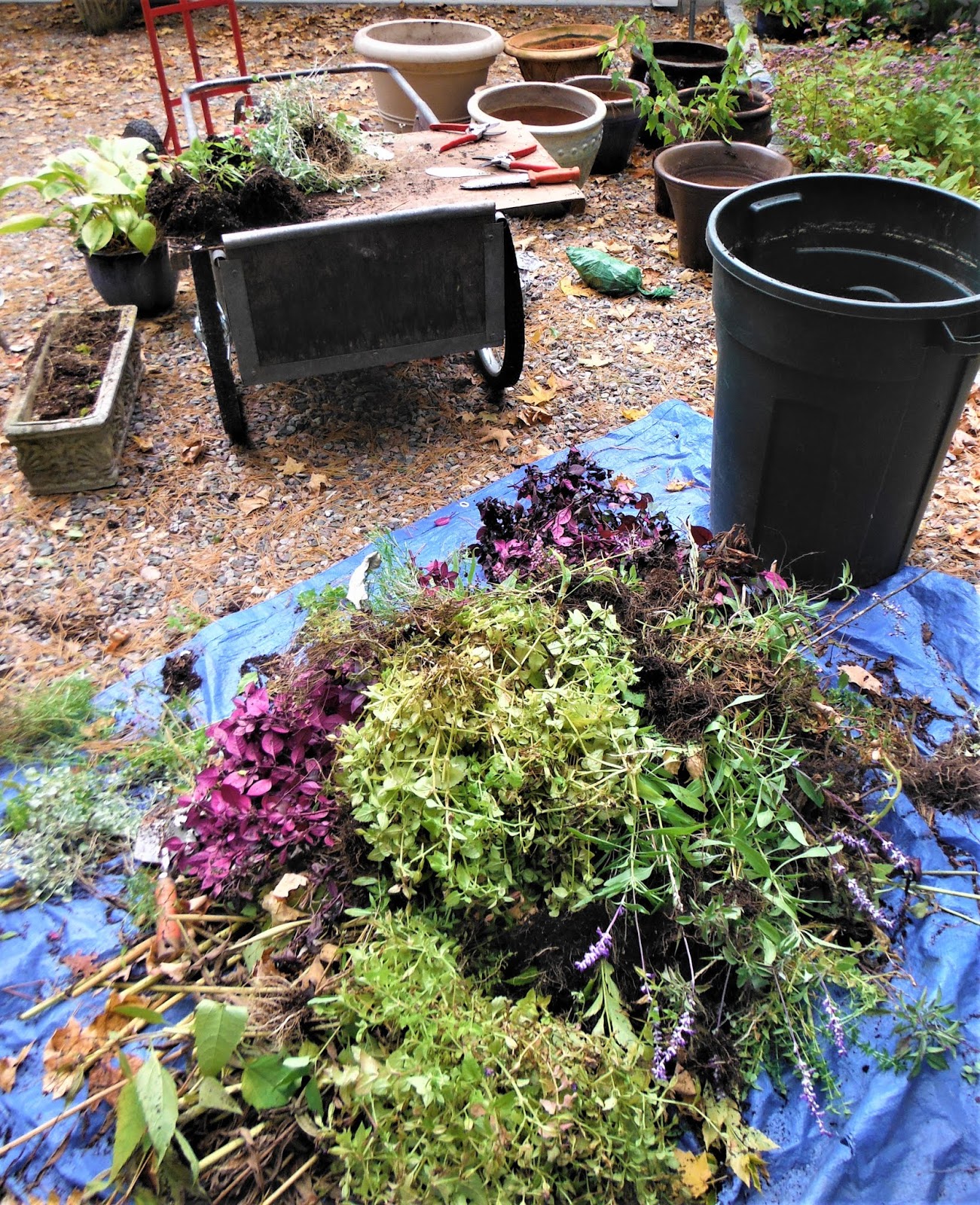
Stalks of perennials have been cut
down, stuffed into bags, and taken
to the transfer station
Betty said she didn’t want any grass in our new garden, and so we planted the half acre that is not wetlands in native trees, shrubs, and perennials.  I not only agreed with her on the subject, I encouraged it.  And I keep urging her to fill in the ‘holes’ in the landscape with yet more perennials.  This fall, I have spent several days cutting back the now-dead stalks on those perennials, bundling them up in tarps, and transporting them to our transfer station for disposal.  Betty has spent even more time trimming back shrubs.  I get to bundle up and remove those as well.

I refuse to pay Whole Foods prices for fresh, organically grown vegetables and so we have a plot at our town’s Community Garden.  The garden has to be tended several hours each week, but it’s a small price to pay for placing food on the table that we have, ourselves, grown.  However, come October, plants stop producing and fruit stops ripening.  There’s an arrogant, overbearing ‘ogre’ who runs the garden and he sends out obnoxious emails telling everyone that must have their plot cleared by the end of the month.  And so, on multiple days, Betty and I have taken apart the garden, cleaning and storing the fencing and cages we’ll use next year, and taking everything else to the transfer station (the corn stalks alone filled the back end of our Prius to its limit).

Everyone loves our driveway
The magic question is, of course, why?  If it’s so much work and backbreaking labor, why not just pay someone to do it for us?  Or, more sensibly, stop doing it at all – dispense with the containers, plant some grass, cut down the damnable pines, and pay Whole Foods their extortionate prices?
The answer is that I wouldn’t change it for the world.  I love those 50-pound containers and the unusual plants Betty finds for them.  Those pines do look majestic against the snow and brighten up our cold, New England winter.  That driveway has a distinctive style all its own that further sets our property apart from the ‘usual’ suburban home, and that all-native and grass-free garden draws compliments that no flower bed out front could possibly get.  And pay Whole Foods prices?  Never.  I’d stop eating first.

Oh, and I’m getting serious exercise doing all this.  People ‘my age’ are supposed to be slowing down and becoming sedentary.  I carried 60 pounds of metal stakes in my arms last week and unloaded tarpaulin after tarpaulin filled with plant debris at the transfer station without resorting to pain-relieving drugs.  And, on top of that, it’s fun.  If all those wishes are, in fact. coming back to bite me, I’ll just put it down to the price of having a good time.

October 29, 2018

Thank you, Dorothy Jasiecki

This is a blog about gardening, which can be reasonably defined as growing, nurturing, caring, and cultivation.  However this edition of the Principal Undergardener will not be about the gardening of flowers or vegetables but, rather, the nurturing of young people's minds, the cultivation of their intellects, and urging the growth of their curiosity.  More specifically, it will be about a very special gardener of young minds: a teacher named Dorothy Jasiecki.

Me in 1967.  The less
said, the better
I am by trade a writer, and I say that with pride.  For 35 years, I plied a very different craft that occasionally required me to put words to paper, but which I can say with complete honesty never gave me anything like the personal and professional satisfaction I have felt for the past 13 years.  The reason this blog exists is because writers, like (for example) pianists, need to practice.  Just as a pianist does not sit down at a concert grand and begin playing ‘The Appassionata’, so a writer does not go to his or her keyboard and begin writing that Great American Novel.  The pianist begins with ‘etudes’ – literally, study pieces - that stretch the fingers and make the mind warm up. 

This blog is my equivalent of an etude.  It is about gardening because I am married to a virtuoso gardener and I am her helper, and also because writing about gardening is considerably more interesting than opining about, say, politics or wine.  Each entry is as carefully thought through as a short story and is polished to fit within a prescribed length.

Me, as I look these 
days. The less
said the better
I am a writer because, from September 1964 until June 1967, Dorothy Jasiecki taught me to love language, literature and words.  She had been recruited by a young principal named John M. Jenkins to teach at a spanking new school, Miami Springs Senior High .  I was in one of her classes that first year strictly by happenstance.  The following two years, she was my English teacher by design.

Dorothy Jasiecki circa 1968
Miss Jasiecki (the notion of calling teachers by anything other than ‘Mister’, ‘Miss’ or ‘Mrs.’ lay many years in the future) created and followed a lesson plan that ensured we read and mastered the material that would appear on tests.  What made her so extraordinary was how she conveyed that information and that she demanded we go far beyond what was required by the Dade County Board of Public Instruction.  She effectively had a second syllabus, one of her own devising, that was intended to stretch – and open - our minds. 

Our reading list was designed to
stretch the mind
Part of her methodology was to reach deep into her own knowledge of literature to awaken our own senses.  She spent much of one class session reading Beowulf in a way that I felt I was gathered around a hearth fire, listening to oral tradition being made.  We delved into poetry far beyond Emily Dickinson or Robert Frost and spent several days dissecting The Wasteland and The Love Song of J. Alfred Prufrock; titles that almost certainly were not sanctioned by the bureaucrats at Lindsey Hopkins.

The balance of her teaching style was to challenge us to think about what we were reading.  To be in her class meant you came to school prepared, and ‘prepared’ meant you had not only read the assigned book but that you had understood it.  And God forbid you came into class spouting something from Cliff’s Notes.  (I tried that once and was found out almost immediately.)

All of this was leavened with philosophy and humor.  The final five minutes of class could comprise a discourse on the importance of shaking hands or a treatise on elbows.  These ‘sermonettes’ as we called them stretched us further still, if for no other reason than because we had no idea of what was coming next.

Miss Jasiecki was a tough grader.  I made very few ‘A’s’ in her class.  But I tried harder than I did in any other subject both because she expected it and I knew it pleased her. 

She was recognized for her skills.  Florida named her a ‘Star Teacher’ and sent her on a statewide tour with a similarly high achieving student from my class.  My great hope is that she inspired other educators as much as she inspired us.

At the 2007 reunion with Ms. J.
That's classmate Jane Greer at right
I last saw Miss Jasiecki eleven years ago at my 40th reunion and spent much of one evening doing nothing but listening to her reminisce about her years in the classroom.  Time had taken its toll on her body, though not on her mind.  It turns out that her best memories were of her first years at Miami Springs and at her predecessor school, Norland High. 

She passed away in 2015.  Were she alive, she would have turned 93 on October 30th.  And, in an important sense, Dorothy Jasiecki is still very much alive in 2018.  She touched thousands of lives and, for a certain number of them (including mine), she left an indelible impression that transcends time.  She still looks over my shoulder as I write; ‘tsking’ at lax grammar and use of ‘easy’ adjectives.

Ms. J circa 2015
We did not all become writers or poets.  We went into computer science, sales, engineering or education; we raised families or went into the military.  But we all learned how to think and, regardless of future occupation, that skill made us better individuals.

Principal Jenkins attracted a pool of talent in those first years that made Miami Springs a school unlike any other.  I had many teachers – Jack Gonzalez, Agustin Ramirez, and Phil Giberson come immediately to mind – who were outstanding and committed to quality education.  But I can draw a direct line back to Dorothy Jasiecki and say, without hesitation, that she was the teacher who most inspired me.  I would not be the person I am today were it not for her.

Happy birthday, Dorothy Jasiecki, and thank you for being the teacher you were, and the inspiration you still are.

October 21, 2018

Farewell to the 2018 Gardening Season


What can you say about a gardening season that was perfect for growing… weeds?

The detritus of our 2018 garden
makes its way to the transfer station
New England summers are notorious for being fickle.  May frosts, monsoon rains in June, July droughts, humidity festivals in August.  You name it, New England can deliver it.  And, this year, boy, did it deliver.

The lettuce, spinach, and beet seeds we planted in early April were washed away.  We replanted, and it was so cold that nothing germinated.  In mid-May, we had a 600-square-foot garden that was barren except for a large patch of dill that sprang from self-planted 2017-vintage seeds.  We were so desperate to show progress in the garden, we left it in place.

Our first square of corn was also a no-show for three weeks, even though we covered the area with netting to dissuade marauding crows.  Finally, in mid-June, we had sufficient sprouts that we could assemble a passable seven rows of corn – from the ten we originally planted.

Our vegetable garden
was under row covers to
keep out bugs
Because of the rains of May and June, we tented everything with row covers.  Our garden began to resemble a refugee camp.  Eggplant, zucchini, green beans, and winter squash were all sequestered until they burst out of their covers… whereupon the squash borers and Mexican bean beetles descended on the plants.

Some vegetables were a bust.  Five pepper plants mysteriously became three.  In the end, we harvested four usable peppers.  Our re-planted lettuce crop bolted so quickly we picked enough for perhaps half a dozen salads and I never did harvest any spinach.

All was not lost, of course.  Eight tomato plants thrived in the midsummer heat and began producing prolifically.  Our corn, not quite ‘knee-high by the Fourth of July’, grew like a teenager in July and early August; so much so that our first and second squares of corn looked identical despite having been planted 20 days apart.  A modest-sized third square produced enough September corn to be worth the effort to cajole it along. 

It was a banner year
for tomatoes
The weather was, apparently, perfect for cucumbers because we handed out dozens of them to our neighbors.  Our zucchini exploded between mid-July and mid-August to the point we had to pick twice a day lest they turn into baseball bats between sunrise and sunset.  We had our best crop ever of fennel, and harvested enough green beans before the bean-beetle onset to feed us through the winter.
We also had a bumper crop of weeds.  They grew everywhere, cozying up to plant roots, hiding between rows, and boldly popping up in pathways.  When we pulled the row cover off our second crop of green beans, the weeds were higher than the surrounding vegetables.

I have spent the past two weeks taking apart the garden - hauling it to the transfer station by the carload to ensure the hitchhiking bugs and diseases do not have an opportunity to burrow in for the winter – and, now, much of the garden is again bare ground.  The late arugula is thriving and I have hopes some late tomatoes will ripen. 

You might think from reading this that I’ve begun to despair of gardening.  Not for an instant.  It took three years to figure out how to grow fennel in our garden and, now that we’ve mastered it, we will enjoy its unique flavor for years to come.  We just enjoyed the last of our corn and marveled at its sweetness. 

Give up gardening because of a little rain and a lot of weeds?  Not in a hundred years.  Once it’s in your blood, it’s there forever.