Showing posts with label autumn cleanup. Show all posts

November 2, 2018

Be Careful What You Wish For


Be careful what you wish for.  It will all come back to bite you in the fall.
All those containers had to be
taken apart and cleaned
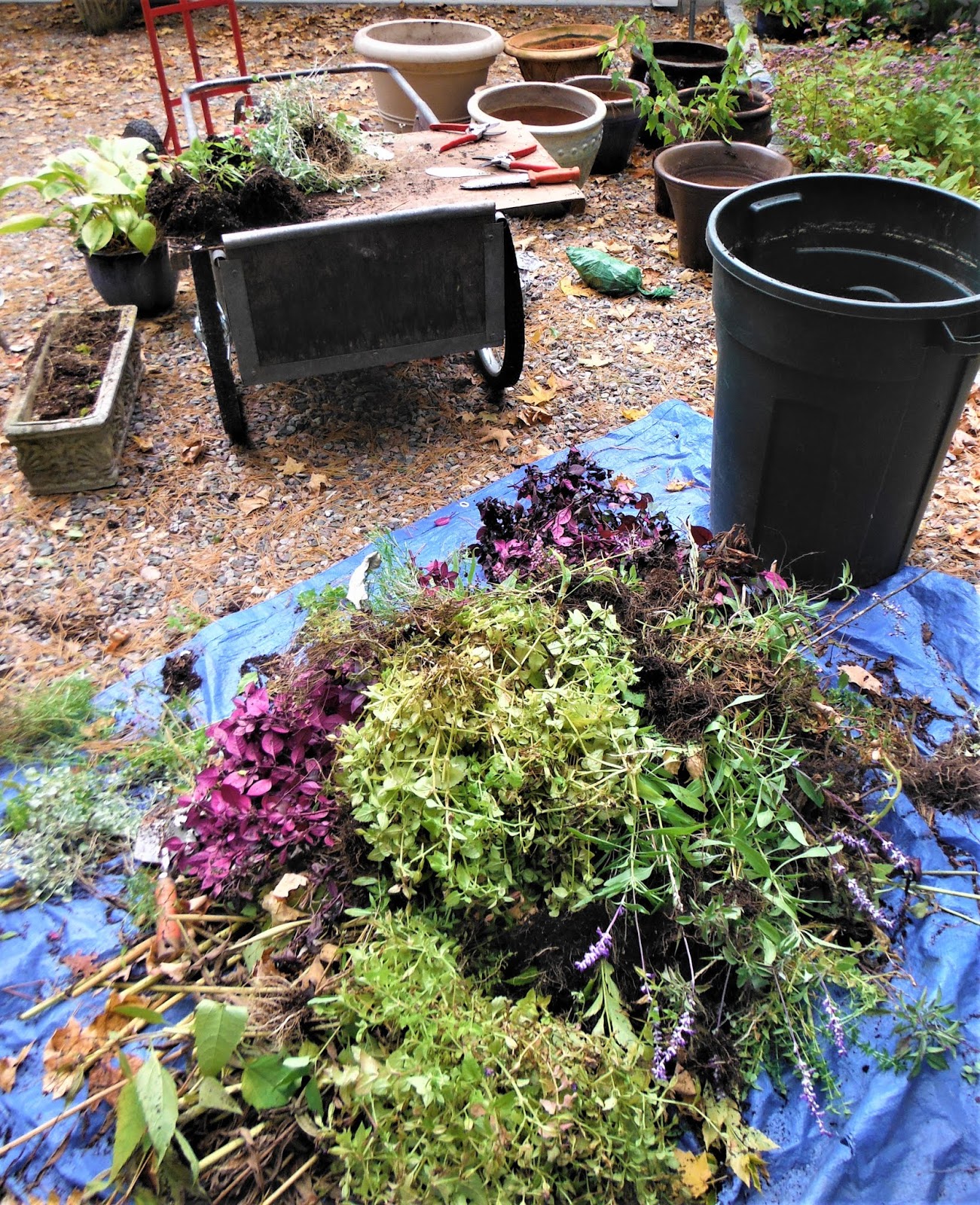
This spring I encouraged Betty to plant container gardens… lots and lots of container gardens filled with glorious annuals than allowed us to place points of color all around out landscape.  In all, she planted up a dozen ‘major’ containers and that many ‘lesser’ pots.  In mid-October, a killing frost wiped out those containers.  It took half a day to empty them, separate out the spent potting mix from the bottles and such we use as ‘ballast’, and clean and bleach the containers and store them in the basement so they’re ready for next year.

We left a dozen pine trees standing at the edges of our gardens because I wanted tall evergreens with deep green needles to contrast again the snows of winter, or dull browns when the snow has melted.  The late October nor’easter deposited several thousand pine cones from those trees onto our garden.  Sticky, sap-drenched pine cones.  Each one had to be picked up by hand and transported to a far edge of the property.  Elapsed time?  At least two hours.

Both for ecological and esthetic reasons, I demanded a driveway that would be asphalt-free and allow water to percolate through to replenish the groundwater, rather than adding to what goes down our town’s storm drains.  This past weekend, I spent two hours raking an inch of leaves and pine needles from the aforementioned nor’easter off our 90-foot-long stone driveway.  In the next few weeks, I have to attach skis (quite literally) to the bottom of our snow blower so I can remove the white stuff this winter without picking up buckets full of stones in the process.  And, does it take longer to clear a stone driveway than a macadam one?  It does, and don’t let anyone tell you differently.

Stalks of perennials have been cut
down, stuffed into bags, and taken
to the transfer station
Betty said she didn’t want any grass in our new garden, and so we planted the half acre that is not wetlands in native trees, shrubs, and perennials.  I not only agreed with her on the subject, I encouraged it.  And I keep urging her to fill in the ‘holes’ in the landscape with yet more perennials.  This fall, I have spent several days cutting back the now-dead stalks on those perennials, bundling them up in tarps, and transporting them to our transfer station for disposal.  Betty has spent even more time trimming back shrubs.  I get to bundle up and remove those as well.

I refuse to pay Whole Foods prices for fresh, organically grown vegetables and so we have a plot at our town’s Community Garden.  The garden has to be tended several hours each week, but it’s a small price to pay for placing food on the table that we have, ourselves, grown.  However, come October, plants stop producing and fruit stops ripening.  There’s an arrogant, overbearing ‘ogre’ who runs the garden and he sends out obnoxious emails telling everyone that must have their plot cleared by the end of the month.  And so, on multiple days, Betty and I have taken apart the garden, cleaning and storing the fencing and cages we’ll use next year, and taking everything else to the transfer station (the corn stalks alone filled the back end of our Prius to its limit).

Everyone loves our driveway
The magic question is, of course, why?  If it’s so much work and backbreaking labor, why not just pay someone to do it for us?  Or, more sensibly, stop doing it at all – dispense with the containers, plant some grass, cut down the damnable pines, and pay Whole Foods their extortionate prices?
The answer is that I wouldn’t change it for the world.  I love those 50-pound containers and the unusual plants Betty finds for them.  Those pines do look majestic against the snow and brighten up our cold, New England winter.  That driveway has a distinctive style all its own that further sets our property apart from the ‘usual’ suburban home, and that all-native and grass-free garden draws compliments that no flower bed out front could possibly get.  And pay Whole Foods prices?  Never.  I’d stop eating first.

Oh, and I’m getting serious exercise doing all this.  People ‘my age’ are supposed to be slowing down and becoming sedentary.  I carried 60 pounds of metal stakes in my arms last week and unloaded tarpaulin after tarpaulin filled with plant debris at the transfer station without resorting to pain-relieving drugs.  And, on top of that, it’s fun.  If all those wishes are, in fact. coming back to bite me, I’ll just put it down to the price of having a good time.

November 18, 2013

All the Leaves Are Brown

We are coming down to the end of the garden clean-up.  The perennial beds have been cut back to stubs and even the grasses are looking weary.  What we are left with are… oak leaves.
We have perhaps two hundred trees on our two-acre property.  There is a healthy mix of specimen trees we planted over the past 14 years (oxydendron, forest pansy redbud, heptacodium, dogwood, cornelian cherry, etc.), but the preponderance of our little forest are trees that were on the property when we got here. 
This fifty-foot oak on our
property still has some leaves
to shed.
Among the latter group are twenty or more oaks.  The largest are over fifty years old and sixty feet high but we have them in all sizes.  What all of the oaks have in common is that they all wait to drop their leaves until after the other trees on the property have done so. Around our home, the maples, ash and birch all shed their leaves in October.  Even the pines completed their needle drop by the end of the month.  It is now mid-November and a good gust of wind can still bring down a cascade of oak leaves.
The lawn was mowed yesterday.  Last
night's storm left it looking like this.
Oak leaves are the savior of lawn services.  Maples, for example, drop their leaves quickly:  typically in two weeks or less.  Moreover, they are ‘thin’ leaves and their C:N ratio (carbon to nitrogen) is around 20.  This means they break down very rapidly when simply mowed into the lawn.  The mulched leaves return the same nutrients needed for next year’s growth.  Lawn services, or course, are not in the business of letting Mother Nature do for free what three guys with a truck can do for a fee.   When the maple leaves fall, there’s a single visit to rake/suck up the leaves and leave the lawn looking neat and tidy.  Lawn ‘nutrition’ will be added later in the form of a ‘fall (chemical) fertilization’.
If not cleared, oak leaves will form
a mat that smothers whatever is
underneath it, like our rock garden.
Oak leaves, on the other hand, can take a month or more to drop.  Their C:N ratio is 60:1 and the leaves are both thick and heavy with tannin.  What this means is that the leaves decompose very slowly (because of the preservative property of the tannin) and, once on the ground, they stay there.  A diligent lawn care company can milk oak leaf season for half a dozen clean-up trips.  Clients pay because there are few things as ugly as an oak-leaf-strewn lawn.
We, of course, don’t use a lawn service.  The earlier, non-oak leaf drops were all mowed into the lawn and have long since disappeared.  The oak leaves, on the other hand, have another fate: we turn them into mulch.  It’s a laborious process but well worth it.
Here’s what we do:  first, we rake all of the leaves out of the various beds and onto the lawn.  We do this because oak leaves tend to mat.  Because they’re not drying out after they fall, they’re still pancake-flat after several weeks.  If you get a layer of oak leaves six or eight thick, it turns into a smothering blanket over your lawn or perennial bed and little moisture gets through.  The result is snow mold and other diseases.
These chopped-up oak leaves are
spread on our beds as a protective
mulch for the perennials.
Next, we chop up the leaves with our lawn mower and bag them.  Then, the well-chopped leaves go right back onto the beds as a mulch.  They won’t mat because they’ve now been torn into tiny pieces.  Bacteria have a lot more edges to chew on, hastening their composting. The oak-leaf mulch provides insulation for the plants in the beds (preventing heaving), a moisture barrier to keep water in the soil from evaporating, and a slow-acting compost to enrich the soil.

By spring, the oak leaves will have mostly disappeared and we’ll put down a layer of brown wood mulch for the season.  In the meantime, we’ve taken a problem (those drab oak leaves) and turned them into an asset. 

October 14, 2013

Twilight Time

In May, more than a hundred
varieties of annuals awaited containers.

Double-click on any image to see
the slideshow at full-screen size.
From the middle of May through the end of August they are the ambulatory roving ambassadors of the garden.  Our containers filled with mixed annuals line the driveway, get massed and un-massed depending upon what is in bloom, fill in holes in beds where perennials have passed, and bring bright splashes of color to our deck where only containers can thrive.
At the height of the season, a
grouping of more than a dozen
containers are massed
The containers are inexpensive, single-season experiments for plants trying out for a permanent place in the garden scheme.  This year we welcomed back coleus ‘Big Red Judy’ for a triumphant return while deciding that a lobelia Laguna Sky Blue bloomed and passed far too quickly to be put on the ‘repeat’ list.  We discovered Kangaroo Paw (anigozanthos) and it immediately earned a gold star for its bloom-till-it-hurts attitude while fragrant nemesia (nemesia aromatic) became a staple in half a dozen containers.
More than a hundred different cultivars of annuals went into the creation of roughly thirty large container gardens.  Another twenty containers have fixed specimens – a loropetalum, a cape plumbago, a crape myrtle and an acuba, for example – that we overwinter in the garage because the shrubs (some now seven or eight years old) are not hardy to zones 5 or 6.  Our water garden plants, too, are overwintered; trimmed severely and placed in a bank of basement windows where they will hang on for seven long months.
By the end of September, the
annuals are fairly well shot
But come the beginning of September, the annuals are spent.  They have spent the summer on steroids; continuing doses of plant food to force blooms and heavy trimming to encourage branching.  By the middle of September, the sun no longer climbs directly overhead and, after the autumnal equinox, daylight shrinks at an alarming rate.
In each of the past five or six years, a September frost has provided a final answer to the question of ‘when should we take apart the containers’.  This year, while temperatures dipped into the upper thirties several times and frost nipped at our vegetable garden, our containers emerged in the morning unscathed.
Ballast that made pots lighter
is removed and cleaned for
use next year
Today was the day we chose to bring the container season to a close.  In a several-hours-long marathon, I placed containers in a cart and brought them, assembly fine fashion, to our ‘potting’ area.  There, Betty ruthlessly yanked out entire plants or broke off tops.  Depending on the size of the pot, either she or I dumped the pot into one of our transplant beds where she methodically tore apart roots, salvaged ‘ballast’ material for reuse next year, and spread the spent potting mix over the bed’s base of topsoil, where I then dug the two planting mediums together.  By next spring, the bed will feature well-aerated soil enriched with peat and vermiculite.
Containers await cleaning
Tomorrow, we begin the second part of the process: cleaning the containers with a mild solution of bleach to ensure that no insects overwinter with the pots that will hibernate in the basement until next May. Those that are destined for the garage will be inspected for both tiny hitchhikers and insufficient room for root growth.  By the end of the week, only a handful of the 50+ containers that were in the garden at the peak of the season will remain on view.

This container will
stay in place for the winter
Two of those will be a pair of cast iron urns that, at present, contain a vigorous coleus ‘Alabama Sunrise’, perennial strawberry (with fruit), and a calibrochoa ‘Lemon Slice’ that has been in continuous bloom since the second week of May.  When that hard frost hits, the coleus and calibrochoa will be taken out and evergreens will take their place.

If this sounds like a lot of work, it is.  But the time elapsed in taking down this part of the garden is a fraction of the weeks that are spent finding and assembling the right plants each year that make this a special part of our garden. 

September 27, 2013

Little White Lies

Do you want to hear someone tell a lie?  Just ask any gardener how much time they spend maintaining their garden. You can be absolutely certain that the answer they give – no matter how large or small the number – will be understated.  The actual time may be ten percent longer or twice as much as they tell you, but it will never be less than what they say.
We tell these fibs for three reasons.  First, we may genuinely think that gardening takes less than five hours a week.  That’s because the gardener is thinking about April or November when chores are light.  Or, they may be averaging in the winter months when, at least in New England, the only gardening is indoors.
The second reason is that gardeners aren’t looking for pity, brownie points, or convoluted looks when the honest answer is, “Oh, twenty hours a week in season, five or six at the beginning and the tag end.”  The gardeners I know are proud of their work and they don’t want to be seen as having some form of mental illness for devoting so much time to making things look really good.
The third reason – and the one that causes me to write this – is that gardeners forget about the ‘big push’ activities that come at the beginning and end of the season. 
The list above (double-click on it to see it at a larger size) is not contrived.  It has been posted to our refrigerator door since September 21.  On that date, Betty and I did a walk through the property and she called out things that need to be done as we get toward the end of the season.  I was the scribe and, because my handwriting is barely legible under the best of cases, I typed up the list after the walk.
This yellowing daylily foliage makes
the garden look ragged
New England gardens at the end of September show their age.  Most annuals are shot, as are perennials like hosta and daylilies.  There are also plants we put up with during the growing season – such as allowing milkweed to run rampant in places – that now look like poor gardening now that the birds, bees and butterflies that fed on them have decamped for warmer climates.  Performing this end-of-September cleanup greatly improves the look of the garden and extends its season by several weeks.
With the daylily foliage cut back.
Manhattan bed shows off the
still-blooming sedum and asters
The list consists of both things that can be done in a few minutes (‘cut hosta flowers in white garden’) and tasks that are backbreaking (‘turn 5-bin composter’).  There are chores that can be done in pieces, such as taking apart those leggy containers, and ones that are best done in one fell swoop, like cutting down daylilies.
Some of the chores are Trojan Horses.  I cut the dozen or so branches that overhung our forest pansy redbud (cercis canadendis) and a Rose of Sharon (hibiscus syriacus).  But taking down those tree limbs brought to light a similar number of ‘problem’ branches that were heretofore hidden.  And, allowing those two cultivars to get adequate light started me thinking about the fate of the shrubs in out Long Island bed that are starting to ‘lean out’ because the copse of trees behind the bed is also sending out intruding branches.
And, some chores only seem simple.  One bed had both bee balm (monarda) and black-eyed susans (rudbeckia) to be cut down.  But the monarda is prone to diseases.  It must all be taken out at once and clippers cleaned with bleach afterward to prevent the spread of the powdery mildew that affects it.  Only when the monarda has all been cleaned and bagged can the balance of that bed be worked on.
I am not doing this alone; Betty is dividing hostas and moving grasses.  She’ll also take on the ‘skilled’ work on the list.  But it is the undergardener’s job to plow into the stands of daylilies and get rid of their now-yellowing foliage.  (See the ‘before’ and ‘after’ photos to understand why this needs to be done.)

So, all in all, how long will it take to complete this list?  I don’t know, probably half a day.

October 30, 2012

After the Storm


Sometimes it takes a hurricane to focus a gardener’s attention.  Until Sandy’s arrival became a question of ‘when’ rather than ‘whether’, I had been following a diligent schedule regarding end-of-season garden clean-up:  I emptied pots or cut down perennials only when I couldn’t come up with an excuse not to do so.

Sandy pushed me into a very different and infinitely more productive gear.  The fence around our 1200-square-foot community vegetable garden plot came down in about three hours versus the full day I had previously thought it would take.  The final dozen containers were emptied of annuals, potting mix and filler in a single morning.  The hosta walk was cut down in an hour.  I was a veritable beehive of activity.

Keeping 'Big Red Judy' (all four feet
of her) allowed me to believe
that it was still summer in October
There is a word here that I have tried to avoid using, but which there is no way around.  The word is ‘procrastination’.  As people who know me will attest, I am not by nature someone who puts off things.  Yet, every October, I let drag an important task that needs to be done.  Why is the closing up of the garden so different?

I suspect the reason is that, through the garden, I can cling to the notion that winter isn’t really on our doorstep.  Yes, there was an overnight freeze in early October that turned unprotected annuals and vegetables to so much limp mush.  But in anticipation of that frost I began parking a number of containers into our garage on cool evenings, including one containing an enormous coleus called ‘Big Red Judy’.  The sight of a four-foot-high tropical plant along the driveway brightened my day, even as the perennials around it turned yellow and brown and the maples faded from their brilliant reds and oranges to muddy yellows.

One day before Sandy’s arrival, ‘Big Red Judy’ went ignominiously into the compost pile.  I did not even save a clipping.  By the time the winds picked up and the first rain bands arrived Sunday morning, the garden, like Big Red Judy, was no more.

Lots of oak leaves, but a new
perspective on what remains
This is written on Tuesday; quite literally the ‘morning after’.  From my office window I can survey the post-Sandy landscape.  The first things I notice is that a month’s worth of oak leaves fell in a day and now carpet the lawn and the maples and other deciduous trees have been stripped of the last of their leaves.  But the second thing I see is that our cersis canadensis – forest pansy redbud – not only still has leaves, but has turned a majestic gold.  The ornamental plum that I routinely ignore has a riot of leaves in the red-yellow spectrum, dancing not five feet from my window.  In short, what was lost in the storm has been gained in the emergence of individual specimen plants. 

We have also regained our view of the pond at least two weeks early.  We are less than 200 feet from its shore, but two-thirds of that distance is town conservation land and, for six months of the year, trees that we are not permitted to thin obscure our view of a picturesque body of water.  From now until the end of May, we’ll have a panoramic vista just outside the banks of windows on the back side of our home.

Hurricane Sandy did put an emphatic ‘period’ to the 2012 gardening season.  But it didn’t mean the end of autumn or of our enjoyment of the season. Autumn in New England is a wonderful time of year, as well as a great state of mind.  We ought to make it linger as long as possible.
The return of the pond view

October 17, 2012

Aye, There's the Rub


There’s a drawback to having a two-acre garden, as well as to having 62 containers arrayed around that garden in eye-pleasing groupings: come October, it all has to be cleaned up.

After the frost:  two containers that
need a lot of tender loving care
Eastern Massachusetts had its first frost last Friday evening.  Temperatures dipped into the upper twenties for about seven hours overnight.  They recovered to the mid-60s by Sunday, but the damage was done.  The frost was the ‘period’ to the growing season that began in April, peaked in June and July, and lingered through a warmer-than-usual September.

When we awakened Saturday morning, the damage was everywhere.  I firmly believe that annuals are nothing but water held in interesting shapes by a thin coating of chlorophyll.  When the air temperature hits 32 degrees, annuals collapse with a speed and finality that is stunning.  Forty of our 62 containers were filled with annuals.  On Saturday morning, we had 40 pots of mush.

This container...
Each pot needed to be emptied but, in our garden, that is not an easy thing to do.  First of all, some pots also held perennials.  Each container was inspected and salvageable perennials were taken out separately, re-potted into plastic containers, and sunk into the transplant bed.  If they survive the winter, they’ll be re-used next year. 

...yielded these two perennials that
will be over-wintered for 2013
Each container also holds ‘ballast’.  We use large pots: some with 20-inch-plus diameters and heights of up to two feet.  Many weigh more than 20 pounds.  If they were filled entirely with potting mix, the combined weight could be half again as much as the container alone.  To keep the containers ‘portable’, Betty fills their bottoms with plastic water bottles, chunks of Styrofoam, packing ‘peanuts’ in plastic bags, and even corks.  Come October, all of this ballast is removed, cleaned and stored.

The overflowing compost bins
Even the potting mix gets recycled, after a fashion. The truism in gardening is that container mix should never be re-used because it potentially carries diseases.  But there’s no prohibition against combining container mix with garden soil, mixing it well, then using it for planting in future years.  We have a special raised bed just for our ‘used’ container mix.

Finally, each pot is scrubbed clean and then rubbed with a bleach solution, allowed to dry, and stored in the basement for use in 2013. 

So, for containers, the litany is a) put the annuals in the compost pile, b) pot up the perennials and place in the transplant bed, c) remove and clean the ‘ballast’, d) place the used container mix in a special bed, e) clean and bleach the container, f) carry to the basement, and g) repeat steps ‘a’ through ‘f’ 40 times.  Because a container filled with dead annuals is something of an eyesore, we try to get through that process in three or four days.

Same bed, after cleanup
The wisteria bed after the
frost.  That's "Kossa Regal"
collapsed in a heap
The frost also did in the hostas, which were already starting to yellow.  With the hostas lying in a heap on the ground, it was clear that all the other perennials were ready to be cut down.  We have 15 principal ‘gardens’ within our property.  While all are maintained throughout the season, the October clean-up means all perennials are cut to the ground, though not all at the same time.  As they are cut, seed heads are removed and anything that looks as though it may have either disease (usually mildew) or insect damage is bagged separately and taken to our town’s transfer station. Everything else goes into the compost bins which, by now, are filled to overflowing.  We also take out several hundred feet of drip-watering hoses each autumn so that they don't go through a long series of freeze-thaw cycles that will shorten their useful lives.

In the bottom of each container:
reusable 'ballast' that makes the
container lighter
There are also relatively minor tasks: three rain barrels are emptied, cleaned and stored in the basement; and 25 water jugs are emptied and sorted to see which are worth saving over the winter (new containers are constantly being ‘created’ because they hold our cat’s litter).  Garden ornaments are located, cleaned, and stored away. 

It is a very physical time of year; a lot of stooping and hunching over.  But the weather outside is nigh on perfect.  A brisk wind, pleasant temperatures and low humidity.  And, all around us is the color: the reds and yellows and rusts of autumn in New England.

We take it one bed at a time.  The process will take about two weeks but, once it is done, it is done for the season.