Showing posts with label vegetable gardening. Show all posts

August 16, 2019

A Groaning Glut of Green Beans


In our 600-square-foot vegetable garden this year we are growing corn, lettuce, chard, dill, carrots, summer squash, winter squash, eight varieties of tomatoes, fennel, cucumbers, peppers, basil, leeks, beets, spinach, amaranth…. and green beans.
The summer zucchini explosion can
be easily addressed by leaving them
on your neighbors' doorsteps
I have no argument with the first 16 items on the list. There is nothing as flavorful as sweet corn eaten minutes after it was picked or a salad topped with tomatoes still warm from the vine. These are the reasons we garden. Even when there is excess (think zucchini), there are neighbors with whom to share the bounty.  And, if your friends begin avoiding you because they know you come bearing suitcases full of the stuff, you can dispose of the surplus on National Sneak Zucchini on Your Neighbors’ Porch Night (which fell on August 8th this year).
Zucchini, though, is a vegetable that must be eaten fresh. No one would ever think of canning or freezing summer squash, because they’d find nothing but mush when they sampled it in January. Not so green beans. Green beans effectively have the same taste and texture whether they’re eaten fresh or frozen.
One of our two wide rows of beans
For reasons known only to her, this year Betty planted two ‘wide rows’ of green beans with the idea we would freeze what we didn’t immediately eat.  To add color to the garden, one of those plots is planted with a bean that is picked when purple, though it disappointingly reverts to green when cooked.  We picked out first green bean in mid-July and are now picking upwards of a pound of beans from of the garden every other day.
This variety of beans is purple... alas,
it turns green when cooked.
The first week was wonderful. The yield was maybe 20 or 30 long, luscious beans a day, perhaps ten minutes worth of picking in the cool, late afternoon. Once home, we pinched off the ends, threw them in a dish, steamed them for three minutes and we had fresh, delicious green beans; high in vitamins and good for us to boot.
Then the yield bounced up to about 60 green beans a day. Fifteen minutes of picking and ten minutes of snipping ends. OK, we cooked half and froze half (two minutes in boiling water, then rinse under cold water to stop the cooking, arrange the beans on a tray, stick them in the freezer for an hour, then bag them and return them to the freezer until needed). I could cope with that.  One reason is that, in earlier years, our green bean season could last as little as two weeks.  Mexican bean beetles would discover the garden and begin chomping on everything in sight.  We would come out one morning and find leaves reduced to skeletons and the beans are half-eaten by voracious beetles.  
I am doomed to pick beans until
well into September
Then, Betty discovered the virtue of floating row covers.  From planting until picking time, the plants were swathed in white tents that thwarted even the most vigilant bugs.  The beans, which are self-pollinating, thrive under the row covers.  Worse, this year, the second plot is about to come into full production.
Now, we are spending half an hour every other day stooped over picking under a blazing sun with suffocating August humidity, pinching ends for another 45 minutes, and then lining up green beans on trays for half an hour. First, it was one double-decked tray of beans to blanch and freeze and then two double-decked trays. Did I mention we still have green beans from last summer?
Dealing with the excess will require a plan I have not yet devised.  Before we moved, we lived next door to a family of vegetarians that gladly took our excess.  Our local Food Cupboard also takes fresh vegetables on the day of their distribution, but there’s only one in August .  Unless I can come up with something, I’m doomed to eat green beans with every meal, and I do not look forward to a green bean omelet.
If only I could stop them...
There is joy in seeing plants first emerging from the ground in May and flourish in June. Alas, the mind does not contemplate the work that will be involved when, as in the ‘Sorcerer’s Apprentice’, the green beans keep maturing by the hundreds every day, demanding to be picked. The great gardening guru Roger Swain calls one of the joys of summer the ‘wretched excess’ from the garden. This August, being a grower of green beans makes it easy to understand the ‘wretched’ part of that statement.

July 21, 2017

The Woodchucks Are Back

Marmota monax, aka woodchuck
(among many aliases)
Only slightly less predictable than the yearly return of the swallows to Mission San Juan Capistrano each March 19 is the mid-July annual pilgrimage of woodchucks to the Medfield Community Garden in Massachusetts.  Unlike the California event, tourists have yet to take notice of the east coast invasion by multiple members of the extended Marmota monax family, so there is still time to get a ringside seat.

While I had not circled the event on my calendar, I was not the least bit surprised to receive an email Thursday morning from one of the plot holders at the community garden that Betty and I manage.  The gardener, Heather, wrote, “When I arrived at the garden this morning there was a chubby woodchuck munching away in my neighbor's (Ed’s) garden. It looked like he went under the fence so it will need some repairs…”

My immediate response was to dash off a memo to each of the 75 gardeners who grows vegetables in the town-owned garden, reprinting Heather’s email, and warning everyone that the woodchucks (there are always more than one) would not be to content to eat just Ed’s vegetables. I warned he or she will follow their nose and seek out other, vulnerable gardens and will likely post reviews on Yelp!   That, in turn, generated a panicked response from Ed, who said he is on vacation, and asked if I could effect some of those emergency repairs.  I said I would do so.

Before I continue with this story, here is what humankind knows about woodchucks.  The first thing is that they have many aliases.  They have fake IDs identifying themselves as groundhogs, whistlepigs, marmots, and half a dozen lesser-known names.  They are endemic in Canada and call home a swath of the United States running roughly from Minnesota south to Arkansas; swooping down into Mississippi, Alabama, and North Carolina.  They are thick as thieves in New England.  They are, technically speaking, a large ground squirrel.

The Medfield Community Garden is
more or less a woodchuck's idea
of heaven
Woodchucks prefer open country and the edges of woodlands.  They live in underground burrows with multiple entrances.  The Medfield Community Garden occupies a one-acre site in a former farm field (the aforementioned ‘open country’) surrounded, in turn, by woodlands that are protected town conservation land.  And, did I mention that hunting is prohibited in Medfield?  “Location, location, location.”

In my warning memo, I wrote that everyone should make certain the fence around their garden was buried.  I said, Yes, I urged you to do this back in April, and most of you took that advice to heart.  So, the real advice is to make certain your fence is still buried in the ground at least three or four inches.  If it is not, or if you did not bury it because it was too much trouble or you assumed the only hungry wildlife you needed to thwart were sheep or capybaras, take the time to bury it now.”

The gap under this fence at the
community garden is three inches.
Anything can crawl in and out.
A quick survey of the community garden this morning revealed that my estimate was a little optimistic.  Fewer than half of the 75 gardeners had buried their fences; including, of course, Ed.  While Ed’s fence at least sat on the ground, many fences in the garden began a good two or three inches above the soil line.

I further wrote, If your plot is on the perimeter of the community garden, consider driving wood or bamboo stakes through vulnerable points of entry.  Make them four to six inches apart and drive them down at least six inches.  Woodchucks are fundamentally lazy.  They won’t try to figure out why they can’t get into your garden; they’ll just go for easier pickings.  And make certain you gate isn’t the Achilles Heel of your protection plan.  Make certain it is tight at the bottom, has no obvious gaps, and consider those wood or bamboo stakes.”

I repaired Ed's garden as best I could
This is what I did for Ed.  I found the two points of entry where the woodchuck had moseyed in, and added ten or twelve stakes to seal those points.  Of course, since none of Ed’s fence is buried, that woodchuck or his cousin Ralphie has another 96 liner feet of fence to crawl under.

Bobbex-R won't kill
woodchucks, but it will
annoy them mightily
My next piece of advice involved chemical warfare.  “Invest in a spray bottle of Bobbex-R.  Bobbex-R doesn’t kill woodchucks; it just smells awful to them, causing them to avoid your garden for a more palatable one.  Apply it around the perimeter of your garden – not on anything you plan to eat.  A 32-ounce ready-to-spray bottle will cover 1,000 square feet, which means a full-size plot can be sprayed ten times; a half-size plot can be sprayed 14 times.  As an application lasts two to three weeks, one bottle will see you through to the end of the gardening season.”

Will people in the community garden buy a rodent repellent?  The uniform price seems to be $32.47 for that ready-to-spray solution.  Given that each garden has several hundred dollars of produce growing in it, it seems like a bargain.  I sniffed the air this morning for the tell-tale scent of putrefied eggs and garlic.  Nothing so far.

“If you find a place in your fence where an animal has entered, repair the site immediately, which does not mean piling up mulch or stone around the affected area,” I wrote.  “Woodchucks may look dumb, but they’re not.  They have good noses, unerringly return to the same locale, and pawing aside some loose debris helps build up an appetite.”

This morning, I observed several gardens with closely-spaced wooden stakes around what may have been previously unnoticed entry sites.  I also found a depressing number of places where gardeners had piled up mulch.  I have to learn to make my declarative sentences shorter.

My last piece of advice to my troops was this: “If all else fails, be prepared to stand guard around your garden for the rest of the season with two metal trash can lids at the ready.  I do not advocate this approach.”


It isn’t that banging garbage can lids is time-consuming (although it would likely get very old, very quickly).  It is that I can imagine that, rather than driving woodchucks from the vicinity of the garden, it would encourage families of adults and chucklings to gather at the periphery of the site, spreading blankets and bringing picnics, waiting for the rest of the band to arrive.

February 2, 2016

Seeds of Expectation

Before I get carried away, let me be clear about one thing.  We’re talking about packets of seeds.  Seeds that cost about a buck fifty for a paper packet containing somewhere between a dozen and 500 seeds.  Starbucks would not swap you a tall decaf mocha latte for four packets of seeds, no matter how you declaim their virtues.
Our 2016 seed order arrived last week.
Double-click for a full-screen view.
But virtues they are.  After you consume that latte, all you’ll have to show for it is an empty cup.  Plant those seeds and you can harvest a season’s worth of Parisian carrots or Tom Thumb butterhead lettuce.  And, talk about bargains, the value of that $1.50 seed package multiplies tenfold, or even a hundredfold.  Case in point: Butternut squash is going for $1.59 a pound at my local supermarket this week.  We’ve been eating our 2015 crop of squash since October and still have a dozen specimens in the basement with a current retail value of more than thirty dollars.
I offer that prologue because, last week, two boxes arrived in our mailbox.  They contained our vegetable and flower seeds for the spring of 2016. 
Betty began poring over seed catalogs in late November (their arrival coincided with the last turkey sandwich made from our Thanksgiving dinner).  We receive more than a dozen such catalogs each year; the ones from which she might order is a small subset of what arrives in the mailbox.  What the semifinalists have in common is that their seeds are grown for a northern climate.  “One size fits all” seed companies need not apply.
The mark-up of the seed
catalogs is a wonder to behold
Betty’s markup of these catalogs is a wonder to behold.  There are bold “X” marks through descriptions that, to my untutored eye, look like great choices.  What, exactly, is wrong with Crosby Egyptian beets?  Some varieties are circled once; others, like Maximillian sunflowers, have multiple bold rings.
Looking through the seed packets now on hand (there are more than 50), there are a few surprises.  For example, we will grow five kinds of beets this year.  Why five?  Flavor, days to maturity, and an interest in trying some new introductions without jeopardizing the main crop.
This year will also mark a momentous turn in our gardening practices.  For more than a decade we have been part of a community garden in our town.  We have had a 600 square foot plot, tilled by the town and overspread with composted manure.  All we had to do was fence and plant our little bit of horticultural heaven.
Our new raised beds give us the option
of gardening at home.
We’ll still have that community garden space but, this year, we’ll augment our real estate by ten percent.  This past autumn I built a pair of raised-bed gardens in the sunniest part of our property.  Each is four feet by eight feet for a total of 64 square feet.  The nifty part of the beds is that when I say ‘raised bed’ I mean beds where the soil line is 30 inches above the surrounding ground.  Most raised beds are up about a foot.  Ours can be worked while sitting on the wooden rail around the garden – or even standing.
And the beauty of a raised bed is that there is not a square inch of wasted space.  There are no ‘aisles’ with a raised bed.  We will plant from board to board and start as soon as the soil is warm enough to germinate early spring crops.  We can even artificially warm the soil with row covers.  Perhaps best of all, picking lettuce for a lunch or dinner salad now will mean a quick walk outside rather than a two-mile drive.
Those seeds are a harbinger of the coming season.  The days are lengthening.  Those seeds are tangible proof that winter’s end is within sight. 

Well, at least it’s a glow on the horizon.  

July 22, 2012

Pickin' Time

July 19 was a memorable date in our vegetable garden.  We picked our first ears of corn (‘Quickie’) and our first cherry tomatoes.  We also picked our umpteenth pound of green beans, yellow and green summer squash, beets, chard and lettuce.  We are, in short, self-sufficient in the vegetable department for the next six weeks.

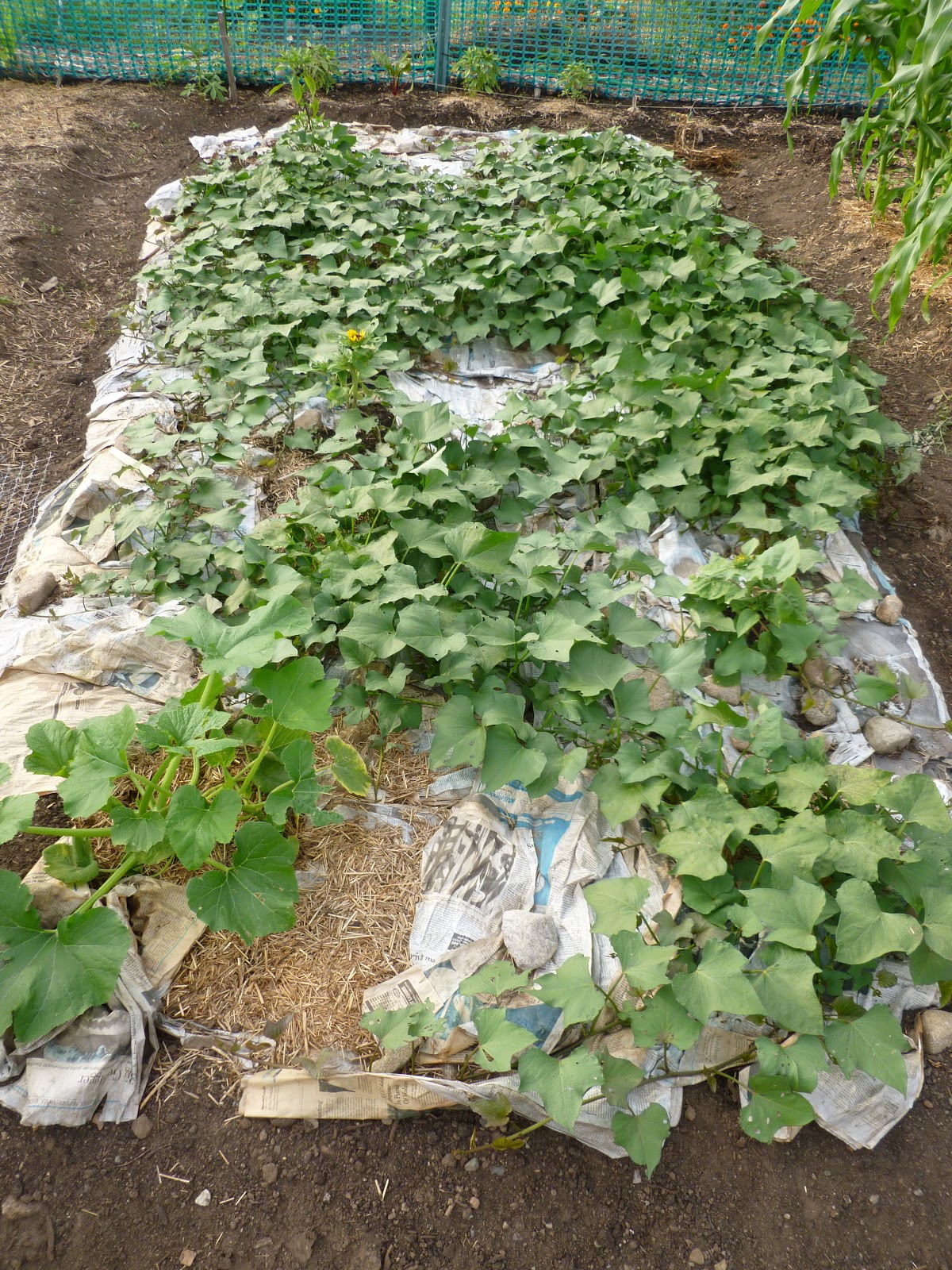
There are four squares of corn, each planted a week apart, which should collectively provide more than a hundred ears of sweet corn; plus six ‘producing’ summer squash plants and a like number of seedlings that will yield somewhere between a hundred pounds and a ton of zucchini.  There are plenty of leeks, fennel and carrots to be harvested in September and half a dozen winter squash vines that are threatening to overrun anything in their path.  There is an eight-foot-by-twenty-foot plot of sweet potatoes growing vigorously (at least the greens are growing; we have no idea what is happening underneath the soil). 

These tomatoes, hard and
green now, will be ripe in
just two weeks
The okra plants – ten of them – are now a foot high and, by early August, will start throwing off pods.  The sweet peppers are small and hard now but will grow rapidly and ripen through August.  There is a Chinese cabbage that Betty planted on a whim that is thriving.  The tomatoes, especially are starting to get serious.  It was a pair of cherry tomatoes that ripened under last week’s blistering heat, but now the large heirlooms and hybrids are catching up quickly.  Absent the appearance of late blight or other disease, we will have a bumper tomato crop and be in lycopene overdrive until well into September.

So why, exactly, do two people need a 1200 square foot vegetable garden?  Our freezer already groans with the bags of processed peas from plants that have now been pulled out.  We have green beans to last us well into the winter yet, just two days ago, Betty replaced the peas with another row of beans.

Part of the reason we grow so much is the joy of eating fresh vegetables every evening – including a few all-vegetarian meals.  Another aspect is the sharing.  Part of last week’s harvest of summer squash went to a community food pantry.  Other vegetables go to friends and neighbors.  A plate of fresh-picked green beans with a dill mayonnaise was a hit at a party.

This is our first-ever effort
to grow sweet potatoes. 
Right now, we have a lot
of greenery.  Only time will
tell if there are sweet
potatoes underneath.
We also have the pleasure of the company of a community of fellow vegetable gardeners.  One of our gardening neighbors is brand new to the process; another has graduated this year from a half-plot to a full one; and a third jumped at the opportunity to claim an adjoining second plot.  It’s a joy to talk to them, hear their ideas, and share their excitement.

And there’s the opportunity to share knowledge.  Any trip to the garden inevitably produces a round of questions from novice gardeners.  Some evenings, a planned ten-minute foray to pick enough lettuce and arugula for dinner salads turns into a 45-minute-long, hands-on seminar on the value of row covers, the right way to water deeply, or pest identification.  It seems as though there’s always a crowd at our garden.

Vegetable gardening is, in reality, a short season in New England.  We put up a fence in late April and plant cold-weather crops in early May, but for that first month there’s nothing to look at but black earth marked with stakes and string (plus an early crop of weeds).  It is only in early June, with the planting of the ‘warm weather’ crops that that there is sufficient greenery to give hope that there will indeed be a crop.  July and August are the garden’s glory.  By the beginning of September, the garden will look tired.  We’re enjoying it while we can.