Showing posts with label garden management. Show all posts

May 10, 2020

There's One In Every Crowd

Medfield's Community Garden

If you are a regular reader of this blog, you will remember that I wrote just a few weeks ago about community gardening being wonderful therapy for a country caught in the jaws of a pandemic, and how I predicted, “people will wave greetings to one another from their respective plots until it is once again safe to offer a hug.  In short, I think it’s going to be a great season for the Community Garden.”

Well, scratch that idea.

A ‘community garden’ is just that… a community built around a common interest in gardening.  Those gardeners, in turn, bring a diverse level of skills and depth of experience.  Some are true, hard-core dirt gardeners; others are dipping their toe into the soil for the first time.

The garden, circa 2007.  Some plots
were never claimed...
Running a community garden is akin to being the mayor of that community.  Ten years ago, Betty and I somehow found ourselves in charge of the Medfield Community Garden; which was then as dysfunctional as an activity could be.  There was a four-page-long, single-spaced rule book, but no one cared about it, much less heeded its Draconian list of commandments. There were nominally 40 plots but just 25 gardeners (some had assembled three- and four-plot dynasties).  Moreover, if a gardener dropped out or the space was never assigned, the plot or plots grew up in weeds.
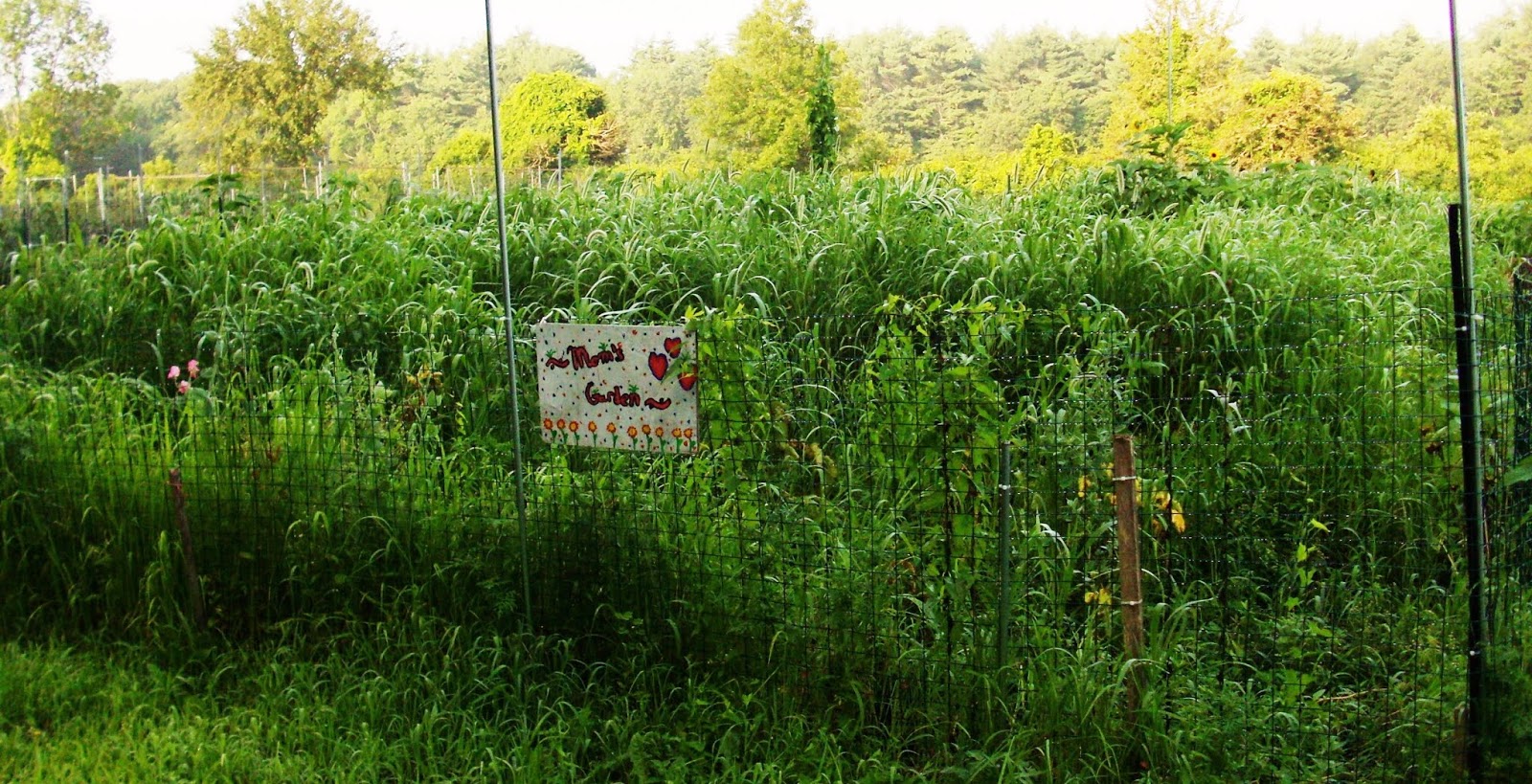
... others were abandoned, like 
'Mom's Garden' from 2009
When we took over, our number one goal was to keep all the plots filled.  Six hundred square feet of fertile topsoil will grow a lot of weeds in just a few weeks; and an abandoned plot will quickly spread its weed seeds to its neighbors.  Our solution to keeping the garden populated was to a) drum up a lot of interest in the garden to ensure each plot was filled at the beginning of every season; b) encourage gardeners to hang in, even if things didn’t go perfectly (and, the corollary to that solution of not doing things that would cause gardeners to leave); and c) have a wait list in the wings for the inevitable mid-season dropouts.

Each year, Betty does
a gardening presentation
Having nominally mastered the art of running a garden, we (and, by ‘we’, I mean Betty) turned our attention to educating gardeners and upgrading the garden’s practices.  Every March, Betty gives a well-attended vegetable gardening talk at our town library.  A steady stream of emailed educational materials (including soil test results and an explanation of how to read them) goes out to plot holders, and even simple queries receive serious responses. 

With the support of Medfield’s Conservation Commission (which oversees the town land upon which the garden is located), we banished pesticides, herbicides, and smoking.  We began sub-dividing plots to give gardeners a choice of size.  We required fencing and well-maintained paths.  The garden grew by nearly half, to 70 plots on a full acre of rich land; 30 of those plots 300 square feet in size and 40 of them the full 600 square feet. We went no-till when it became apparent our annual plowing of the garden disrupted the soil food web underneath.

Despite its claims to the contrary,
scientists were increasingly
questioning plastic mulch's effect
on the food soil web
As a Lifetime Master Gardener and avid horticulturalist, Betty regularly attends talks by people who are at the cutting of gardening science.  By last year, what was once a murmur that perhaps ‘plastic mulch’ (rows of plastic matting laid down over fields to warm the soil and prevent weeds) had significant downsides, had become a rising, though hardly universal, chorus of concern.  Betty read the studies, and reached a logical conclusion: there is nothing a plastic mulch can do that an organic mulch cannot do, and there are truly important things (like break down into humus and ultimately new soil) organic mulches can do that plastic ones cannot.

We decided to implement a ‘no plastic mulch’ policy effective with the 2020 gardening season.  It would affect perhaps four gardeners who had laid down plastic over their entire plot in 2019, and another twenty or so who lay down plastic sheets between raised rows.  On March 29, the date we opened the garden after staking it, we sent an email to everyone in the garden giving our reasons for the new policy. To those gardeners who questioned why we were making the change, we explained and they said, ‘OK, we understand’.

Seven days later, I was walking the garden when I was stopped in my tracks by a garden partially cloaked in plastic sheets, with additionally rolls of matting waiting to go down.  I went home and wrote the gardener – I’ll use the gender-neutral name ‘Reilly’.  I politely pointed out the earlier memo.  The following afternoon, Reilly responded at length, starting with the observation that this was “an awfully silly thing to quibble about during a global pandemic.”  The gardener went onto say, “there is ample science supporting the beneficial use of landscape fabric.”

There are two things I know with certainty.  The first is that, on any controversial topic, the first page of Google results – including the ones that don’t say ‘ad’ – have been bought and paid for by organizations with deep pockets, a vested financial interest, and an ability to ‘game’ Google’s ranking algorithm.  The second thing I know is that there is no upside in picking fights with my fellow gardeners.  As self-appointed 'Garden Ogre', my management policy is to ‘nudge’ gardeners into doing the right thing; not make enemies of them.  I agreed with Reilly on a few points and offered praised for having had the foresight to purchase a better grade of plastic mulch.  But, I stressed, the policy is the policy. No plastic sheets. Please remove them.

Reilly responded with an even longer missive, ending with the statement, “I intend to leave my ground covering down.”  That’s when I went to Medfield’s Conservation Commissioner, Leslee Willetts, and said, “This is above Betty’s and my pay grade.”

On April 12, the scientific journal Global Change Biology published the blockbuster results of a peer-reviewed study on plastic mulch, concluding its use boosted yields for a single season, then became injurious to the soil and crops grown in it; all the while doing long-term damage to that soil food web.  Concurrent with the publication of the study, China – hardly an enlightened paragon of environmental practices – set in motion laws to outlaw the use of plastic mulch.

Ultimately, Reilly asked for and, last Thursday got, a hearing (held via Zoom) before the Conservation Commission. Reilly came prepared with a PowerPoint presentation.  I responded with abstracts of several peer-reviewed studies and said Reilly was ‘flat wrong on the science’.  The Commission voted unanimously to uphold the ban on plastic mulch.

Reilly then shifted gears and asked for a hardship exemption for this season, stating it had taken Reilly’s family all day to put in the fence and plastic sheets, the garden was now growing and well established, taking out the plastic was impossible at this late date, and Reilly’s family was uneasy about going out in a Covid-19 world for such a task.  Reilly’s plea swayed three commissioners.  The plastic would stay down for this season.

The photo I wish I had at the
Commission meeting
The next day, I went to the Community Garden and took photos of Reilly’s plot – something I did not think to do before the Commission meeting.  There are no thriving plants.  I could have taken out the plastic sheeting in a morning without disturbing the site.  If there were sprouted seeds, they were likely killed by Saturday night’s hard freeze.

But Reilly’s plastic will stay for this season.  Betty and I won the larger battle – a ban on plastic mulch.  It will not make me alter my management style; I’ll continue to change behavior by nudging, not by wielding a sledgehammer.  But it was a learning experience that will stay with me for a very long time: the world is full of people like Reilly who choose to follow only those rules that do not inconvenience them.

March 10, 2018

The Return of the Ogre


This month, for the ninth year in a row, I will go into a cave and come out wearing my Garden Ogre suit.  For the next seven months, I will prowl the Medfield Community Garden with one task: to tell 75 gardeners to weed their plots, tighten their fences, and be nice to one another.  I know with complete certainty that, by the end of October, half a dozen gardeners will hate me.  The rest will find me merely annoying.

Nine-and-a-half years ago, Betty and I cornered one of our town’s selectmen and complained that our town’s small Community Garden was a wreck.  Plots grew up in weeds and no one cared.  Two families took a quarter of the garden for themselves.  Water spigots leaked or didn’t work.  We demanded action.

Abandoned garden plots used to grow
up in weeds, like 'Mom's Garden'
What we got was a call from the Town Clerk, telling us we were to be sworn in as members of the Garden Committee.  After we took our oath, we asked who were the other members.  The answer was: “Just you; everyone else resigned.”

We generate publicity
seeking new gardeners
Betty and I took our newfound responsibility seriously.  A four-page list of Draconian ‘Rules’ became a single page of ‘guidelines’.  Articles appeared in the local papers seeking gardeners and new recruits showed up in droves.  Six thousand square feet of gardens were added, and then another 3,000 square feet, bringing the garden to a full acre in size.  New gardeners were encouraged to start with a 300-square-foot ‘half-plot’ space, and an early-Spring class on vegetable gardening became a staple at the town library.

It all sounds idyllic, except even ‘guidelines’ need to be enforced.  The secret to having 75 people gardening together is to ensure that everyone plays nice.  That’s where the Ogre comes in. 

Weeds along the fence
My number one responsibility is to ensure everyone keeps the paths around their garden weed-free.  It’s a simple request: every week, spend five minutes pulling any grass or weeds that are in the three-foot-wide aisles and, especially, along your fence line.  If you have a front-row garden, there are fifteen gardeners behind you who depend on being able to walk by your plot unmolested. 

Yet, every year, gardeners decide it’s not their job.  It begins with weeds growing in their fence and, left unchecked, escalates until there’s a carpet of crabgrass that will spew billions of seeds into every plot.  I start with kind notes: “Hey, the next time you’re at the garden, could you take a few minutes and weed the aisles?”  Some people comply, others don’t.  The next note is just a little testy: “Hey, I’m getting complaints about the weeds in your aisles.  Please take care of them.”  This send-and-ignore pas-de-deux continues until I send out one that says, “Weed your fence line and aisles or else I’ll do it.  And if I do it, you lose your garden.”  That’s the note the recipient posts to social media to show how a simple, friendly community endeavor has devolved into a dystopian nightmare.

Common sense says not
to shade your neighbors
As the season progresses, the problems escalate to include ten-foot-high sunflowers and eight-foot-high stalks of corn.  With just three feet between gardens, common sense says not to grow stuff that casts a shadow over your neighbors’ plot.  Yet, some gardeners insist it their Flora-the-Goddess-of-Gardening-given-right to not only grow this stuff at the back of their plot (where it shades the front of the adjacent garden), but to use it as a border around their garden, thereby shading everyone in sight.
Out go the memos, with predictable results.

I take photos of
rogue squash vines
Come August, two things happen.  First, everyone goes away for two weeks.  And, second, everyone’s squash vines run amok.  The vines push out fences, turning three-foot passageways into Amazonian-caliber jungle pathways where machetes are required for navigation.  I plead via email for cooperation and receive replies from Patagonia where, I’m informed, the skiing is wonderful but they’ll take care of the vines just as soon as their holiday is over and they’ve ‘decompressed’.  Some express amazement that ‘Madison’, who had faithfully pledged to tend their garden in their absence, hasn’t stopped by.

Then comes the end of the season.  Most gardeners clear their plots during September, even though they have until the end of October.  The days are shorter and few things are ripening.   A few gardeners, though, just stop gardening; leaving everything in place with predictable results.  Three gardeners did this in the autumn of 2017.  Oh, they finally took down their fence and cleared the plot, but not before the weeds were two feet high.  They were livid when I told them their plots were being given away.

Now, it’s March, and the process has started all over again.  Between people ‘aging out’ and moving away, I have nine plots to fill with up to 18 gardeners.  The newspaper articles began appearing last week and the response has been enthusiastic.  Everyone who inquires gets a copy of those Gardening Guidelines with a plea to read them before they send a check.  Everyone says they have so.  In theory, this year should be one of bonhomie and bountiful harvests of well-contained squash. 

But I’m not counting on it.

August 31, 2015

The Ogre and the Squash Vine Memo

Eight years ago, Betty and I made the mistake of complaining to one of Medfield's town’s selectman about the sad state of the volunteer-managed community garden.  We noted that the garden seemed to exist for the pleasure of a few well-placed friends of ‘the Committee’, who lavished multiple plots on themselves while neglecting basic services such as water and mowing.  Plot-holders abandoned their gardens in mid-season and those gardens grew up in weeds.  Couldn’t something be done, we asked?
Something was done.  A few weeks later, we found ourselves in charge of the operation.  Just the two of us.  The Committee had resigned en masse.
At first, the
squash vines
were a minor
problem
We like to think that we’ve made the garden a better place in the intervening years. Now covering three-quarters of an acre, there are 62 gardeners and 62 gardens (all occupied, thank you) in two sizes.  The perimeter is mowed regularly, aged manure has been overspread on the site enough times that the garden is now a foot above the surrounding fields, wood chips are delivered to create paths, and the six water spigots all function properly.
There are no ‘rules’ for the garden, only guidelines; and they fit neatly on one page.  But even guidelines require some level of enforcement.  Enforcement requires an Ogre.  That’s me.  Every week, I walk the garden looking for problems.  What follows is a true story.  Only the name of the individual has been changed. 
It is the time of year when the gardening season is winding down.  The gardens, though, are lush with crops.  In some of the gardens, pumpkin and winter squash vines climb and/or go under fences.  Zinnias and cleomes press against groaning fences as do tomatoes heavy with fruit. Gardens that were spotless a few weeks ago now show noticeable weeds.  The result is the three-foot-wide walkways around certain plots become impassable. 
But then the
vines spilled over
the fence
It is time for the Garden Ogre to go to work:  I send out ‘The Squash Vine Memo’.
My first email is light and breezy:
Subject:  Garden maintenance
“Hey, Judy!  Can you get down to the garden this weekend and take care of the squash vines out in the walkways?”
I send out twelve such emails, each personalized and tailored to the specific problems in that plot.  Four gardeners quickly respond that they will get right on it.
On Monday morning I’m back at the garden.  Six of the gardens have been brought back to a semblance of order.  Excellent!  But six have not been touched and the vines are longer and more treacherous.  I go home and write:
Subject:  Please take care of your garden
“Judy:  The squash vines from your garden have spilled out into the walkway, making it difficult for people to get to their own gardens.  We would all appreciate your taking time this evening to clear your path.”
By the time of the
third email the
squash was out of
control
That email to the six miscreants will draws three responses along the lines of, “Sorry!  We were away!  I’ve sent my son down to take care of it.”
Two days later, I am again at the garden.  Two of the six gardens have been cleaned.  The other four – including one that promised immediate response – have vines that now are completely across the aisle and climbing the neighbors’ fences.  I go home and write:
Subject:  You need to clean your garden right now!
“Judy:  This is my third email about getting the vines out of the aisles around your garden. You owe your neighbors an apology and you need to get down to the garden today to clean up the mess.”
This was the state of
the squash vines when
I sent out the 'now
or else' memo
The next day, two of the remaining gardens have, in fact, been cleared of vines.  I even have a note from one of the offenders apologizing for taking so long to take action.
But two gardens remain holdouts.  Not only are the vines still a problem, the weeds have started going to seed.  And so I go home and write one final message:
Subject:  You are going to lose your plot at the community garden
“Judy:  Your garden has become a hazard for everyone else.  If, by the end of today, you have not completely cleared the weeds and vines that are clogging the walkways around your garden, I will take them down myself.  If I have to do that, you will lose your right to a plot next year.
Neal Sanders
Garden Ogre”
The next day, I go to the garden, hoe and clippers in hand.  But I don’t need my tools: both gardens have been ridded of vines in the aisles and weeds along the fence line.
I go home and open my email.  I find this message:
Subject:  My plot at the garden
“Dear Mr. Sanders:
Why do you have to be so mean about it?  All you had to do was ask.
Judy”
As a writer, I spend my days exploring the mystery of human nature.  I invent characters who commit crimes.  I dream up sleuths who can see through the fog of warped motives and personal turpitude to point a finger of justice at the guilty party.  Then, just when I think I’ve finally got a handle on the inner workings of my fellow man, along comes a “Judy” and I have to go back to square one.